What Is an Artificial Pancreas System? How It Works
An artificial pancreas system automates insulin delivery using a CGM and pump. Here is how closed-loop tech works and who can use it in 2026.

In this article(10)
An artificial pancreas system does what people with Type 1 diabetes do manually every day, except it automates the process. It reads glucose levels, calculates insulin needs, and delivers a dose in real time. The technology is no longer experimental, and several closed-loop devices are FDA-approved and widely available in 2026. Understanding how this approach works can help you decide if it belongs in your management plan.
This piece walks through the three components that make up the system, the difference between hybrid and fully closed-loop setups, the pumps that power them, and what daily life actually looks like once you switch. We also cover who qualifies, what insurance tends to cover, and what the system still asks you to do.
How an Artificial Pancreas System Works
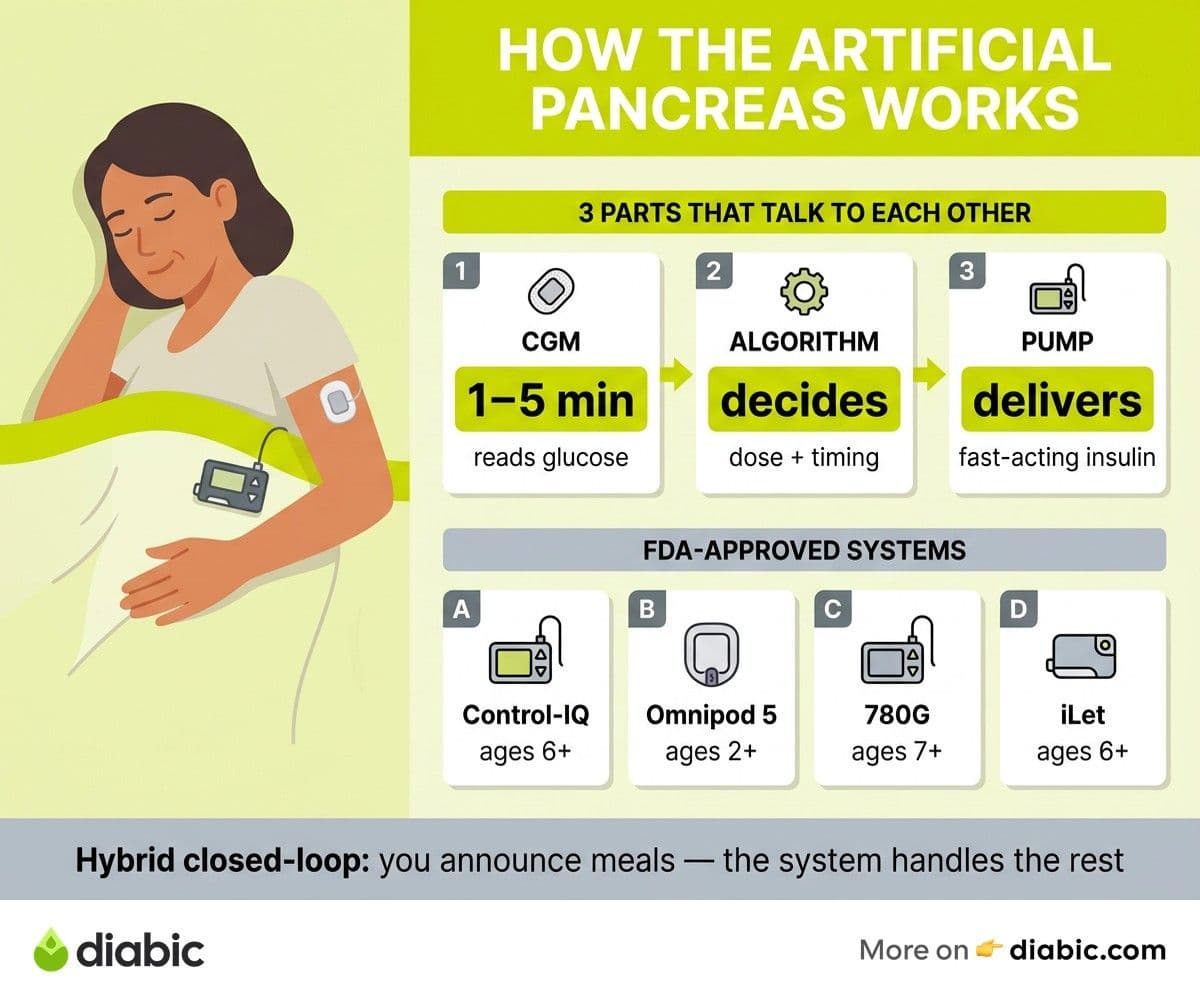
A closed-loop setup has three parts that talk to each other. The first is a continuous glucose monitor, or CGM, that reads your glucose every one to five minutes. The second is an insulin pump that delivers small doses of fast-acting insulin through a cannula under your skin. The third is a control algorithm, which is the software brain that decides how much insulin to deliver based on what the CGM is reporting.
Here is the important distinction. Most systems on the market today are hybrid closed-loop, not fully closed-loop. A hybrid system automates background insulin and corrects highs without you doing anything, but you still announce meals so it knows how many carbs you are eating. A fully closed-loop system would handle meals on its own, and that level of automation is still emerging in clinical trials. The JDRF artificial pancreas project resources, now part of Breakthrough T1D, document the research path from hybrid to fully autonomous systems.
Hybrid closed-loop systems already approved by the FDA include the Tandem t:slim X2 with Control-IQ, the Medtronic 780G, the Insulet Omnipod 5, and the Beta Bionics iLet. Each uses a slightly different algorithm and pump design, but the basic principle is the same. The New England Journal of Medicine has published multiple trials showing that closed-loop systems improve time in range, reduce hypoglycemia, and lower A1C compared to standard pump therapy with manual adjustments.
The Role of the CGM in Closed-Loop Systems
The CGM is the eyes of the system, and it has to be accurate enough for the algorithm to trust it. Most current systems use a Dexcom G6, Dexcom G7, or a Libre 2 Plus depending on the pump platform. Sensor readings flow to the pump every five minutes, and the algorithm uses that data plus the trend direction to decide what to do next.
Sensor accuracy requirements for closed-loop are stricter than for standalone CGM use. If the sensor reads 90 when blood is 70, the algorithm might deliver insulin you do not need. This is why most systems still require a few fingerstick calibrations during the first day of a new sensor, and why every system has a way to switch to manual mode if the sensor fails. Studies in Diabetes Care document how sensor accuracy directly affects time-in-range outcomes in pediatric and adult trials.
The system reads glucose and adjusts insulin around the clock, including overnight while you sleep, which is the single biggest reason people switch. Overnight is when most severe lows happen and when manual adjustment is hardest. A closed-loop system is awake when you are not. For more on the underlying technology, our piece on continuous glucose monitoring system basics covers how sensor readings flow into the algorithm.
Insulin Pumps Used in Closed-Loop Setups
Several insulin pumps power closed-loop systems, and the choice matters because the pump and algorithm are sold together. The Tandem t:slim X2 runs Control-IQ technology and pairs with the Dexcom G6 or G7. It is a touchscreen tubed pump that holds 300 units of insulin. The Insulet Omnipod 5 is a tubeless patch pump that runs the SmartAdjust algorithm and pairs with the Dexcom G6, G7, or Libre 2 Plus. Pods last three days each.
The Medtronic MiniMed 780G is a tubed pump that runs SmartGuard automation and pairs with Medtronic's own Guardian or Simplera CGM sensors. The Beta Bionics iLet Bionic Pancreas is the newest entrant and uses a different design philosophy. Tubed and tubeless options each have trade-offs. Tubed pumps usually offer larger reservoirs, more on-pump controls, and slightly lower upfront cost. Tubeless pods are discrete, waterproof, and easier for active lifestyles, with the trade-off of changing every three days.
If you are weighing an upgrade or a first pump, our insulin pump guide for type 1 diabetes walks through the comparison in detail. Pump hardware sets the ceiling on what the algorithm can do, since the algorithm can only deliver insulin as fast or as precisely as the pump allows.
Bionic Pancreas vs Traditional Insulin Pump
The bionic pancreas vs insulin pump comparison usually centers on the iLet from Beta Bionics, which received FDA clearance in 2023. The iLet is different because it is designed to remove most of the manual input. You do not enter a basal rate, an insulin-to-carb ratio, or correction factors. You enter your weight when you set up the pump, and the algorithm learns the rest from your CGM and pump data.
For meals, you tap a button and pick "less than usual," "usual," or "more than usual" instead of counting carbs. The algorithm makes a decision and adjusts based on what happens. Beta Bionics clinical results show that the iLet reduces the cognitive burden of carb counting, particularly for people who struggle with that piece of management or who are newly diagnosed and overwhelmed.
The trade-offs are real. Removing fine-grained control means the iLet does not respond to specific carb counts the way Control-IQ or Omnipod 5 can with a precise meal bolus. People who run very tight time-in-range targets through aggressive bolusing sometimes find the iLet does not match their previous results. The iLet shines for people who want to think less about diabetes between meals, and the iLet Bionic Pancreas review covers the daily-use experience in detail.
Who Can Use an Artificial Pancreas System?
FDA-approved age ranges have expanded significantly in the last few years. The Tandem Control-IQ is approved for ages 6 and up. The Omnipod 5 is approved down to age 2. The Medtronic 780G is approved for ages 7 and up. The iLet Bionic Pancreas is approved for ages 6 and up. Approval details and indications are documented in the FDA medical device databases, which are updated as new clearances roll in.
These systems are approved for Type 1 diabetes. Some are being studied for Type 2, and small clinical trials have shown promise, but as of 2026 closed-loop systems are not broadly indicated for Type 2 diabetes outside of research settings. Talk to your endocrinologist about whether your specific case might fit a clinical trial.
Insurance coverage in the United States is generally good for Type 1 diabetes when prescribed by an endocrinologist, but specifics vary. Most major commercial insurers and Medicare cover the pump and CGM as durable medical equipment, with monthly out-of-pocket costs ranging from $40 to several hundred dollars depending on the plan. Candidacy usually requires that you already use insulin, are willing to wear devices continuously, and can engage with the technology through training and follow-up visits.
Living With a Closed-Loop System: What to Expect
Daily routines on a closed-loop system are simpler than on a traditional pump, but they are not zero-effort. Most days you announce meals, change a pump site or pod every two to three days, change a CGM sensor every 7 to 15 days depending on the model, and charge a phone or pump receiver. The system handles overnight basal adjustments, post-meal corrections, and most of the grunt work that used to require constant attention.
What the system handles well is the boring middle. Steady afternoons, sleep, and gentle activity are where automation shines. Where it still struggles is at the edges. Heavy carb meals, intense exercise, illness, hormones, and stress can outpace the algorithm and require manual intervention. Most users describe an adjustment period of two to six weeks while their data trains the algorithm and they learn its quirks.
From my experience: I have lived with Type 1 diabetes for 14 years and switched to a hybrid closed-loop system several years ago. The single biggest change was sleep. I used to set alarms at 3 a.m. to check my number, and on a closed-loop system I rarely need to. I still bolus for meals, still treat lows, and still pay attention to exercise, but the constant background math is gone. My A1C improved, but the win I did not expect was getting my mental energy back.
If you travel, our practical guide to traveling with diabetes devices covers airport security, time zone adjustments, and supply backups for closed-loop users. For a broader look at what is shaping the wearable category, our roundup of best diabetes wearable devices in 2026 places these closed-loop tools in context with other devices.
FAQ
How does a closed-loop system work?
This kind of setup uses a continuous glucose monitor to read glucose every one to five minutes, sends those readings to a control algorithm running on an insulin pump or paired phone, and the algorithm calculates and delivers insulin in real time. Most systems available today are hybrid closed-loop, meaning they automate background insulin and corrections but still ask you to announce meals.
Is the artificial pancreas available yet?
Yes, several hybrid closed-loop systems are FDA-approved and available in the United States, including the Tandem t:slim X2 with Control-IQ, the Insulet Omnipod 5, the Medtronic MiniMed 780G, and the Beta Bionics iLet. A fully closed-loop system that handles meals without any user input is still in clinical research and is not yet approved for general use.
Does an artificial pancreas work for Type 2 diabetes?
Current artificial pancreas systems are FDA-approved for Type 1 diabetes. Research is underway on closed-loop systems for Type 2 diabetes, particularly for people with Type 2 who use insulin and have a high glucose burden, but as of 2026 these systems are not broadly indicated for Type 2 outside of clinical trials. Talk to your doctor about whether you might qualify for a trial.
Shahriar P. Shuvo is the founder of Diabic. He has lived with diabetes for over 14 years, and built Diabic to deliver the practical, evidence-based self-management tools he wished existed when he was first diagnosed. By trade, Shahriar is a senior design and frontend engineer with 6+ years shipping products at Agora, Timescale (now Tiger Data), and ShareTrip. He writes from the intersection of lived diabetes experience and product craft, focused on what works in daily management rather than what sounds good in a textbook.
Medically reviewed by
Dr. Shanto Arian is an internal medicine physician now specializing in clinical and aesthetic dermatology, with a parallel academic focus on epidemiology and public health. He holds an MBBS, MPH, MSc (UK), MRCP (UK), MRCPI (Ireland), Diploma in Dermatology (UK), and Diploma in Aesthetic Medicine (USA). Dr. Arian trained in internal medicine, including hospital work on hematology cases such as graft-versus-host disease, before moving toward dermatology. Skin is one of the earliest places diabetes shows itself, from acanthosis nigricans and diabetic dermopathy to slow foot wound healing, and that intersection is where his clinical and Diabic-review work meet. On Diabic, Dr. Arian medically reviews content on diabetes diagnosis, complications, dermatologic manifestations, and pharmacotherapy, ensuring every claim aligns with current ADA, NICE, and peer-reviewed literature.
More from Devices & Technology
View all
Fasting vs Postprandial Glucose: What's the Difference
Fasting vs postprandial glucose readings tell different stories about your blood sugar. Learn what each number means and how to act on it.

Best Glucometer for Elderly and Low-Vision Users
Best glucometer for elderly and low-vision users: large displays, audio readouts, no-coding strips, and budget picks that make daily testing easier.

Online Diabetes Coaching: How to Choose a Good One
Online diabetes coaching can fill the gaps between doctor visits. Learn what credentials to check, red flags to avoid, and how to pick a quality program.
Clinician-reviewed habits, plain-language guides, and honest answers - the small shifts that make living with diabetes feel lighter, every day.