Simplified Diabetes Management for Seniors
Simplified diabetes management for seniors focuses on sustainable routines, smart medication use, and tools that make daily care easier without.

In this article(13)
Simplified diabetes management for seniors is not about cutting corners on care, it is about making the daily routine sustainable. When managing diabetes starts to feel like a second job of finger sticks, pill bottles, and conflicting advice, the small daily decisions get harder rather than easier. Streamlining the process can protect both health outcomes and the quality of life that makes those outcomes worth pursuing.
For most older adults, the goal shifts at some point in their 60s or 70s. Tight numbers matter less than steady ones, and avoiding lows often matters more than chasing a perfect A1C. The American Diabetes Association Standards of Care reflects this with explicit guidance on individualized targets for older adults, especially those with multiple conditions, cognitive changes, or a history of hypoglycemia.
This guide walks through how to make the routine simpler without making it less safe. We will look at medication, daily habits, food and movement, and the small pieces of technology that can quietly do the heavy lifting in the background.
Why Simplified Diabetes Management for Seniors Matters
Complexity is a hidden risk factor in older age. The more pills, schedules, devices, and decisions stacked into a single day, the higher the chance that one of them quietly slips. A missed dose here, a doubled dose there, a forgotten meal that lines up with a long-acting medication, and the result can be a low blood sugar episode or a hospital visit that pulls everything else off track.
Research published in JAMA Internal Medicine found that adults 65 and older with diabetes account for a striking share of emergency department visits for hypoglycemia and insulin errors. The pattern is not about effort or intelligence, it is about the sheer volume of moving parts in a typical regimen and how that volume scales poorly with aging vision, dexterity, memory, and energy.
Simplification is also a stated clinical priority. The ADA's older-adult chapter recommends loosening A1C targets when appropriate, reducing high-risk medications, and aligning treatment with each person's overall health and life expectancy. This is not a softer standard, it is a more honest one. For someone navigating the challenges of diabetes after 65, a steady A1C of 7.5% with no severe lows often produces better real-world outcomes than a 6.8% achieved through a regimen that lands them in the ER twice a year.
When Simplifying Improves Outcomes
There is a concept in geriatric medicine called the "treatment burden," which captures how much daily work a care plan costs the person living with it. When burden gets too high, adherence drops and errors rise, no matter how motivated the person is. Lowering the burden, even slightly, often raises real adherence and steadies glucose more than adding another medication ever would.
Simplification also creates room for the parts of self-care that actually move the needle long term. Sleep, walking, hydration, social connection, and consistent meals are quietly powerful. They tend to be the first casualties of an overly complicated regimen, and the first wins when things calm down.
Streamlining Medication for Diabetes in Seniors
Medication is usually the place where the most complexity hides. The average older adult with type 2 diabetes takes several medications across diabetes, blood pressure, cholesterol, and other conditions. Each refill, dose, and interaction adds friction, and the friction compounds across a week.
A practical first step is a structured medication review with your doctor or pharmacist. The American Geriatrics Society Beers Criteria lists medications that pose elevated risk in older adults, including some longer-acting sulfonylureas commonly used for diabetes. Walking through your full list against this kind of evidence-based reference can surface quiet wins. A single switch from a long-acting sulfonylurea to a lower-risk class, for example, may reduce hypoglycemia risk without any new technology or routine change.
Combination medications can also collapse two pills into one. Many type 2 diabetes drugs are now available in fixed-dose combinations, which can drop the daily pill count meaningfully. If you take insulin, talk to your doctor about whether a once-daily basal regimen might fit your goals, especially if multiple daily injections feel unsustainable. The right answer here depends on your A1C, your hypoglycemia history, and how confident you feel with the current routine.
Pharmacy Sync and Deprescribing
Pharmacy synchronization is one of the simplest underused tools in older-adult care. Most pharmacies will align all your refills to the same monthly date, so you make one trip or one delivery instead of three or four. Ask your pharmacist about "med sync" by name. The administrative weight that disappears once it is set up is genuinely substantial.
Deprescribing is the formal name for the process of reviewing and removing medications that are no longer adding value. It is increasingly recognized as standard care, not a sign of giving up. If your A1C has been steady for years and your overall health profile has shifted, talking to your doctor about whether any diabetes medication can come off the list is a reasonable conversation. The same applies for medications that were added during a hospital stay and never reviewed afterward, which is a surprisingly common pattern. Our piece on simplifying medications for older adults goes deeper into how those reviews tend to unfold.
From my experience: I have lived with type 1 diabetes for 14 years, and the times my regimen got too complicated were never the times I felt healthiest. A few years ago I cut my routine down to fewer touchpoints with steadier outcomes, and the lesson stuck with me. For older adults, that same principle applies with even more weight, because the cost of complexity is higher and the benefit of simplicity is more visible.
Building a Simple Daily Self-Care Diabetes Routine
A daily self care diabetes routine works best when it rides on top of habits you already have rather than asking you to build new ones from scratch. Tying glucose checks, medication, and meals to fixed anchors in your day reduces the mental load of remembering and turns the routine into something closer to muscle memory.
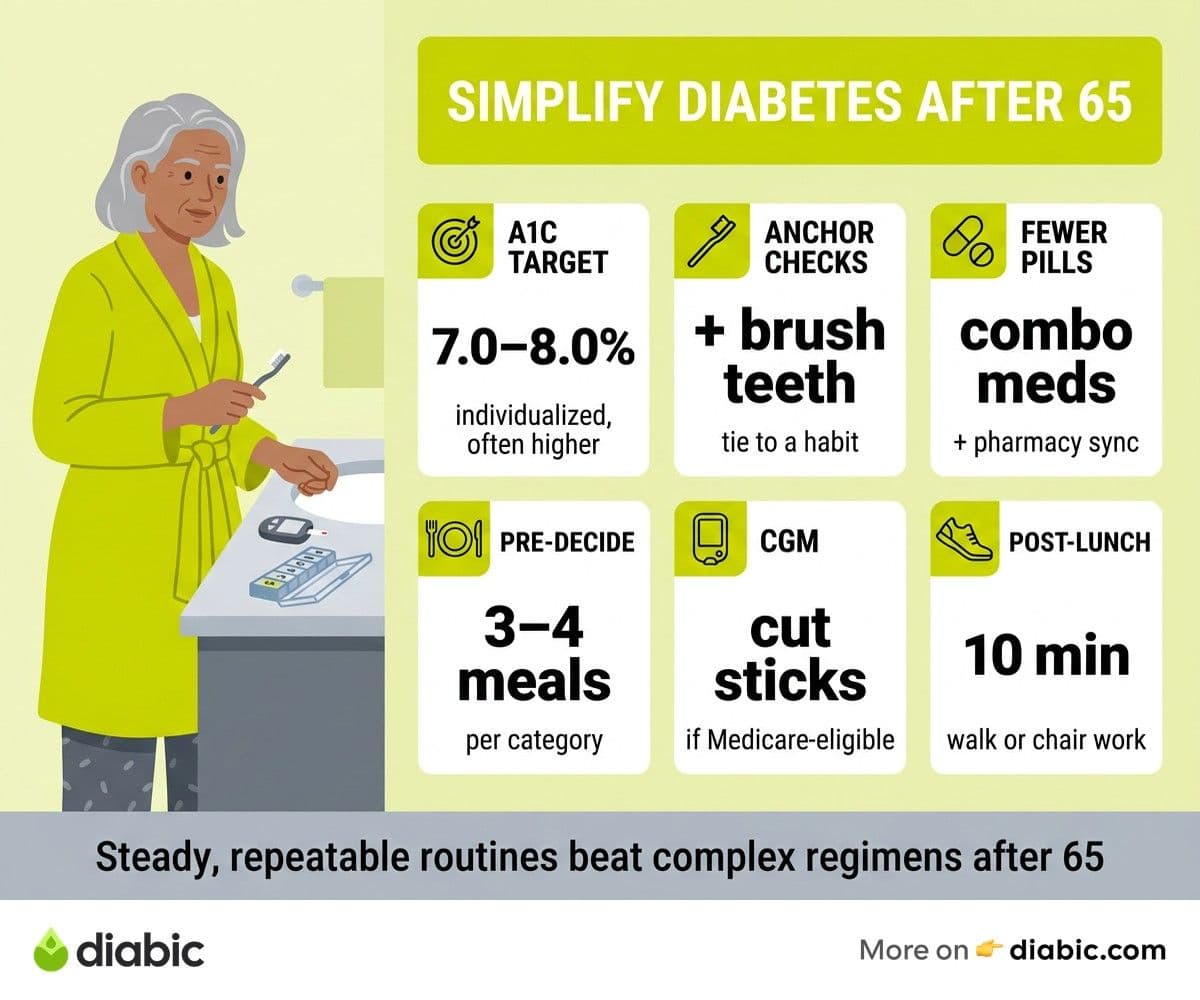
A workable sample day for many seniors with stable type 2 diabetes might look like this. A morning blood sugar check or CGM glance after waking, paired with brushing teeth. Breakfast within an hour, with morning medications taken right after. A short walk after lunch, even ten minutes around the block or down a hallway. Dinner at a consistent time, with evening medications tied to a nightly habit like setting out clothes for the next day. The point is not the specific schedule, it is the pairing.
For people on insulin or sulfonylureas, glucose monitoring still needs to happen, but the frequency can often be optimized rather than maximized. Talk to your doctor about whether you can move from four daily fingersticks to two, or whether a continuous glucose monitor would let you reduce sticks even further while improving safety.
Reducing the Number of Decisions
Decision fatigue is a real factor in any chronic condition, and it gets heavier with age. A useful trick is to pre-decide as much as possible. A short list of three or four go-to breakfasts, lunches, and dinners that you actually like and that work for your blood sugar means you stop reinventing the wheel three times a day. The same applies to snacks for lows, exercise routines, and shopping lists.
Consistent meal timing is one of the most underrated simplification levers. Eating breakfast, lunch, and dinner at roughly the same hour each day stabilizes glucose patterns and lets your medications do their job predictably. It is a free intervention that often outperforms more complicated changes.
Diabetes in Seniors: Adapting Diet and Exercise
Diet and movement do not need to be elaborate to support glucose stability. In fact, the simpler and more repeatable they are, the more likely they are to actually happen. The goal in older age is steady patterns and protected muscle, not aggressive restriction.
Protein-forward eating becomes more important after 65 because muscle mass naturally declines with age, and muscle is one of the body's main glucose sinks. Including protein at each meal, whether eggs, fish, poultry, beans, dairy, or tofu, helps maintain strength, balance, and insulin sensitivity. The CDC's nutrition guidance for older adults reinforces protein as a foundation for healthy aging alongside fiber and hydration.
Exercise for seniors does not need to look like the gym. The CDC Physical Activity Guidelines for Older Adults recommend a mix of aerobic movement, strength work, and balance practice across the week, with adjustments for ability. Walking, gardening, swimming, and chair-based exercises all count. A gentle chair yoga routine for people with diabetes can be a surprisingly effective entry point because it builds strength, mobility, and balance without requiring a floor-to-standing transition. For caregivers helping a parent through this transition, our piece on diabetes care for aging parents shares practical ways to share the load without taking it over.
Hydration is another quiet variable. Older adults often have a blunted thirst response, which means the cue to drink water can fade well before dehydration shows up. Keeping a water bottle visible, drinking a glass with each meal and medication, and watching urine color are simple habits that protect both kidney function and glucose stability.
Technology That Makes Diabetes Easier
The right pieces of technology can quietly remove daily work without adding new complications. The trick is matching the tool to the person, not adopting whatever is newest.
Continuous glucose monitors are the single biggest simplification in modern diabetes care for many older adults. A CGM removes most fingersticks, surfaces overnight patterns, and can alert family members or caregivers to dangerous lows in real time. Both Dexcom and Abbott FreeStyle Libre systems have user interfaces designed for daily glanceability, and Medicare now covers CGMs for many people on insulin and an expanding group of non-insulin users. Talk to your doctor about whether you qualify and which system fits your hands, eyes, and routine best.
Smart insulin pens with dose memory solve a specific and common problem, which is the question "did I take that dose already?" A pen that records every dose and timestamp on a phone app means caregivers and clinicians can verify dosing without anyone having to remember.
Reminders and Telehealth
Medication reminder apps designed for older adults focus on large text, simple interfaces, and family-shared visibility. Built-in reminders on phones and watches work well too, and a paper pill organizer with morning and evening compartments remains one of the most reliable tools ever invented. Whatever you choose, simpler beats fancier almost every time.
Telehealth visits remove the travel burden of routine appointments. For follow-ups that are mostly conversation rather than physical exam, a video or phone visit can replace a half-day of logistics with a 20-minute call. The National Council on Aging maintains practical resources for older adults exploring telehealth, including how to talk to providers about which visits qualify.
FAQ
How can you simplify diabetes management for elderly patients?
Work with the healthcare team to review the full medication list against the AGS Beers Criteria and consider deprescribing where appropriate. Use combination medications, pharmacy sync, and once-daily insulin options to reduce daily touchpoints. Establish consistent routines anchored to existing habits, lean on technology like CGMs and reminder apps to reduce manual work, and shift toward realistic, individualized blood sugar targets rather than aggressive ones.
What does an easy daily diabetes routine for seniors look like?
A workable routine often includes one or two glucose checks at consistent times, three meals at predictable hours, medications tied to fixed daily habits like brushing teeth, and a short walk or seated exercise session. Pre-decided meals and snacks reduce decision fatigue, and a CGM can replace several fingersticks while improving safety. The exact schedule matters less than its repeatability and how well it fits the rest of your day.
Should older adults aim for the same A1C as younger adults?
Not always. The American Diabetes Association recommends individualized A1C targets for older adults, often in the 7.0% to 8.0% range or even higher for those with multiple conditions or limited life expectancy. Looser targets are not a step backward, they are a way to reduce the risk of severe hypoglycemia, which becomes more dangerous with age. Talk to your doctor about what target fits your overall health picture.
The biggest shift in simplified diabetes management for seniors is letting go of the idea that more effort always means better care. Steady, repeatable routines that protect against lows and fit your real life tend to outperform complex regimens that look impressive on paper. Pick one area from above, whether that is a medication review, a routine anchor, or a piece of technology, and consider talking to your doctor about how to make it your next small win.
Shahriar P. Shuvo is the founder of Diabic. He has lived with diabetes for over 14 years, and built Diabic to deliver the practical, evidence-based self-management tools he wished existed when he was first diagnosed. By trade, Shahriar is a senior design and frontend engineer with 6+ years shipping products at Agora, Timescale (now Tiger Data), and ShareTrip. He writes from the intersection of lived diabetes experience and product craft, focused on what works in daily management rather than what sounds good in a textbook.
Medically reviewed by
Dr. Shanto Arian is an internal medicine physician now specializing in clinical and aesthetic dermatology, with a parallel academic focus on epidemiology and public health. He holds an MBBS, MPH, MSc (UK), MRCP (UK), MRCPI (Ireland), Diploma in Dermatology (UK), and Diploma in Aesthetic Medicine (USA). Dr. Arian trained in internal medicine, including hospital work on hematology cases such as graft-versus-host disease, before moving toward dermatology. Skin is one of the earliest places diabetes shows itself, from acanthosis nigricans and diabetic dermopathy to slow foot wound healing, and that intersection is where his clinical and Diabic-review work meet. On Diabic, Dr. Arian medically reviews content on diabetes diagnosis, complications, dermatologic manifestations, and pharmacotherapy, ensuring every claim aligns with current ADA, NICE, and peer-reviewed literature.
More from Living with Diabetes
View all
A Gentle Chair Yoga Routine for people with diabetes
A gentle chair yoga for people with diabetes routine with safe poses, modifications for neuropathy, retinopathy, and joint pain, plus tips for older.

Shift Work and Diabetes: Managing Irregular Hours
Shift work and diabetes is a tough combination. Learn how to manage meals, sleep, medication, and blood sugar when your hours rotate or flip overnight.

Dating with Diabetes: When to Tell a New Partner
Dating with diabetes brings unique disclosure questions. Here is when to tell a new partner, what to say, and how to handle the conversation with.
Clinician-reviewed habits, plain-language guides, and honest answers - the small shifts that make living with diabetes feel lighter, every day.