Best Continuous Glucose Monitors for Type 2 Diabetes in 2026
Compare the best continuous glucose monitor for type 2 diabetes options, including Stelo, FreeStyle Libre 3, and Dexcom G7, with pricing and accuracy.

In this article(13)
A continuous glucose monitor for type 2 diabetes used to mean fighting your insurance for months and ending up with the same sensor a friend with type 1 wore. That changed in 2024 when the first over-the-counter CGMs hit pharmacy shelves, and 2026 is the year choice finally caught up with demand.
Picking the right CGM still feels overwhelming because every brand claims to be the best at something. We tested and compared the top options, talked to readers using them every day, and weighed the trade-offs that matter once the sensor is on your arm. The result is a side-by-side look at which CGM fits which kind of type 2 routine.
Why a Continuous Glucose Monitor Helps With Type 2 Diabetes
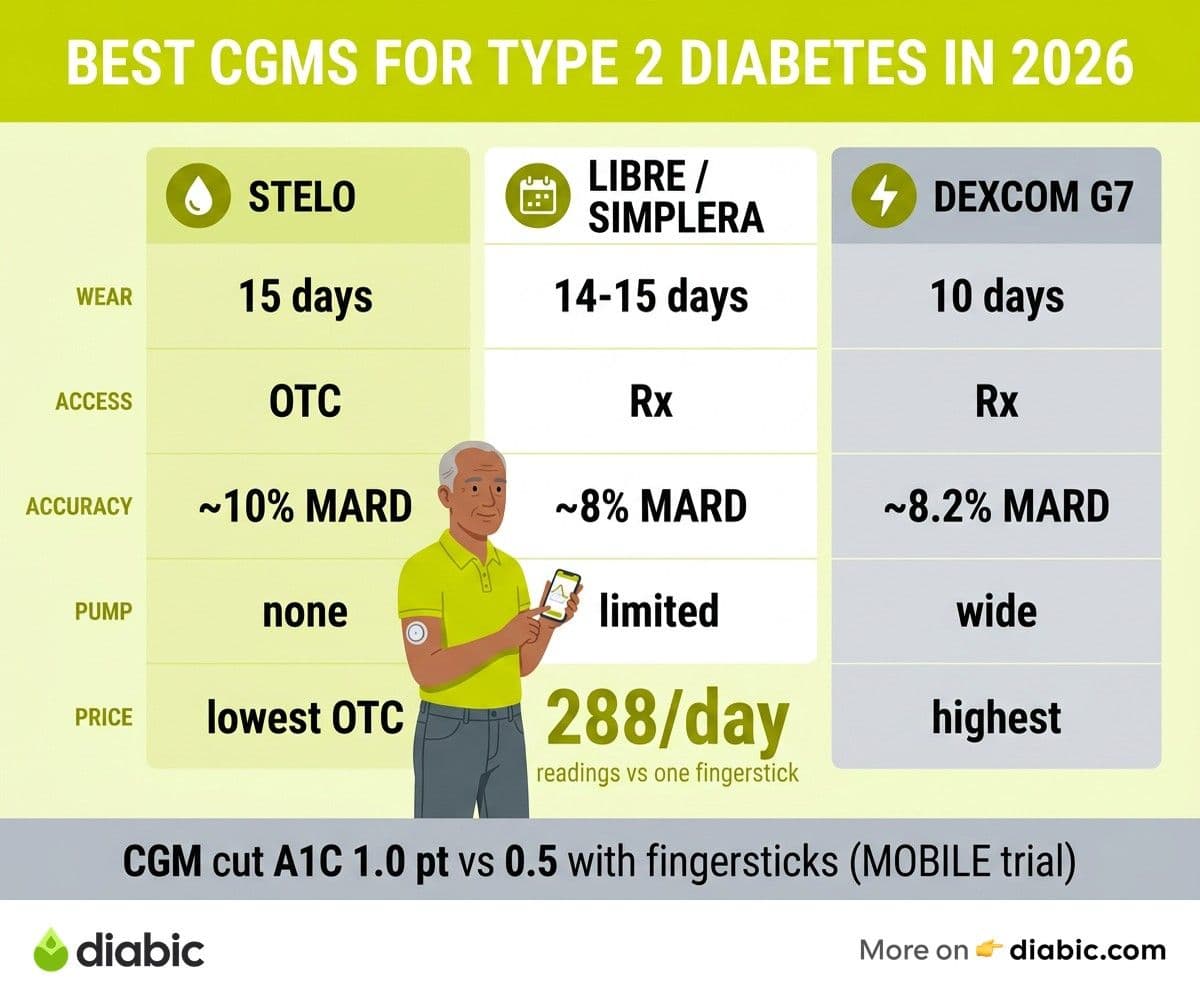
A finger stick gives you one number. A continuous glucose monitor gives you 288 numbers a day, plus trend arrows that tell you which direction your glucose is heading. For someone with type 2 diabetes, that constant feedback turns abstract numbers into a clear picture of what your body is doing.
The clinical evidence is strong. The MOBILE study by Martens et al. published in JAMA in 2021 followed 175 adults with type 2 diabetes on basal insulin and found that those using a CGM dropped their A1C by 1.0 percentage point versus 0.5 in the fingerstick group, with no increase in hypoglycemia. Later research has shown similar benefits even for people not using insulin.
The benefit goes deeper than A1C. CGMs reveal patterns no fingerstick schedule can catch, such as the post-lunch spike that resolves before your usual 4 p.m. check, or the slow overnight rise that contributes to your morning number. If you have never seen your own glucose curve, the first few days with a CGM can change how you eat without anyone telling you what to change.
CGMs also surface lows that go unnoticed. Many people with type 2 on sulfonylureas or insulin experience nocturnal hypoglycemia they sleep through, and a CGM with alerts catches it. Our deeper look at using a CGM for hypoglycemia detection walks through what to set up.
If you are still mapping out the differences between type 1 and type 2 management, our explainer on the key differences between type 1 and type 2 diabetes puts CGM use in context. And if you want a primer on how the sensors actually read glucose under your skin, see our explainer on how a continuous glucose monitoring system works.
Can a CGM Help With Insulin Resistance
A continuous glucose monitor for insulin resistance does something fingersticks cannot: it shows you the size and shape of every meal response. Insulin resistance is fundamentally about how your body handles glucose loads, and a CGM is the cheapest tool available for studying that response in real time.
When you eat a bowl of white rice and your glucose climbs from 110 to 220 mg/dL over 90 minutes, then takes another two hours to come down, you are watching insulin resistance happen. A smaller spike with the same meal a month later, after you have lost 10 pounds or added a daily walk, shows you that resistance is shifting in a useful direction.
CGMs also help identify trigger foods that fingerstick testing misses. Most people only check before meals and maybe two hours after, which means a glucose peak at 60 minutes goes invisible. A continuous picture catches the spike, lets you adjust portion sizes or pair foods differently, and gives you immediate feedback on what worked.
The honest limitation is that a CGM measures glucose, not insulin levels. You cannot tell from a sensor alone how hard your pancreas is working to maintain a given glucose number. For most people with type 2 diabetes, that is fine. The glucose data is what shapes day-to-day decisions, and the insulin numbers are something your provider can measure separately if needed.
Best CGMs for Type 2 Diabetes Compared
Three CGMs dominate the type 2 market in 2026. Each has a different sweet spot, and the right pick depends on your insulin status, budget, and how much real-time alerting you want.
Best for OTC Access: Dexcom Stelo
The Dexcom Stelo is the first CGM cleared by the FDA for over-the-counter sale to adults not using insulin. You can buy it directly from Dexcom or through Amazon, CVS, and Walgreens with no prescription. Two sensors cost roughly $99, with each sensor lasting 15 days, which works out to about $200 per month if you wear it continuously.
Stelo skips the urgent low and high alerts found on Dexcom G7, which makes sense for the audience it targets: people with type 2 not on insulin who want lifestyle insights rather than safety alarms. The Stelo app shows trends, average glucose, time in range, and meal markers, and the data exports cleanly to share with your provider. Our deeper look in our Dexcom Stelo honest review covers real-world wear time and accuracy.
The trade-off is alarm fatigue, or rather the lack of any alarms. If you are at risk for hypoglycemia, Stelo is not the right tool. Pick a system with urgent low alerts instead.
Best for Affordability and Pharmacy Pickup: FreeStyle Libre 3
The Abbott FreeStyle Libre 3 is the most prescribed CGM in the world by volume and the cheapest brand-name option once insurance kicks in. Each sensor lasts 14 days and is the smallest CGM on the market at roughly the size of two stacked pennies. Insertion is essentially painless and the sensor reads automatically every minute through a phone app.
For people with type 2 on basal insulin, the Libre 3 hits a sweet spot of strong accuracy (MARD around 7.9% per Abbott's published data), low cost through Medicare and most private plans, and high availability at every major pharmacy. Optional alarms cover urgent low, low, and high readings.
The Libre 3 ships data to the LibreLinkUp app, which lets caregivers and family members follow remotely. The accuracy edge cases (compression lows when you sleep on the sensor, occasional first-day variability) are minor for most users.
Best for Real-Time Alerts and Insulin Integration: Dexcom G7
The Dexcom G7 is the gold standard for users who need robust alerts and the option to integrate with an insulin pump or smartpen. Sensors last 10 days plus a 12-hour grace period, and the system delivers a glucose reading every five minutes with industry-leading accuracy (MARD 8.2% per Dexcom's published data).
For someone with type 2 diabetes on intensive insulin therapy or with a history of hypoglycemia, G7 is the safer pick. Urgent low alerts trigger at 55 mg/dL by default, predictive low alerts can warn 20 minutes before a drop, and the share function lets up to ten people follow your readings.
The cost is the catch. Without insurance, G7 sensors run $90 to $130 each, which works out to $300 to $400 per month. Insurance coverage is now broad for people on insulin, and Medicare covers G7 for type 2 on any insulin therapy.
Comparison Table
The FDA's CGM clearance database lists every approved sensor along with its intended use, which is worth checking if you are considering a less common brand.
From my experience: I have worn a Dexcom continuously for over a decade as someone with type 1, and the single most important thing I tell readers with type 2 thinking about a CGM is to start with a sensor and a notebook for the first two weeks. The data is more useful when you write down what you ate, when you walked, and how you slept. The patterns reveal themselves faster than you expect.
Key Benefits of a Continuous Glucose Monitor for Type 2 Diabetes
The continuous glucose monitor benefits for type 2 diabetes break down into four areas, each one underrated until you experience it yourself.
Spotting patterns that fingerstick testing misses is the most common reason readers tell us they stick with a CGM. The 11 a.m. spike from cream in your coffee, the 4 p.m. dip on long meeting days, the 90-minute lag after a heavy carb dinner, none of these show up on a four-times-daily fingerstick schedule. Patterns are where behavior change happens.
Motivation through visual feedback is real even though it sounds soft. Watching your post-meal curve flatten over six weeks of dietary changes is more rewarding than waiting three months for your next A1C. Many readers report that the trend graph itself is the behavior-change tool, more than any specific intervention.
Reduced hypoglycemia risk matters most for people on sulfonylureas (glimepiride, glipizide) or any insulin. The ADA's Standards of Care 2026 explicitly recommends CGM for adults with type 2 on multiple daily insulin injections or basal insulin therapy, with growing evidence supporting use even on oral medications.
Better conversations with your healthcare team is the benefit clinicians cite most. Your provider can review your CGM download and see exactly when and why your glucose is misbehaving, instead of guessing from an A1C and a few logbook entries. Adjustments happen faster and more precisely.
How to Choose the Right CGM for Your Situation
Three questions get you most of the way to the right pick. Start with whether you use insulin. If yes, you need a system with urgent low alerts (Libre 3 or G7), not Stelo. If no, any of the three is reasonable.
Next, consider whether you want alarms at all. Some people find them stressful and prefer a passive monitor like Stelo. Others sleep better knowing their CGM will wake them if they drop. There is no wrong answer; the question is what you will tolerate long term.
Then check your insurance and budget. Call the customer service number on your card and ask what CGM brands are covered for type 2 diabetes, what the prior authorization process looks like, and whether your status (on insulin or not, on Medicare or commercial, with documented hypoglycemia or not) affects coverage. Coverage rules have shifted rapidly in the last two years, and what was excluded in 2023 is often covered in 2026.
If insurance does not cover any prescription CGM, Stelo at $99 to $200 per month is the most affordable starting point. If insurance covers Libre but not Dexcom, start there. If you have full coverage and need alarms, G7 is the strongest pick.
Talk to your doctor about which CGM fits your medications, your hypoglycemia history, and what kind of data you both want to review at follow-ups. The right CGM is the one that lasts on your arm and gets read regularly.
FAQ
How accurate is a continuous glucose monitor for type 2 diabetes?
Modern CGMs cleared by the FDA have a Mean Absolute Relative Difference (MARD) between 7% and 10%, which is similar to a typical home blood glucose meter. Dexcom G7 and FreeStyle Libre 3 both publish MARD around 8% across the full glucose range. Accuracy can dip in the first 24 hours of a new sensor and during rapid glucose changes, so confirm with a fingerstick before any major treatment decision.
How long can you wear a continuous glucose monitor?
Wear time varies by brand. The Dexcom G7 lasts 10 days plus a 12-hour grace period, the FreeStyle Libre 3 lasts 14 days, and the Dexcom Stelo lasts 15 days. Removing a sensor early due to adhesive failure or accidental knocks happens occasionally, and most companies replace sensors that fail within the first few days at no charge.
Does insurance cover a CGM for type 2 diabetes?
Insurance coverage for CGMs in type 2 diabetes has expanded significantly in 2024 and 2025. Medicare covers CGMs for adults with type 2 on any insulin therapy, and most private insurance plans follow similar guidelines. Coverage for type 2 patients not on insulin is more variable but is increasingly available with documentation of hypoglycemia or a recent A1C above target. Your endocrinologist's office can submit a prior authorization on your behalf.
If you are choosing a continuous glucose monitor for type 2 diabetes, start by matching the device to your insulin status and your tolerance for alerts. Stelo for lifestyle awareness, Libre 3 for affordability with insurance, and G7 for full alert coverage cover most readers. Whichever you pick, the real value comes from wearing it long enough to see the patterns.
Dr. Shanto Arian is an internal medicine physician now specializing in clinical and aesthetic dermatology, with a parallel academic focus on epidemiology and public health. He holds an MBBS, MPH, MSc (UK), MRCP (UK), MRCPI (Ireland), Diploma in Dermatology (UK), and Diploma in Aesthetic Medicine (USA). Dr. Arian trained in internal medicine, including hospital work on hematology cases such as graft-versus-host disease, before moving toward dermatology. Skin is one of the earliest places diabetes shows itself, from acanthosis nigricans and diabetic dermopathy to slow foot wound healing, and that intersection is where his clinical and Diabic-review work meet. On Diabic, Dr. Arian medically reviews content on diabetes diagnosis, complications, dermatologic manifestations, and pharmacotherapy, ensuring every claim aligns with current ADA, NICE, and peer-reviewed literature.
Medically reviewed by
Dr. Rezwana Parvin Rumpa is an obstetrics and gynaecology specialist with clinical focus on gestational diabetes, PCOS, and fertility. She holds the MRCOG (Final Part) from the Royal College of Obstetricians and Gynaecologists in London, the MRCPI (Final Part) from the Royal College of Physicians of Ireland, and an MBBS from Shaheed Monsur Ali Medical College under Dhaka University. Dr. Rumpa serves as a Senior Medical Officer in the Obs and Gynae department at BRB Hospitals Ltd, where she has spent three years managing prenatal care, emergency obstetric cases, and women's-health surgery. On Diabic, she medically reviews content for women living with diabetes, with particular attention to pregnancy, PCOS, and reproductive-health intersections.
More from Devices & Technology
View all
Fasting vs Postprandial Glucose: What's the Difference
Fasting vs postprandial glucose readings tell different stories about your blood sugar. Learn what each number means and how to act on it.

Best Glucometer for Elderly and Low-Vision Users
Best glucometer for elderly and low-vision users: large displays, audio readouts, no-coding strips, and budget picks that make daily testing easier.

Online Diabetes Coaching: How to Choose a Good One
Online diabetes coaching can fill the gaps between doctor visits. Learn what credentials to check, red flags to avoid, and how to pick a quality program.
Clinician-reviewed habits, plain-language guides, and honest answers - the small shifts that make living with diabetes feel lighter, every day.