Best Blood Glucose Meters for Home Testing in 2026
Compare the best blood glucose meter options for home testing in 2026, including accuracy ratings, strip costs, and features that matter day to day.

In this article(15)
You stand in the pharmacy aisle holding two boxes, trying to figure out which blood glucose meter is actually worth your money. One looks sleek but uses expensive strips. The other has a giant display but no smartphone app. Most reviews focus on flashy features, not the boring stuff that decides whether you will keep using the meter six months from now.
Choosing the right meter comes down to four things people rarely talk about together: clinical accuracy, ongoing strip cost, sample size, and whether the design fits how you actually live. We tested and compared the devices most people end up with at home, then ranked them on the criteria that matter once the unboxing excitement wears off.
What to Look for in a Blood Glucose Meter
Every meter sold in the United States must clear the FDA before it reaches a pharmacy shelf. You can confirm any model through the FDA 510(k) database for glucose monitors, which lists every cleared device along with its intended use. Clearance is the floor, not the ceiling, so look beyond it when comparing models.
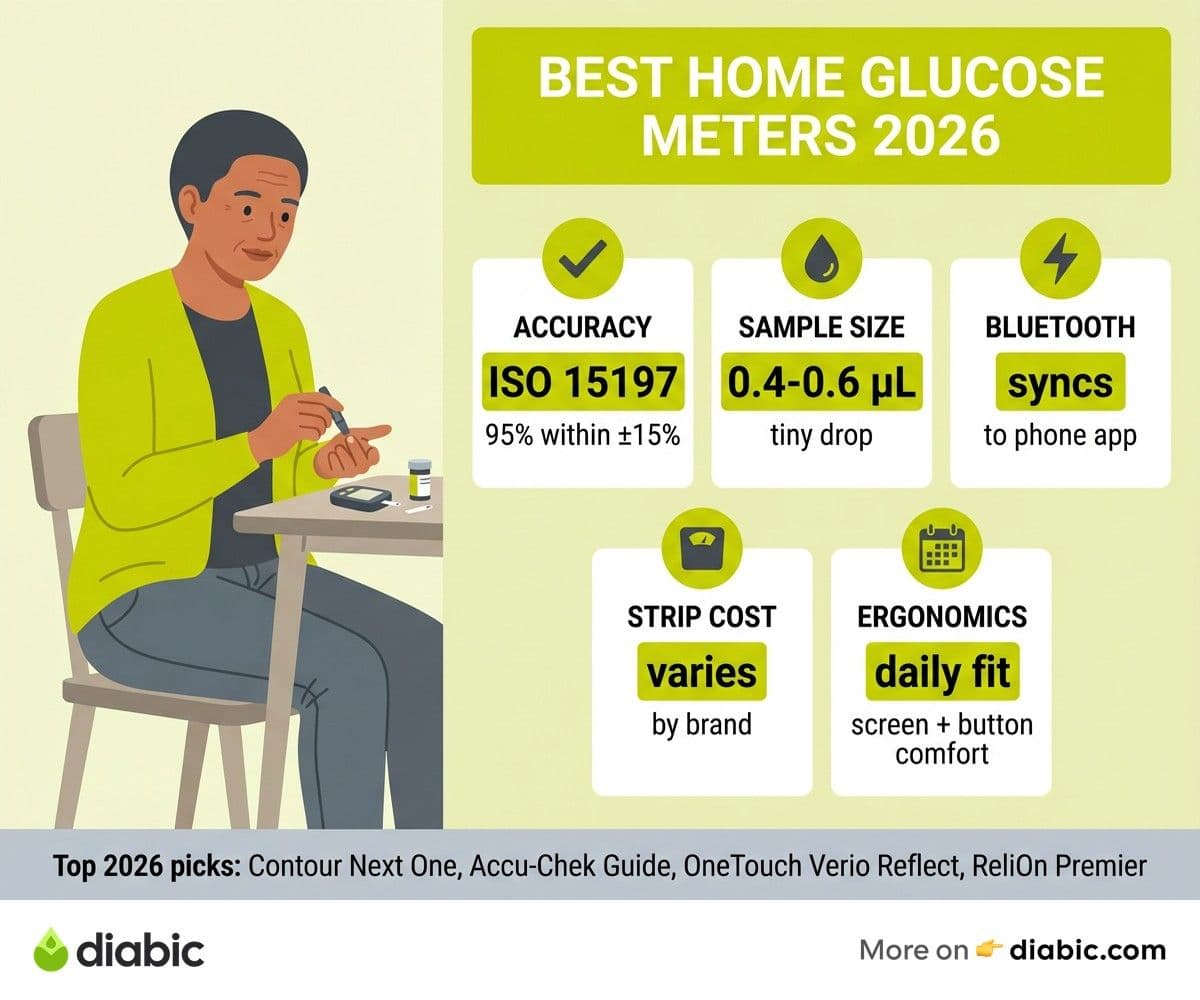
Accuracy is judged against the ISO 15197:2013 standard, which requires that 95% of meter results fall within plus or minus 15 mg/dL of a lab reference at glucose levels under 100 mg/dL, and within 15% above that. Some meters publish data showing they exceed this floor. If a brand will not share its ISO performance data publicly, treat that as a signal.
Test strip cost is the line item most people underestimate. A meter that costs $20 can quietly cost you $600 a year in strips if you test four times a day. The American Diabetes Association notes in its Standards of Care that frequent self-monitoring is most useful for people on insulin, so your testing volume should drive the math.
Sample size matters more than it sounds. Older meters needed a generous drop of blood, which often meant a second finger stick on cold mornings. Modern meters draw between 0.3 and 0.6 microliters, which is roughly the size of a pinhead. Smaller is friendlier on your fingertips over years of testing.
Display readability, memory capacity, and connectivity round out the comparison. A backlit screen helps at 2 a.m. checks. Bluetooth pairing reduces the friction of logging numbers your endocrinologist asks for. None of this matters if the meter is so fiddly you stop using it.
Top Picks for Home Testing in 2026
We compared the meters that show up most often in pharmacy reviews, endocrinology recommendations, and our own readers' inboxes. Each pick has clear strengths and equally clear trade-offs.
Best for Accuracy: Contour Next One
The Contour Next One from Ascensia Diabetes Care consistently posts strong accuracy numbers in third-party testing, with published data showing performance that exceeds ISO 15197:2013 thresholds at every glucose range. It uses a small 0.6 microliter sample and offers a Second-Chance sampling feature that lets you reapply blood to the same strip within 60 seconds, which prevents wasted strips on partial fills.
The meter pairs with the Contour Diabetes app over Bluetooth, syncs your readings automatically, and shares trends with your care team. The trade-off is strip cost. Contour Next strips run roughly 25 to 50 cents each retail, depending on pack size, which adds up if you are paying out of pocket.
Best Budget Option: ReliOn Premier Classic
ReliOn meters are sold exclusively at Walmart and have built a quiet following among people paying cash for supplies. The Premier Classic meter itself is often under $20, and ReliOn strips frequently come in under 20 cents each, which is a fraction of name-brand pricing. Accuracy meets ISO 15197 standards, though the meter lacks Bluetooth and the app ecosystem is minimal.
For a person with type 2 diabetes testing once or twice daily, this is often the most rational choice. If you need affordable test strips and a simple display without ongoing subscription fees, this is where most readers land. We cover trade-offs in more detail in our breakdown of affordable test strips and budget meter options.
Best for Smartphone Integration: OneTouch Verio Reflect
The OneTouch Verio Reflect leans into coaching. Its ColorSure indicator flags out-of-range readings, and the Blood Sugar Mentor feature offers brief tips inside the OneTouch Reveal app. Bluetooth pairing is reliable, and the app integrates with Apple Health and Google Fit if you want one place for all your health data.
This is a good fit for someone who wants reminders and trend visualizations baked into the experience. Strip cost sits in the mid range, and OneTouch runs frequent manufacturer coupons that can lower the per-strip price meaningfully.
Best for Large Display and Low Vision: Accu-Chek Guide Me
Accu-Chek's Guide Me model prioritizes a large, high-contrast display and a spill-resistant SmartPack vial that lets you take one strip at a time without spilling the rest. The buttons are physical and well spaced, which matters if you have arthritis or reduced manual dexterity.
Accuracy is solid and the meter pairs well with caregivers who help an older parent. For more options designed around aging eyes and hands, see our roundup of the best glucometers for elderly and low-vision users.
Comparison Table
From my experience: I have used a Contour Next as my backup meter for nearly a decade alongside my CGM, and the thing I notice most is how forgiving it is with imperfect blood drops. After 14 years with type 1, fingertips get stubborn, and the second-chance feature has saved me from wasting strips more times than I can count.
How Test Strip Costs Affect Your Choice
Strips, not meters, are where the money lives. A person with type 2 diabetes testing twice a day uses about 60 strips a month. A person with type 1 testing six times daily uses around 180. At an average retail price of 50 cents per name-brand strip, that is between $360 and $1,080 a year before insurance.
Generic strips have closed much of the historical accuracy gap. ReliOn, CVS-brand, and pharmacy-house generics generally meet the same ISO 15197 standard as name brands, though independent comparison studies show name-brand meters still tend to perform slightly better at the edges. For routine monitoring of stable glucose, the difference is usually clinically irrelevant.
Bulk buying through subscription services like Diathrive or Better Living often beats retail by 30 to 50%. Manufacturer coupons can knock another 20% off name-brand strips, especially for OneTouch and Contour. Costco and Sam's Club pharmacies stock house-brand strips at very competitive prices for members.
If you are testing infrequently and paying cash, an affordable meter and generic strips will serve you well. We dig deeper into matching strips to your testing pattern in our diabetes test strips guide, including what to look for on the box and how to verify lot accuracy.
Glucometers vs CGMs: Which Do You Need
A glucometer gives you a single point-in-time reading. A continuous glucose monitor (CGM) gives you a glucose number every one to five minutes, plus trend arrows and alerts. Both have a place. Neither replaces the other entirely.
A meter is often enough if you have type 2 diabetes managed with diet, lifestyle, or oral medication and your A1C sits in your target range. It is also a reasonable fit during prediabetes, gestational diabetes when your provider recommends fingerstick testing, or for occasional spot checks. Meters are also still required to verify CGM readings before dosing for many users.
A CGM tends to make more sense if you take insulin, experience frequent or unexplained low blood sugars, want to see how meals and exercise affect you in real time, or struggle with overnight glucose variability. Our CGM vs glucometer comparison walks through the decision in detail.
Many people use both. A CGM handles trend tracking and alerts, while a meter confirms suspicious readings and serves as a backup when sensors fail or fall off. If you are open to wearable tech beyond glucose tracking, our review of the best diabetes wearables worth buying in 2026 covers the broader landscape.
How to Test Your Blood Sugar Accurately at Home
The technique is simple, but small details swing the result. The ADA's self-monitoring guidance emphasizes clean, dry hands and a strip from a fresh vial as the foundations of an accurate reading.
Start by washing your hands with warm water and soap, then drying thoroughly. Residue from food, hand cream, or fruit juice can shift a reading by 30 mg/dL or more. If you cannot wash, wipe the first drop of blood away and use the second.
Insert a fresh strip, lance the side of your fingertip rather than the pad, and apply blood until the meter beeps or the indicator fills. Side sites hurt less because there are fewer nerve endings, and they heal faster with repeated testing.
Common mistakes that skew readings include using expired strips, testing at high altitude with a meter not rated for it, leaving strips exposed to humidity, and failing to code older meters when changing strip lots. Each of these can swing accuracy by 10% or more.
When you test depends on your treatment plan. People on insulin often check fasting, before meals, two hours after meals, at bedtime, and before driving. People on lifestyle and oral medication may only need a fasting reading or a few weekly post-meal checks to spot trends. Talk to your doctor about a testing schedule that matches your goals.
Insurance and Cost Considerations
Medicare Part B covers glucose meters and test strips as durable medical equipment for beneficiaries with diabetes, with quantity limits tied to whether you take insulin. Insulin users typically qualify for up to 300 strips every three months, while non-insulin users are capped at 100 per quarter. Your provider can request more with documentation.
Private insurance coverage varies, but most plans treat strips as a pharmacy benefit with a copay tied to a preferred brand. Calling the customer service number on your card and asking which meters and strips are on formulary saves the most money. Switching brands to match formulary often drops your copay to a few dollars per month.
Manufacturer assistance programs help when insurance falls short. OneTouch, Contour, and Accu-Chek all run cash-pay programs that lower strip costs significantly, and patient assistance foundations cover the rest for qualifying low-income households. The Diabetes Patient Assistance Program directory maintained by the ADA is a useful starting point.
FAQ
What is the best meter for home testing?
The best home meter depends on how often you test and what you are willing to pay per strip. The Contour Next One leads on accuracy, the ReliOn Premier Classic wins on cost, and the OneTouch Verio Reflect is the easiest pick if you want app integration. Each one meets the ISO 15197 accuracy standard required for home use.
How do I choose the right glucose meter?
Start with strip cost, since that is what you will pay every month. Then look at sample size, display readability, and whether the device pairs with an app you will actually open. Test in your hands at the pharmacy if possible, and ask your doctor or diabetes educator which models they see patients stick with long term.
How often should you test your blood sugar at home?
Testing frequency depends on your treatment. People taking multiple daily insulin injections often check four to ten times a day, while people on oral medication may only check once daily or a few times a week. Your healthcare provider can set a schedule based on your A1C, hypoglycemia risk, and personal goals.
If you are evaluating which blood glucose meter to bring into your routine, start with strip cost, accuracy, and how the device fits your hands and your eyes. The right meter is the one you will actually use without fighting it.
Shahriar P. Shuvo is the founder of Diabic. He has lived with diabetes for over 14 years, and built Diabic to deliver the practical, evidence-based self-management tools he wished existed when he was first diagnosed. By trade, Shahriar is a senior design and frontend engineer with 6+ years shipping products at Agora, Timescale (now Tiger Data), and ShareTrip. He writes from the intersection of lived diabetes experience and product craft, focused on what works in daily management rather than what sounds good in a textbook.
Medically reviewed by
Dr. Rezwana Parvin Rumpa is an obstetrics and gynaecology specialist with clinical focus on gestational diabetes, PCOS, and fertility. She holds the MRCOG (Final Part) from the Royal College of Obstetricians and Gynaecologists in London, the MRCPI (Final Part) from the Royal College of Physicians of Ireland, and an MBBS from Shaheed Monsur Ali Medical College under Dhaka University. Dr. Rumpa serves as a Senior Medical Officer in the Obs and Gynae department at BRB Hospitals Ltd, where she has spent three years managing prenatal care, emergency obstetric cases, and women's-health surgery. On Diabic, she medically reviews content for women living with diabetes, with particular attention to pregnancy, PCOS, and reproductive-health intersections.
More from Devices & Technology
View all
Fasting vs Postprandial Glucose: What's the Difference
Fasting vs postprandial glucose readings tell different stories about your blood sugar. Learn what each number means and how to act on it.

Best Glucometer for Elderly and Low-Vision Users
Best glucometer for elderly and low-vision users: large displays, audio readouts, no-coding strips, and budget picks that make daily testing easier.

Online Diabetes Coaching: How to Choose a Good One
Online diabetes coaching can fill the gaps between doctor visits. Learn what credentials to check, red flags to avoid, and how to pick a quality program.
Clinician-reviewed habits, plain-language guides, and honest answers - the small shifts that make living with diabetes feel lighter, every day.