Continuous Glucose Monitor for Pregnancy: What to Know
Using a continuous glucose monitor for pregnancy can help protect both you and your baby. Here is what to know about safety, accuracy, and benefits.

In this article(9)
Pregnancy already changes a lot of things about your day. When diabetes is in the picture, the targets get tighter, the insulin needs shift week by week, and a single high reading can feel heavier than usual. A continuous glucose monitor for pregnancy gives you a steady stream of information at exactly the moment when guesswork costs the most.
Whether you have type 1, type 2, or gestational diabetes, a CGM can show you patterns that traditional fingersticks simply cannot catch. That visibility is one of the most useful tools you and your care team have during these forty weeks. Below, we walk through how a CGM helps during pregnancy, which devices are cleared for use, what accuracy actually looks like at this stage of life, and the safety details worth raising with your provider.
Why a Continuous Glucose Monitor Helps During Pregnancy
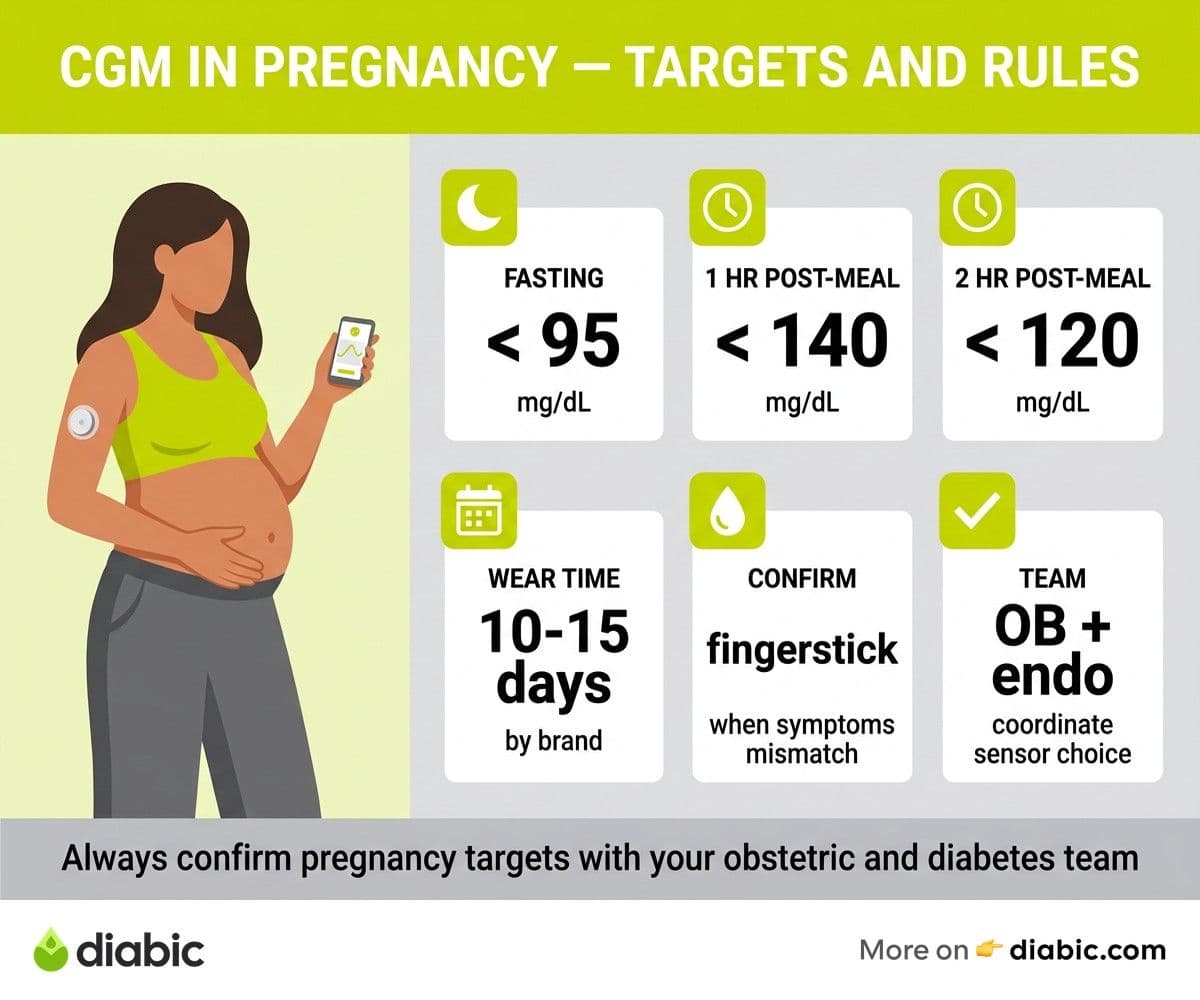
The glucose targets for pregnancy are tighter than the targets you may be used to. The American Diabetes Association recommends fasting glucose under 95 mg/dL, one-hour post-meal under 140 mg/dL, and two-hour post-meal under 120 mg/dL for most pregnancies complicated by diabetes (ADA Standards of Care 2026). Hitting those windows with four to ten fingersticks a day is genuinely hard.
A continuous glucose monitor for pregnancy fills the gaps between checks. It captures the post-breakfast spike that peaks at 75 minutes, the dawn rise that starts at 4 a.m., and the slow drift down before lunch. Those are exactly the moments where a fingerstick is least likely to be in your hand.
The CONCEPTT trial, published in The Lancet in 2017, randomized 325 pregnant women with type 1 diabetes to either CGM plus capillary monitoring or capillary monitoring alone (Feig et al., 2017). The CGM group spent more time in range, had fewer large-for-gestational-age babies, and saw fewer NICU admissions over 24 hours. Those are not small wins. They are the outcomes most parents care about most.
How a Continuous Glucose Monitoring System Works for Pregnant Users
A continuous glucose monitoring system uses a thin filament inserted just under the skin to measure glucose in your interstitial fluid every one to five minutes. The same hardware works whether you are pregnant or not, but the targets and alerts shift to match pregnancy guidelines. If you are new to the technology, our overview of what a CGM is and how it works walks through the basics.
For pregnancy, most providers recommend setting a tighter high alert (often 140 mg/dL post-meal) and keeping a low alert at 70 mg/dL or higher. Some endocrinologists also use a "predictive low" alert so you catch a drop before it lands. These settings are personal, so work with your care team to choose the right thresholds for your stage of pregnancy.
A handful of CGMs are commonly used during pregnancy in the United States, the UK, and Canada. Dexcom G7 carries an FDA indication for use during pregnancy. The FreeStyle Libre 3 and the newer Abbott Simplera are also widely prescribed for pregnant users, though indications vary by region. Your endocrinologist or diabetes educator will know which device fits your insurance, your pump (if any), and your data-sharing preferences.
Benefits of a Continuous Glucose Monitor for Pregnancy
The continuous glucose monitor benefits during pregnancy stack up in ways that surprise even longtime CGM users. Insulin sensitivity changes dramatically across the three trimesters, sometimes within the same week. Real-time trend arrows let you respond to a rising number before it becomes a 220 mg/dL reading you spend two hours correcting.
From my experience: I have lived with type 1 diabetes for fourteen years and used a CGM through some of the toughest stretches of my management. The single biggest shift a CGM brings is overnight visibility. You stop guessing what is happening at 3 a.m. and start sleeping again. That alone is reason enough during a pregnancy, where rest is already in short supply.
Time in range is one of the most important pregnancy metrics. The international consensus target for type 1 diabetes during pregnancy is more than 70% of time between 63 and 140 mg/dL (3.5 to 7.8 mmol/L). Higher time in range is associated with lower rates of pre-eclampsia, neonatal hypoglycemia, and preterm birth. Our deeper guide to time in range explained walks through how to read these numbers.
Other benefits worth noting:
- Fewer hypoglycemic episodes, especially overnight, when many pregnant users are most vulnerable
- Faster correction of post-meal spikes thanks to trend arrows you can act on within minutes
- Easier data sharing with your endocrinologist, OB, and partner through cloud-connected apps
- Less mental load, because you are no longer running calculations from memory between fingersticks
If you also live with type 2 diabetes, our roundup of the best CGMs for type 2 covers options that fit different budgets and insulin regimens.
Is a CGM Accurate Enough for Pregnancy?
CGM accuracy is usually reported as MARD, or mean absolute relative difference, between sensor readings and a lab reference. The Dexcom G7 reports an overall MARD of 8.2% in adults and 8.1% in pregnancy studies, which is roughly on par with non-pregnant accuracy. The FDA-cleared label for G7 reflects this pregnancy data (Dexcom).
Pregnancy does introduce a few wrinkles. Hydration shifts, edema, and changes in subcutaneous fat can affect sensor performance. Many users see slightly more lag during the first 24 hours of a new sensor and slightly more variability in the third trimester. None of that makes a CGM unreliable, but it does mean a fingerstick still has a role.
Talk to your doctor about confirming with a fingerstick if your CGM number does not match how you feel, if you are about to take a correction dose at the edge of your range, or if a reading swings more than 30 mg/dL in five minutes without a clear cause. Many endocrinologists also recommend dosing decisions be backed by a fingerstick when you are below 70 mg/dL, especially during the first trimester. The FDA labeling for each CGM lists specific situations where a confirmatory test is required (FDA).
Safety Considerations: What Pregnant Users Should Know
A continuous glucose monitor for pregnancy is generally considered safe to wear, but the details deserve attention. The American College of Obstetricians and Gynecologists supports CGM use as part of a broader diabetes care plan during pregnancy, particularly for type 1 (ACOG). Even so, every pregnancy is different, so this conversation belongs in your prenatal visit.
Skin changes during pregnancy are real. Hormonal shifts can make adhesives more irritating, and sites that worked fine before may suddenly itch or peel after a few days. Barrier wipes, hypoallergenic over-patches, and rotating sites every sensor change can help. If you are new to insertion, our piece on does a CGM hurt breaks down what to expect.
Sensor placement options expand as your body changes. The back of the upper arm is the most common site for both Dexcom G7 and FreeStyle Libre 3 / Simplera. Some users move to the upper buttock or outer thigh in later trimesters when belly skin is too tight or sensitive. Always check your specific device's labeling for approved sites, since off-label placement can affect accuracy.
A few practical safety notes:
- Remove your sensor before any MRI. Most CGMs are not MRI-safe and the magnet can damage the sensor and cause skin burns
- Inform your delivery team you are wearing a CGM. Some hospitals have policies for labor and delivery monitoring
- Keep extra fingerstick supplies on hand, especially during the third trimester when sensors may need replacing more often
Talk to your provider before starting a CGM during pregnancy if you have not used one before, even if you have used fingersticks for years. The training time during pregnancy is short, and getting your alert thresholds right early matters.
FAQ
Is a continuous glucose monitor safe during pregnancy?
Research suggests CGMs are safe to use during pregnancy, and devices like the Dexcom G7 carry an FDA indication for pregnancy. Studies including the CONCEPTT trial show CGM use during pregnancy is associated with better outcomes for both parent and baby. That said, talk to your obstetrician and endocrinologist before starting, especially if you have a high-risk pregnancy or skin conditions.
How long can you wear a continuous glucose monitor while pregnant?
Wear time depends on the device. Dexcom G7 sensors last up to 10 days, FreeStyle Libre 3 sensors last up to 14 days, and Abbott Simplera sensors last up to 14 or 15 days depending on region. You can wear them throughout pregnancy as long as your skin tolerates the adhesive and accuracy stays within expected ranges. Some pregnant users replace sensors slightly early in late trimesters if accuracy slips.
Does insurance cover a CGM for gestational diabetes?
Coverage varies by insurer, country, and the specific diagnosis. In the United States, most private plans cover CGMs for type 1 and insulin-using type 2 diabetes during pregnancy, and an increasing number cover gestational diabetes when insulin is required. Medicaid coverage varies by state. In the UK, the NHS provides CGM access through specialist diabetes pregnancy clinics. Call your insurer and ask specifically about pregnancy and gestational diabetes coverage.
If a continuous glucose monitor for pregnancy is part of your plan, the next useful step is making sure your pump or pen routine matches your new targets. Our practical guide to insulin pump care covers what changes during pregnancy and what stays the same. The right setup, paired with steady CGM data, gives you the visibility to keep glucose in tighter targets without spending the next forty weeks counting fingersticks.
Dr. Rezwana Parvin Rumpa is an obstetrics and gynaecology specialist with clinical focus on gestational diabetes, PCOS, and fertility. She holds the MRCOG (Final Part) from the Royal College of Obstetricians and Gynaecologists in London, the MRCPI (Final Part) from the Royal College of Physicians of Ireland, and an MBBS from Shaheed Monsur Ali Medical College under Dhaka University. Dr. Rumpa serves as a Senior Medical Officer in the Obs and Gynae department at BRB Hospitals Ltd, where she has spent three years managing prenatal care, emergency obstetric cases, and women's-health surgery. On Diabic, she medically reviews content for women living with diabetes, with particular attention to pregnancy, PCOS, and reproductive-health intersections.
Medically reviewed by
Dr. Shanto Arian is an internal medicine physician now specializing in clinical and aesthetic dermatology, with a parallel academic focus on epidemiology and public health. He holds an MBBS, MPH, MSc (UK), MRCP (UK), MRCPI (Ireland), Diploma in Dermatology (UK), and Diploma in Aesthetic Medicine (USA). Dr. Arian trained in internal medicine, including hospital work on hematology cases such as graft-versus-host disease, before moving toward dermatology. Skin is one of the earliest places diabetes shows itself, from acanthosis nigricans and diabetic dermopathy to slow foot wound healing, and that intersection is where his clinical and Diabic-review work meet. On Diabic, Dr. Arian medically reviews content on diabetes diagnosis, complications, dermatologic manifestations, and pharmacotherapy, ensuring every claim aligns with current ADA, NICE, and peer-reviewed literature.
More from Devices & Technology
View all
Fasting vs Postprandial Glucose: What's the Difference
Fasting vs postprandial glucose readings tell different stories about your blood sugar. Learn what each number means and how to act on it.

Best Glucometer for Elderly and Low-Vision Users
Best glucometer for elderly and low-vision users: large displays, audio readouts, no-coding strips, and budget picks that make daily testing easier.

Online Diabetes Coaching: How to Choose a Good One
Online diabetes coaching can fill the gaps between doctor visits. Learn what credentials to check, red flags to avoid, and how to pick a quality program.
Clinician-reviewed habits, plain-language guides, and honest answers - the small shifts that make living with diabetes feel lighter, every day.