Diabetes Employment Rights: Know the Law at Work
A plain-language guide to employment diabetes rights, ADA accommodations, FMLA leave, and what to do when an employer crosses the line.

In this article(10)
You should not have to choose between checking your blood sugar and keeping your job. Yet many people quietly skip finger sticks, postpone insulin doses, or eat lunch at their desks in secret because they assume their boss can push back. That assumption is usually wrong, and your employment diabetes rights are far stronger than most workplaces let on.
We hear from readers who have been denied a snack break, questioned about a CGM alarm, or written up after a low. In almost every case, federal law was already on their side. The challenge is knowing which law applies, what to ask for, and how to put protections into practice without turning every conversation into a fight.
From my experience: I waited almost a year at one job before asking for a small accommodation, just permission to keep juice and a Dexcom receiver at my desk and step out briefly for a low. I had built it up in my head as a giant conversation. The actual exchange with HR took ten minutes and a one-paragraph note from my endocrinologist. Looking back at 2018, the part I regret is the months I spent treating lows in the bathroom because I assumed asking would make me look fragile.
Employment Diabetes Rights Under Federal Law
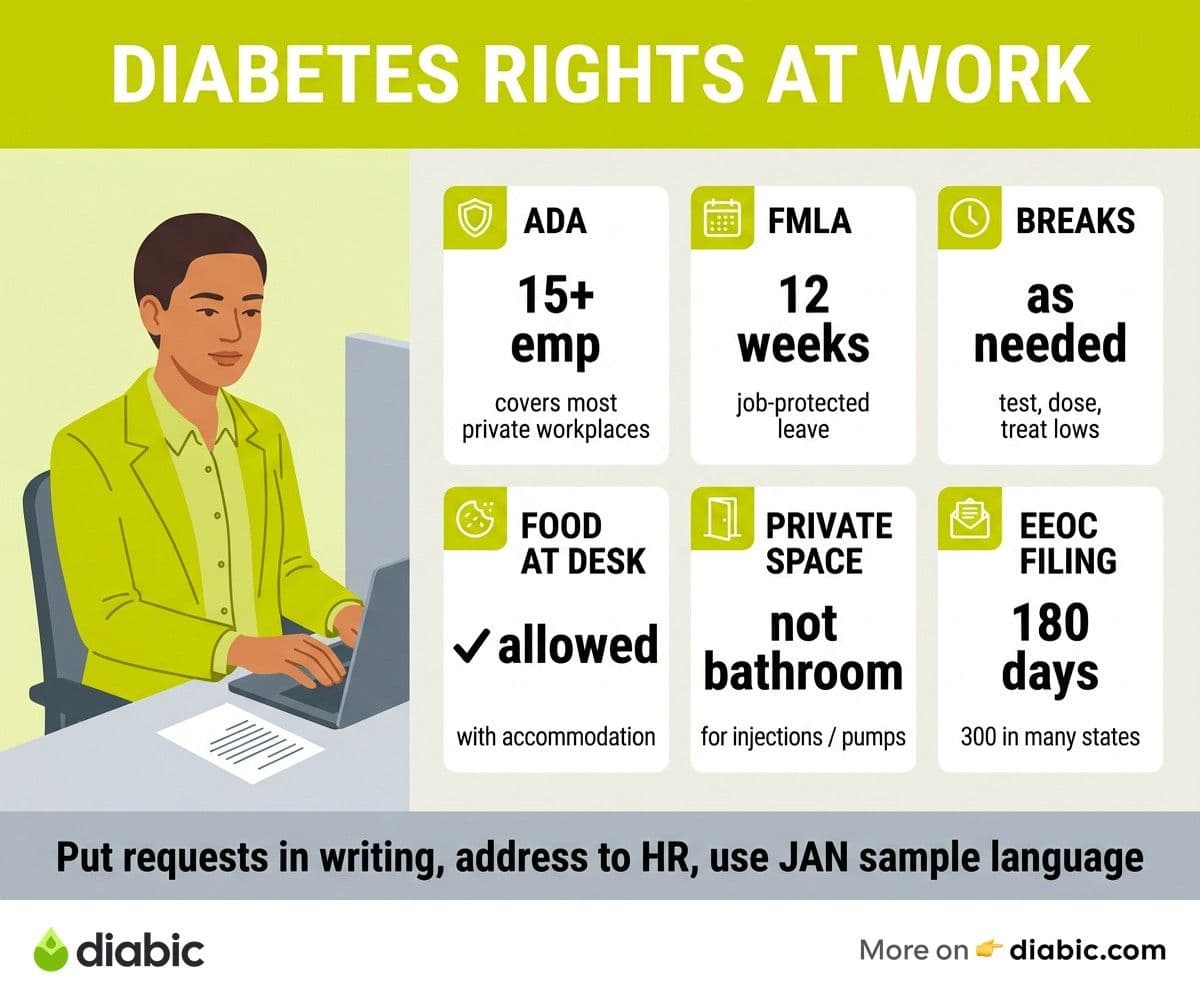
In the United States, the foundation of your employment diabetes rights is the Americans with Disabilities Act, or ADA. The ADA covers private employers with 15 or more employees, plus state and local governments. Diabetes is treated as a disability under the law because it substantially limits the major life activity of endocrine function, which means you qualify for protection regardless of how well your numbers look on a given day.
The ADA does two big things for you. First, it bans discrimination in hiring, firing, promotion, pay, and the daily terms of your job because of diabetes. Second, it requires your employer to provide reasonable accommodations that let you do your job safely, unless those accommodations would cause significant difficulty or expense, what the law calls "undue hardship."
If you work for the federal government or a federal contractor, the same protections come through Section 504 of the Rehabilitation Act and Section 501 for federal employees. The standards mirror the ADA, and the same agency interprets both. Knowing which statute covers you matters mostly for where you file a complaint, not for what you can ask of your manager day to day.
The Family and Medical Leave Act, administered by the Department of Labor, adds another layer. FMLA gives eligible employees up to 12 weeks of unpaid, job-protected leave per year for serious health conditions, and diabetes qualifies. You can take FMLA in continuous blocks for hospital stays or in intermittent chunks for endocrinology appointments, dialysis, retinal procedures, or recovery from a severe low. Your employer must keep your health insurance in place during the leave and return you to the same or an equivalent role when you come back.
Diabetes Accommodation at Work: What You Can Request
A diabetes accommodation at work does not need to be exotic. Most requests are small, cheap, and easy to implement once you frame them clearly. The Job Accommodation Network, or JAN, is a free federal resource that publishes example accommodations for almost every job category, and we recommend pulling specific language from their site when you write your request.
Common accommodations that the EEOC and JAN have repeatedly endorsed include:
- Short, predictable breaks to test blood sugar, dose insulin, treat a low (per the ADA's hypoglycemia guidance, lows need fast carbohydrate within minutes), or change a pump or sensor site.
- Permission to keep food, glucose tabs, juice, or water at your workstation, even in roles where eating on the floor is normally banned.
- A flexible start time or modified schedule to accommodate medical appointments, dawn phenomenon management, or shift work that disrupts insulin timing.
- A private, clean space (not a bathroom stall) for injections, pump changes, or pumping for nursing parents who also live with diabetes.
- Temporary reassignment of safety-sensitive tasks during a period of unstable glucose, after a medication change, or while recovering from severe hypoglycemia.
You can also request equipment accommodations, such as a refrigerator for insulin storage, a chair if your role requires long periods of standing, or permission to wear a CGM receiver where electronic devices are otherwise restricted. For deeper tactics on day-to-day execution, our guide on practical strategies for managing diabetes at work walks through scripts and routines that pair well with formal accommodations. The point is that you do not have to invent the request from scratch, and you do not have to justify it in clinical detail.
Disclosing Diabetes to Your Employer
Disclosure is almost always your choice. An employer cannot ask whether you have a disability before extending a job offer, and even after hire they can only request medical information that is job-related and consistent with business necessity. You do not have to mention diabetes on an application, in an interview, or during onboarding unless you want an accommodation right away.
The moment you ask for an accommodation, however, you trigger the "interactive process." This is a back-and-forth conversation in which you and your employer figure out what will work. You will likely need to confirm that you have a qualifying condition and that the accommodation is connected to it, but you do not have to hand over your full medical chart. A short letter from your endocrinologist or primary care provider that names the condition and the recommended accommodation is usually enough.
Your employer is required to keep this information confidential. Medical records must be stored separately from your personnel file, and managers should only learn the specific accommodations they need to support, not the underlying diagnosis. If you are weighing how much to share with whom, our piece on deciding whether to tell your boss about diabetes walks through the trade-offs in more detail. Take the time you need to make a thoughtful choice, because once you disclose, you cannot undo it.
Diabetes Management at Work: Putting Rights Into Practice
Knowing the law is only half the work. Putting it into practice is where managing diabetes at work either gets easier or quietly falls apart. We always tell readers to put accommodation requests in writing, even if your culture is informal. An email creates a date-stamped record that protects both sides if memories drift later.
Address your request to HR when possible, and copy your direct manager so nothing feels like an end-run. Use clear, neutral language: state that you have a medical condition covered by the ADA, list the specific accommodations you are requesting, and offer to provide a supporting letter from your healthcare provider. Skip the medical history. Resources from requesting workplace accommodations for diabetes and from JAN can give you template language if you freeze up at the keyboard.
If your request is denied or watered down, ask for the reasons in writing and propose alternatives. The interactive process is supposed to be a dialogue, not a one-shot decision. Keep copies of every email, performance review, and meeting note in a personal account, not just your work drive, because access to company systems can disappear quickly if a relationship sours. Building this paper trail is not paranoid, it is basic professional hygiene for anyone navigating a chronic condition at work.
When Your Rights Are Violated
Sometimes the system fails. You ask for a reasonable accommodation and get stonewalled, you mention diabetes and suddenly miss a promotion, or you are written up for a performance issue that never came up before your CGM started beeping in meetings. These patterns can amount to discrimination or retaliation under the ADA, and you have several escalation paths.
Start internally if it feels safe. File a written complaint through your HR or ethics channel, citing the ADA by name and describing the specific incidents. If internal channels go nowhere or you fear retaliation, you can file a charge with the Equal Employment Opportunity Commission. The EEOC has strict deadlines, generally 180 days from the discriminatory act, extended to 300 days in many states, so do not wait. Filing is free, you do not need a lawyer to start, and the EEOC will investigate before you ever see a courtroom.
Many states and cities offer broader protections than the ADA, including coverage for smaller employers, longer filing windows, or stronger remedies. State human rights agencies often work in parallel with the EEOC. If your case involves termination, lost wages, or serious emotional harm, consulting a plaintiff-side employment attorney is worth the call. Most offer free initial consultations and work on contingency, meaning you pay nothing up front. The American Diabetes Association also runs a legal advocacy program that can connect you with attorneys who understand diabetes-specific cases.
Can an Employer Take Action Because of Diabetes?
The short answer is no, an employer cannot fire, demote, or refuse to promote you because you have diabetes. They also cannot force you out by making your job impossible, a tactic the law calls "constructive discharge." Adverse action that is motivated by your condition, your accommodation request, or your use of FMLA leave is illegal.
There is one narrow exception worth understanding. The ADA allows employers to exclude an employee whose condition poses a "direct threat" of substantial harm that cannot be reduced through reasonable accommodation. The bar is high, and the analysis must be based on objective medical evidence, not stereotypes about diabetes. A pilot, commercial driver, or heavy-equipment operator may face additional federal safety rules, but even those are increasingly flexible as CGM and pump technology has matured.
Performance issues unrelated to diabetes are still fair game. If you miss deadlines, your numbers are not the legal shield. The line gets blurry when performance dips during a period of poor glucose management, which is precisely why early disclosure and documented accommodations matter. They turn a performance conversation into a medical one, where the law is on your side.
Notes for Canadian and UK readers
If you work in Canada, federal employees and federally regulated industries fall under the Canadian Human Rights Act, enforced by the Canadian Human Rights Commission, while most other workers are covered by their provincial human rights code. The duty to accommodate to the point of undue hardship is well established across both. In the United Kingdom, the Equality Act 2010 treats diabetes as a disability and requires employers to make reasonable adjustments. ACAS provides free guidance, and you can bring a claim through an employment tribunal within three months of the incident.
FAQ
What are your rights at work with diabetes?
Under the ADA, you have the right to reasonable accommodations, protection from discrimination based on your condition, and confidentiality regarding your medical information. That includes break time for testing and dosing, access to food and beverages at your workstation, flexible scheduling for medical appointments, and a private space for injections or pump changes. State, Canadian, and UK laws often add further protections.
Can an employer fire you for having diabetes?
No. Firing someone because they have diabetes is illegal under the ADA, and the same is true under the Canadian Human Rights Act and the UK Equality Act 2010. Employers can still take action for legitimate performance or conduct reasons unrelated to your condition, but they cannot use diabetes as a pretext. If you suspect you were fired because of your diabetes, accommodation request, or FMLA leave, file a charge with the EEOC or your local equivalent within the deadline.
The reason we keep returning to the basics here is that strong employment diabetes rights only protect you when you can name them and use them. Read the relevant law once, save the key links, and write down the accommodations you actually need. Most employers, given a calm and specific request, do the right thing. For the cases where they do not, the agencies and statutes above exist exactly so that managing your condition at work is not something you have to fight for in private.
Shahriar P. Shuvo is the founder of Diabic. He has lived with diabetes for over 14 years, and built Diabic to deliver the practical, evidence-based self-management tools he wished existed when he was first diagnosed. By trade, Shahriar is a senior design and frontend engineer with 6+ years shipping products at Agora, Timescale (now Tiger Data), and ShareTrip. He writes from the intersection of lived diabetes experience and product craft, focused on what works in daily management rather than what sounds good in a textbook.
Medically reviewed by
Dr. Shanto Arian is an internal medicine physician now specializing in clinical and aesthetic dermatology, with a parallel academic focus on epidemiology and public health. He holds an MBBS, MPH, MSc (UK), MRCP (UK), MRCPI (Ireland), Diploma in Dermatology (UK), and Diploma in Aesthetic Medicine (USA). Dr. Arian trained in internal medicine, including hospital work on hematology cases such as graft-versus-host disease, before moving toward dermatology. Skin is one of the earliest places diabetes shows itself, from acanthosis nigricans and diabetic dermopathy to slow foot wound healing, and that intersection is where his clinical and Diabic-review work meet. On Diabic, Dr. Arian medically reviews content on diabetes diagnosis, complications, dermatologic manifestations, and pharmacotherapy, ensuring every claim aligns with current ADA, NICE, and peer-reviewed literature.
More from Living with Diabetes
View all
A Gentle Chair Yoga Routine for people with diabetes
A gentle chair yoga for people with diabetes routine with safe poses, modifications for neuropathy, retinopathy, and joint pain, plus tips for older.

Shift Work and Diabetes: Managing Irregular Hours
Shift work and diabetes is a tough combination. Learn how to manage meals, sleep, medication, and blood sugar when your hours rotate or flip overnight.

Dating with Diabetes: When to Tell a New Partner
Dating with diabetes brings unique disclosure questions. Here is when to tell a new partner, what to say, and how to handle the conversation with.
Clinician-reviewed habits, plain-language guides, and honest answers - the small shifts that make living with diabetes feel lighter, every day.