Diabetes Disclosure at Work: Tell Your Boss?
Diabetes disclosure at workplace is a personal call. We weigh pros, cons, ADA legal protections, and how to tell your boss if you choose to.

In this article(10)
The question hovers over coffee breaks and quiet drives home: do you mention the insulin pen in your bag, or keep it tucked away for another year? Diabetes disclosure at workplace is one of the most personal calls you will make in your career, and the anxiety around it is completely valid. There is no single right answer, and we want to walk through the trade-offs honestly so you can decide what fits your job, your manager, and your peace of mind.
What we can offer is a clearer picture of your rights, realistic pros and cons, and a practical way to handle the conversation if you choose to have it. We will focus on the United States with a brief look at Canada and the UK.
From my experience: I waited almost two years at one job before telling my manager about my T1D, and the trigger was a CGM alarm going off in a quiet meeting in 2019. The disclosure itself took maybe ninety seconds and ended with her asking where I kept my juice. Looking back, the months of mentally rehearsing the conversation cost me more energy than the conversation ever did.
Understanding Diabetes Disclosure at Workplace
Disclosure feels loaded because it sits at the intersection of identity, health, and livelihood. You are not just sharing a medical fact, you are inviting your manager into a part of your life they may not understand well. People worry about being seen as fragile, about being passed over for travel or promotions, or about awkward questions every time they reach for a snack. Those fears are not paranoid, they reflect real patterns researchers have documented in workplace bias studies.
There is a useful distinction between voluntary and required disclosure. Voluntary disclosure is when you choose to share because it builds trust or makes accommodations easier. Required disclosure is rare and usually limited to safety-sensitive roles like commercial driving or piloting, where regulatory bodies set their own rules. For most office, retail, healthcare, and trade jobs, the choice belongs to you alone.
Workplace culture matters more than any single policy document. A team that openly discusses mental health and chronic conditions is usually a safer place to share, while a culture that prizes "always on" performance and treats sick days as weakness is a harder one. We encourage you to read the room before you read the rulebook, because the people around you shape your daily experience far more than HR ever will. This is similar to deciding when and how to tell a new partner about diabetes, where context and timing carry as much weight as the words you use.
Your Employment Diabetes Rights Around Disclosure
In the United States, the Americans with Disabilities Act (ADA) treats diabetes as a protected disability, which means employers with 15 or more workers cannot discriminate against you in hiring, firing, pay, or promotion based on your condition. The NIDDK's overview of managing diabetes underscores how routine self-care, like glucose checks and meal timing, often requires small workplace adjustments to fit around the workday. The U.S. Equal Employment Opportunity Commission spells this out in detail, including what employers can and cannot ask. During hiring, an employer generally cannot ask about your medical history before a job offer, though they can ask whether you can perform essential job functions with or without accommodation.
After a conditional offer, employers may require a medical exam if they require it of all candidates in the same role. Once you are employed, your employer can only ask about your health when there is a clear, job-related reason, like an accommodation request or a documented performance concern. They cannot quiz you about your A1C or insulin doses out of curiosity. We cover the broader picture of your legal rights with diabetes at work in a dedicated piece.
Confidentiality is the piece most people miss. When you do disclose, your employer is legally required to keep your medical information separate from your personnel file and share it only with people who genuinely need to know. In Canada, similar protections come from the Canadian Human Rights Act and provincial codes, while in the UK the Equality Act 2010 covers diabetes as a disability when it has a substantial long-term effect on daily activities. The frameworks differ in detail, but the core principle holds across all three: your health information is yours to share on your terms.
The Case for Telling Your Boss
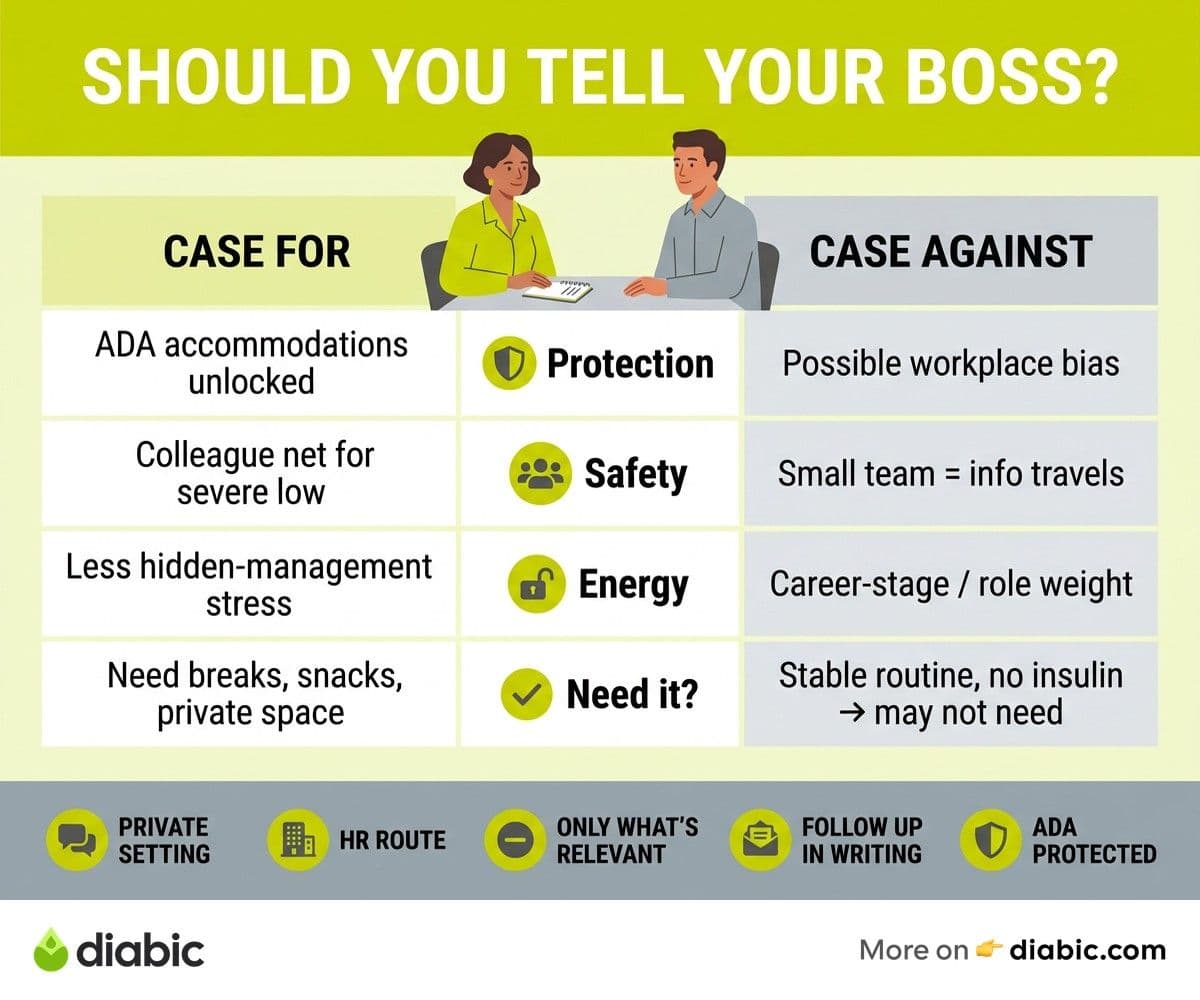
The strongest argument for disclosure is access. Workplace accommodations, like scheduled breaks for blood sugar checks, a private space to inject or change a pump site, or a flexible lunch hour to time meals with insulin, only exist if your employer knows you need them. You cannot request a reasonable accommodation under the ADA without first revealing the underlying condition, even if only to HR. For people on insulin or other glucose-lowering medications, those small adjustments can make the difference between a manageable workday and a constant battle with hypoglycemia.
Safety is the second big reason. If your blood sugar drops fast and you cannot communicate, a colleague who knows what to do can hand you juice, call for help, or use your glucagon. We have heard from readers whose coworkers caught the signs of a low before they did, and that early intervention prevented a much worse outcome. You do not need to brief the whole office, but one or two trusted people on your shift can be a real safety net.
There is also the quieter benefit of not hiding. Carrying a chronic condition in secret takes mental energy, every snack timed in private, every appointment explained as "errands," every off day attributed to a vague excuse. Many people describe a noticeable drop in stress after telling their manager, even when nothing about the job changed. Our guide on practical strategies for managing diabetes at work covers the day-to-day logistics once disclosure is behind you.
The Case for Keeping It Private
Disclosure also carries real risks that we are not going to sugarcoat. Bias, even unintentional, exists. A manager may start questioning your reliability before a big project, route travel assignments to a colleague "to be safe," or assume you cannot handle stretch goals. The American Diabetes Association employment discrimination resource tracks employment discrimination cases and reports they happen often enough to take seriously, even in the post-ADA era. Legal protection is not the same as cultural protection.
Career advancement concerns weigh heavily for younger workers and people in competitive industries. If you are early in your career, in a role with frequent client travel, or working toward a leadership position, you may reasonably decide the timing is not right. Some workplaces, particularly small teams without HR or environments where personal information travels quickly, feel risky for sharing anything personal. Trust your read of the room.
There are plenty of jobs where you can manage diabetes quietly without compromising care. If you have predictable hours, easy access to food, and a stable routine, you may not need formal accommodation. People with type 2 diabetes managed through diet and oral medication often find disclosure unnecessary, while those on insulin typically benefit from telling at least one trusted coworker. Privacy is a legitimate choice, not a failure of openness.
Requesting Accommodations Without Over-Sharing
If you decide you need accommodations but want to keep the details minimal, you have more flexibility than most people realize. Under the ADA, you only need to share enough information to establish that you have a qualifying condition and to explain what you need. You do not have to name your specific medication, share your A1C, or describe your daily management routine. A simple statement like "I have a medical condition that requires me to eat at regular intervals and check my blood sugar" is often enough to start the conversation.
Working with HR rather than your direct supervisor can give you an extra layer of privacy when handling diabetes disclosure at workplace. HR is trained to handle medical information confidentially and can communicate only the practical accommodations to your manager without disclosing the diagnosis. This works especially well in larger organizations. In smaller companies without dedicated HR, you may need to talk directly with your manager, which is where a well-worded doctor's note becomes useful. Your endocrinologist or primary care provider can write a brief letter stating that you have a medical condition requiring specific workplace adjustments, without naming diabetes outright if you prefer.
The Job Accommodation Network offers free, confidential guidance and sample request language you can adapt. A typical request might read: "To manage a medical condition, I am requesting permission to keep snacks at my workstation, take a brief break every two to three hours to check my blood sugar, and have access to a private space when needed." Specific, solution-focused, and minimally personal.
How to Disclose If You Choose To
Choose a private setting and a calm moment, not the hallway after a tense meeting. Ask your manager for a brief one-on-one and frame it around your work, not your worries. Something like, "I want to share something that helps me do my best work here," sets a constructive tone. Avoid apologies or long medical explanations, because the conversation goes better when you are giving information rather than asking permission.
Share what is relevant to your job and stop there. Your manager does not need a tutorial on the difference between type 1 and type 2, or the mechanics of a continuous glucose monitor, unless they ask. Focus on what they will actually see: occasional snacks at your desk, a phone alert from your CGM, a short break for testing, or a discreet pump that may beep. Offer to answer questions but do not feel pressured to fill silence with more disclosure than you planned.
Always follow up in writing. Send a short email summarizing what you discussed and any accommodations you agreed on. This protects both of you and creates a record if anything changes later. Keep it factual and friendly: "Thanks for the conversation today. As discussed, I will take brief breaks every few hours to check my blood sugar and keep glucose tablets at my desk. Let me know if you need anything else from me." That paper trail is your best friend if a future manager or HR question comes up.
Frequently Asked Questions
Should you tell your employer about your diabetes?
It depends on your needs and your workplace culture. If you need accommodations like break time for testing, snack access, or a private space for injections, disclosure is necessary to access those rights under the ADA. If you can manage comfortably without accommodations and your job is low-risk for hypoglycemia, it is a personal choice with no legal obligation to share.
How should you disclose diabetes to your employer?
Choose a private setting, frame the conversation around what helps you do your best work, share only what is relevant to your role, and follow up with a written summary by email. You can route the conversation through HR if you prefer a formal process and an extra layer of confidentiality, or speak directly with your manager if your workplace is small and the relationship is strong.
Can my employer fire me for having diabetes?
In the United States, no. The ADA protects you from being fired, demoted, or denied promotion based on diabetes, as long as you can perform the essential functions of your job with or without reasonable accommodation. Similar protections exist under the UK Equality Act and the Canadian Human Rights Act. If you suspect discrimination, document everything and contact the EEOC or your local equivalent.
Diabetes disclosure at workplace is ultimately your call to make on your own timeline. Talk to your doctor about which accommodations would actually help your day, weigh the culture you work in, and choose the path that protects both your health and your peace of mind.
Shahriar P. Shuvo is the founder of Diabic. He has lived with diabetes for over 14 years, and built Diabic to deliver the practical, evidence-based self-management tools he wished existed when he was first diagnosed. By trade, Shahriar is a senior design and frontend engineer with 6+ years shipping products at Agora, Timescale (now Tiger Data), and ShareTrip. He writes from the intersection of lived diabetes experience and product craft, focused on what works in daily management rather than what sounds good in a textbook.
Medically reviewed by
Dr. Rezwana Parvin Rumpa is an obstetrics and gynaecology specialist with clinical focus on gestational diabetes, PCOS, and fertility. She holds the MRCOG (Final Part) from the Royal College of Obstetricians and Gynaecologists in London, the MRCPI (Final Part) from the Royal College of Physicians of Ireland, and an MBBS from Shaheed Monsur Ali Medical College under Dhaka University. Dr. Rumpa serves as a Senior Medical Officer in the Obs and Gynae department at BRB Hospitals Ltd, where she has spent three years managing prenatal care, emergency obstetric cases, and women's-health surgery. On Diabic, she medically reviews content for women living with diabetes, with particular attention to pregnancy, PCOS, and reproductive-health intersections.
More from Living with Diabetes
View all
A Gentle Chair Yoga Routine for people with diabetes
A gentle chair yoga for people with diabetes routine with safe poses, modifications for neuropathy, retinopathy, and joint pain, plus tips for older.

Shift Work and Diabetes: Managing Irregular Hours
Shift work and diabetes is a tough combination. Learn how to manage meals, sleep, medication, and blood sugar when your hours rotate or flip overnight.

Dating with Diabetes: When to Tell a New Partner
Dating with diabetes brings unique disclosure questions. Here is when to tell a new partner, what to say, and how to handle the conversation with.
Clinician-reviewed habits, plain-language guides, and honest answers - the small shifts that make living with diabetes feel lighter, every day.