Managing Diabetes at Work: Practical Strategies
Managing diabetes at work takes more than willpower. Build a practical system around meals, movement, monitoring, and stress that fits your real schedule.

In this article(11)
Managing diabetes at work is a daily balancing act, juggling blood sugar checks, meal timing, medication, and the demands of a job that does not pause for any of it. You are running a glucose strategy in the background while you run a meeting in the foreground, and most days nobody around you knows the math you are doing. The good news is that with a few repeatable systems, the workday can become one of the steadiest parts of your week instead of the most chaotic.
We have spent years refining what works between 9 and 5, both for ourselves and inside the Diabic community. The strategies below focus on what you can actually do at your desk, in the breakroom, on a job site, or between back-to-back calls. None of it requires a perfect day or a perfect employer, just a system that bends with you.
From my experience: I have lived with type 1 for about 14 years and the workday has always been the part I had to engineer most carefully. The first time my Dexcom buzzed at 68 mg/dL in the middle of a client call, I learned the hard way that I needed glucose tabs in the same drawer as my notepad, not in a bag across the room. That one move, plus a standing post-lunch walk, cut my afternoon lows in half within a month.
The Fundamentals of Managing Diabetes at Work
Workplace diabetes management deserves its own strategy because work changes nearly every variable that affects your glucose. Stress hormones rise, meal timing slips, movement drops, and the cues that normally remind you to test or eat get drowned out by deadlines. Treating your workday like a medical environment, with its own protocols and supplies, is the difference between reacting and planning.
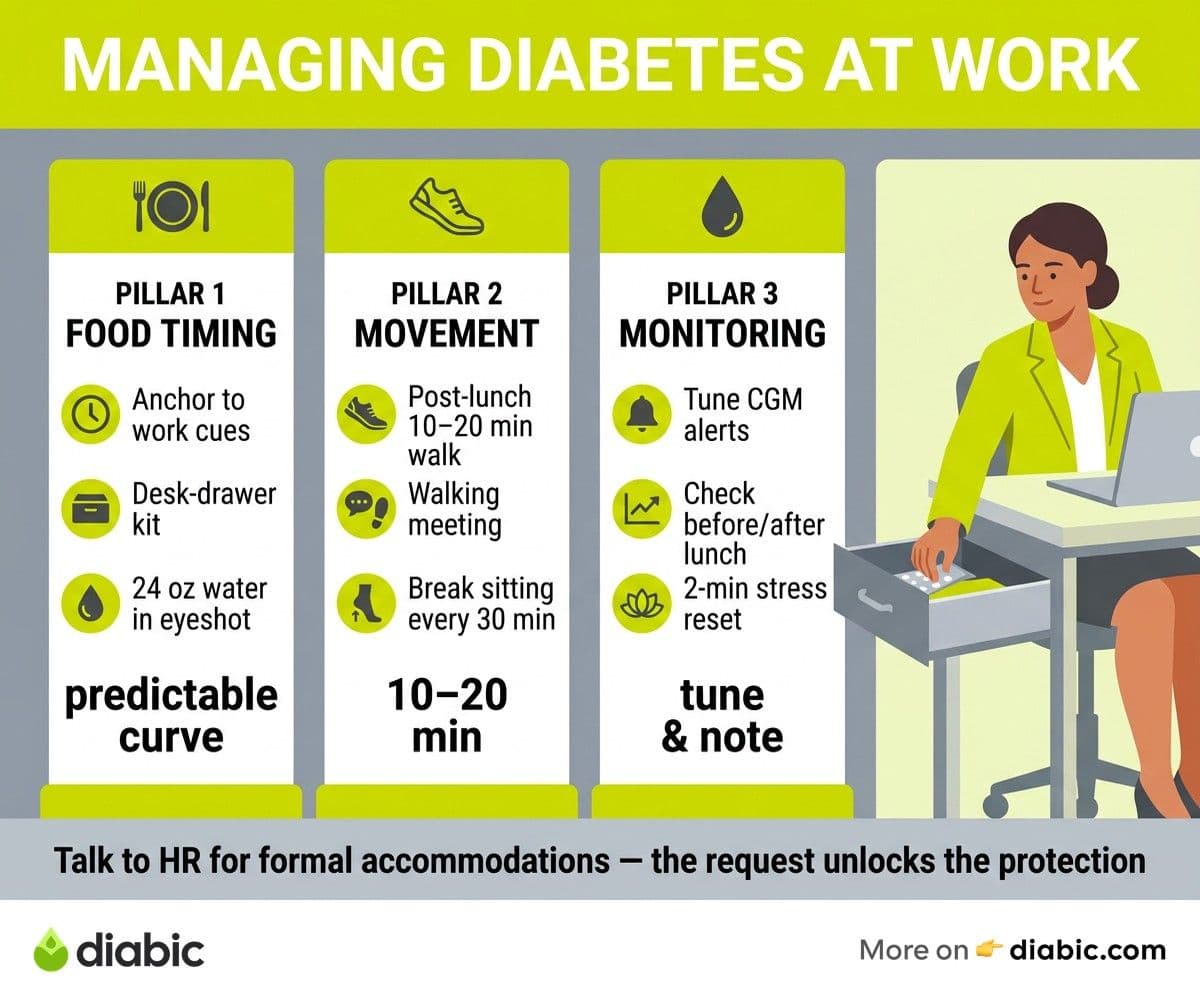
We think of workday management as three pillars: food timing, movement, and monitoring. Food timing keeps your glucose curve predictable, movement keeps insulin sensitivity high during long sitting blocks, and monitoring tells you when one of the other two needs adjusting. When one pillar wobbles, the other two carry more weight, and that is usually when patterns start to drift.
Different jobs create different challenges, and strategies need to flex accordingly. A nurse pulling a 12-hour shift handles food and lows differently than a developer in back-to-back calls or a contractor moving between sites. Pay attention to the rhythm of your specific role, then design around its weakest moments rather than copying a generic plan.
Setting up your workspace is the smallest investment with the biggest payoff. A drawer with fast-acting glucose, shelf-stable snacks, a water bottle in eyeshot, and a discreet spot for your meter or CGM receiver removes friction from every decision. The American Diabetes Association covers workplace rights and accommodations in its employment discrimination resources, and our guide on talking to your boss about diabetes walks through the conversation step by step.
Blood Sugar Management During the Workday
A testing or monitoring schedule built around your work tasks holds up better than one built around the clock. We recommend anchoring checks to recurring events, such as before your first meeting, after lunch, and before your commute home, so the habit survives even on chaotic days. If you use a continuous glucose monitor, set alerts at thresholds that give you enough runway to act before a meeting rather than during one.
Blood sugar management during meetings is where most people lose ground, because attention is elsewhere and treatment options feel awkward. Keep a small, quiet snack within arm's reach during every long block, and decide in advance what your "I need to step out" line looks like. A glucose tab is faster and more predictable than digging through a drawer when your hands are starting to shake.
CGM technology has reshaped passive monitoring in professional settings, and research in Diabetes Technology and Therapeutics continues to show meaningful reductions in time-out-of-range when alerts are tuned to a person's schedule. Tighten your high alert during sedentary blocks and loosen your low alert in the hour after meals so you are not buzzing through every normal post-meal rise. The point is useful signal, not constant noise.
When you cannot step away, have a no-movement plan ready. That usually means a glucose tab kept in a pocket, a tested low-carb snack you can chew silently, and a mental script for how you will excuse yourself if a number keeps climbing or falling. Knowing the script in advance keeps a glucose moment from becoming a workplace moment.
Office Snacking for Stable Blood Sugar
A snack rotation beats a snack stash because variety prevents the slow drift toward whatever is fastest, sweetest, or closest. We aim for three categories on hand at all times: a protein-forward option like jerky or cheese, a fiber-and-fat option like nuts or seeds, and a fast-acting carb reserved for treating lows. Keeping those categories visually separated, even in different containers, prevents the 3 p.m. grab from turning into a glucose spike.
Timing matters as much as content. A small protein-and-fat snack 60 to 90 minutes before lunch can blunt a midday crash, and a similar pre-meeting snack can prevent the stress-driven hunt for vending machine carbs. Your goal is to never arrive at a meal or a meeting genuinely hungry, because hunger narrows your choices to whatever is closest.
Long work blocks like all-day trainings or back-to-back rounds need a layered plan: a real meal before, a steady snack during, and a recovery snack after. Pair the during-snack with water rather than caffeine, since caffeine on an empty stomach can nudge glucose upward through cortisol. For ideas that hold up in a desk drawer, our roundup of the best office snacks for people with diabetes goes deeper on combinations and portions.
Office food culture, the birthday cakes and pizza Fridays and client lunches, does not have to feel like a minefield. Decide before you walk in whether this is a small-portion-with-protein day or a no-thanks-already-ate day, and you remove the in-the-moment negotiation. Most colleagues respect a quick "I am good, thanks" far more than they notice what is on your plate.
Staying Active in a Sedentary Job
Movement breaks are the single most underrated tool for steady workday glucose, and they do not need to look like exercise to count. A two-minute walk to a farther bathroom, a lap around the floor between meetings, or even calf raises during a call can blunt a post-meal rise. The Centers for Disease Control and Prevention's workplace health resources emphasize that short, frequent movement breaks help workers with chronic conditions maintain better metabolic markers across the day.
Walking meetings and standing desk options take this further by changing the default. If a meeting does not need a screen, propose a phone call you can take while walking, and if you sit at a desk, alternate sitting and standing in 30 to 45 minute blocks. The goal is not to stand all day, since that has its own downsides, but to interrupt long sedentary stretches that flatten insulin sensitivity.
Lunchtime walks deserve their own mention because the data is consistent: a 10 to 20 minute walk after lunch noticeably lowers the afternoon glucose curve for many people. We treat the post-lunch walk as a non-negotiable, even if it is just a loop around the parking lot or a few flights of stairs. Pair it with a podcast or a friend and it stops feeling like a chore.
Stretching routines pull double duty by easing the physical tension that builds across a desk day and the cortisol that drives stress hyperglycemia. A 90-second stretch every hour, focused on hips, shoulders, and neck, can be enough to reset both posture and mood. For a small library of moves you can do in office clothes without drawing attention, see our guide to desk exercises for better blood sugar.
Building a Self-Care Routine That Fits Your Schedule
A sample workday timeline gives you a starting frame. We suggest a protein-forward breakfast within 30 minutes of waking, a glucose check or CGM scan before your first commitment, a planned snack about two hours before lunch, a 10 to 20 minute post-lunch walk, an afternoon snack around the 3 p.m. dip, and a final glucose check before your commute. Anchoring each step to an existing work cue makes the sequence almost automatic.
Morning preparation is where most of the day is decided. Pack snacks the night before, top up your water bottle, refill low-treatment supplies, and review your calendar for any block longer than 90 minutes. Five minutes of evening prep removes a dozen micro-decisions from the next morning.
End-of-day review does not have to be elaborate. A 60-second look at your CGM graph or logbook, paired with a one-line note about what threw off your numbers, builds a personal pattern library faster than any app. Over a few weeks you will see your specific triggers: the Wednesday standing meeting, the post-lunch slump, the Friday client call.
Weekend routines support the weekday system by replenishing what work depletes. Use Sunday to restock the snack drawer, prep a couple of lunches, and scan the week ahead for travel days or late meetings that need extra planning. For a fuller framework, our walkthrough on building a daily self-care diabetes routine connects the workday plan to the rest of your week.
Keeping Blood Sugar Steady at the Office
Hydration is the easiest lever and the most overlooked one. Mild dehydration concentrates blood glucose and intensifies fatigue, which then drives carb cravings, which then drives spikes. A 24 ounce bottle visible on your desk, refilled twice before lunch and twice after, is usually enough for a typical office day.
Workplace stress directly affects glucose through cortisol and adrenaline, and the American Psychological Association's workplace wellbeing research consistently links chronic work stress to worse metabolic outcomes. Two-minute resets between tasks, such as box breathing, a brief walk, or a window-gazing pause, take real pressure off the system. You are not aiming to eliminate stress, just to keep it from compounding for eight hours straight.
Knowing when to involve your manager or HR is part of a mature diabetes-at-work plan, not a sign that something has gone wrong. Reasonable accommodations like flexible break timing, a private space for testing or injections, or remote-work flexibility on rough glucose days are legally protected in many regions, and the U.S. Equal Employment Opportunity Commission outlines what diabetes-related accommodations look like under the ADA. Free, confidential guidance is also available through the Job Accommodation Network, which can help you frame the request before you make it. For a closer look at the legal side, our piece on your workplace rights with diabetes covers what to document and what to expect.
Emergency preparation closes the loop. Keep a clearly labeled low kit at your desk and a backup in your bag, share the basics of a severe low with one trusted coworker, and have a written sick-day plan you can hand to a manager if you need to leave suddenly. Tips for keeping blood sugar steady at the office come down to one principle: the calmer the surprise, the smaller the disruption.
FAQ
How can you manage blood sugar at work all day?
Start with a protein-rich breakfast, set CGM or testing reminders that match your work cues, keep both a stable snack and a low-treatment option at your desk, take a movement break every 30 to 60 minutes, drink water consistently, and have a short script ready for highs and lows. Consistency in meal timing and monitoring is the foundation, and small adjustments compound week over week.
What tips help keep blood sugar steady at the office?
Eat at consistent times, anchor a 24 ounce water bottle to your line of sight, schedule short movement breaks between tasks, take a 10 to 20 minute post-lunch walk when possible, manage stress with brief resets between meetings, and keep low-blood-sugar treatment within arm's reach. Over a few weeks of paying attention to your own pattern, you will know which levers move your numbers most.
Do you have to tell your employer you have diabetes?
You are not legally required to disclose diabetes to your employer in most situations, but disclosure is what unlocks formal accommodations and legal protection under laws like the ADA. Many people share with a manager or HR only what is needed to support reasonable accommodations, and keep the rest private.
What should you do if your blood sugar drops during a meeting?
Treat it immediately with a fast-acting carb you keep on you, then quietly excuse yourself if symptoms persist after a few minutes. A short "I need to step out for a moment" requires no further explanation, and treating early prevents a small dip from becoming a disruptive low.
The systems above turn managing diabetes at work into a quiet routine rather than a daily battle. Pick the two changes that feel most realistic for your specific job, run them for two weeks, and then layer in a third. The point is not to overhaul your workday in one go but to build a workday that supports your numbers without demanding constant attention.
Shahriar P. Shuvo is the founder of Diabic. He has lived with diabetes for over 14 years, and built Diabic to deliver the practical, evidence-based self-management tools he wished existed when he was first diagnosed. By trade, Shahriar is a senior design and frontend engineer with 6+ years shipping products at Agora, Timescale (now Tiger Data), and ShareTrip. He writes from the intersection of lived diabetes experience and product craft, focused on what works in daily management rather than what sounds good in a textbook.
Medically reviewed by
Dr. Shanto Arian is an internal medicine physician now specializing in clinical and aesthetic dermatology, with a parallel academic focus on epidemiology and public health. He holds an MBBS, MPH, MSc (UK), MRCP (UK), MRCPI (Ireland), Diploma in Dermatology (UK), and Diploma in Aesthetic Medicine (USA). Dr. Arian trained in internal medicine, including hospital work on hematology cases such as graft-versus-host disease, before moving toward dermatology. Skin is one of the earliest places diabetes shows itself, from acanthosis nigricans and diabetic dermopathy to slow foot wound healing, and that intersection is where his clinical and Diabic-review work meet. On Diabic, Dr. Arian medically reviews content on diabetes diagnosis, complications, dermatologic manifestations, and pharmacotherapy, ensuring every claim aligns with current ADA, NICE, and peer-reviewed literature.
More from Living with Diabetes
View all
A Gentle Chair Yoga Routine for people with diabetes
A gentle chair yoga for people with diabetes routine with safe poses, modifications for neuropathy, retinopathy, and joint pain, plus tips for older.

Shift Work and Diabetes: Managing Irregular Hours
Shift work and diabetes is a tough combination. Learn how to manage meals, sleep, medication, and blood sugar when your hours rotate or flip overnight.

Dating with Diabetes: When to Tell a New Partner
Dating with diabetes brings unique disclosure questions. Here is when to tell a new partner, what to say, and how to handle the conversation with.
Clinician-reviewed habits, plain-language guides, and honest answers - the small shifts that make living with diabetes feel lighter, every day.