Pregnancy With Type 1 Diabetes
Pregnancy with type 1 diabetes is possible and increasingly common. Here is what to expect from preconception through postpartum, with practical planning.

In this article(9)
We want to start with the most important thing we can say about pregnancy with type 1 diabetes: it is absolutely possible to have a healthy one. Outcomes have improved enormously over the past two decades, and women who plan carefully and partner with the right team are giving birth to healthy babies every day. That said, we are not going to pretend it is easy. It takes more checks, more visits, and more mental energy than a pregnancy without diabetes, and that reality deserves to be acknowledged out loud.
If you are reading this in the planning stage, you are already doing the most useful thing you can do. The months before conception shape almost everything that follows, including how steady your numbers feel, how your team responds when things wobble, and how prepared you are when insulin needs start swinging. We will walk you through each phase of the next nine months, share what tends to surprise women most, and help you build a mental map you can return to as the trimesters change.
Pregnancy with Type 1 Diabetes: Preconception Planning
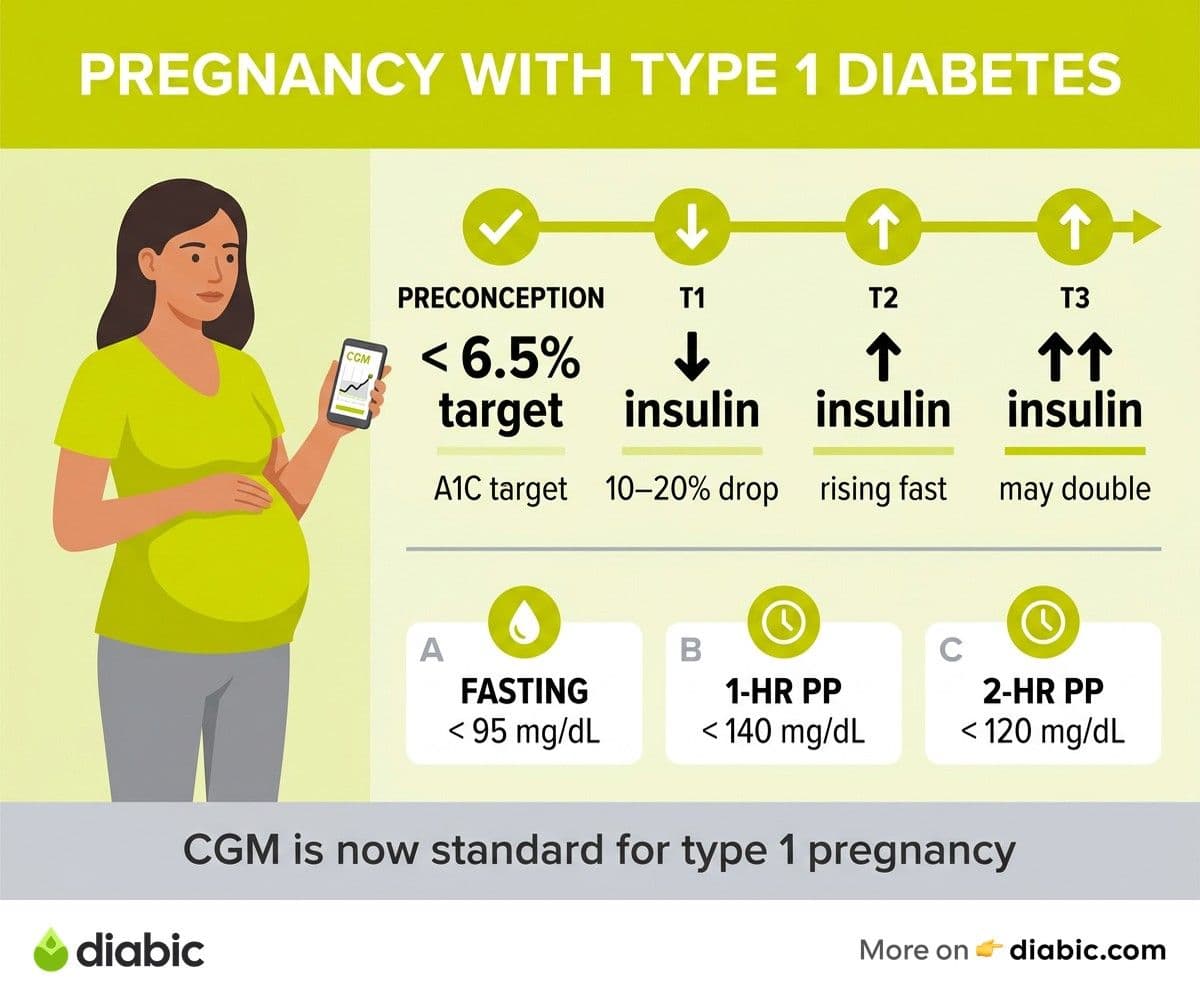
The single best thing you can do is plan before you are pregnant. Most endocrinologists and maternal-fetal medicine specialists suggest aiming for an A1C below 6.5%, and ideally below 6%, before you start trying. The reason is biological: the baby's organs form in the first eight weeks, often before you even know you are pregnant, and elevated glucose during that window raises the risk of birth defects and miscarriage. The ADA's Standards of Care for diabetes in pregnancy lay out these targets in detail.
Use this preconception window to review every medication you take. Some blood pressure drugs, statins, and certain thyroid or autoimmune medications are not pregnancy-safe and should be switched well before conception. Start a high-dose folic acid supplement, generally 5 mg per day for women with type 1 diabetes, at least three months before trying. Book a baseline eye exam, since pregnancy can accelerate retinopathy, and ask for kidney screening as well. Our preconception planning checklist walks through each of these in more detail.
This is also the right moment to assemble your care team. You will want an endocrinologist who is comfortable with pregnancy, an obstetrician or maternal-fetal medicine specialist, and ideally a diabetes educator or dietitian. If you are using a pump or hybrid closed-loop system, confirm your pump trainer is available for ongoing support, because settings will change a lot in the months ahead. Building this team early makes everything that follows feel less chaotic.
First Trimester: Tight Targets and Unexpected Lows
The first trimester is often the trickiest stretch emotionally and practically. Pregnancy asks for tight targets right out of the gate: fasting glucose below 95 mg/dL, one-hour post-meal below 140 mg/dL, and two-hour post-meal below 120 mg/dL. These numbers feel demanding, especially when morning sickness scrambles your routine and food aversions push you toward the carbs your body normally tolerates worst.
Many women find their insulin needs actually drop in the first trimester, sometimes by 10 to 20%, which catches people off guard. Lows can become more frequent, more intense, and more sudden. We strongly suggest moving to a continuous glucose monitor if you are not already on one. The CONCEPTT trial, the largest randomized controlled trial of CGM use in type 1 pregnancy, found that women who used CGM had better glycemic outcomes and fewer LGA births than those who used fingersticks alone. That data has reshaped pregnancy care, and most teams now consider CGM a standard part of the toolkit.
Hypoglycemia awareness can blunt during pregnancy, partly from hormones and partly from how often you may dip low. Talk with your partner or someone close to you about glucagon, refresh how to use it, and keep it accessible. If you have not used a glucagon emergency kit before, the first trimester is a good time to learn. Communicate often with your team, even when nothing feels broken, because small adjustments early prevent big problems later.
Second and Third Trimesters: When Insulin Needs Surge
Around week 16 to 20, the metabolic landscape flips. Placental hormones drive insulin resistance hard, and many women find their insulin needs double or even triple by the third trimester. This is not a sign that anything is wrong. It is the physiology of a normal pregnancy expressed through the lens of type 1 diabetes, and your team will help you adjust as it unfolds.
Expect more frequent visits during this phase, often every two to four weeks with your endocrinologist and a parallel cadence with your obstetric team. Growth scans will track the baby's size, since uncontrolled high numbers can drive macrosomia and complications at birth. The ACOG guidelines on pregestational diabetes recommend non-stress tests starting around 32 weeks, with frequency increasing as you approach delivery.
Preeclampsia is more common when type 1 is in the picture, so blood pressure monitoring becomes routine. Watch for sudden swelling, severe headaches, vision changes, or pain under the right ribs, and call your team if anything feels off. The pattern also carries differences from pregnancy with type 2 diabetes, particularly around insulin sensitivity, so the playbook your friend with type 2 used may not match yours.
The third trimester is exhausting. We do not say that to discourage you. We say it so you do not feel like something is wrong when you are tired, frustrated, or grieving the easier pregnancy you imagined. This is a season, not a forever, and the people who came out the other side describe it consistently as one of the hardest and most worthwhile stretches of their lives.
Labor, Delivery, and the Postpartum Cliff
Labor and delivery for women with type 1 diabetes usually involves an IV insulin drip and frequent glucose checks. The goal during labor is to keep your blood sugar in a tight range, generally between 70 and 110 mg/dL, to reduce the chance of neonatal hypoglycemia after birth. Most hospitals have a written protocol, and your maternal-fetal medicine team will share theirs in advance so you can ask questions while you are still calm and rested.
A vaginal delivery is encouraged whenever possible. C-section rates are higher in type 1 pregnancies, partly because of larger babies and partly because some teams move faster to surgical delivery if labor stalls. Most providers recommend induction at or just before 39 weeks if you have not gone into labor naturally, since the NICE guidance on diabetes in pregnancy (NG3) supports delivery between 37 and 38 weeks plus 6 days for women with type 1 diabetes to reduce stillbirth risk.
The postpartum cliff is real and often shocking. Insulin needs drop dramatically within hours of delivery, sometimes back to pre-pregnancy levels or even lower. Women who have spent the third trimester taking large doses can suddenly hypo on a fraction of that. Talk with your team before you go into labor about a postpartum dosing plan, because nobody wants to be making those decisions on no sleep with a newborn in the room.
Breastfeeding adds another layer. The act of nursing burns calories and pulls glucose down, so many women run lower during long sessions and need to adjust basals or eat a small snack before feeding. Our postpartum diabetes management guide covers the first weeks home in more detail, including sleep, mental health, and the slow rebuild of your routine.
Frequently Asked Questions
What is pregnancy like with type 1 diabetes?
Pregnancy with type 1 diabetes involves more frequent blood sugar checks, tighter targets, more provider visits, and significant changes in insulin needs across the trimesters. The first trimester often brings unexpected lows, the second and third trimesters bring a surge in insulin resistance, and the postpartum period brings a sharp drop. Most women describe it as demanding but manageable, especially with a strong care team and modern tools like CGM and pumps.
What are the risks of pregnancy with type 1 diabetes?
The main risks include miscarriage and birth defects when A1C is elevated at conception, preeclampsia, preterm birth, larger-than-average babies, neonatal hypoglycemia, and progression of retinopathy or kidney disease in the mother. Strong preconception planning and tight glycemic management throughout pregnancy substantially reduce most of these risks. Talk with your endocrinologist and obstetrician about your specific risk profile.
Will my baby have type 1 diabetes?
The risk is higher than in the general population but still relatively low. The American Diabetes Association's overview of diabetes genetics puts a child's risk at roughly 1 in 25 if the mother was younger than 25 at delivery and 1 in 100 if she was older, compared with about 0.4% in the general population. Genetic predisposition matters, but environmental factors play a role too, and most children of mothers with type 1 diabetes do not develop the condition.
Should I use a CGM during pregnancy?
Most teams supporting pregnancy with type 1 diabetes now recommend CGM. The CONCEPTT trial showed clear benefits in terms of time in range and reduced rates of large-for-gestational-age babies, and the technology has improved further since the trial. Talk with your endocrinologist about which sensor fits your situation.
Dr. Rezwana Parvin Rumpa is an obstetrics and gynaecology specialist with clinical focus on gestational diabetes, PCOS, and fertility. She holds the MRCOG (Final Part) from the Royal College of Obstetricians and Gynaecologists in London, the MRCPI (Final Part) from the Royal College of Physicians of Ireland, and an MBBS from Shaheed Monsur Ali Medical College under Dhaka University. Dr. Rumpa serves as a Senior Medical Officer in the Obs and Gynae department at BRB Hospitals Ltd, where she has spent three years managing prenatal care, emergency obstetric cases, and women's-health surgery. On Diabic, she medically reviews content for women living with diabetes, with particular attention to pregnancy, PCOS, and reproductive-health intersections.
Medically reviewed by
Dr. Shanto Arian is an internal medicine physician now specializing in clinical and aesthetic dermatology, with a parallel academic focus on epidemiology and public health. He holds an MBBS, MPH, MSc (UK), MRCP (UK), MRCPI (Ireland), Diploma in Dermatology (UK), and Diploma in Aesthetic Medicine (USA). Dr. Arian trained in internal medicine, including hospital work on hematology cases such as graft-versus-host disease, before moving toward dermatology. Skin is one of the earliest places diabetes shows itself, from acanthosis nigricans and diabetic dermopathy to slow foot wound healing, and that intersection is where his clinical and Diabic-review work meet. On Diabic, Dr. Arian medically reviews content on diabetes diagnosis, complications, dermatologic manifestations, and pharmacotherapy, ensuring every claim aligns with current ADA, NICE, and peer-reviewed literature.
More from Living with Diabetes
View all
A Gentle Chair Yoga Routine for people with diabetes
A gentle chair yoga for people with diabetes routine with safe poses, modifications for neuropathy, retinopathy, and joint pain, plus tips for older.

Shift Work and Diabetes: Managing Irregular Hours
Shift work and diabetes is a tough combination. Learn how to manage meals, sleep, medication, and blood sugar when your hours rotate or flip overnight.

Dating with Diabetes: When to Tell a New Partner
Dating with diabetes brings unique disclosure questions. Here is when to tell a new partner, what to say, and how to handle the conversation with.
Clinician-reviewed habits, plain-language guides, and honest answers - the small shifts that make living with diabetes feel lighter, every day.