Diabetic Macular Edema: Causes and Treatment
Diabetic macular edema is treatable when caught early. Learn the causes, symptoms, diagnosis tools, and current treatment options for protecting your.

In this article(18)
Diabetic macular edema (DME) is one of the most common causes of vision loss in people with diabetes, and it is also one of the most treatable when caught early. If you or your eye doctor have flagged DME as a concern, understanding the condition and your treatment options can help you feel prepared rather than overwhelmed. The diagnosis sounds heavy, but for most people, it is a manageable condition that responds well to current therapies.
We get a lot of questions from readers who have just been told they have macular swelling, or whose retinopathy is being monitored closely for signs of fluid leakage. The goal of this guide is to walk through what the condition actually is, how it develops, the symptoms to watch for, how it is diagnosed, what treatment looks like today, and what life with DME tends to look like over time. The recommendations below align with current American Diabetes Association and National Eye Institute guidance.
What Is Diabetic Macular Edema?
DME is swelling in the macula, the small central part of the retina responsible for sharp, detailed vision. The macula is what you use when you read, drive, recognize faces, or thread a needle. It is densely packed with light-sensitive cells, and even a small amount of swelling can change how clearly you see.
DME happens when blood vessels damaged by diabetes leak fluid into the macular tissue. The fluid pools in and around the central retina, causing it to thicken and distort. Because the macula handles your most precise central vision, this swelling can produce noticeable changes even when the rest of your retina looks healthy.
DME can develop at any stage of diabetic retinopathy, including early non-proliferative stages. That surprises a lot of people. You do not have to have advanced retinopathy to develop macular edema, which is one reason why eye doctors monitor the macula closely even when overall retinopathy looks mild.
How DME Develops
The chain of events that leads to DME starts with the same vascular damage behind most diabetes-related eye problems. Long-term high blood sugar weakens the walls of the tiny capillaries that feed the retina. Over time, those weakened vessels develop microaneurysms, become leaky, or close off entirely. When fluid escapes from these compromised vessels and accumulates in the macula, swelling sets in. The NIDDK describes this as a gradual process driven by chronic vascular stress, not a sudden event.
What makes DME tricky is that this leakage often happens silently. The swelling builds gradually, sometimes over months, before producing symptoms you would notice in daily life. Some people only realize something is off after their eye doctor flags retinal thickening on imaging. Others notice straight lines starting to look slightly wavy or text becoming harder to read at the same distance they used to manage easily. Either way, the underlying mechanism connects directly to the broader picture of diabetic retinopathy symptoms and stages.
Risk factors that increase the chance of developing DME include longer diabetes duration, persistently elevated A1C, high blood pressure, kidney disease, and high cholesterol. None of these are guarantees, and many people with these risk factors never develop DME. They simply make regular eye monitoring more important.
Symptoms to Watch For
Early DME often has no symptoms at all, which is why screening matters even when your vision feels fine. Once symptoms do appear, they tend to follow a few common patterns.
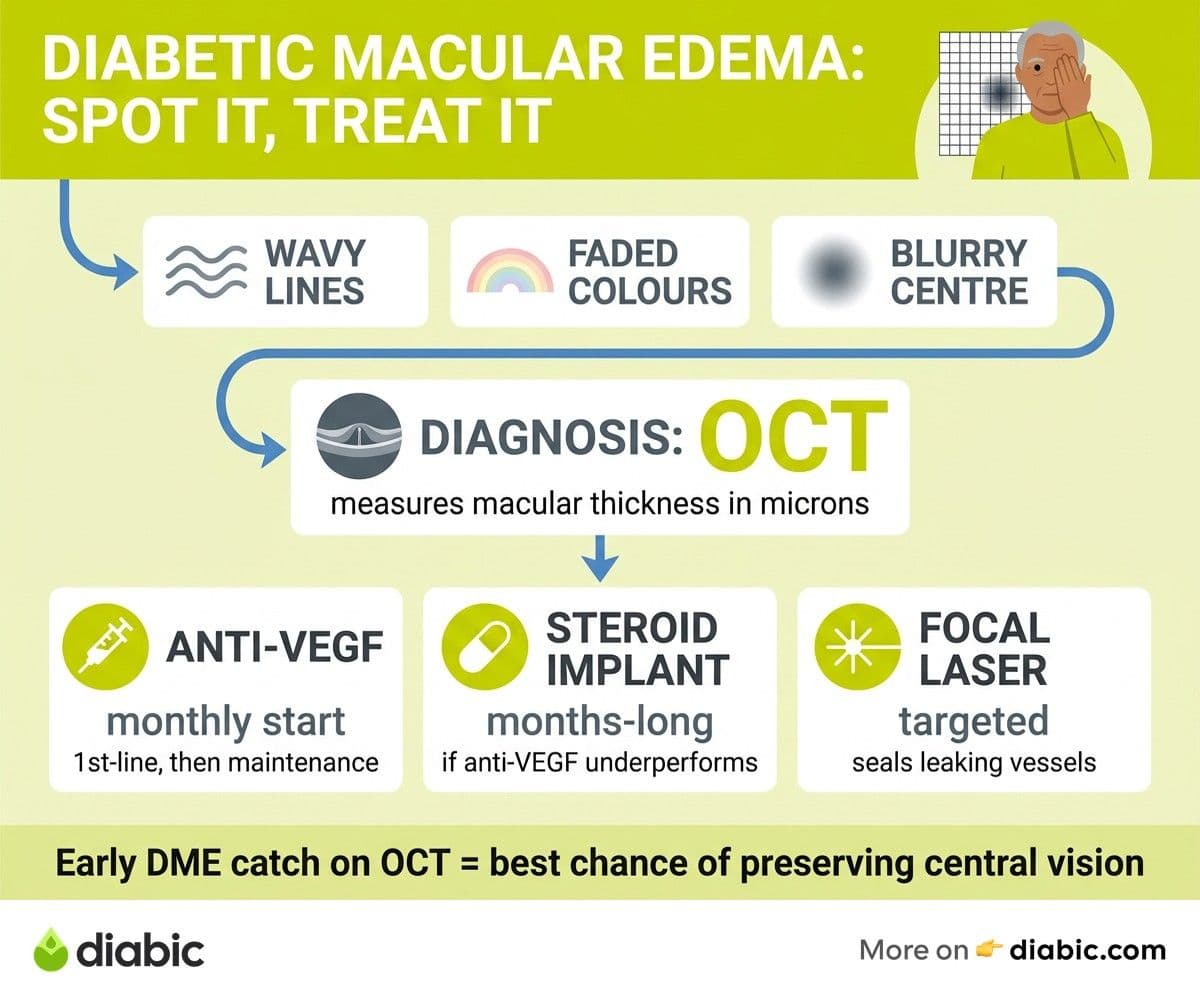
Central vision may look blurry or wavy, especially when reading or looking at faces. Some people describe it as a smudge or distortion right in the middle of their field of view, while peripheral vision stays sharp. Colors can appear faded or washed out compared to how they used to look. Reading and recognizing fine details, like text on a screen or the threads of a fabric, becomes harder.
A specific symptom to watch for is straight lines appearing bent or wavy. This is called metamorphopsia, and it is a hallmark of macular swelling. If door frames, window edges, or the lines on a notebook page start looking slightly distorted, that is a signal to call your eye doctor. Vision changes from DME may fluctuate from day to day, and that variability is a feature of the condition, not a contradiction. Because some of these symptoms overlap with general blurred vision and diabetes, pattern matters more than any single symptom. New floaters or flashes layered on top of central distortion can also appear, and our guide to floaters and vision changes covers when those should be treated as urgent.
Diagnosis: How DME Is Detected
Detecting DME early is mostly about good imaging, and the tools available today make it possible to find swelling long before you would notice it yourself. A diagnostic workup usually combines several of the methods below, in line with Mayo Clinic recommendations.
Dilated Eye Exam
A comprehensive dilated exam lets your eye doctor inspect the macula directly. They use a bright light and special lenses to look for thickening, hemorrhages, and exudates (yellowish deposits from leaked fluid). This is the foundation of every DME diagnosis.
Optical Coherence Tomography (OCT)
OCT is the workhorse of modern DME care. It uses light waves to create cross-sectional images of the retina, almost like an ultrasound for your eye. The scan shows the layers of the retina in detail and measures macular thickness in microns. Even very small amounts of fluid show up clearly on OCT, which is why your retinal specialist may use it at every visit to track changes over time.
Fluorescein Angiography
For some cases, a fluorescein angiogram helps map exactly which vessels are leaking. A small amount of fluorescent dye is injected into a vein in your arm, and a camera tracks the dye as it moves through the blood vessels of your retina. Leaking spots light up clearly, which helps guide treatment decisions.
Why Early Detection Matters
The big reason for OCT every visit is that DME caught at the first signs of swelling responds far better to treatment than DME caught after months of progression. Modern imaging makes it possible to start treatment before central vision is meaningfully affected, which is the best-case scenario.
Treatment Options for DME
Treatment has come a long way in the past 15 years, and outcomes today are dramatically better than they were a generation ago. The right plan depends on the severity of your DME, how it has responded to previous treatment, and what your retinal specialist sees on imaging. Working with the right specialist matters here, and our guide to ophthalmologist vs optometrist for diabetes care explains how these roles differ when treatment is needed.
Anti-VEGF Injections (First-Line Treatment)
Anti-VEGF (vascular endothelial growth factor) drugs are the current standard of care for most cases of DME. These medications, injected directly into the vitreous of the eye, block the proteins that cause leaky retinal vessels. Common options include aflibercept, ranibizumab, and bevacizumab. The injections sound intimidating, but they are quick and most people find them more uncomfortable than painful. Numbing drops are used, the actual injection takes a few seconds, and you walk out the same day.
Treatment typically starts with a series of monthly injections, then a maintenance schedule based on how your retina responds. Many people see vision stabilize or improve within a few months. Research published in Diabetes Care and other peer-reviewed journals has shown that anti-VEGF injections can preserve and often improve vision in the majority of people with DME when started early.
Corticosteroid Implants
For DME that does not respond well to anti-VEGF, or for people who cannot tolerate frequent injections, sustained-release corticosteroid implants are another option. These tiny implants are placed in the eye and slowly release medication over months. Steroids carry some additional risk of cataract progression and increased eye pressure, which is why they are usually a second-line choice rather than first-line.
Laser Therapy
Focal or grid laser photocoagulation was the standard treatment before anti-VEGF drugs and is still used in specific situations. The laser seals leaking vessels and reduces fluid accumulation. It is sometimes combined with injections rather than used alone.
How Decisions Are Made
Your retinal specialist will weigh the location and severity of swelling, your visual acuity, your response to previous treatment, and your other health conditions. Improvement timelines vary. Some people notice clearer vision within a few weeks. Others stabilize first, then gradually improve over six to twelve months. The honest framing is that treatment usually preserves or improves vision rather than restoring it perfectly, especially in cases caught later.
From my experience: A close friend in our type 1 diabetes community went through six months of anti-VEGF injections last year for macular edema in her left eye. She told me the first injection was the scariest part, and by the third visit it felt routine. Her vision stabilized within four months and improved enough that she stopped noticing the wavy distortion in straight lines. What helped her most was knowing the timeline ahead of time, so the gradual pace of improvement did not feel like nothing was happening.
Living with DME: Long-Term Management
DME is rarely a one-and-done diagnosis. Most people manage it as a long-term condition that ebbs and flows with overall diabetes care, blood pressure, and follow-up monitoring.
Consistent blood sugar management is the foundation. Lower A1C and steadier glucose patterns slow the underlying vascular damage that drives macular swelling. The same goes for blood pressure and cholesterol. None of this requires perfection, just steady attention. Following the recommended diabetes eye exam frequency is essential, and during active treatment your retinal specialist may want to see you every four to eight weeks until things stabilize.
Day-to-day life with DME varies by severity. Some people barely notice it once treatment is underway. Others adapt to fluctuating central vision by using larger fonts on their phones, brighter task lighting, and audiobooks during periods when reading is harder. Low-vision specialists, occupational therapists, and resources like the National Eye Institute's vision rehabilitation page can help if vision changes affect daily activities. Consistent care is what stabilizes vision, and many people who started treatment years ago are still maintaining the gains they got early on.
FAQ
What is diabetic macular edema?
Diabetic macular edema is swelling in the macula, the central part of the retina responsible for sharp vision. It happens when blood vessels damaged by diabetes leak fluid into the macular tissue. DME can develop at any stage of diabetic retinopathy and is one of the most common causes of vision loss in people with diabetes.
How is DME treated?
The first-line treatment is anti-VEGF injections, which block the proteins that cause leaky retinal vessels. Treatment usually starts with monthly injections and shifts to a maintenance schedule based on response. Corticosteroid implants and laser therapy are alternatives for cases that do not respond to anti-VEGF or for people who need a different approach.
Can DME vision loss be reversed?
Some vision loss from DME can be reversed, especially when treatment starts early. Many people see their vision stabilize or improve over the first six to twelve months of treatment. Vision lost to long-standing or untreated DME may be harder to recover, which is why early detection through regular dilated eye exams matters.
Shahriar P. Shuvo is the founder of Diabic. He has lived with diabetes for over 14 years, and built Diabic to deliver the practical, evidence-based self-management tools he wished existed when he was first diagnosed. By trade, Shahriar is a senior design and frontend engineer with 6+ years shipping products at Agora, Timescale (now Tiger Data), and ShareTrip. He writes from the intersection of lived diabetes experience and product craft, focused on what works in daily management rather than what sounds good in a textbook.
Medically reviewed by
Dr. Rezwana Parvin Rumpa is an obstetrics and gynaecology specialist with clinical focus on gestational diabetes, PCOS, and fertility. She holds the MRCOG (Final Part) from the Royal College of Obstetricians and Gynaecologists in London, the MRCPI (Final Part) from the Royal College of Physicians of Ireland, and an MBBS from Shaheed Monsur Ali Medical College under Dhaka University. Dr. Rumpa serves as a Senior Medical Officer in the Obs and Gynae department at BRB Hospitals Ltd, where she has spent three years managing prenatal care, emergency obstetric cases, and women's-health surgery. On Diabic, she medically reviews content for women living with diabetes, with particular attention to pregnancy, PCOS, and reproductive-health intersections.
More from Health & Complications
View all
Diabetes and Dental Implants: What to Know First
Diabetes dental implants guide covering safety, A1C targets, recovery expectations, gum health prep, and what to ask your oral surgeon before surgery.

Burning Mouth Syndrome and Diabetes Explained
Burning mouth syndrome diabetes link explained, including neuropathy, dry mouth, and thrush causes plus treatment options that may bring real relief.

Dental Care for people with diabetes: Tips That Help
Practical dental care diabetics need, with real tips for protecting teeth and gums when diabetes raises your risk for oral health problems.
Clinician-reviewed habits, plain-language guides, and honest answers - the small shifts that make living with diabetes feel lighter, every day.