Ophthalmologist vs Optometrist for Diabetes Care
Ophthalmologist vs optometrist for diabetes care: learn which eye doctor fits your needs, what a person with diabetes eye exam involves, and when to.

In this article(9)
Choosing between an ophthalmologist vs optometrist for your diabetes eye care can feel confusing, especially when both can perform eye exams. The right choice depends on your current eye health, the stage of any existing conditions, and what kind of care you need. This guide breaks down the differences so you can make a confident decision.
Many readers are surprised to learn that an annual diabetic eye exam can often be performed by either type of provider, as long as the exam is dilated and thorough. The distinction matters more once specific conditions appear, like retinopathy or macular edema, where surgical training becomes important.
We will walk through what each provider does, who is the better fit at each stage, and what to actually expect at the appointment.
What Does an Ophthalmologist Do?
An ophthalmologist is a medical doctor, an MD or a DO, who specializes in eye and vision care. Their training includes four years of medical school, followed by an internship year, then three to four years of ophthalmology residency. Many go on to a fellowship in a subspecialty such as retina or cornea, which adds another one to two years.
That depth of training matters because ophthalmologists can do everything an eye care provider can do, plus more. They diagnose and manage all eye conditions, prescribe any medication for the eye, perform laser procedures, and operate. The American Academy of Ophthalmology outlines this scope in detail and is a useful reference if you want to understand training standards.
For people with diabetes, an ophthalmologist becomes especially important when there is a known retinal problem. A retina specialist is a sub-type of ophthalmologist who focuses entirely on conditions affecting the back of the eye, including diabetic retinopathy symptoms and stages and diabetic macular edema treatment. They perform injections, laser treatments, and surgeries that other providers cannot.
What Does an Optometrist Do?
An optometrist is a Doctor of Optometry, abbreviated OD. Their training is four years of optometry school after a bachelor's degree, focused entirely on the eyes and the visual system. Many also complete a one-year residency, often in primary care optometry or a specialty like ocular disease.
Optometrists handle the bulk of routine eye care in most communities. They perform comprehensive eye exams, prescribe glasses and contact lenses, and diagnose a wide range of eye conditions, including diabetic eye disease. The American Optometric Association describes the scope of practice in detail, though specifics vary by state.
In recent years, many states have expanded optometric practice to include prescribing oral medications for some eye conditions and performing minor procedures like foreign body removal. A growing number of optometrists also use OCT imaging and other advanced diagnostic tools in their offices. For most stable, well-managed people with diabetes, an experienced optometrist can serve as the primary eye care provider for years, referring out only when surgical care is needed.
Ophthalmologist vs Optometrist: Which Eye Doctor Should People with Diabetes See?
The right answer depends on where you are in your eye health, not on a one-size-fits-all rule. Both providers can perform a high-quality dilated diabetic eye exam, and what matters most is consistency and thoroughness.
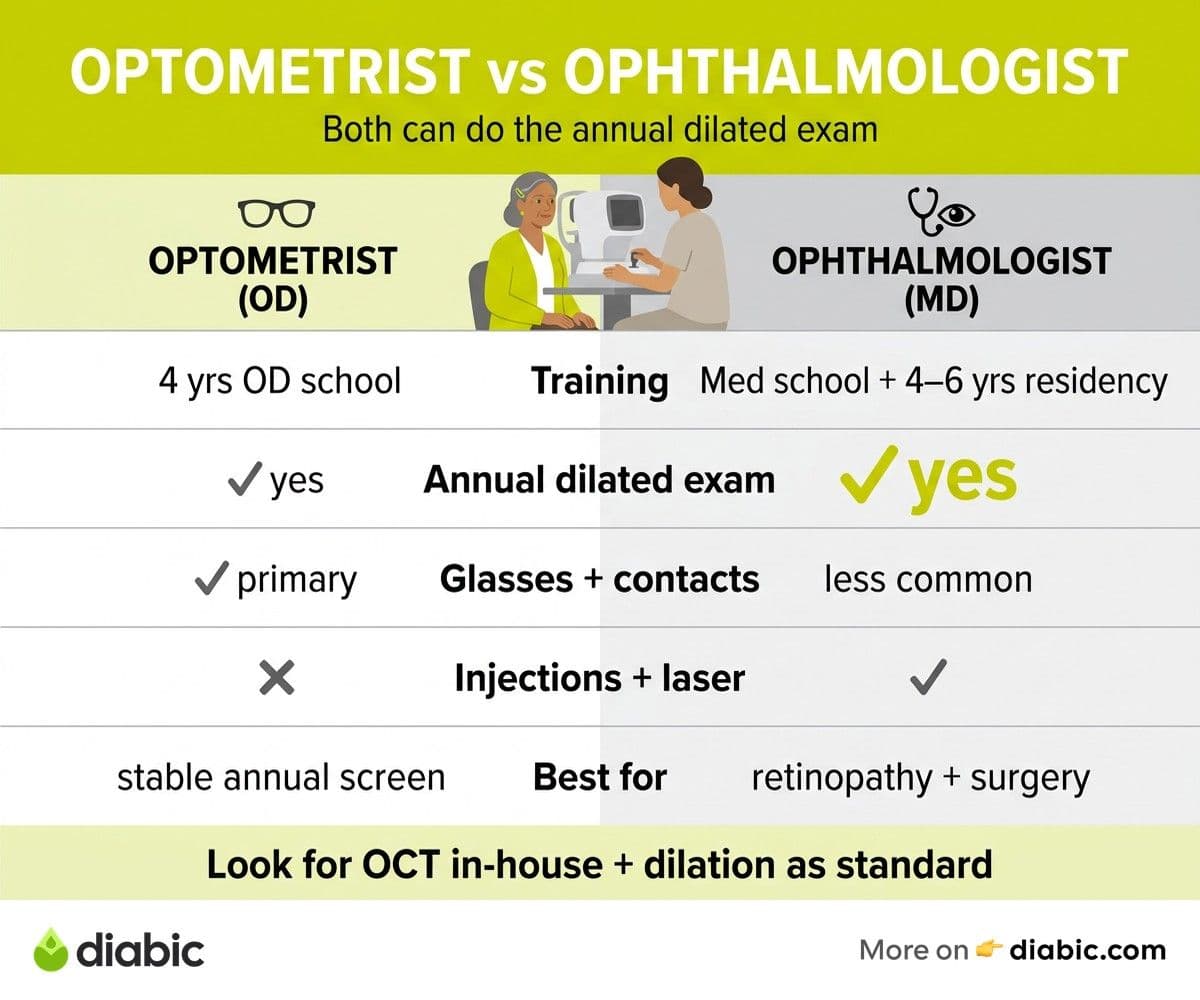
At a glance, here is how the two roles line up for diabetes eye care:
Most people with diabetes end up using both over time, with an optometrist for annual screening and an ophthalmologist when treatment thresholds are in play.
For routine annual exams when your retina looks healthy, an optometrist trained in diabetic eye care is a perfectly reasonable choice. Look for someone who routinely sees people with diabetes and who uses dilation plus, ideally, OCT imaging. This is the same standard described by the NIDDK guidance on diabetes and eye care.
The picture changes if you have already been diagnosed with retinopathy. At that point, most guidelines suggest care from an ophthalmologist, often a retina specialist. The reason is practical: if your condition progresses, you want the person who can immediately recommend or perform treatment, rather than a referral chain that adds weeks. People needing eye surgery, including cataract surgery, will also see an ophthalmologist for that part of their care.
A few signs your optometrist may refer you to an ophthalmologist:
- New or worsening retinopathy on a dilated exam
- Macular swelling visible on OCT
- New floaters or vision changes that suggest a bleed
- Glaucoma needing more advanced treatment
- Cataracts mature enough to consider surgery
If you already manage other complications and want a refresher on what symptoms to flag, our guide on blurred vision and diabetes is a useful companion read.
What to Expect at a person with diabetes Eye Exam
A person with diabetes eye exam is more thorough than a routine vision check. Expect the appointment to last 45 minutes to an hour, with most of that time devoted to looking at the retina rather than measuring your prescription. Plan for someone to drive you home if your eyes are dilated, since bright sunlight will be uncomfortable for a few hours.
The core elements of the exam usually include:
- Visual acuity testing on a standard letter chart
- Refraction to check your current prescription
- Tonometry to measure pressure inside the eye, which screens for glaucoma
- Slit lamp examination of the front of the eye
- Dilated examination of the retina with a bright light and special lenses
- OCT imaging if available, to look for swelling or thinning in the retinal layers
The National Eye Institute explains why dilation is non-negotiable for people with diabetes. Without dilating drops, the provider can only see a small portion of the retina, and meaningful changes can hide in the periphery. The American Diabetes Association recommends this dilated exam annually for most adults with diabetes, with adjustments based on your history.
Your provider will also review recent A1C readings and ask about any vision changes since your last visit. That conversation is part of the exam, so come prepared with notes if anything has shifted. For more on the cadence, see our diabetes eye exam frequency guide.
From my experience: For my first decade with type 1 diabetes I saw a general optometrist who did a fine job, but my exams felt rushed once retinopathy showed up on imaging. Switching to an ophthalmologist with a retina focus changed everything. The exam was longer, the OCT scans more detailed, and most importantly the conversation around treatment thresholds was clearer. If you have any retinal changes on record, it is worth asking your primary care or endocrinologist for a referral to someone who specializes.
How to Find the Right Eye Doctor for Your Needs
Start with the people already on your diabetes care team. Your primary care provider or endocrinologist usually has a short list of eye doctors they trust for diabetic eye care. A direct referral often gets you in faster than a cold call to a clinic.
Look for clear signals of experience with diabetes. A practice that mentions diabetic eye disease, retinopathy, or macular edema on its website is more likely to have appropriate equipment and protocols. OCT imaging in-house is a strong plus. So is a clinic that communicates with your endocrinologist and primary care provider through shared records.
When you call to schedule, ask a few questions:
- Do you perform dilated diabetic eye exams as a routine part of your care?
- Do you offer OCT imaging in-office?
- Will you send a copy of the exam report to my endocrinologist or primary care provider?
- If you find retinopathy, what is your typical referral path?
Insurance coverage is the other practical piece. Most vision plans cover annual exams, but a person with diabetes eye exam may be billed under medical insurance rather than vision, since it screens for a specific medical condition. Confirm with the office front desk in advance to avoid surprise bills. Once you find a provider, build a habit of consistent yearly visits, and pair that with the everyday habits in our diabetes eye care tips for daily life guide.
FAQ
Should people with diabetes see an ophthalmologist or optometrist?
Either can provide excellent annual diabetic eye care if they are experienced with diabetes and perform a dilated exam. People with diagnosed retinopathy, macular edema, or surgical needs are typically better served by an ophthalmologist, often a retina specialist. The right answer depends on your current eye health rather than a fixed rule.
Which eye doctor is best for diabetic eye care?
For routine annual exams when your eyes are healthy, an optometrist with diabetes experience is a strong choice. For more advanced disease or any treatment needs, a retina specialist within ophthalmology has the deepest training. Many people with diabetes see both over time, with an optometrist for routine care and a retinal ophthalmologist when issues arise.
How often should people with diabetes get eye exams?
Most guidelines, including those from the ADA, recommend a dilated eye exam at least once a year for adults with diabetes. People with type 1 diabetes generally start within five years of diagnosis, while those with type 2 begin at diagnosis. Your provider may recommend more frequent exams if there are existing changes, and some low-risk patients may extend to every two years if their last exam was clear.
The ophthalmologist vs optometrist question almost always comes down to fit rather than ranking. A skilled optometrist can manage routine diabetic eye care for years, and a retina-focused ophthalmologist becomes essential the moment treatment is on the table. Pair the right provider with consistent yearly exams and the steady self-care habits we cover elsewhere on the site, and your eyes get a real shot at staying healthy through a lifetime with diabetes.
Shahriar P. Shuvo is the founder of Diabic. He has lived with diabetes for over 14 years, and built Diabic to deliver the practical, evidence-based self-management tools he wished existed when he was first diagnosed. By trade, Shahriar is a senior design and frontend engineer with 6+ years shipping products at Agora, Timescale (now Tiger Data), and ShareTrip. He writes from the intersection of lived diabetes experience and product craft, focused on what works in daily management rather than what sounds good in a textbook.
Medically reviewed by
Dr. Rezwana Parvin Rumpa is an obstetrics and gynaecology specialist with clinical focus on gestational diabetes, PCOS, and fertility. She holds the MRCOG (Final Part) from the Royal College of Obstetricians and Gynaecologists in London, the MRCPI (Final Part) from the Royal College of Physicians of Ireland, and an MBBS from Shaheed Monsur Ali Medical College under Dhaka University. Dr. Rumpa serves as a Senior Medical Officer in the Obs and Gynae department at BRB Hospitals Ltd, where she has spent three years managing prenatal care, emergency obstetric cases, and women's-health surgery. On Diabic, she medically reviews content for women living with diabetes, with particular attention to pregnancy, PCOS, and reproductive-health intersections.
More from Health & Complications
View all
Diabetes and Dental Implants: What to Know First
Diabetes dental implants guide covering safety, A1C targets, recovery expectations, gum health prep, and what to ask your oral surgeon before surgery.

Burning Mouth Syndrome and Diabetes Explained
Burning mouth syndrome diabetes link explained, including neuropathy, dry mouth, and thrush causes plus treatment options that may bring real relief.

Dental Care for people with diabetes: Tips That Help
Practical dental care diabetics need, with real tips for protecting teeth and gums when diabetes raises your risk for oral health problems.
Clinician-reviewed habits, plain-language guides, and honest answers - the small shifts that make living with diabetes feel lighter, every day.