Diabetic Retinopathy Symptoms, Stages, and Treatment
Spot diabetic retinopathy symptoms early, understand the four stages, and learn current treatment options to protect your vision long-term.

In this article(14)
Diabetic retinopathy symptoms can be easy to overlook in the early stages, which is exactly why knowing what to watch for matters. According to the National Eye Institute, this condition is the leading cause of vision loss among working-age adults with diabetes in the United States. The encouraging part is that early detection paired with current treatments can preserve sight in the vast majority of cases when people stay engaged with regular eye exams.
This article walks through what diabetic retinopathy actually is, the early and advanced symptoms to know, the four stages of progression, how it gets diagnosed, the treatment options at each stage, and the practical steps you can take to protect your vision long-term. The goal is to give you a clear, calm picture rather than a list of warnings, so you can have informed conversations with your eye care team.
What Is Diabetic Retinopathy
Diabetic retinopathy is a complication of diabetes that affects the blood vessels in the retina, the light-sensitive layer at the back of the eye. The National Institute of Diabetes and Digestive and Kidney Diseases describes it as a condition that develops gradually as high blood sugar damages the tiny retinal blood vessels over time.
The retina relies on a dense network of small vessels to deliver oxygen and nutrients. When chronic high glucose weakens those vessel walls, they can leak fluid, swell, or close off entirely. Some vessels become blocked, which signals the retina to grow new vessels, but the new ones are fragile and prone to bleeding. That cascade is what drives the progressive forms of the condition.
Anyone with type 1 or type 2 diabetes can develop diabetic retinopathy, and risk increases the longer someone has diabetes. People with diabetes for 20 years or more have a high lifetime probability of developing some degree of retinopathy, which is why annual screening is part of standard diabetes care regardless of how good your numbers look.
The condition often develops without noticeable symptoms at first, which is one of its more frustrating features. Damage can be visible on a dilated eye exam well before vision changes occur, which is why screening catches what you cannot. People sometimes feel fine right up to the point where vision loss starts, and by then more aggressive treatment may be needed.
Early and Advanced Diabetic Retinopathy Symptoms to Watch For
The early diabetic retinopathy symptoms list is short on purpose: most early stages have no symptoms at all. That is not a reassurance, it is a reason to schedule the dilated exam even when your vision feels normal. Once symptoms appear, they tend to be subtle at first and more noticeable as the condition progresses.
Floaters or dark spots in your vision are one of the more common early signs people notice. They look like cobwebs, threads, or small specks drifting across your field of view. A few floaters can be normal, especially as people age, but a sudden increase in number, especially in someone with diabetes, deserves prompt evaluation. Our deeper look at floaters and vision changes with diabetes covers when to be concerned and when not to be.
Blurry or fluctuating vision is another common symptom. Vision may seem clear in the morning and hazy by evening, or it may shift over days. This kind of fluctuation can happen with blood sugar swings even without retinopathy, but persistent or worsening blurriness deserves an eye exam. The piece on blurred vision and diabetes walks through the most common causes.
Dark or empty areas in your visual field can suggest more advanced damage, where parts of the retina are no longer functioning normally. Difficulty seeing colors clearly, especially distinguishing certain shades, can also signal retinal involvement.
When changes in vision need prompt attention is a useful question to keep handy. Sudden vision loss, sudden increase in floaters, flashes of light, a curtain or shadow moving across your vision, or any sense that something is suddenly different all warrant calling your eye care provider right away rather than waiting for your next scheduled visit.
The Four Stages of Diabetic Retinopathy
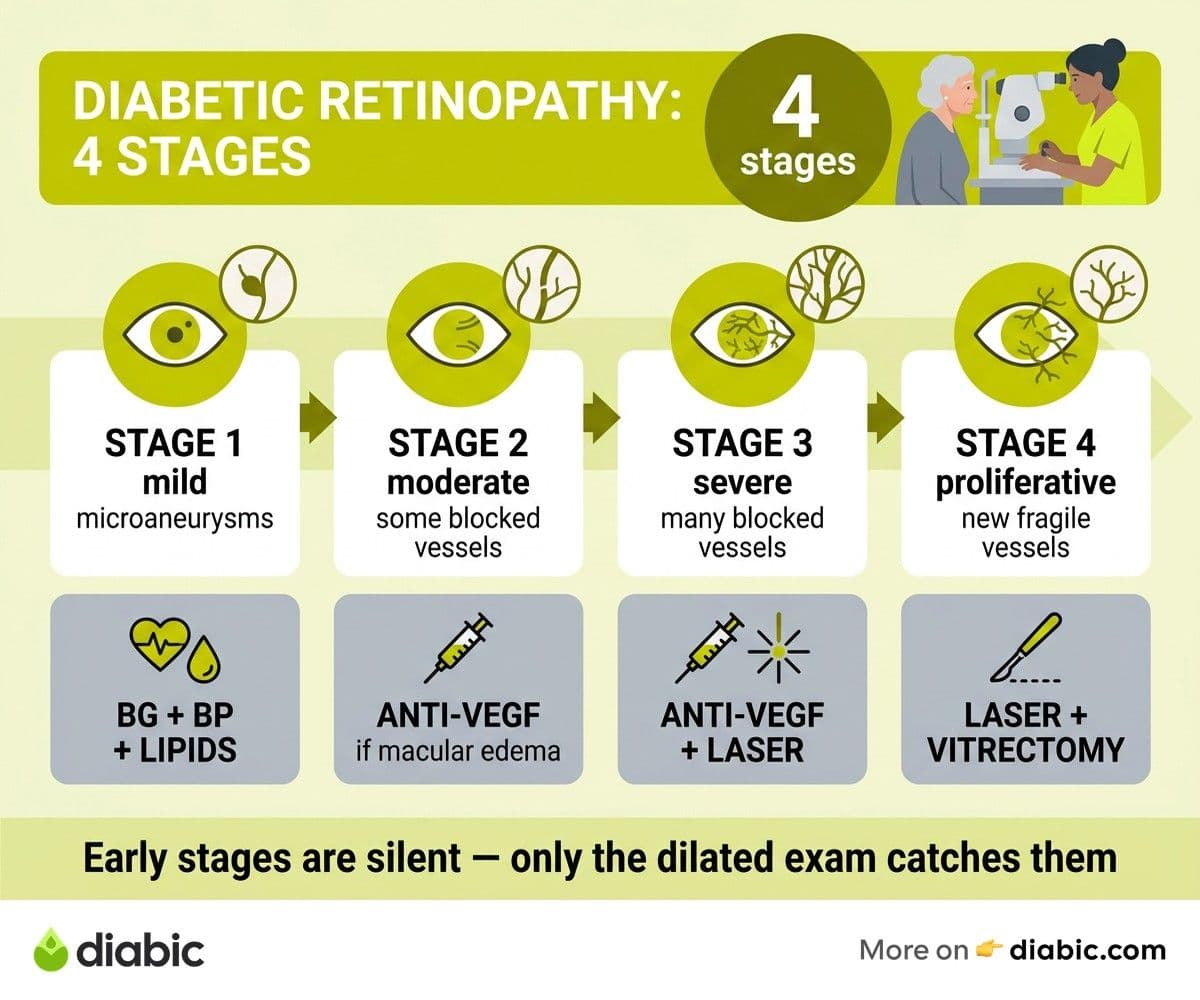
Understanding the stages helps you understand what your provider is describing and what your treatment options look like. The condition progresses through four recognized stages, and progression is not inevitable, especially with good care.
Stage 1: Mild Nonproliferative
In the earliest stage, small areas of swelling called microaneurysms appear in the retinal blood vessels. These tiny bulges can leak small amounts of fluid into the retina. Vision is usually normal at this stage, and most people have no symptoms. Treatment focuses on managing blood sugar, blood pressure, and cholesterol to slow or prevent progression.
Stage 2: Moderate Nonproliferative
As the condition advances, some blood vessels become blocked and stop delivering oxygen and nutrients efficiently. The retina starts to show more damage on imaging, though vision may still be normal or only mildly affected. Macular edema, or swelling in the central part of the retina, may also appear at this stage. If macular edema develops, our piece on diabetic macular edema causes and treatment covers it in detail.
Stage 3: Severe Nonproliferative
Many more blood vessels are blocked at this stage, and the retina begins signaling the body to grow new vessels to replace the damaged supply. This is the final stage before proliferative retinopathy. Vision changes may or may not be present, but the risk of progression to the most advanced form rises significantly without treatment.
Stage 4: Proliferative Diabetic Retinopathy
The most advanced stage involves new, fragile blood vessels growing on the surface of the retina or into the vitreous, the gel that fills the eye. These new vessels can leak blood, leading to floaters, blurry vision, or significant vision loss. Scar tissue from the abnormal vessels can also pull on the retina, causing retinal detachment. Treatment becomes more urgent and intensive at this stage, but options exist and outcomes have improved substantially in recent years.
How progression happens varies by person. Blood sugar management, blood pressure control, lipid management, and consistent eye exams all influence whether and how quickly someone moves through these stages. Many people stay at an early stage for many years or never progress further when they engage with care.
How Diabetic Retinopathy Is Diagnosed
Diagnosis relies on imaging and examination because symptoms alone are unreliable, especially in early stages. The American Diabetes Association Standards of Care recommend regular eye exams as a core part of diabetes care for this reason.
A dilated eye exam is the foundation. Drops are placed in your eyes to widen the pupils, and the eye care provider uses a specialized magnifier to examine the retina directly. The drops typically take 15 to 30 minutes to work and leave you light-sensitive for several hours afterward, which is why most people bring sunglasses and someone to drive them home. The exam itself is painless and takes only a few minutes once your pupils are dilated.
Optical coherence tomography, or OCT, is a non-invasive imaging test that takes detailed cross-sectional images of the retina. It can show swelling, fluid, and structural changes that are hard to see on a standard exam. OCT has become a standard tool for both diagnosis and tracking changes over time.
Fluorescein angiography uses a small injection of dye into a vein in your arm. The dye travels to the blood vessels in your eye, and a special camera takes images as it moves through the retina. Areas where the dye leaks reveal damaged or abnormal vessels. This test is not always needed but is useful in moderate to advanced cases or when planning treatment.
How often people with diabetes should be screened depends on the type of diabetes, how long they have had it, and whether retinopathy is present. The Mayo Clinic's guidance on diabetic retinopathy and current ADA recommendations generally suggest a baseline dilated exam at diagnosis for type 2 diabetes, within 5 years of diagnosis for type 1 diabetes, and at least every two years for people with no retinopathy. Annual exams are recommended for most people with any retinopathy. Our piece on diabetes eye exam frequency covers the schedule in more depth.
Treatment Options for Each Stage
Treatment has improved significantly over the past two decades, and outcomes today are better than ever. The right approach depends on the stage and on whether macular edema is involved.
In early stages, the most important treatment is managing the systemic factors that drive the condition. Blood sugar management, blood pressure control, and lipid management slow progression and in some cases may improve early findings. Smoking cessation matters here too, since smoking accelerates retinal vessel damage. Many people in early stages do not need eye-specific treatment at all if their overall diabetes care is solid.
Anti-VEGF injections have become a cornerstone of treatment for moderate and advanced retinopathy and for diabetic macular edema. VEGF stands for vascular endothelial growth factor, the molecule that signals abnormal vessel growth and leakage. Anti-VEGF medications, given as injections into the eye, block that signal. The procedure sounds intimidating but is generally well tolerated with numbing drops, takes only a few minutes, and is done in the office. Studies published in Diabetes Care and other peer-reviewed journals have shown strong outcomes for vision preservation and improvement with anti-VEGF therapy.
Laser photocoagulation therapy uses a focused laser to seal leaking vessels or to treat the peripheral retina in proliferative cases. Pan-retinal photocoagulation, which treats areas of the retina away from the central vision, reduces the drive for abnormal vessel growth and has been a standard treatment for proliferative retinopathy for decades. Focal laser treatment targets specific leaking vessels.
Vitrectomy is a surgical option for advanced cases involving significant bleeding into the vitreous or scar tissue pulling on the retina. The procedure removes the cloudy vitreous and any scar tissue, often combined with other treatments to stabilize the retina. It is more involved than injections or laser but has good outcomes when needed.
Why treatment effectiveness improves with earlier intervention comes down to how much retinal tissue is still healthy when treatment starts. Catching issues early gives the most options and the best long-term outcomes, which is the practical case for staying on top of regular exams.
From my experience: 14 years into type 1, I have had years where my A1C drifted, and the only place I felt the consequences first was in the eye exam room. Two visits in particular nudged me back into closer management because the photos showed mild changes that I could not feel. That feedback loop is part of why I keep my dilated exam scheduled like a non-negotiable, even in the years where everything feels fine.
Protecting Your Vision Long-Term
Long-term vision protection comes down to a few habits done consistently rather than any single intervention. Blood sugar management is the strongest protective factor, and the evidence has been remarkably consistent over decades of research. Better A1C and time in range are both associated with lower retinopathy risk and slower progression when it does develop.
Regular eye exams on the recommended schedule are the second pillar. Most major insurance plans, including Medicare, cover annual dilated exams for people with diabetes. Many areas also have low-cost or sliding-scale eye care for people without comprehensive coverage.
Blood pressure and cholesterol management protect retinal vessels in the same way they protect heart and kidney vessels. People with both diabetes and hypertension have higher rates of retinopathy and faster progression than people who keep blood pressure in target ranges.
Quitting smoking has measurable benefits for retinal health, partly because smoking damages small blood vessels throughout the body. The benefit shows up within months and continues to grow over years. If you want a broader set of daily habits that support eye health alongside other parts of diabetes care, our simple diabetes eye care tips for daily life guide pulls them together.
Staying informed and proactive about eye care is the underrated piece. People who ask questions, track their own exam reports, know their current stage if any, and engage with treatment recommendations tend to do better than people who treat eye care as a checkbox.
FAQ
What are the early symptoms of diabetic retinopathy?
The earliest stages often have no symptoms at all, which is why screening exams are essential. When symptoms do appear, they may include floaters or dark spots in your vision, blurry or fluctuating vision, dark areas in your visual field, or difficulty seeing colors clearly. Sudden vision changes or sudden increase in floaters should prompt a same-day call to your eye care provider.
What are the stages of diabetic retinopathy?
There are four recognized stages: mild nonproliferative, where small swellings appear in retinal vessels; moderate nonproliferative, where some vessels become blocked; severe nonproliferative, where many vessels are blocked and growth signals begin; and proliferative, where new fragile vessels grow and can leak. Macular edema can develop at any stage and affects central vision specifically.
Can diabetic retinopathy be treated successfully?
Yes, current treatments are effective at preserving and often improving vision, especially when started earlier in the progression. Anti-VEGF injections, laser photocoagulation, and vitrectomy each have strong evidence for specific stages. The most successful outcomes happen when treatment is combined with consistent management of blood sugar, blood pressure, and cholesterol. Talk to your eye care provider about which option fits your stage and goals.
The most useful summary is that diabetic retinopathy symptoms are often silent until they are not, and the gap between those two states is exactly where annual screening lives. Keep your eye exams on the calendar, bring questions about any vision changes to the room, and treat the imaging report as part of your diabetes care, not a separate appointment.
Shahriar P. Shuvo is the founder of Diabic. He has lived with diabetes for over 14 years, and built Diabic to deliver the practical, evidence-based self-management tools he wished existed when he was first diagnosed. By trade, Shahriar is a senior design and frontend engineer with 6+ years shipping products at Agora, Timescale (now Tiger Data), and ShareTrip. He writes from the intersection of lived diabetes experience and product craft, focused on what works in daily management rather than what sounds good in a textbook.
Medically reviewed by
Dr. Shanto Arian is an internal medicine physician now specializing in clinical and aesthetic dermatology, with a parallel academic focus on epidemiology and public health. He holds an MBBS, MPH, MSc (UK), MRCP (UK), MRCPI (Ireland), Diploma in Dermatology (UK), and Diploma in Aesthetic Medicine (USA). Dr. Arian trained in internal medicine, including hospital work on hematology cases such as graft-versus-host disease, before moving toward dermatology. Skin is one of the earliest places diabetes shows itself, from acanthosis nigricans and diabetic dermopathy to slow foot wound healing, and that intersection is where his clinical and Diabic-review work meet. On Diabic, Dr. Arian medically reviews content on diabetes diagnosis, complications, dermatologic manifestations, and pharmacotherapy, ensuring every claim aligns with current ADA, NICE, and peer-reviewed literature.
More from Health & Complications
View all
Diabetes and Dental Implants: What to Know First
Diabetes dental implants guide covering safety, A1C targets, recovery expectations, gum health prep, and what to ask your oral surgeon before surgery.

Burning Mouth Syndrome and Diabetes Explained
Burning mouth syndrome diabetes link explained, including neuropathy, dry mouth, and thrush causes plus treatment options that may bring real relief.

Dental Care for people with diabetes: Tips That Help
Practical dental care diabetics need, with real tips for protecting teeth and gums when diabetes raises your risk for oral health problems.
Clinician-reviewed habits, plain-language guides, and honest answers - the small shifts that make living with diabetes feel lighter, every day.