Blurred Vision and Diabetes: Causes and Next Steps
Blurred vision and diabetes are linked in several ways. Learn the common causes, how to tell if it is temporary or serious, and what steps to take next.

In this article(21)
Blurred vision diabetes questions land in our inbox almost every week, usually after someone notices the world has gone slightly soft and is not sure if it is a passing thing or a warning. Blood sugar fluctuations alone can temporarily blur your eyesight, while other causes may need closer attention. Understanding the difference helps you respond calmly rather than panicking every time the edges of the page look fuzzy.
We hear from a lot of people who notice blurry vision after a high or low and immediately worry it is the start of permanent damage. Sometimes it is just lens swelling that resolves in a few days. Sometimes it is a signal worth investigating with an eye doctor. This guide walks through the most common reasons diabetes causes blurred vision, how to tell what is urgent, and the practical next steps for each situation.
Why Diabetes Causes Blurred Vision
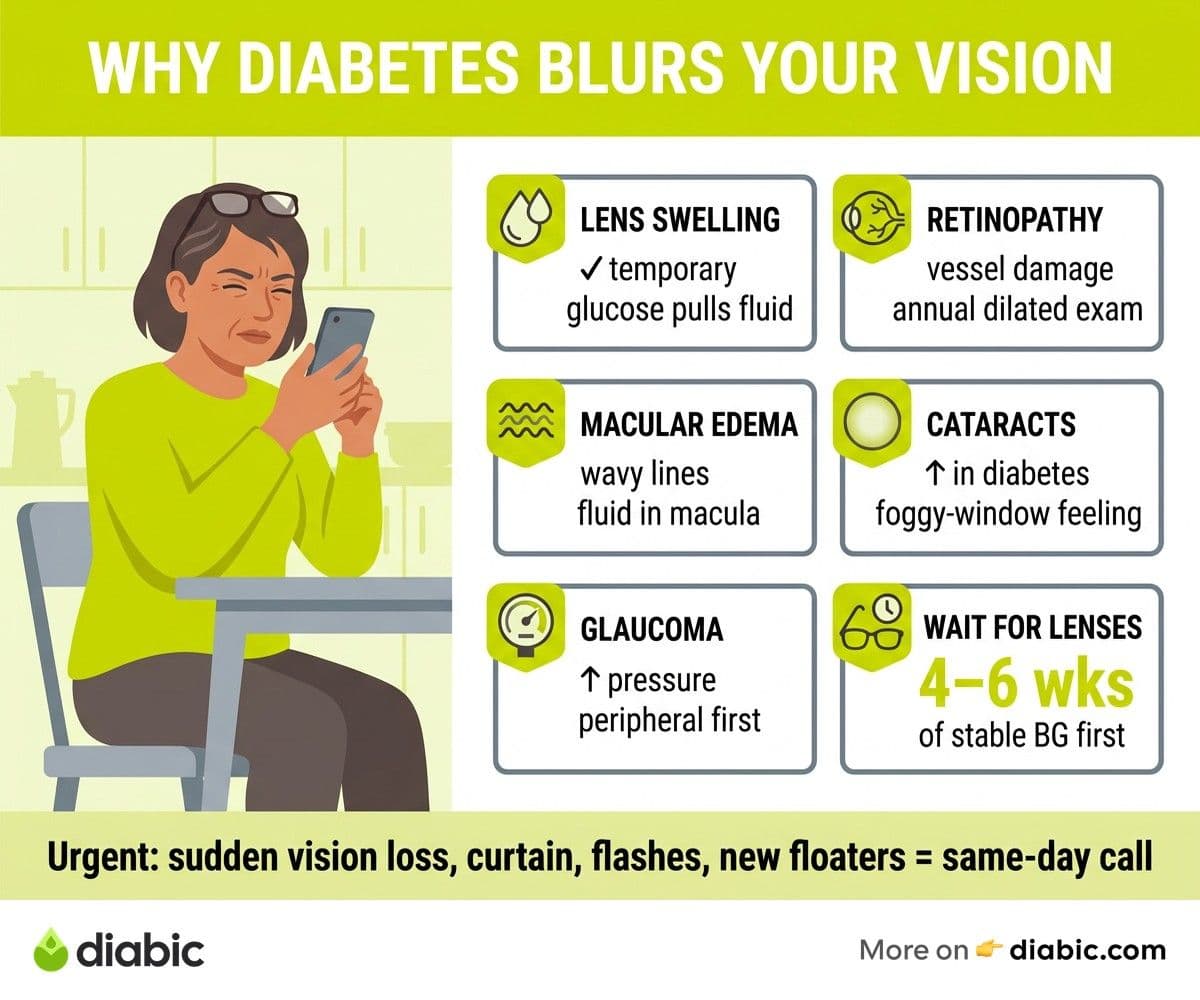
The lens inside your eye is mostly water, and it bends light to focus images on your retina. When blood sugar runs high, glucose pulls fluid into the lens, causing it to swell and change shape. That shape change shifts the focal point and produces the soft, slightly off vision that many people describe as a sudden need for new glasses. The American Diabetes Association describes this lens-swelling effect as one of the most common reasons new glucose patterns produce blurry vision.
Low blood sugar can produce a similar effect, though through a different mechanism. The brain uses glucose to interpret what your eyes see, and when fuel drops, vision can briefly go fuzzy or hard to focus. Both of these scenarios are usually temporary. Once your blood sugar settles into a steadier range for a week or two, the lens returns to its normal shape and your vision typically clears up.
The takeaway is that blurry vision during a high or low is very rarely a sign of permanent damage. It is a sign your eyes are reacting to a change in your body. The Diabetes Care journal has published research showing that refractive shifts during glycemic fluctuations are common and reversible. The reason we still take blurriness seriously is that other causes look similar, and ruling those out is the only way to know which kind you are dealing with.
Common Causes of Blurred Vision Diabetes Patients Face
Beyond temporary lens swelling, there are several diabetes-related conditions that can cause persistent or progressive blurriness. The National Eye Institute groups these under the umbrella of diabetic eye disease, and each has its own pattern.
Blood Sugar Fluctuations
This is the most common cause and almost always the first one to consider. If your blurriness started during a stretch of unusually high or low readings, or just after starting a new medication that changed your glucose pattern, lens swelling is the likely explanation. It tends to clear within a few days to a few weeks of stable readings.
Diabetic Retinopathy
Retinopathy is damage to the tiny blood vessels in the retina caused by long-term high blood sugar. In its early stages there are often no symptoms at all. As it progresses, blurriness, floaters, and patchy vision can appear. Catching it early matters, which is why we cover diabetic retinopathy symptoms and stages in a dedicated guide. New floaters or flashes that come on suddenly should be treated as urgent, and you can read more about floaters and vision changes with diabetes to understand which patterns warrant a same-day call.
Diabetic Macular Edema
The macula is the small central part of the retina that handles sharp, detailed vision. When fluid leaks from damaged retinal vessels and pools there, the macula swells and central vision blurs or distorts. Straight lines may look wavy, colors may look washed out, and reading or recognizing faces becomes harder. We cover this condition in depth in our guide to diabetic macular edema.
Cataracts
Cataracts (clouding of the lens) develop earlier and progress faster in people with diabetes than in the general population. The blurriness is usually gradual, often described as looking through a foggy window, and is most noticeable in bright light or while driving at night. According to Mayo Clinic, cataract surgery is highly effective and routine when vision becomes affected.
Glaucoma
Diabetes also raises the risk of glaucoma, a group of conditions where pressure inside the eye damages the optic nerve. Open-angle glaucoma, the most common form, often progresses without symptoms until peripheral vision starts to narrow. Acute angle-closure glaucoma is rarer but causes sudden eye pain, halos around lights, and rapid vision changes, and it is a medical emergency.
How to Tell If Blurred Vision Is Temporary or Serious
The single most useful question to ask is: how long has it lasted, and what was happening with your blood sugar around it? The patterns below can help you sort temporary from worth-investigating from urgent.
Likely Temporary
Blurriness that started during a stretch of high or low readings, then improved as your blood sugar steadied, is usually lens swelling. So is blurriness right after a meaningful diet change or a new medication that lowered your A1C. These often resolve within a week or two once your readings stabilize.
Worth Investigating
Persistent blurriness that lasts more than a few days even when blood sugar is in a reasonable range, or blurriness that comes and goes with no obvious connection to your readings, deserves an exam. Wavy lines, missing patches, or vision that is clearly worse in one eye than the other also fall into this category. Schedule an eye exam within a week or two.
Treat as Urgent
Sudden vision loss in one or both eyes, a curtain or shadow moving across your field of view, a sudden flood of new floaters, flashing lights, or eye pain should be treated as an emergency. These can signal a retinal detachment, a vitreous hemorrhage, or acute glaucoma. Call your eye doctor the same day, or go to the emergency room if you cannot reach them.
From my experience: After 14 years with type 1 diabetes, I have learned to keep a small note on my phone with the date and circumstances anytime my vision goes blurry. Twice it turned out to be lens swelling that cleared on its own. Once it lasted long enough that my retinal specialist found a small spot of macular edema that needed monitoring. Without that timeline, I would have struggled to describe the pattern at my appointment, and the eye doctor would have had less to work with.
What to Do When Your Vision Is Blurry
If blurriness shows up unexpectedly, a short, calm checklist helps you respond well rather than reacting in the moment.
Check Your Blood Sugar First
Whether you use a meter or a CGM, get a current reading. If you are high or low, treat it appropriately and give your eyes a couple of days as readings settle. Most blood sugar related blurriness clears once your numbers steady.
Hold Off on a New Glasses Prescription
This one trips a lot of people up. If your vision feels off and you assume you need new lenses, wait. Getting a prescription during a stretch of swinging blood sugar locks in a correction for a temporary shape change in your lens. Once your readings stabilize, the lens changes back, and you are stuck with glasses that do not match your real prescription. Most eye doctors recommend waiting at least four to six weeks of stable blood sugar before updating lenses.
Schedule an Eye Exam If It Persists
If blurriness lasts beyond a few weeks of steady readings, book a comprehensive dilated exam. Bring your blood sugar logs and the timeline note we mentioned earlier. The more context your eye doctor has, the easier it is for them to sort the lens swelling story from the retinal story.
Track Vision Changes for Your Care Team
A simple log with the date, what you noticed, what your blood sugar was doing, and how long it lasted gives your endocrinology and eye care teams a real picture of what is going on. Patterns that look random in the moment often look meaningful when you can see them all together.
Preventing Vision Problems with Diabetes
Most of the prevention strategy is the same diabetes care you are already doing, applied with eye health in mind. Consistent blood sugar management reduces the lens-swelling episodes and slows the micro-damage that builds into retinopathy over years. The NIDDK is clear that staying within your target range, even imperfectly, protects retinal vessels over time.
Regular dilated eye exams are the second pillar. Catching retinopathy or macular edema early, before symptoms appear, is what makes treatment most effective. Our guide on diabetes eye exam frequency lays out the recommended schedule by diabetes type. Blood pressure and cholesterol management protect the same retinal blood vessels that high blood sugar damages, so working those into your overall plan is part of eye care too. Daily habits like UV-blocking sunglasses, hydration, and screen breaks add small but real protection, and our simple diabetes eye care tips walk through the routines we recommend.
FAQ
Why does diabetes cause blurred vision?
The most common reason is lens swelling. High blood sugar pulls fluid into the lens of the eye, changing its shape and shifting your focus. Low blood sugar can also briefly affect vision because the brain runs on glucose. These are usually temporary. Persistent blurriness can also be caused by retinopathy, macular edema, cataracts, or glaucoma, all of which are more common in people with diabetes.
When should I see a doctor for blurred vision with diabetes?
Schedule an exam if blurriness lasts more than a week or two of stable blood sugar, if it is worse in one eye, or if straight lines look wavy. Treat sudden vision loss, a curtain or shadow across your vision, flashes, a flood of new floaters, or eye pain as an emergency and call your eye doctor the same day.
Can blurry vision from diabetes be permanent?
Blurriness from blood sugar fluctuations almost always resolves once readings stabilize. Blurriness from advanced retinopathy, macular edema, or untreated cataracts can become long-term, but most cases are treatable, especially when caught early. Regular dilated eye exams are the best tool for spotting these conditions before they cause permanent change.
Most blurred vision diabetes episodes have a clear, fixable explanation when you slow down and look at the timeline. Track what your blood sugar was doing, give a few weeks for lens shape to settle, and keep your dilated exams on the calendar. The eyes are one of the few organs where catching a small change early can save a lot of vision later, and a calm response gives your care team the best information to work with.
Shahriar P. Shuvo is the founder of Diabic. He has lived with diabetes for over 14 years, and built Diabic to deliver the practical, evidence-based self-management tools he wished existed when he was first diagnosed. By trade, Shahriar is a senior design and frontend engineer with 6+ years shipping products at Agora, Timescale (now Tiger Data), and ShareTrip. He writes from the intersection of lived diabetes experience and product craft, focused on what works in daily management rather than what sounds good in a textbook.
Medically reviewed by
Dr. Shanto Arian is an internal medicine physician now specializing in clinical and aesthetic dermatology, with a parallel academic focus on epidemiology and public health. He holds an MBBS, MPH, MSc (UK), MRCP (UK), MRCPI (Ireland), Diploma in Dermatology (UK), and Diploma in Aesthetic Medicine (USA). Dr. Arian trained in internal medicine, including hospital work on hematology cases such as graft-versus-host disease, before moving toward dermatology. Skin is one of the earliest places diabetes shows itself, from acanthosis nigricans and diabetic dermopathy to slow foot wound healing, and that intersection is where his clinical and Diabic-review work meet. On Diabic, Dr. Arian medically reviews content on diabetes diagnosis, complications, dermatologic manifestations, and pharmacotherapy, ensuring every claim aligns with current ADA, NICE, and peer-reviewed literature.
More from Health & Complications
View all
Diabetes and Dental Implants: What to Know First
Diabetes dental implants guide covering safety, A1C targets, recovery expectations, gum health prep, and what to ask your oral surgeon before surgery.

Burning Mouth Syndrome and Diabetes Explained
Burning mouth syndrome diabetes link explained, including neuropathy, dry mouth, and thrush causes plus treatment options that may bring real relief.

Dental Care for people with diabetes: Tips That Help
Practical dental care diabetics need, with real tips for protecting teeth and gums when diabetes raises your risk for oral health problems.
Clinician-reviewed habits, plain-language guides, and honest answers - the small shifts that make living with diabetes feel lighter, every day.