How to Support Diabetic Wound Healing at Home
A practical home care guide to diabetic wound healing, with step-by-step cleaning, signs of healing, infection warning signs, and prevention tips.

In this article(13)
Supporting diabetic wound healing at home starts with understanding why a small cut, scrape, or blister behaves differently when blood sugar runs high. The repair process is slower, the immune response is dulled, and a minor injury that would close in days for someone without diabetes can take weeks. The encouraging news is that most minor wounds still heal well at home with the right routine. Here are the steps that actually move the needle.
A few habits, repeated daily, prevent the majority of complications. Blood sugar management, gentle cleaning, the right dressing, and knowing when to call a clinician will carry you through almost every minor injury you encounter.
Why Diabetic Wound Healing Takes Longer
Healing is a coordinated cascade of cell signals, blood flow, and tissue rebuilding. High glucose interrupts that cascade in several places at once.
White blood cells, the body's frontline infection fighters, become less effective when blood glucose is elevated. Their ability to engulf bacteria drops, and inflammation that should resolve drags on. The NIDDK overview of diabetes complications explains how this immune sluggishness is one reason foot infections become serious so quickly in people with diabetes.
Reduced blood flow is the second factor. Years of high blood sugar damage small blood vessels and stiffen larger arteries, so fewer nutrients and less oxygen reach the wound site. Without adequate oxygen, new tissue cannot rebuild efficiently. Peripheral neuropathy adds a third problem: numbness in the feet and lower legs means injuries can go unnoticed for hours or days, giving bacteria a head start.
Underlying these mechanisms is chronic, low-grade inflammation, which is well documented in the ADA's Diabetes Care journal research on wound healing in diabetes. For a broader look at how diabetes affects the skin overall, our piece on skin complications of diabetes covers the conditions that often appear alongside slow healing.
How to Care for Minor Wounds at Home
A minor wound is a shallow cut, scrape, or small blister on a non-foot location. Foot wounds, even tiny ones, are a separate category that we cover further down. For everything else, this four-step routine works for the vast majority of cases.
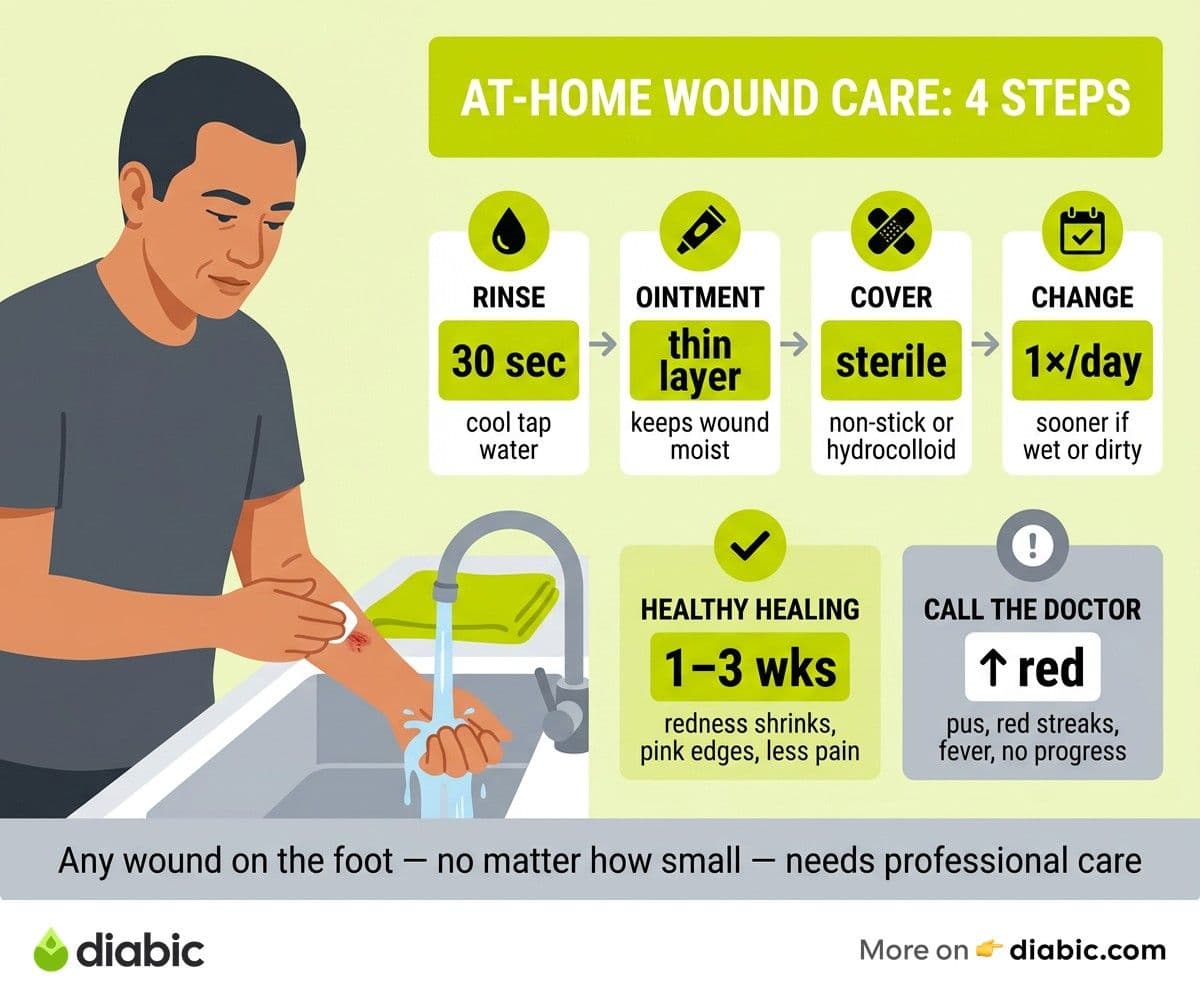
Step 1: Clean the wound gently. Rinse with cool to lukewarm tap water for at least 30 seconds to flush out dirt and debris. Wash the surrounding skin with a mild, unscented soap, but try to keep soap out of the wound itself. Pat dry with a clean towel or gauze.
Step 2: Apply a thin layer of antibiotic ointment. Petroleum jelly or a basic over-the-counter antibiotic ointment helps keep the wound bed moist, which is what speeds healing. The CDC's wound care guidance emphasizes that moist wound healing is faster and produces less scarring than air-drying.
Step 3: Cover with a sterile bandage. Use a non-stick pad or hydrocolloid dressing, depending on the wound size. Change it once a day, or sooner if it becomes wet, dirty, or saturated.
Step 4: Keep the surrounding skin moisturized. Once a wound starts to close, gentle moisturizing prevents the new skin from cracking. Avoid putting lotion directly on an open wound.
A note on what to skip. Hydrogen peroxide and rubbing alcohol can damage healthy tissue around the wound and slow healing, despite being old standbys in many medicine cabinets. The ADA's wound care guidance recommends mild soap and water as the primary cleanser. If you are caring for a wound after a procedure like a piercing or tattoo, our guide on tattoos and diabetes safety covers aftercare specific to those situations.
What about saline?
Sterile saline (the kind sold for wound irrigation or contact lenses) is also a fine choice for cleaning, particularly for wounds that sting with tap water. It is gentle, neutral, and unlikely to disrupt healing tissue.
Signs a Wound Is Healing Properly
It helps to know what success looks like. A wound that is healing well goes through predictable stages, even if the timeline is stretched compared with what someone without diabetes would experience.
In the first day or two, you will see some redness, mild swelling, and tenderness. This is the inflammatory phase, and it is supposed to happen. Within a few days, the redness should start fading inward from the edges, and a thin layer of pink, slightly raised tissue should begin filling in. By the end of the first week, the wound surface usually looks smaller, and any scab that forms should be intact rather than oozing.
Minor cuts and scrapes typically close within 1 to 3 weeks for most people with diabetes who are managing blood sugar well. Healing that takes longer than this, or stalls for several days without progress, is a sign to check in with a clinician.
The visual checklist for healthy healing:
- Redness and swelling shrink rather than grow
- New pink (or sometimes pale) tissue at the edges
- Pain decreases day by day
- No foul odor from the wound or dressing
- Discharge, if any, is clear or pale and small in volume
Warning Signs That Need Medical Attention
Knowing when to stop home care and call your doctor is the most important skill in this whole process. A delay of even a day or two can turn a manageable infection into a hospital visit.
Call your healthcare provider promptly if you notice any of these:
- Increasing redness, warmth, or swelling around the wound
- Pus or foul-smelling discharge
- Red streaks extending outward from the wound
- A fever, chills, or feeling generally unwell
- A wound that has not improved at all after 1 to 2 weeks
- Significantly more pain than the day before
Mayo Clinic's overview of wound infection signs is a useful visual reference if you are unsure what cellulitis or a spreading infection looks like. For a deeper dive into recognizing infections specifically, our guide on diabetes skin infection prevention covers both bacterial and fungal types.
From my experience: Living with type 1 diabetes for 14 years taught me that the cost of "wait and see" is almost always higher than the cost of an extra clinic visit. The two times I waited too long on a wound, I ended up on oral antibiotics. The half a dozen times I called early, the answer was usually a quick reassurance and a different bandage. I would rather feel slightly silly than face a hospital admission.
One firm rule for the feet
Any wound on the foot, no matter how small, deserves professional eyes. A blister from a new pair of shoes, a paper-thin cut from walking barefoot, a callus that splits open: all of these can become serious. If you are noticing foot wounds repeatedly, our diabetic foot ulcer treatment article walks through the specialist care pathway and why early intervention prevents amputation.
Preventing Wounds in the First Place
Prevention is genuinely more effective than any treatment. Three habits, done consistently, head off most of the wounds that turn into emergencies.
Daily skin inspections. Every evening, look over your feet, ankles, lower legs, and any area where shoes or clothing rub. Use a hand mirror or your phone camera to see the bottoms of your feet. You are looking for redness, blisters, cuts, splits in calluses, or anything that was not there yesterday.
Daily moisturizing. Diabetes-prone skin tends toward dryness and cracking, especially on the heels and lower legs. A plain, unscented moisturizer applied after showering keeps the skin barrier intact. Avoid putting lotion between the toes, where trapped moisture can encourage fungal growth.
Smart footwear and movement. Well-fitting shoes (broken in gradually), clean socks changed daily, and never going barefoot (even at home) prevents the majority of foot injuries. Avoid hot bathwater and never use heating pads on numb areas, where you can burn the skin without feeling it. Our diabetic foot care guide walks through the full daily routine in more detail.
Underlying all of this is blood sugar management. Steady glucose levels are the single most powerful wound prevention strategy, because they protect the small blood vessels and immune cells that repair injuries.
When Professional Wound Care Is Needed
Some situations are beyond what you should manage at home, even if the wound looks small. Call or book an appointment for any of these:
- Any wound on the feet, regardless of size
- Wounds deeper than the surface layer of skin (visible fat, muscle, or bleeding that does not slow with pressure)
- Burns, electrical injuries, or puncture wounds (including stepping on a nail)
- Wounds with any signs of infection (redness, warmth, drainage, odor)
- Wounds on someone with poor circulation, neuropathy, or active CKD
- Any wound on a person with diabetes that has not improved in 2 weeks
A specialty wound care clinic, podiatrist, or your primary care provider can debride dead tissue, prescribe targeted antibiotics if needed, and choose dressings that match the wound type. Many cities have certified wound care nurses who do home visits for people with mobility limitations. Erring on the side of professional help is the right call when something feels off.
What to Take Away
Diabetic wound healing comes down to a few honest truths. Cuts and scrapes take longer to close, and your skin needs more help than it used to. A simple routine of gentle cleaning, antibiotic ointment, a clean dressing, and daily inspection handles most minor injuries well. Anything on the feet or anything that worsens after 48 hours deserves a clinician's eyes.
Talk to your doctor about your personal wound risk and create a plan you can actually follow on your worst days, not just your best ones. Steady blood sugar, daily skin checks, and a low threshold for professional help will carry you through almost everything.
Frequently Asked Questions
Why do wounds heal slowly with diabetes?
High blood sugar weakens immune cells, reduces blood flow to the wound, and causes chronic inflammation that interferes with the normal repair process. Neuropathy can also delay detection of injuries, giving bacteria a head start before treatment begins.
How to care for a wound at home when you have diabetes?
Rinse the wound with cool tap water, apply a thin layer of antibiotic ointment, cover with a sterile bandage, and change the dressing daily. Keep blood sugar in your target range, avoid hydrogen peroxide and alcohol, and inspect the wound each day for signs of infection.
When should a person with diabetes see a doctor about a wound?
See a clinician for any wound on the feet, any wound deeper than surface level, signs of infection (spreading redness, pus, foul odor, fever), or any wound that has not improved within 1 to 2 weeks of consistent home care.
The honest summary on diabetic wound healing is that home care does most of the work, but a low threshold for professional help is the safety net that keeps small wounds small. Lean on the four-step routine, watch for the warning signs, and trust your instincts when something does not look right. The cost of an extra clinic visit is almost always lower than the cost of waiting too long.
Shahriar P. Shuvo is the founder of Diabic. He has lived with diabetes for over 14 years, and built Diabic to deliver the practical, evidence-based self-management tools he wished existed when he was first diagnosed. By trade, Shahriar is a senior design and frontend engineer with 6+ years shipping products at Agora, Timescale (now Tiger Data), and ShareTrip. He writes from the intersection of lived diabetes experience and product craft, focused on what works in daily management rather than what sounds good in a textbook.
Medically reviewed by
Dr. Rezwana Parvin Rumpa is an obstetrics and gynaecology specialist with clinical focus on gestational diabetes, PCOS, and fertility. She holds the MRCOG (Final Part) from the Royal College of Obstetricians and Gynaecologists in London, the MRCPI (Final Part) from the Royal College of Physicians of Ireland, and an MBBS from Shaheed Monsur Ali Medical College under Dhaka University. Dr. Rumpa serves as a Senior Medical Officer in the Obs and Gynae department at BRB Hospitals Ltd, where she has spent three years managing prenatal care, emergency obstetric cases, and women's-health surgery. On Diabic, she medically reviews content for women living with diabetes, with particular attention to pregnancy, PCOS, and reproductive-health intersections.
More from Health & Complications
View all
Diabetes and Dental Implants: What to Know First
Diabetes dental implants guide covering safety, A1C targets, recovery expectations, gum health prep, and what to ask your oral surgeon before surgery.

Burning Mouth Syndrome and Diabetes Explained
Burning mouth syndrome diabetes link explained, including neuropathy, dry mouth, and thrush causes plus treatment options that may bring real relief.

Dental Care for people with diabetes: Tips That Help
Practical dental care diabetics need, with real tips for protecting teeth and gums when diabetes raises your risk for oral health problems.
Clinician-reviewed habits, plain-language guides, and honest answers - the small shifts that make living with diabetes feel lighter, every day.