Simple Diabetes Eye Care Tips for Daily Life
Practical diabetes eye care tips you can build into daily life. Six habits that may help protect your vision, from steady blood sugar to UV-blocking.

In this article(11)
- Why These Diabetes Eye Care Tips Matter Day to Day
- Tip 1: Keep Your Blood Sugar Steady
- Tip 2: Schedule and Keep Your Annual Eye Exams
- Tip 3: Protect Your Eyes from Sun and Screens
- Tip 4: Manage Blood Pressure and Cholesterol
- Tip 5: Know the Warning Signs That Need Attention
- Tip 6: Build Eye-Friendly Eating Habits
Protecting your eyesight when you have diabetes does not require complicated routines. A few simple diabetes eye care tips, practiced consistently, can make a meaningful difference in preserving your vision for the long haul. Here are practical habits you can build into your daily life starting today, none of which require new gadgets or a major overhaul of how you already manage diabetes.
We get a lot of questions about what to do day-to-day to lower the risk of diabetic eye disease. The honest answer is that most of the protective work is the same diabetes care you are already doing, applied with eyes in mind. The six tips below come straight from current American Diabetes Association and National Eye Institute recommendations, plus what we have seen work for people in our community over many years.
Why These Diabetes Eye Care Tips Matter Day to Day
Diabetes is the leading cause of preventable blindness in working-age adults, according to the CDC. That sounds heavy, but the framing matters. Most diabetes-related eye damage is preventable or manageable when daily habits and regular monitoring are in place. The bigger picture is that what you do most days, not what you do occasionally, shapes long-term outcomes.
Daily habits reduce the risk of three main conditions: diabetic retinopathy, macular edema, and glaucoma. None of these usually appear overnight. They develop slowly over months and years, fed by spikes in blood sugar, blood pressure swings, UV exposure, and the small daily stressors that add up. The flip side is that small daily choices also compound in your favor. Steady blood sugar, an annual exam, and a few protective habits add up to real protection over a decade or two.
You do not need to do all six of these tips at once. Pick the one that feels most doable and start there. Consistency beats intensity every time when it comes to long-term eye health.
Tip 1: Keep Your Blood Sugar Steady
Steady blood sugar is the single most protective thing you can do for your eyes. The lens, the retina, and the tiny blood vessels that feed them all respond to glucose levels in real time. Big swings stress the lens and damage retinal capillaries over time, while steady readings give those structures a chance to recover and stay healthy.
Steady does not mean perfect. The NIDDK is clear that even modest A1C improvements meaningfully reduce the risk of retinopathy and macular edema. Dropping from 9.0% to 8.0%, or from 7.5% to 7.0%, is a real win for your eyes, even if it is not where you eventually want to be. The goal is consistent direction, not arrival at a perfect number.
Use the monitoring tools you already have, whether that is a meter, a CGM, or both. Look at your patterns rather than individual numbers. Identify the times of day when readings drift highest, and work with your care team on small adjustments. Time in range matters more than any single reading.
Tip 2: Schedule and Keep Your Annual Eye Exams
A dilated eye exam is the only way to catch problems before they affect your vision. By the time blurriness, floaters, or distortion show up, retinopathy or macular edema is often already in progress. Catching changes earlier means simpler treatment plans and better outcomes.
Add the appointment to your calendar at the same time every year so it becomes automatic. A lot of people in our community pair it with their birthday or another annual marker so it is impossible to forget. If you have lived with diabetes for many years, you know how easy it is for a year to slip past. Anchoring the appointment to a fixed date helps.
When you go, bring a list of questions and any vision changes you have noticed. If you are not sure whether to see an ophthalmologist or an optometrist, our guide on ophthalmologist vs optometrist for diabetes care walks through the difference. For more on schedules by diabetes type, our diabetes eye exam frequency guide lays out the recommendations from diagnosis onward. If cost is a barrier, federally qualified health centers, EyeCare America, and telemedicine retinal screening through your endocrinology clinic can all be options.
Tip 3: Protect Your Eyes from Sun and Screens
UV exposure increases cataract risk, which is already higher in people with diabetes. Sunglasses are not just a summer accessory. The Mayo Clinic recommends UV-blocking sunglasses (look for 99% to 100% UVA and UVB protection) year-round, even on overcast days. UV passes through clouds, and reflected light off snow, water, or pavement adds to daily exposure.
Screens are the other big chunk of modern eye stress. They do not directly cause diabetic eye disease, but they contribute to dryness, eye strain, and headaches that make your overall eye experience worse. The 20-20-20 rule is the simplest screen habit worth building. Every 20 minutes, look at something 20 feet away for 20 seconds. It interrupts the close-focus tension that builds up over a workday.
Blink consciously when you are at a screen. Most people blink half as often when reading or scrolling, which dries the eye surface. A small bottle of preservative-free artificial tears in your bag or on your desk is an easy backup if your eyes feel scratchy by mid-afternoon.
Tip 4: Manage Blood Pressure and Cholesterol
High blood pressure damages the same retinal blood vessels that high blood sugar damages, and the two together are more harmful than either alone. The vascular system in your eye is small and delicate, and elevated pressure adds direct mechanical stress to vessels that may already be compromised. Bringing blood pressure into target range is one of the most powerful things you can do to protect your retina.
Cholesterol management protects vascular health throughout your body, including in the tiny eye vessels. Working with your doctor on a plan that fits your needs (whether that includes lifestyle changes, statins, or other medications) supports the same vessels your blood sugar work is protecting. Our guide on blood pressure and diabetes goes deeper on this connection.
Eye care is whole-body care. The cardiovascular work you do for your heart, kidneys, and brain is also work for your eyes. Most people we talk to find this framing motivating, because the same handful of daily habits protect multiple systems at once.
Tip 5: Know the Warning Signs That Need Attention
Daily care is mostly preventive, but knowing what counts as urgent helps you act fast when something does change. Most of the conditions covered in our diabetic retinopathy symptoms and stages guide and our blurred vision and diabetes guide give you warning before they get serious, but only if you know what to listen for.
Sudden vision loss in one or both eyes is an emergency. So is a curtain or shadow moving across your field of view, a flood of new floaters, flashing lights, or a sudden appearance of dark spots. These can signal a retinal detachment or vitreous hemorrhage, both of which need same-day care. Call your eye doctor immediately, or go to the emergency room if you cannot reach them.
Eye pain or pressure, especially with halos around lights or nausea, can signal acute glaucoma. This is also an emergency. Persistent blurriness that does not match your blood sugar pattern, wavy lines where there used to be straight ones, or vision that is clearly worse in one eye than the other are not emergencies but should be addressed within a week. Trust your gut. If something feels off and you are not sure whether to call, call.
From my experience: After 14 years with type 1 diabetes, I have learned that vague vision changes are easy to dismiss in the moment and harder to describe at an appointment three months later. I keep a short note on my phone with the date, what I noticed, and what my blood sugar was doing. It has saved me at appointments more times than I can count, and it gives my eye doctor a real timeline to work with rather than a vague memory.
Tip 6: Build Eye-Friendly Eating Habits
The good news is that an eye-healthy diet overlaps almost entirely with a diabetes-friendly diet. You do not need a separate plan. A few specific foods are worth highlighting because of their direct link to retinal and macular health.
Leafy greens (spinach, kale, collards) are rich in lutein and zeaxanthin, two carotenoids that concentrate in the macula and may help filter harmful blue light. Aim for a serving most days. Omega-3 rich fish like salmon, sardines, and mackerel support retinal cell membrane health. Two servings a week is the common recommendation. Colorful fruits and vegetables (berries, peppers, sweet potatoes, carrots) provide antioxidants that protect retinal tissue from oxidative stress.
You do not need to overhaul your diet to get these benefits. Adding a handful of spinach to your eggs, swapping a meat-heavy lunch for salmon once a week, or putting berries on your morning yogurt is enough to start. Small swaps, repeated over months and years, are what move the needle. The same diet that supports stable blood sugar also supports healthy vision, which is one of the small wins we celebrate in this work.
These six diabetes eye care tips are not a checklist to perfect. They are a set of habits to build in the order that fits your life. Start with the one that feels most doable, let it become automatic, then add another. Over years, the cumulative protection these habits offer is substantial, and your future self will thank you.
FAQ
How can people with diabetes protect their eyesight daily?
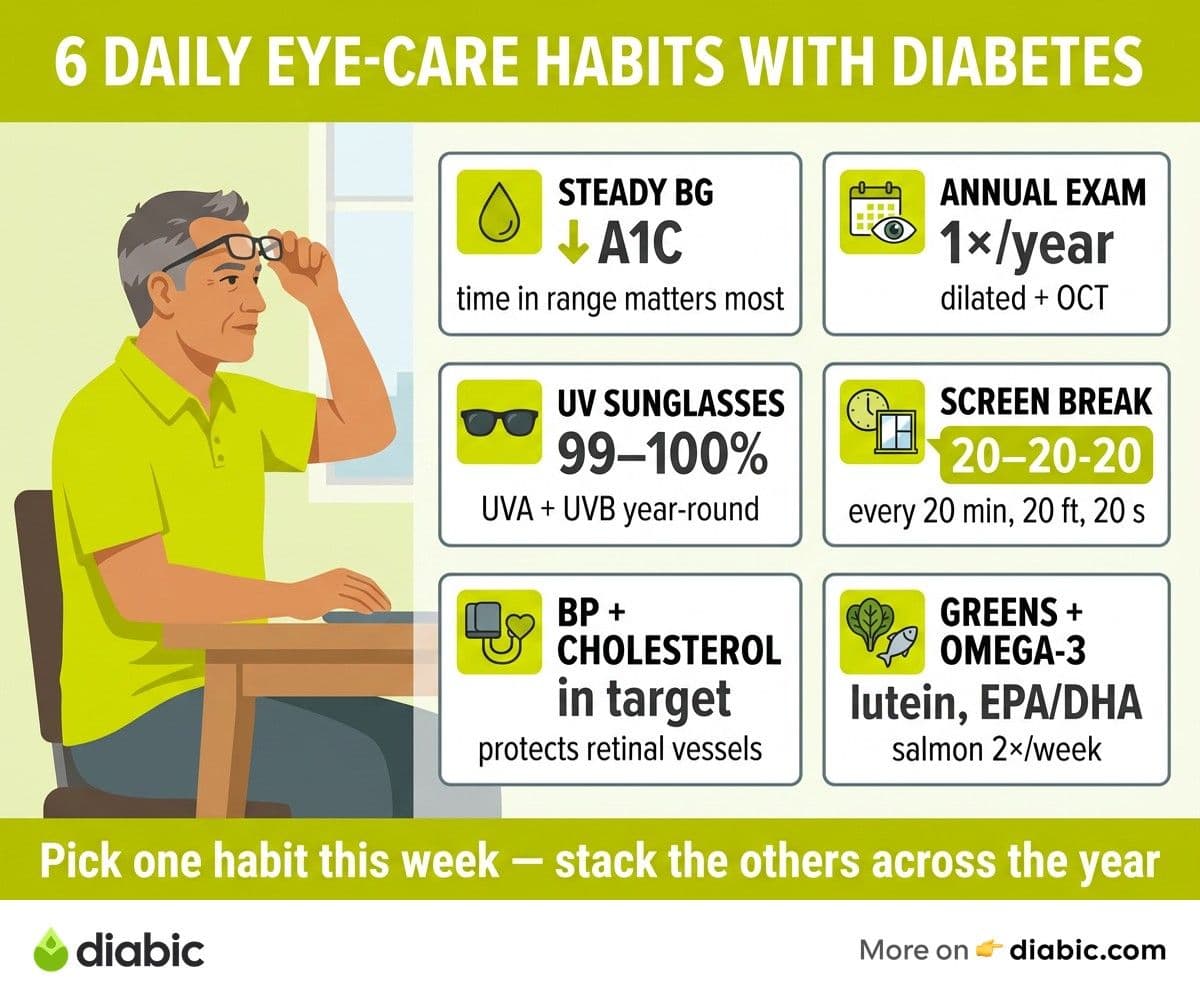
The most protective daily habits are keeping blood sugar steady, scheduling annual dilated eye exams, wearing UV-blocking sunglasses, taking screen breaks, managing blood pressure and cholesterol, and eating leafy greens and omega-3 rich foods. None of these alone is a guarantee, but practiced together over years they substantially reduce the risk of diabetic eye disease.
What eye care habits help prevent diabetic eye problems?
Steady blood sugar is the foundation. Annual dilated eye exams catch problems before symptoms appear. UV-blocking sunglasses reduce cataract risk. The 20-20-20 rule for screens reduces eye strain. Blood pressure and cholesterol management protect retinal vessels. Knowing the warning signs of urgent vision changes lets you act fast when something does shift.
Are there foods that specifically help diabetes eye health?
Leafy greens like spinach and kale are rich in lutein and zeaxanthin, which concentrate in the macula. Omega-3 rich fish such as salmon and sardines support retinal cell health. Colorful fruits and vegetables provide antioxidants that protect retinal tissue. None of these are magic, but consistently including them alongside the other diabetes eye care tips above may help support long-term vision.
Shahriar P. Shuvo is the founder of Diabic. He has lived with diabetes for over 14 years, and built Diabic to deliver the practical, evidence-based self-management tools he wished existed when he was first diagnosed. By trade, Shahriar is a senior design and frontend engineer with 6+ years shipping products at Agora, Timescale (now Tiger Data), and ShareTrip. He writes from the intersection of lived diabetes experience and product craft, focused on what works in daily management rather than what sounds good in a textbook.
Medically reviewed by
Dr. Rezwana Parvin Rumpa is an obstetrics and gynaecology specialist with clinical focus on gestational diabetes, PCOS, and fertility. She holds the MRCOG (Final Part) from the Royal College of Obstetricians and Gynaecologists in London, the MRCPI (Final Part) from the Royal College of Physicians of Ireland, and an MBBS from Shaheed Monsur Ali Medical College under Dhaka University. Dr. Rumpa serves as a Senior Medical Officer in the Obs and Gynae department at BRB Hospitals Ltd, where she has spent three years managing prenatal care, emergency obstetric cases, and women's-health surgery. On Diabic, she medically reviews content for women living with diabetes, with particular attention to pregnancy, PCOS, and reproductive-health intersections.
More from Health & Complications
View all
Diabetes and Dental Implants: What to Know First
Diabetes dental implants guide covering safety, A1C targets, recovery expectations, gum health prep, and what to ask your oral surgeon before surgery.

Burning Mouth Syndrome and Diabetes Explained
Burning mouth syndrome diabetes link explained, including neuropathy, dry mouth, and thrush causes plus treatment options that may bring real relief.

Dental Care for people with diabetes: Tips That Help
Practical dental care diabetics need, with real tips for protecting teeth and gums when diabetes raises your risk for oral health problems.
Clinician-reviewed habits, plain-language guides, and honest answers - the small shifts that make living with diabetes feel lighter, every day.