Gestational Diabetes Symptoms Most Women Miss
Most gestational diabetes symptoms hide inside normal pregnancy discomforts. Learn which signs deserve a closer look and why screening matters more than.

In this article(10)
Pregnancy already comes with a long list of new sensations. Extra trips to the bathroom, surges of fatigue, weird thirst at 2 a.m. Most of the time, those things are just pregnancy doing its work. Sometimes, though, they are quiet gestational diabetes symptoms hiding inside what looks like business as usual.
That overlap is exactly why so many women miss the early signs. There is no flashing alarm, no obvious before-and-after moment. The body adapts to pregnancy and to rising blood sugar at the same time, and the two changes blur together.
We wrote this guide for the parent who has Googled at midnight wondering if something feels off. The honest answer is that symptoms alone are not a reliable way to catch gestational diabetes, and that is exactly why universal screening exists. Knowing what to watch for and what to expect from testing puts you a few steps ahead.
Common Gestational Diabetes Symptoms
When gestational diabetes does cause noticeable symptoms, they tend to mirror the things you might already be feeling in pregnancy. That is the trap. Each one in isolation looks normal. Together, or unusually intense, they may be worth mentioning at your next prenatal visit.
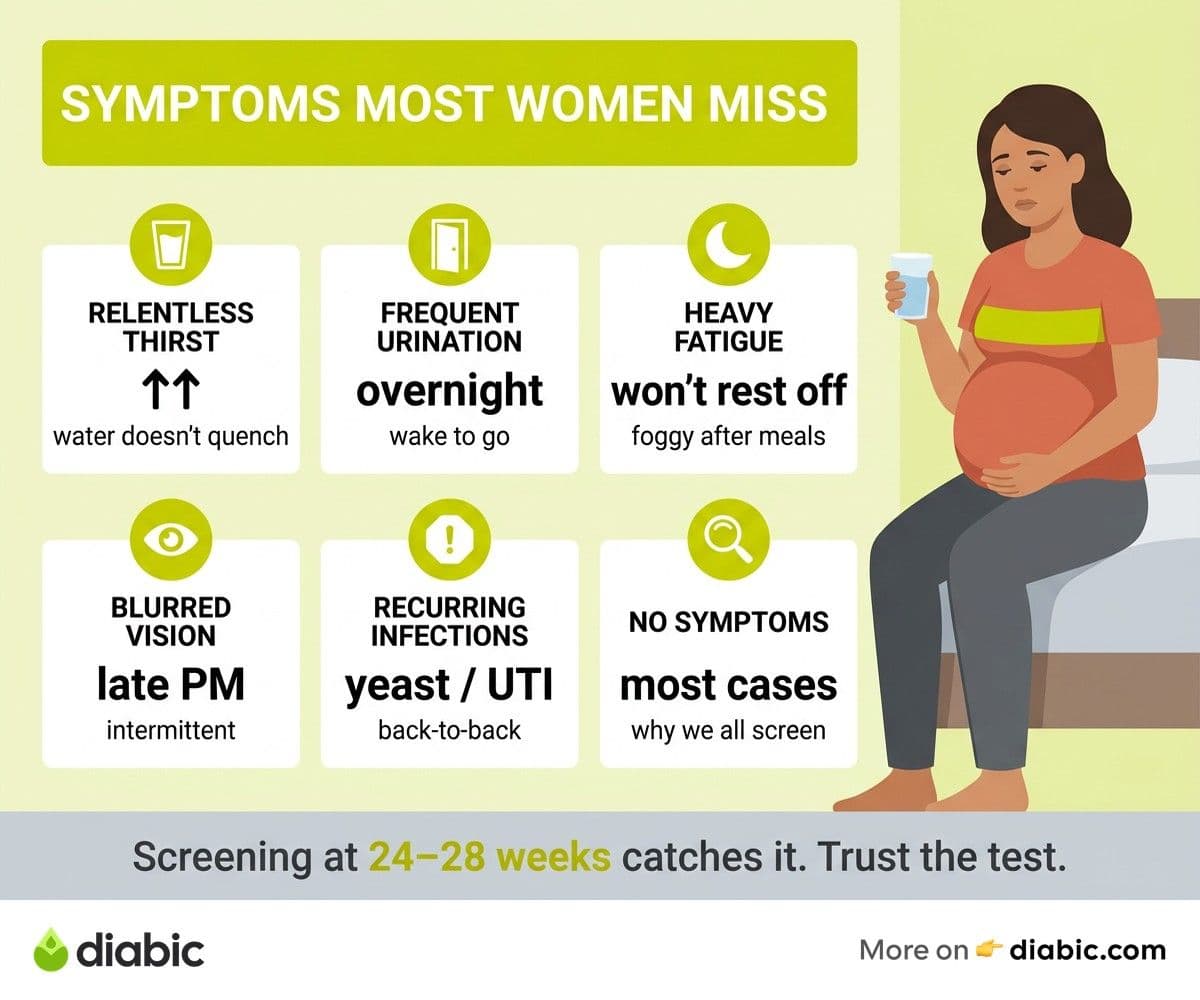
Increased thirst is one of the most reported signs. Pregnancy raises your fluid needs, so some extra thirst is expected. The signal to pay attention to is thirst that feels relentless, the kind where a full glass of water barely touches it. The NIDDK lists this alongside frequent urination as the most commonly described symptoms when symptoms appear at all.
Frequent urination is the second half of that pair. Most pregnant people are already going more often, especially in the first and third trimesters. What stands out with gestational diabetes is urination that goes beyond the usual rhythm, including waking multiple times overnight even when you have not had much to drink.
Fatigue that feels disproportionate is harder to pin down. Pregnancy fatigue is real and exhausting on its own. The version that may signal blood sugar trouble feels heavier, less responsive to rest, and sometimes pairs with a foggy or slightly off-balance feeling after meals. Blurred vision and recurring infections, particularly yeast infections or urinary tract infections, can also show up because elevated glucose creates conditions where these issues thrive.
Why Symptoms of Gestational Diabetes Are Easy to Miss
Pregnancy itself produces nearly every classic symptom of gestational diabetes. Hormones shift fluid balance, kidneys filter more blood, the growing uterus presses on the bladder, and energy demands surge. A reasonable person would chalk all of it up to pregnancy and move on, which is exactly what most women do.
The bigger reason symptoms slip past, though, is that the majority of women with gestational diabetes do not have symptoms at all. Their blood sugar can be elevated enough to require treatment without producing any noticeable feeling in their body. This is similar to other diabetes symptoms that sneak up on you outside of pregnancy, where the condition does its work quietly for months before anyone notices.
Assuming you would feel something if your blood sugar were high is one of the most common misunderstandings about gestational diabetes. Your placenta, your kidneys, your liver, and your insulin response are all making rapid adjustments behind the scenes. The body is remarkably good at compensating, right up until it cannot.
The takeaway is not to be on high alert for every twinge. It is to take screening seriously and trust the test more than you trust how you feel.
What Are the First Signs of Gestational Diabetes?
For most women, the honest answer is that there are no clear first signs. Gestational diabetes typically develops in the second trimester, between weeks 24 and 28, as the placenta produces hormones that increase insulin resistance. The body responds by ramping up insulin production, and for many women, that internal balance holds. For some, it does not.
When subtle changes do appear before screening, they tend to be vague. A sense of needing more water than usual. A feeling that fatigue has shifted from the foggy first trimester tiredness into something heavier and harder to shake. Slight blurring of vision in the late afternoon. None of these are diagnostic, and most have ordinary explanations.
The real reason early detection matters is not because waiting for symptoms works. It does not. Waiting for symptoms means missing weeks or months where blood sugar was elevated and could have been managed. Glucose testing is what catches gestational diabetes reliably, which is why it is built into standard prenatal care.
If something feels meaningfully off in your body, mention it to your provider sooner rather than later. They may move your screening earlier or repeat it. You are not being dramatic for asking.
Can You Have Gestational Diabetes Without Symptoms?
Yes, and this is actually the most common scenario. According to the American Diabetes Association, most women with gestational diabetes have no obvious symptoms before screening. The condition is detected because of routine testing, not because anything felt wrong.
This is also why universal screening is the standard recommendation. The American College of Obstetricians and Gynecologists advises that all pregnant people be screened for gestational diabetes between 24 and 28 weeks, regardless of symptoms or perceived risk. The recommendation exists precisely because symptom-based detection misses too many cases.
Silent gestational diabetes still affects the baby. Elevated blood sugar in the parent crosses the placenta and can cause the baby to grow larger than expected, raise the risk of preterm birth, and lead to low blood sugar in the newborn after delivery. None of this is meant to scare anyone, and most outcomes with diagnosed and managed gestational diabetes are excellent. The point is simply that absence of symptoms is not the same as absence of the condition.
If you have already passed your screening with normal results, that is genuinely reassuring. If your test is coming up, knowing what to expect can take the edge off.
The Role of Glucose Testing in Pregnancy
The standard screening process happens in two possible steps. Most providers start with the one-hour glucose challenge test, where you drink a sweet liquid containing 50 grams of glucose and have your blood drawn an hour later. If the result is above the cutoff, you move to the three-hour glucose tolerance test for confirmation.
Some women are screened earlier, often at the first prenatal visit, if they have risk factors. These include a previous gestational diabetes diagnosis, a BMI in the obesity range, a family history of type 2 diabetes, or a history of polycystic ovary syndrome. Earlier screening lets you start management sooner if needed.
The test itself is not anyone's favorite part of pregnancy. The drink is sweet and a little chalky. Some people feel briefly queasy or jittery. Most are fine. For a fuller walk-through, including tips that have helped real parents, our piece on what to expect from the glucose test covers the practical side.
If you do receive a gestational diabetes diagnosis, the path forward is well established and almost always manageable through some combination of nutrition, movement, blood sugar monitoring, and sometimes medication. Our calm guide to gestational diabetes lays out what the next weeks tend to look like.
What to Do If You Notice These Symptoms
If something in this article matched your experience, the next step is not to spiral. It is to mention it to your provider. A short message through your patient portal or a note at your next visit is enough to start the conversation.
Your provider may move your screening earlier, run a fasting glucose, or simply reassure you that what you are describing is within the range of normal pregnancy. Either answer is useful. Testing gives you certainty, and certainty is much easier to act on than a vague worry.
Early management leads to better outcomes for both parent and baby. That is the most important thing to know. Catching gestational diabetes at week 26 instead of week 36 gives you ten extra weeks of steadier blood sugar, and those weeks matter for fetal growth, delivery planning, and how you feel day to day.
From my experience: I have lived with diabetes for fourteen years, and one of the things I tell every pregnant friend who asks is that the glucose test is worth taking seriously, even when everything feels fine. Feeling fine is not data. The number on the lab report is data. There is a real relief that comes from knowing one way or the other.
FAQ
What are the first signs of gestational diabetes?
Most women do not experience obvious first signs. When symptoms do appear, they may include unusual thirst, frequent urination beyond what is typical for pregnancy, and excessive fatigue. Routine glucose screening between 24 and 28 weeks is the most reliable detection method, which is why it is part of standard prenatal care.
Can you have gestational diabetes without symptoms?
Yes. The majority of women with gestational diabetes have no noticeable symptoms, which is why universal glucose screening during pregnancy is standard medical practice. Silent gestational diabetes can still affect fetal growth and delivery, which is why testing matters even when you feel completely well.
Should I ask for earlier screening?
If you have risk factors such as a previous gestational diabetes diagnosis, a family history of type 2 diabetes, a BMI in the obesity range, or a history of polycystic ovary syndrome, talk to your provider about screening at your first prenatal visit. Many providers already screen high-risk patients earlier, but it is reasonable to ask.
Pregnancy asks a lot of your body and your attention, and gestational diabetes symptoms have a way of hiding in plain sight. Trusting the screening process more than you trust how you feel is one of the kinder things you can do for yourself this season.
Dr. Rezwana Parvin Rumpa is an obstetrics and gynaecology specialist with clinical focus on gestational diabetes, PCOS, and fertility. She holds the MRCOG (Final Part) from the Royal College of Obstetricians and Gynaecologists in London, the MRCPI (Final Part) from the Royal College of Physicians of Ireland, and an MBBS from Shaheed Monsur Ali Medical College under Dhaka University. Dr. Rumpa serves as a Senior Medical Officer in the Obs and Gynae department at BRB Hospitals Ltd, where she has spent three years managing prenatal care, emergency obstetric cases, and women's-health surgery. On Diabic, she medically reviews content for women living with diabetes, with particular attention to pregnancy, PCOS, and reproductive-health intersections.
Medically reviewed by
Dr. Shanto Arian is an internal medicine physician now specializing in clinical and aesthetic dermatology, with a parallel academic focus on epidemiology and public health. He holds an MBBS, MPH, MSc (UK), MRCP (UK), MRCPI (Ireland), Diploma in Dermatology (UK), and Diploma in Aesthetic Medicine (USA). Dr. Arian trained in internal medicine, including hospital work on hematology cases such as graft-versus-host disease, before moving toward dermatology. Skin is one of the earliest places diabetes shows itself, from acanthosis nigricans and diabetic dermopathy to slow foot wound healing, and that intersection is where his clinical and Diabic-review work meet. On Diabic, Dr. Arian medically reviews content on diabetes diagnosis, complications, dermatologic manifestations, and pharmacotherapy, ensuring every claim aligns with current ADA, NICE, and peer-reviewed literature.
More from Diabetes Knowledge
View all
6 Safe Dessert for Gestational Diabetes Recipes You Can
Six dessert for gestational diabetes recipes that satisfy your sweet tooth without spiking blood sugar, with carb counts and pairing tips you can use.

8 High Fiber Foods That Help with Prediabetes
Add these 8 high fiber foods for prediabetes to slow glucose absorption, support steady blood sugar, and meet the daily fiber target most people miss.

Mediterranean Diet for Prediabetes: A Practical Guide
The mediterranean diet for prediabetes is one of the best-studied eating patterns for prevention. Here is what to eat, what to avoid, and how to start.
Clinician-reviewed habits, plain-language guides, and honest answers - the small shifts that make living with diabetes feel lighter, every day.