8 Diabetes Symptoms That Sneak Up: Spot Them Early
Diabetes symptoms often look like ordinary tiredness or stress. Here are 8 warning signs to recognize early, plus when to call your doctor.

In this article(18)
Most diabetes symptoms develop so gradually that people write them off as stress, aging, or a rough week. By the time the pattern becomes obvious, blood sugar has often been elevated for months or even years. That delay is one of the main reasons roughly one in five adults living with diabetes in the United States does not yet know they have it.
Recognizing the warning signs earlier can change a lot, including how soon treatment starts, how much damage is prevented, and how reversible the situation still is. The eight symptoms below are the ones that sneak past most people, often because each one looks ordinary on its own.
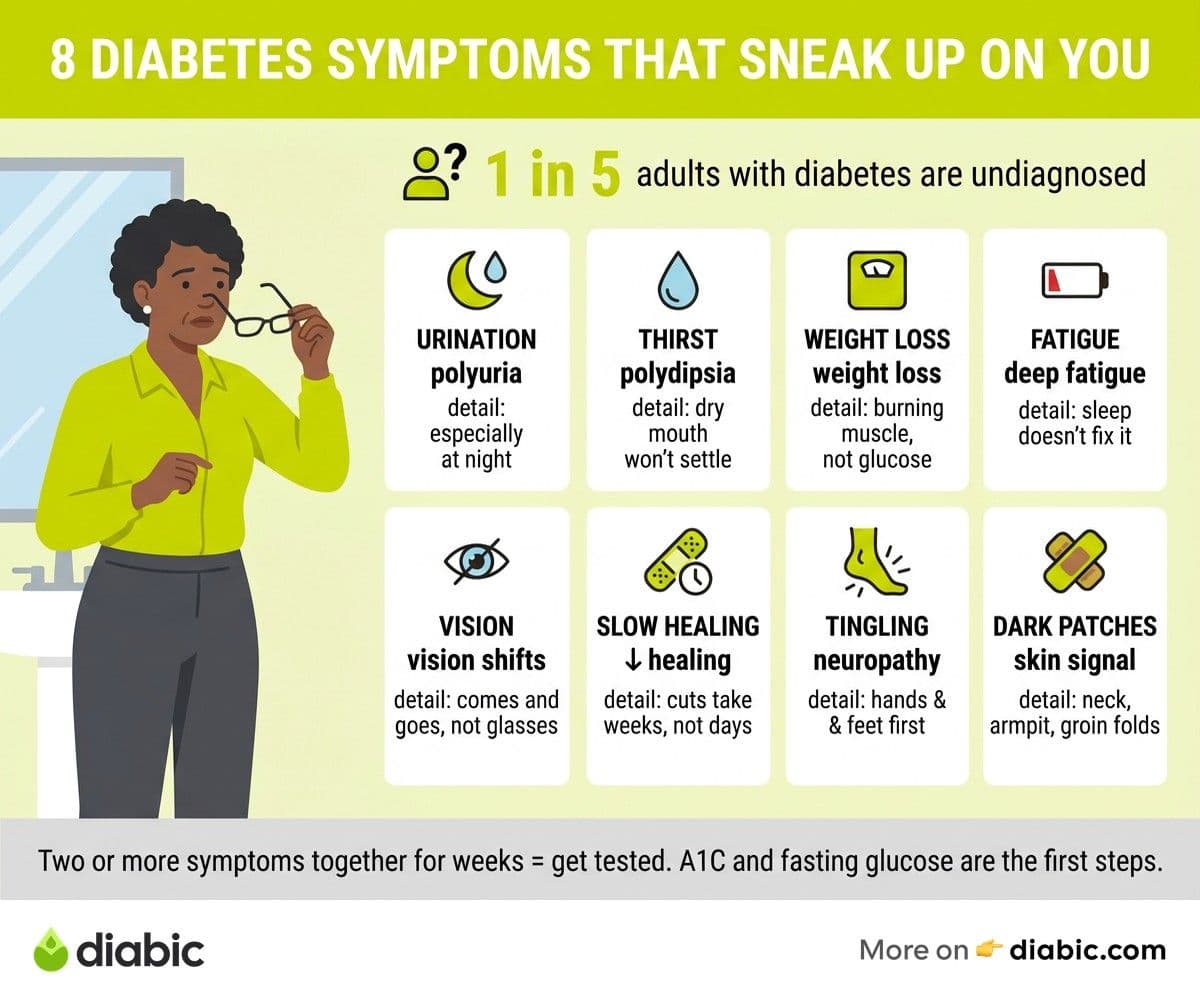
The 8 Diabetes Symptoms Most People Miss
These are the symptoms of diabetes that consistently appear on the American Diabetes Association and Mayo Clinic lists. Read them as a pattern, not a checklist. A single symptom rarely points to diabetes on its own, but two or three appearing together over a few weeks is worth investigating.
1. Frequent urination, especially at night
When blood sugar runs high, the kidneys work harder to filter out the excess glucose, and that extra water gets flushed with it. The medical term is polyuria. People often notice it as needing to get up two or three times a night, after years of sleeping through.
2. Unquenchable thirst
The fluid loss from frequent urination triggers thirst that does not seem to settle, even after a full glass of water. This is polydipsia, and it usually shows up alongside the bathroom trips. People sometimes describe it as a dry mouth that will not go away.
3. Unexplained weight loss
Type 1 diabetes can cause noticeable weight loss in weeks. Type 2 can do the same more slowly. When cells cannot use glucose for energy, the body starts breaking down muscle and fat, and the scale moves down even when appetite stays the same or increases.
4. Fatigue that sleep does not fix
Persistent tiredness is one of the most ignored symptoms because everyone is tired sometimes. With diabetes, the fatigue tends to be deeper and unrelated to sleep quality. The body is essentially running on a fuel it cannot fully use.
5. Blurred vision that comes and goes
High blood sugar pulls fluid into the lens of the eye, changing its shape and blurring vision. The blur often shifts as blood sugar swings. People sometimes assume they need new glasses, get a prescription, then find their vision changes again a month later.
6. Slow-healing cuts and bruises
Elevated blood sugar interferes with circulation and immune function, both of which the body needs to repair tissue. Small cuts that used to heal in a few days may take a week or more, and minor scrapes can become more easily infected.
7. Tingling or numbness in hands and feet
Persistent high blood sugar damages nerves over time, a condition called peripheral neuropathy. Early signs include pins and needles, burning, or numbness, often starting in the toes and feet before moving up the legs or appearing in the hands.
8. Dark patches of skin
Acanthosis nigricans is the medical name for velvety, darker patches of skin that often show up around the neck, armpits, or groin. It is associated with insulin resistance and can appear well before a diabetes diagnosis. It is one of the few signs you can sometimes see in the mirror.
Why These Signs of Diabetes Go Unnoticed
The signs of diabetes overlap with so many ordinary complaints that people rarely connect the dots. Tired? Long week. Thirsty? Hot day. Up at night? Stress. Each symptom has at least one perfectly innocent explanation, which is why the CDC emphasizes screening as the most reliable way to catch type 2 diabetes early.
The gradual onset matters too. Type 2 diabetes usually develops over years, not weeks. Blood sugar creeps up slowly, the body adapts to feeling slightly off, and there is no single dramatic moment that says "go to the doctor today." Many people only realize how unwell they had been feeling after their numbers normalize and the fatigue lifts.
The picture is different in type 1 diabetes, which can develop quickly, sometimes within weeks. Symptoms in type 1 tend to be more dramatic, including rapid weight loss and intense thirst, and they are more likely to push someone into urgent care. The differences between type 1 vs type 2 diabetes explain why the two conditions can look so different even though both involve elevated blood sugar.
People who have already noticed one or two changes often dismiss them until a third or fourth piles on. The diabetes symptoms that finally push someone to call a doctor are usually the ones that have been quietly stacking up for months. If something on this list rings a bell, it is worth pairing with our list of signs of diabetes that are easy to miss to see whether a fuller pattern is emerging.
When the Warning Signs Become Urgent
Most warning signs develop slowly, but some demand same-day attention. Very high blood sugar can tip into two emergencies that need immediate care, particularly in people who do not yet know they have diabetes.
In type 1 diabetes, the most dangerous acute complication is diabetic ketoacidosis, or DKA. The NIDDK describes warning signs that include fruity-smelling breath, rapid breathing, nausea or vomiting, abdominal pain, and confusion. DKA is a medical emergency. Anyone with these symptoms, especially alongside very high blood sugar, should go to the emergency room. Our breakdown of DKA warning signs covers what to watch for.
In type 2 diabetes, the parallel emergency is hyperglycemic hyperosmolar syndrome, or HHS. It usually develops more slowly than DKA, often over days, and tends to affect older adults. Signs include extreme thirst, very high blood sugar, dry mouth, weakness on one side of the body, and altered mental state. HHS is also a medical emergency and requires hospital treatment.
For non-emergency symptoms, the rule of thumb is simpler. If symptoms have been present for a few weeks, schedule a regular appointment with your primary care provider rather than going to urgent care. If symptoms are escalating quickly or include any of the DKA or HHS signs, do not wait.
What to Do if You Recognize These Signs
The first step is straightforward: ask your doctor for a fasting blood glucose test, an A1C test, or both. Both are simple blood draws, widely available, and usually covered by insurance. They are also the only reliable way to confirm or rule out diabetes, since symptoms alone are not enough to diagnose.
While you wait for the appointment, keep a brief symptom journal. Note when symptoms occur, how often, what you were doing, and whether anything seems to make them better or worse. A week of notes gives your doctor a much clearer picture than trying to remember from the exam table.
Avoid the temptation to self-diagnose with an at-home glucose meter unless you know how to interpret the readings. Single readings can mislead in either direction, and a normal reading on a home meter does not rule out prediabetes or diabetes. Our guide to early signs of diabetes covers what to bring to your appointment to make it more productive.
Delay is the costly part. Even if a diagnosis confirms diabetes, catching it earlier means less time spent at high blood sugar levels, which directly reduces the risk of complications down the road.
Who Is at Higher Risk for Undetected Diabetes
Some people are more likely to carry undiagnosed diabetes than others. Knowing your risk profile makes it easier to push for screening even when you feel fine.
Higher-risk groups include:
- People with a parent or sibling who has type 2 diabetes
- Adults aged 35 and older, where routine screening is recommended
- People who are overweight or have a higher waist circumference
- People of Black, Hispanic or Latino, Native American, Asian American, or Pacific Islander descent, who face higher rates of type 2 diabetes
- People with a history of gestational diabetes or a baby weighing over 9 pounds at birth
- People with PCOS, high blood pressure, or unfavorable cholesterol numbers
Warning signs can also present differently in women, including more frequent yeast and urinary tract infections that do not clear easily. Our coverage of how the picture looks different in women walks through patterns that are easy to attribute to other conditions.
Prediabetes deserves a mention here too. The early signs of diabetes and the early signs of prediabetes are nearly identical, since both involve elevated blood sugar. Catching either one earlier opens the same window for intervention.
From my experience: in the months before my diagnosis 14 years ago, the symptom I most underestimated was the fatigue. I assumed it was the workload, the season, the schedule. The thirst and bathroom trips were obvious in hindsight, but the fatigue had been there for at least six months by the time I connected it to anything else. Trust the persistent feeling that something is off. It is almost always trying to tell you something useful.
FAQ
What are the most common warning signs?
The most common signs of the condition include frequent urination, excessive thirst, unexplained weight loss, persistent fatigue, blurred vision, and slow wound healing. Some people also notice tingling in their extremities or darkened skin patches around the neck and armpits. A blood test is the only way to confirm a diagnosis.
What is diabetes and how does it show up?
Diabetes is a metabolic condition in which the body either cannot produce enough insulin (type 1) or cannot use insulin effectively (type 2), leading to elevated blood sugar. Early signals often include increased thirst, frequent trips to the bathroom, fatigue, and blurred vision, though they can be subtle enough to go unnoticed for months or even years.
Can you have diabetes without warning signs?
Yes, particularly with type 2 diabetes. Many people have elevated blood sugar for years before signals become noticeable, which is why routine screening is recommended for adults at higher risk. Some people are diagnosed only after a routine blood test or after a complication appears.
How long can these warning signs go unnoticed?
For type 2 diabetes, warning signs can be present quietly for several years before they become noticeable. Type 1 onset tends to appear more quickly, often within weeks. The CDC estimates that about one in five US adults with diabetes does not know they have it, which highlights how easily early signals can be missed.
If any of these diabetes symptoms felt familiar, the most useful next step is a short conversation with your doctor and a simple blood test. Knowing your number, even if everything turns out fine, is one of the most quietly powerful things you can do for the next decade of your health.
Shahriar P. Shuvo is the founder of Diabic. He has lived with diabetes for over 14 years, and built Diabic to deliver the practical, evidence-based self-management tools he wished existed when he was first diagnosed. By trade, Shahriar is a senior design and frontend engineer with 6+ years shipping products at Agora, Timescale (now Tiger Data), and ShareTrip. He writes from the intersection of lived diabetes experience and product craft, focused on what works in daily management rather than what sounds good in a textbook.
Medically reviewed by
Dr. Shanto Arian is an internal medicine physician now specializing in clinical and aesthetic dermatology, with a parallel academic focus on epidemiology and public health. He holds an MBBS, MPH, MSc (UK), MRCP (UK), MRCPI (Ireland), Diploma in Dermatology (UK), and Diploma in Aesthetic Medicine (USA). Dr. Arian trained in internal medicine, including hospital work on hematology cases such as graft-versus-host disease, before moving toward dermatology. Skin is one of the earliest places diabetes shows itself, from acanthosis nigricans and diabetic dermopathy to slow foot wound healing, and that intersection is where his clinical and Diabic-review work meet. On Diabic, Dr. Arian medically reviews content on diabetes diagnosis, complications, dermatologic manifestations, and pharmacotherapy, ensuring every claim aligns with current ADA, NICE, and peer-reviewed literature.
More from Diabetes Knowledge
View all
6 Safe Dessert for Gestational Diabetes Recipes You Can
Six dessert for gestational diabetes recipes that satisfy your sweet tooth without spiking blood sugar, with carb counts and pairing tips you can use.

8 High Fiber Foods That Help with Prediabetes
Add these 8 high fiber foods for prediabetes to slow glucose absorption, support steady blood sugar, and meet the daily fiber target most people miss.

Mediterranean Diet for Prediabetes: A Practical Guide
The mediterranean diet for prediabetes is one of the best-studied eating patterns for prevention. Here is what to eat, what to avoid, and how to start.
Clinician-reviewed habits, plain-language guides, and honest answers - the small shifts that make living with diabetes feel lighter, every day.