What to Expect From Your Glucose Test in Pregnancy
A clear walkthrough of the glucose test pregnancy appointment: how to prepare, what happens at the lab, what your numbers mean, and what comes next.

In this article(30)
If you have a glucose test pregnancy appointment coming up, knowing what to expect can quiet a lot of the mental noise. The test itself is routine, fairly quick, and one of the most reliable ways to keep both you and your baby healthy through the second half of pregnancy. Most people leave the lab feeling fine, even if the sweet drink takes some getting used to.
We hear from a lot of expecting parents who feel anxious less about the needle and more about the unknown. What is in the drink? Why are there two different versions of the test? What happens if a number comes back high? This guide walks through all of it in plain language so you can show up prepared and leave with a clearer picture of what your results actually mean.
What Happens During a Glucose Test in Pregnancy
There are two versions of the glucose test, and they serve different jobs. The first is a screening test, and the second is a diagnostic follow-up only if the first comes back elevated. Most people only ever take the screening version.
The one-hour glucose challenge test
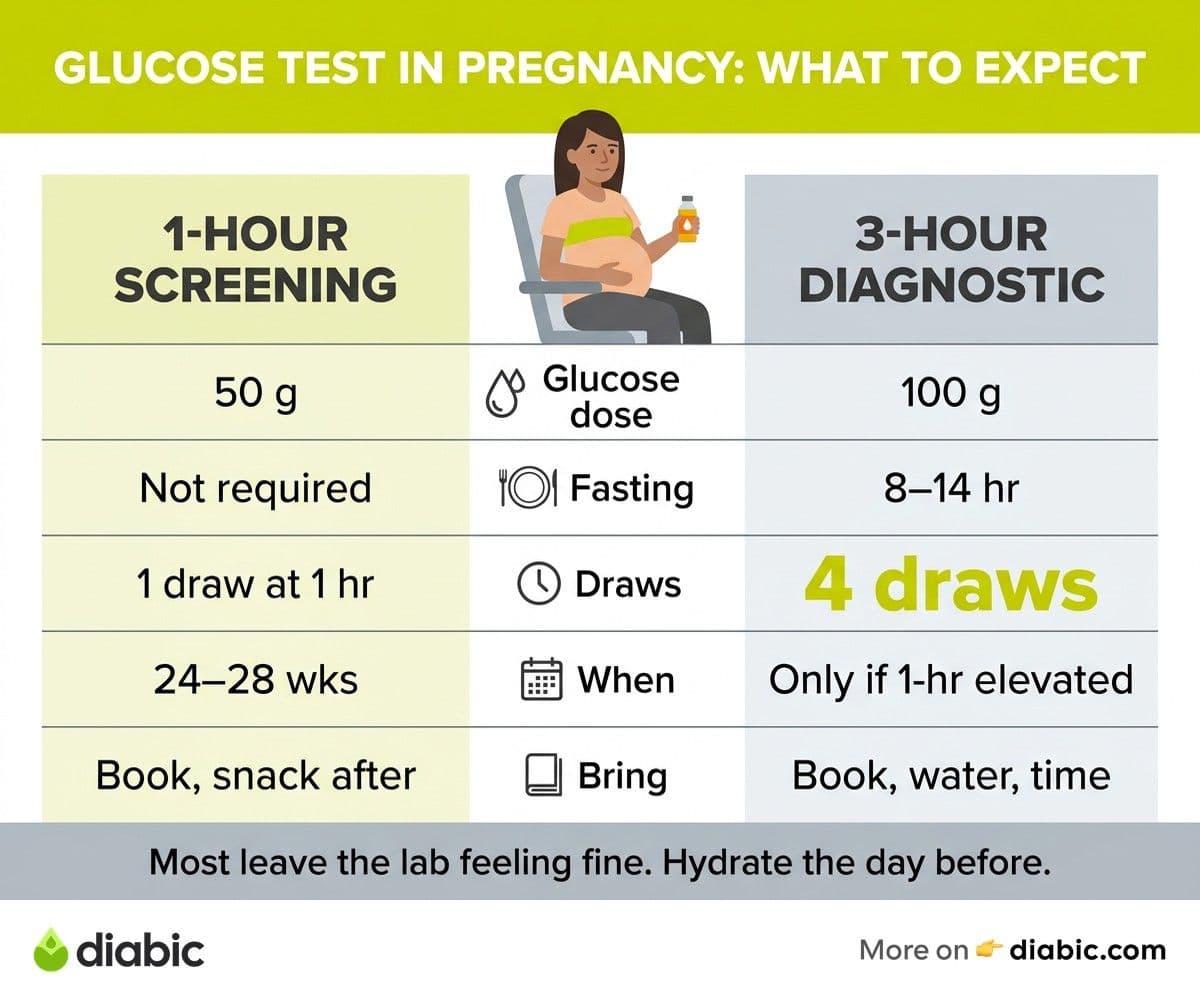
The one-hour glucose challenge test is the standard screening tool, usually given between 24 and 28 weeks of pregnancy. You drink a sweet liquid containing 50 grams of glucose, then sit and wait for one hour. After the hour is up, a technician draws a single blood sample and sends it to the lab.
You do not need to fast for this version. You can eat breakfast, take your prenatal vitamin, and go about your morning normally before heading in. The whole appointment usually takes about 75 to 90 minutes from check-in to walking out the door.
The three-hour glucose tolerance test
The three-hour glucose tolerance test is the diagnostic version. Your provider only orders it if your one-hour result was above the lab's threshold. This test uses a stronger 100-gram glucose drink and requires fasting for at least 8 hours beforehand.
A baseline blood sample is drawn first, then you drink the solution. After that, blood is drawn at the one-hour, two-hour, and three-hour marks. According to the NIDDK overview of glucose tolerance testing, this multi-point measurement gives a much more complete picture of how your body handles sugar over time.
What they actually measure
In both tests, the lab is measuring how high your blood glucose climbs after a known sugar load and how well your body brings it back down. During pregnancy, hormones from the placenta naturally make insulin work less efficiently. The test reveals whether that normal shift has tipped into something that needs closer attention.
How to Prepare for a Glucose Test Pregnancy Appointment
Preparation is short and simple, but the right prep depends on which test you are taking. A few small choices the day before can make the experience more comfortable.
Fasting versus non-fasting
For the one-hour screening test, no fasting is required. Eat normally that morning. For the three-hour test, you will fast for 8 to 14 hours, usually overnight, and only sip plain water during that window.
Some clinics ask you to follow a carbohydrate-rich diet for three days before the three-hour test. This is to make sure your results reflect your typical metabolism, not a recent low-carb stretch. Ask your provider if this applies to you.
What to eat before the screening test
A balanced breakfast with protein, fat, and some carbohydrate can help reduce nausea after the drink. Think eggs with toast, Greek yogurt with berries, or a peanut butter sandwich. Avoid loading up on sugar before the test, since a large dessert or sugary cereal could artificially push your numbers higher.
Stay well hydrated the day before. Easy-to-find veins make the blood draw quicker, and water also helps blunt the queasy feeling some people get from the glucose drink.
What to bring to the appointment
Bring a book, headphones, or a fully charged phone. The waiting period is the longest part of the appointment, and you will not be allowed to leave the clinic during the hour or three-hour window. Snacks are off-limits during the wait, but you can pack something to eat the moment your last draw is done.
Understanding Your Glucose Test Results
The numbers can feel cryptic at first glance, but the framework is straightforward. Each test has thresholds, and your provider will compare your blood sugar to those benchmarks.
Normal versus elevated numbers
For the one-hour screening test, most labs use a cutoff of 130 to 140 mg/dL. Anything at or above the threshold is considered elevated and triggers the three-hour follow-up. The exact number varies by clinic, so ask which threshold yours uses.
For the three-hour test, providers look at four blood draws. According to ACOG screening guidelines, commonly used thresholds are roughly 95 mg/dL fasting, 180 mg/dL at one hour, 155 mg/dL at two hours, and 140 mg/dL at three hours. If two or more of your readings meet or exceed these levels, that meets the diagnostic criteria for gestational diabetes.
If you want to dig deeper into how blood sugar numbers are interpreted in non-pregnancy contexts too, what your prediabetes A1C number means offers a useful frame of reference for how labs categorize glucose levels.
What it means to "fail" the one-hour test
About 15 to 25 percent of people who take the one-hour screening test get an elevated result. That sounds like a lot, and it is, because the screening is intentionally set to catch as many possible cases as it can. A high one-hour number does not mean you have gestational diabetes. It only means more information is needed.
Of those who go on to take the three-hour test, only a fraction are actually diagnosed. Try not to spiral after a "failed" screening. The follow-up exists precisely because the screen alone is not specific enough to make a diagnosis.
Why the three-hour test gives a clearer picture
The screening test takes one snapshot. The three-hour test takes four, plus a fasting baseline, so it captures the full arc of how your body handles a much larger sugar load. That fuller view is what lets your provider make a confident call.
What Does It Mean If You Fail the Glucose Test
The word "fail" is a bit misleading here. An elevated screening result is a flag, not a diagnosis. The screening test is designed to err on the side of catching too many people rather than missing anyone who actually has gestational diabetes.
If your one-hour number is high, your provider will schedule the three-hour diagnostic test, usually within a week or two. Plenty of people who fail the screening pass the three-hour test with normal numbers. Their bodies simply reacted to that specific sugar challenge in a particular moment.
If the three-hour test does confirm gestational diabetes, the next steps are typically appointments with a diabetes educator and a dietitian. You may also be asked to start checking your blood sugar at home a few times a day. Most people manage gestational diabetes with diet and movement alone, and treatment is short-term, ending with delivery.
Gestational Diabetes Diagnosis After Testing
A formal gestational diabetes diagnosis comes from the three-hour test or, in some clinics, from a one-step alternative protocol. The criteria are well defined, and your provider will walk you through what your specific numbers mean.
How doctors use the results
Per the ADA Standards of Care for gestational diabetes screening, most U.S. clinics follow the two-step approach: a 50-gram one-hour screen followed by the 100-gram three-hour diagnostic test if the screen is elevated. A single elevated value on the three-hour test usually warrants a repeat or close monitoring, while two or more elevated values lead to a diagnosis.
Some practices use the alternative one-step approach with a 75-gram, two-hour test. If even one value is elevated on this version, gestational diabetes is diagnosed. Both approaches are evidence-based, just different in how they sort cases.
The criteria for a diagnosis
The diagnostic thresholds are based on research linking specific glucose levels to pregnancy outcomes. They are not arbitrary, and they have been refined over decades. If your numbers cross the line, your care team will explain exactly which thresholds you met and what the next steps look like.
If a diagnosis does happen, our calm guide to gestational diabetes walks through the day-to-day of management without the doom-and-gloom framing.
Why early diagnosis matters
Catching gestational diabetes early gives you the most time to manage blood sugar before it can affect baby's growth, delivery, or your own postpartum metabolic health. Most people who follow their care plan have healthy pregnancies and babies. The earlier the team knows, the smoother that plan tends to go.
Gestational Diabetes Symptoms vs Test Results
One of the trickier things about gestational diabetes is that most people who have it feel completely normal. There are no flashing warning signs, which is exactly why universal screening exists.
Why some have symptoms while most do not
A small number of pregnant people notice unusual thirst, more frequent urination, or fatigue beyond the usual pregnancy tiredness. Even then, those symptoms overlap so much with normal pregnancy changes that they rarely stand out. The classic gestational diabetes symptoms most providers list are subtle and easy to miss, especially in the second and third trimesters when fatigue and bathroom trips already feel constant.
If you want a deeper look at what to watch for, the gestational diabetes symptoms to know about covers the quieter signals that often get attributed to pregnancy itself.
How testing catches what symptoms miss
Routine screening exists because relying on symptoms alone would miss the majority of cases. Blood glucose elevation in pregnancy can be silent yet still affect baby's development. The test is what closes that gap.
That is why the screening is recommended for almost everyone, not just those with risk factors. A symptom-based approach simply would not catch enough cases in time to make a difference.
The case for routine screening
Universal screening also removes the guesswork around who is "high enough risk" to test. Race, weight, family history, and prior pregnancy outcomes all play a role, but they do not predict perfectly. Testing everyone keeps the process fair and thorough.
Tips for Getting Through the Test
The test itself is short. The waiting and the drink are usually what people dread. A few small adjustments make the appointment more bearable.
Managing the sugar drink
The drink tastes like flat orange or lemon-lime soda, only sweeter. Drinking it cold helps a lot, since cold dulls the sweetness on the palate. Sip steadily over the five minutes the lab gives you rather than chugging, which can trigger nausea.
If you tend to get queasy, a small balanced snack about an hour before the screening test can help your stomach handle the sugar load. Bring a barf bag in your purse just in case. It is not common to get sick, but having one tucked away takes the worry off the table.
From my experience: I have lived with diabetes for 14 years, and I still remember the first glucose tolerance test as one of the more uncomfortable mornings of my life. The trick that worked for me, and that I have since heard from a lot of pregnant clients in our community, is to walk slowly around the waiting area between draws when you are allowed to. Light movement keeps the queasy feeling at bay and helps your body process the glucose more steadily, which can also help your numbers reflect your true metabolic baseline.
Bringing entertainment for the wait
Download a podcast or two, queue up a show, or bring a book you have been meaning to start. The hour or three goes faster when your mind is occupied. Some people use the time to catch up on emails or call a friend.
Avoid pacing the lobby anxiously. Anxiety can affect blood sugar slightly, and being relaxed gives you the most accurate reading.
Staying calm about glucose test pregnancy results
Whatever your numbers turn out to be, they are information, not a verdict. A high screen leads to a follow-up. A diagnosis leads to a manageable plan. Pregnancy is full of moments where the data sounds scarier than it actually is, and the glucose test is one of them.
Most providers will call within a few days with results. If you do not hear back in a week, follow up. Knowing the number sooner takes the waiting weight off your shoulders.
FAQ
What happens during a glucose test in pregnancy?
You drink a sweet glucose solution and have your blood drawn after a set time. For the one-hour screening test, you wait 60 minutes for a single blood draw. For the three-hour diagnostic test, blood is drawn at fasting and again at one, two, and three hours after the drink. The lab measures how your body processes the sugar.
What does it mean if you fail the glucose test?
Failing the one-hour screening does not mean you have gestational diabetes. It means your blood sugar was above the cutoff and a more thorough three-hour test is needed for a clear answer. Many people who get an elevated screening result go on to pass the three-hour test with normal numbers.
Do I have to drink the whole glucose drink?
Yes. The dose is calibrated to match the test, and finishing the drink within the time the lab gives you (usually five minutes) is what makes the results valid. If you cannot keep it down, the test will need to be rescheduled.
Can I drink water during the wait?
Plain water is allowed during the waiting period for both tests. Skip coffee, tea, juice, and anything with sweetener, since they can affect the reading.
A glucose test pregnancy appointment is one of those moments that looms larger in the imagination than in reality. Walk in prepared, take the drink slowly, and remember that whatever the number says, it is the start of a conversation with your care team, not the end of one.
Dr. Rezwana Parvin Rumpa is an obstetrics and gynaecology specialist with clinical focus on gestational diabetes, PCOS, and fertility. She holds the MRCOG (Final Part) from the Royal College of Obstetricians and Gynaecologists in London, the MRCPI (Final Part) from the Royal College of Physicians of Ireland, and an MBBS from Shaheed Monsur Ali Medical College under Dhaka University. Dr. Rumpa serves as a Senior Medical Officer in the Obs and Gynae department at BRB Hospitals Ltd, where she has spent three years managing prenatal care, emergency obstetric cases, and women's-health surgery. On Diabic, she medically reviews content for women living with diabetes, with particular attention to pregnancy, PCOS, and reproductive-health intersections.
Medically reviewed by
Dr. Shanto Arian is an internal medicine physician now specializing in clinical and aesthetic dermatology, with a parallel academic focus on epidemiology and public health. He holds an MBBS, MPH, MSc (UK), MRCP (UK), MRCPI (Ireland), Diploma in Dermatology (UK), and Diploma in Aesthetic Medicine (USA). Dr. Arian trained in internal medicine, including hospital work on hematology cases such as graft-versus-host disease, before moving toward dermatology. Skin is one of the earliest places diabetes shows itself, from acanthosis nigricans and diabetic dermopathy to slow foot wound healing, and that intersection is where his clinical and Diabic-review work meet. On Diabic, Dr. Arian medically reviews content on diabetes diagnosis, complications, dermatologic manifestations, and pharmacotherapy, ensuring every claim aligns with current ADA, NICE, and peer-reviewed literature.
More from Diabetes Knowledge
View all
6 Safe Dessert for Gestational Diabetes Recipes You Can
Six dessert for gestational diabetes recipes that satisfy your sweet tooth without spiking blood sugar, with carb counts and pairing tips you can use.

8 High Fiber Foods That Help with Prediabetes
Add these 8 high fiber foods for prediabetes to slow glucose absorption, support steady blood sugar, and meet the daily fiber target most people miss.

Mediterranean Diet for Prediabetes: A Practical Guide
The mediterranean diet for prediabetes is one of the best-studied eating patterns for prevention. Here is what to eat, what to avoid, and how to start.
Clinician-reviewed habits, plain-language guides, and honest answers - the small shifts that make living with diabetes feel lighter, every day.