What Is Type 3 Diabetes? The Brain-Insulin Connection
Type 3 diabetes describes the proposed link between brain insulin resistance and Alzheimer's. Here's what the research actually says, and what it means.

In this article(8)
You may have come across the phrase type 3 diabetes in a podcast, a news headline, or a conversation with your doctor. The term sounds straightforward, like it should sit neatly between type 1 and type 2 on a chart. The reality is more interesting, and a little messier.
The label is not an official medical diagnosis. It is a research concept that describes the growing evidence that insulin resistance in the brain may play a role in Alzheimer's disease. For people already managing diabetes or supporting someone who is, this connection matters because it links daily blood sugar habits to long-term brain health.
We wanted to write something that respects both the science and the uncertainty. Below is what the research currently shows, what it does not yet prove, and what you can reasonably do with this information today.
What Type 3 Diabetes Refers To
The phrase was popularized in the mid-2000s by researchers studying insulin signaling in the brain. They noticed that brains affected by Alzheimer's disease showed patterns of insulin resistance similar to what happens in the body during type 2 diabetes. That parallel led some scientists to propose a new label for Alzheimer's, framing it as a metabolic disease of the brain.
It is worth being clear: the World Health Organization, the NIDDK, and the American Diabetes Association do not currently recognize this label as a clinical diagnosis. Your doctor will not test for it, and you will not see it on a lab result. The term lives mainly in research papers and in popular health writing.
That said, the underlying science is real. The brain uses insulin to support memory formation, learning, and the basic energy demands of nerve cells. When that signaling breaks down, cognitive function suffers. Some of the diabetes mellitus misconceptions we hear most often relate to this idea that diabetes is purely about blood sugar in the bloodstream, when in fact insulin acts almost everywhere in the body, including the brain.
So when researchers reach for the phrase, they are pointing at a mechanism, not a new disease category. Think of it as shorthand for a hypothesis that is still being tested.
The Science Behind the Diabetes-Brain Connection
The brain is one of the most insulin-rich organs in the body. Insulin receptors cluster in the hippocampus, the region central to memory, and in the cortex, where higher reasoning happens. Insulin helps neurons take up glucose, regulate synaptic activity, and clear out the protein fragments that, when they accumulate, form the amyloid plaques associated with Alzheimer's.
When brain cells become resistant to insulin, several things appear to go wrong at once. Neurons may struggle to access fuel. Amyloid clearance slows down. Inflammation rises. Over years, these changes may add up to the cognitive decline that families recognize as dementia. Researchers writing in journals indexed on PubMed have published a growing body of work tracing this pathway, although there is still active debate about cause versus correlation.
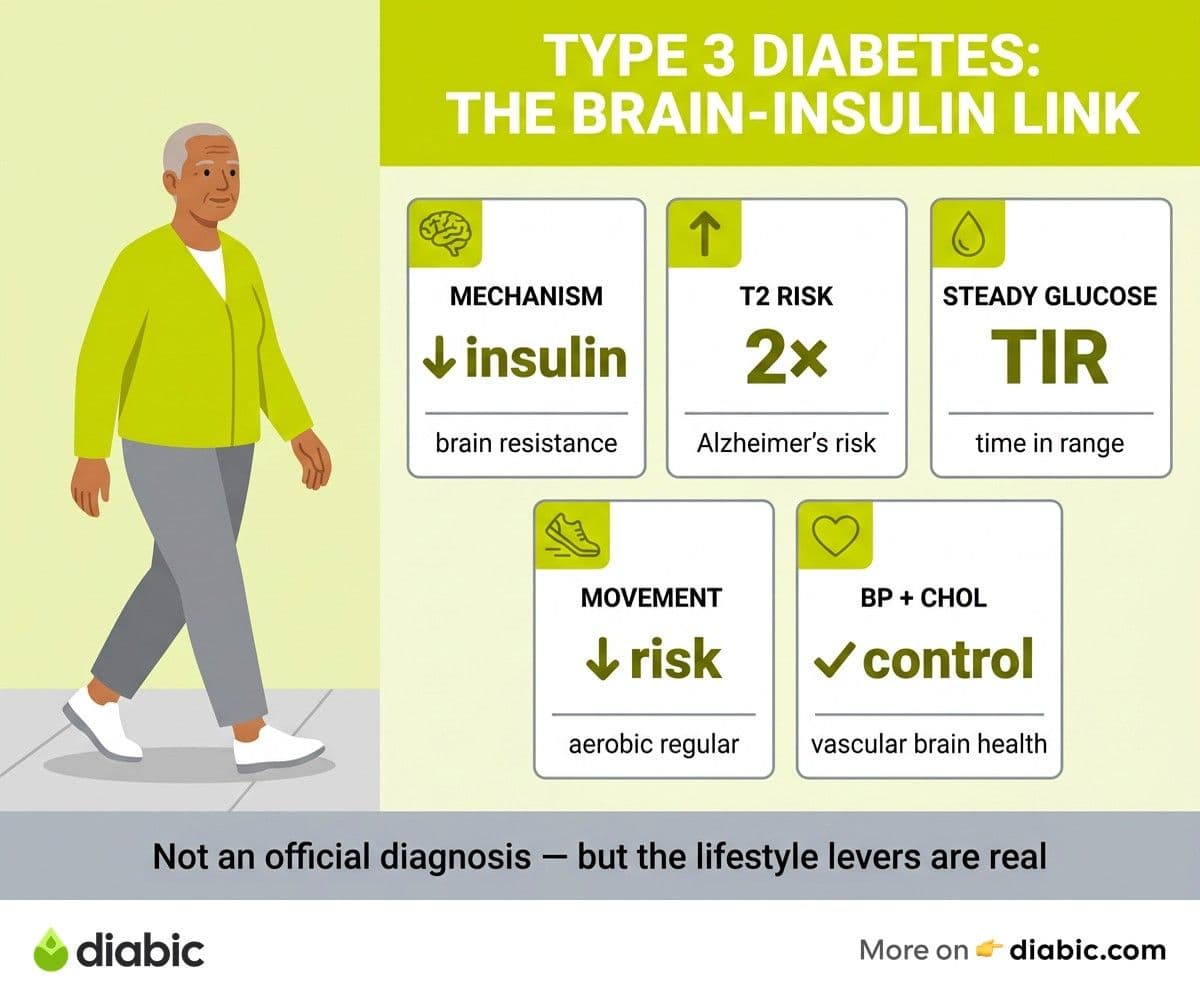
The clinical evidence is also striking. Adults with type 2 diabetes have roughly double the risk of developing Alzheimer's disease compared to adults without diabetes, according to data summarized by the Alzheimer's Association. That risk does not appear in every person, and it is shaped by many other factors, but the signal is consistent across large studies.
For a foundational refresher on how insulin and glucose work together throughout the body, our overview of what is diabetes walks through the basics in plain language. Understanding that core mechanism makes the brain piece much easier to follow.
From my experience: I have lived with diabetes for fourteen years, and the brain-health angle was something I only started taking seriously in my late twenties. The first time my endocrinologist mentioned long-term cognitive risk, I felt the same flutter of dread I felt at diagnosis. What helped was reframing it. Every walk after dinner, every steadier overnight glucose reading, every small choice was no longer just about today's numbers. It was also a quiet investment in the brain I want to have at seventy.
How It Compares to Type 1 and Type 2
To see why this label is both useful and controversial, it helps to line up the three concepts side by side.
Type 1 diabetes is an autoimmune condition. The immune system attacks the insulin-producing beta cells in the pancreas, leaving the body unable to make insulin on its own. People living with it depend on injected or pumped insulin every day. Our explainer on what is type 1 diabetes covers the mechanism in more detail.
Type 2 diabetes involves insulin resistance throughout the body, particularly in muscle, liver, and fat tissue. The pancreas often still makes insulin, sometimes in larger amounts, but cells stop responding to it normally. Over time, beta cell function may also decline. You can read more in our overview of what is type 2 diabetes.
The proposed third category would refer to insulin resistance localized in the brain. The classification stays controversial because the mechanism overlaps significantly with Alzheimer's disease itself. Critics argue that calling Alzheimer's a form of diabetes risks oversimplifying a condition with multiple causes, including genetics, vascular health, and inflammation. Supporters argue that naming the metabolic component pushes researchers and clinicians to take it seriously.
Both points hold weight. The label may eventually fade from use, or it may stick. Either way, the research it has spurred is reshaping how we think about brain aging.
What This Means for People With Diabetes
The practical takeaway is reassuring. The same daily habits that help you manage diabetes appear to also support brain health. You are not being asked to do anything extra or exotic.
Steady blood sugar matters. Wide swings between highs and lows place stress on the brain, and chronically elevated glucose contributes to vascular damage that affects cognition. Aiming for time in range, rather than chasing perfect numbers, is what most clinicians recommend. The Mayo Clinic notes that cardiovascular risk factors and cognitive risk factors overlap heavily, which is why blood pressure and cholesterol management are part of dementia prevention too.
Movement is one of the most consistent protective factors in the research. Regular aerobic activity improves insulin sensitivity in the body and appears to support brain volume and memory function in older adults. Even short walks after meals have been shown to flatten glucose spikes, which is a small win that compounds over years.
Diet patterns also play a role. Approaches that emphasize vegetables, whole grains, fish, nuts, and olive oil have been associated with both better diabetes outcomes and lower rates of cognitive decline. Genetics shape your starting point, and our piece on whether diabetes is genetic digs into how heredity interacts with daily habits.
Sleep, social connection, and stress management round out the picture. None of these are silver bullets, but together they form the kind of foundation that supports both metabolic and cognitive health over decades.
FAQ
Is the type 3 label the same as Alzheimer's?
The label is not the same as Alzheimer's, but it describes a proposed mechanism linking brain insulin resistance to the development of Alzheimer's disease. Some researchers use the term to highlight how insulin dysfunction in the brain may contribute to cognitive decline. It is not an officially recognized medical diagnosis, and you will not see it on standard lab results.
What is the connection between diabetes and the brain?
The brain relies on insulin to support memory, learning, and nerve cell function. When brain cells become resistant to insulin, it may contribute to the buildup of amyloid plaques associated with Alzheimer's. People with type 2 diabetes have an elevated risk of developing dementia, which is what drives this line of research.
Should I be tested for it?
There is no clinical test because it is not a recognized diagnosis. If you are concerned about your cognitive health, talk to your doctor about screening options for memory and thinking, especially if you have type 2 diabetes or a family history of dementia. Managing your blood sugar, blood pressure, and cardiovascular health is the most evidence-backed step you can take today.
The conversation around type 3 diabetes is a reminder that diabetes is a whole-body condition, not just a number on a glucose meter. The same effort that supports your A1C today is also quietly supporting the brain you want decades from now. That feels like a worthwhile reason to keep going.
Shahriar P. Shuvo is the founder of Diabic. He has lived with diabetes for over 14 years, and built Diabic to deliver the practical, evidence-based self-management tools he wished existed when he was first diagnosed. By trade, Shahriar is a senior design and frontend engineer with 6+ years shipping products at Agora, Timescale (now Tiger Data), and ShareTrip. He writes from the intersection of lived diabetes experience and product craft, focused on what works in daily management rather than what sounds good in a textbook.
Medically reviewed by
Dr. Shanto Arian is an internal medicine physician now specializing in clinical and aesthetic dermatology, with a parallel academic focus on epidemiology and public health. He holds an MBBS, MPH, MSc (UK), MRCP (UK), MRCPI (Ireland), Diploma in Dermatology (UK), and Diploma in Aesthetic Medicine (USA). Dr. Arian trained in internal medicine, including hospital work on hematology cases such as graft-versus-host disease, before moving toward dermatology. Skin is one of the earliest places diabetes shows itself, from acanthosis nigricans and diabetic dermopathy to slow foot wound healing, and that intersection is where his clinical and Diabic-review work meet. On Diabic, Dr. Arian medically reviews content on diabetes diagnosis, complications, dermatologic manifestations, and pharmacotherapy, ensuring every claim aligns with current ADA, NICE, and peer-reviewed literature.
More from Diabetes Knowledge
View all
6 Safe Dessert for Gestational Diabetes Recipes You Can
Six dessert for gestational diabetes recipes that satisfy your sweet tooth without spiking blood sugar, with carb counts and pairing tips you can use.

8 High Fiber Foods That Help with Prediabetes
Add these 8 high fiber foods for prediabetes to slow glucose absorption, support steady blood sugar, and meet the daily fiber target most people miss.

Mediterranean Diet for Prediabetes: A Practical Guide
The mediterranean diet for prediabetes is one of the best-studied eating patterns for prevention. Here is what to eat, what to avoid, and how to start.
Clinician-reviewed habits, plain-language guides, and honest answers - the small shifts that make living with diabetes feel lighter, every day.