Ozempic for Type 2 Diabetes: Hype vs Reality
An honest look at Ozempic for type 2 diabetes, what the clinical data actually shows, common side effects, and how to decide if it fits your plan.

In this article(10)
You have probably heard about Ozempic from a celebrity interview, a viral TikTok, or a coworker whispering about a weight loss shortcut. For people actually living with type 2 diabetes, that noise can feel exhausting. The pharmacy line gets longer, the insurance approvals get harder, and the conversation rarely seems to be about blood sugar at all.
We want to step back from the headlines and look at what the evidence really says about Ozempic for type 2 diabetes. This is not a sales pitch and it is not a takedown. It is a balanced read on a medication that has helped many people, carries real risks, and sits at the center of a cultural moment that often forgets the patients it was designed for.
What Ozempic Is and How It Works
Ozempic is the brand name for semaglutide, a once-weekly injectable medication approved by the U.S. Food and Drug Administration for adults with type 2 diabetes. It belongs to a class of drugs called GLP-1 receptor agonists, which mimic a natural hormone your gut releases after meals. We have a fuller breakdown of how this drug class reshaped diabetes care if you want to understand the broader picture.
When semaglutide binds to GLP-1 receptors, three useful things happen for blood sugar management. Your pancreas releases more insulin in response to meals, your liver releases less stored sugar through a hormone called glucagon, and your stomach empties more slowly so glucose enters the bloodstream at a gentler pace. That last effect also tends to make you feel full sooner and stay full longer, which is part of the reason weight loss often follows.
Labels matter here, because the public conversation tends to blur them. Ozempic is approved specifically for type 2 diabetes management, while a higher-dose version of semaglutide is sold under the brand name Wegovy and approved for weight management. The phrase "semaglutide for weight loss" almost always refers to Wegovy or to off-label prescribing, not to the diabetes indication. According to Novo Nordisk, the manufacturer of both, the active ingredient is the same molecule, but the approved use and patient population differ.
Ozempic is given as a small subcutaneous injection, usually in the abdomen, thigh, or upper arm. Your provider will set a schedule that starts low and slowly steps up, which we will come back to when we talk about side effects.
What the Clinical Data Actually Shows
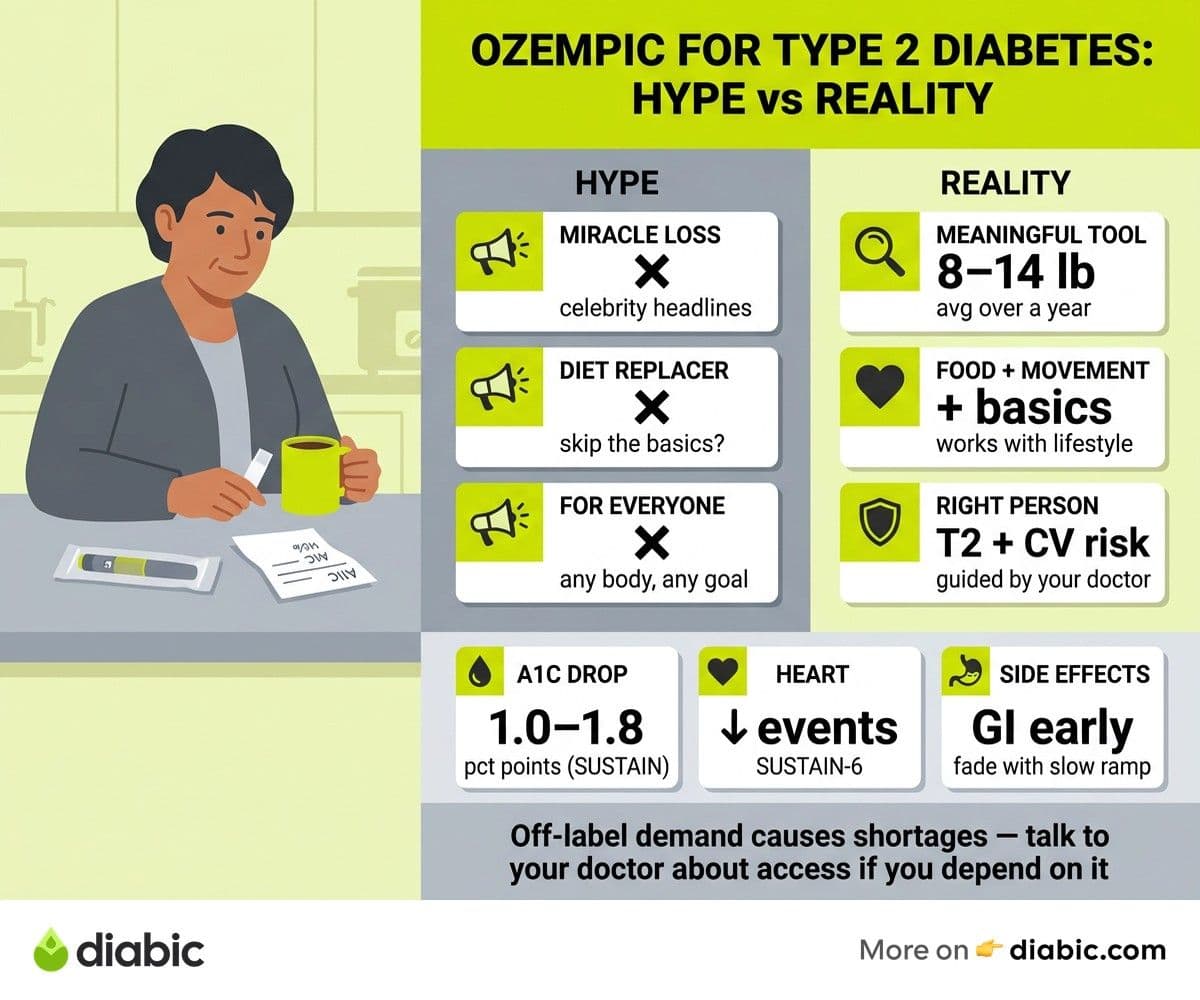
The strongest evidence on semaglutide comes from the SUSTAIN trial program, a series of randomized studies published in journals like the New England Journal of Medicine and Diabetes Care. Across these trials, participants with type 2 diabetes saw average A1C reductions of roughly 1.0 to 1.8 percentage points, depending on the dose and the comparator drug. For a person sitting at an A1C of 8.5, that kind of drop can move them meaningfully closer to their target range.
Weight change was a consistent secondary finding. Participants in the SUSTAIN trials lost an average of 8 to 14 pounds over roughly a year, with some losing significantly more and others much less. This is not a guaranteed outcome and it tends to plateau, but it explains why weight became such a prominent part of the public story. We dig deeper into how this compares with newer options in our piece on semaglutide vs tirzepatide.
Cardiovascular benefit is one of the most underdiscussed findings. The SUSTAIN-6 trial showed that semaglutide reduced the risk of major adverse cardiovascular events, including nonfatal heart attack and stroke, in people with type 2 diabetes who had established cardiovascular disease. The later SELECT trial, also in NEJM, expanded these findings. For people whose diabetes overlaps with heart disease risk, this is not a small detail.
Head-to-head studies in the SUSTAIN program compared semaglutide with sitagliptin, exenatide extended-release, insulin glargine, and dulaglutide. In most of these comparisons, semaglutide produced larger A1C reductions and more weight loss, though also more gastrointestinal side effects. Real-world data from Diabetes Care has echoed the trial findings, with somewhat smaller average effects because real-world adherence is messier than trial adherence.
Separating the Hype from the Evidence
The cultural conversation about Ozempic has drifted a long way from a diabetes clinic. Red carpet weight loss, "Ozempic face," and TikTok before-and-afters dominate the feed, while the people who were prescribed this medication for blood sugar management often feel like an afterthought. We think that gap matters, and not just for hurt feelings.
Shortages have been one practical consequence. When demand spikes from off-label prescribing, supply tightens for the people who depend on Ozempic as part of their type 2 diabetes treatment. Some have had to switch medications mid-treatment, which can disrupt blood sugar stability and force people back into trial-and-error mode. The FDA has tracked these supply issues publicly.
Weight loss alone is not the same as metabolic health, and Ozempic was never designed as a cosmetic product. Weight loss happens for many people on it, but so does loss of lean muscle if nutrition and movement are not addressed. People without diabetes who use it to slim down are taking on the same risk profile, often without the same medical follow-up. For context on how older medications fit in, our explainer on whether metformin causes weight loss offers a useful comparison.
The reality, as far as we can see it, sits between two extremes. Ozempic is a meaningful addition to the toolbox for type 2 diabetes that may help lower A1C, support weight reduction, and reduce cardiovascular risk for the right person. It is not a miracle, it is not a shortcut around the basics of nutrition and movement, and it is not appropriate for everyone.
Here is how the popular narrative lines up with what the clinical evidence actually shows:
The takeaway is not that Ozempic is overhyped or underhyped, but that the headline version of the drug rarely matches the version your prescriber is weighing for your specific case.
Common Side Effects and How to Handle Them
Most people who start a type 2 diabetes injection medication like Ozempic notice some gastrointestinal effects in the first weeks. Nausea is the most common, followed by diarrhea, vomiting, constipation, and a low-grade queasiness that tends to be worst right after injection day. For most people these symptoms fade as the body adjusts.
This is exactly why providers use slow dose escalation. Starting at a low dose and stepping up gradually gives your gut time to adapt to slower stomach emptying, which is the mechanism behind most of the nausea. If you push the dose up too fast, the side effects often become harder to tolerate without offering much extra benefit. We will not get into specific dosing schedules here, because that conversation belongs with your prescriber.
A few practical patterns help people stay comfortable. Smaller meals tend to sit better than large ones, fatty and very rich foods often trigger more nausea, and staying hydrated helps with both nausea and constipation. If symptoms are interfering with eating, sleep, or work for more than a few weeks, that is a clear signal to talk to your doctor about adjusting the plan.
Injection site reactions are usually mild, with some redness, itching, or a small bump that fades within a day or two. Rotating sites between the abdomen, thigh, and upper arm reduces irritation and gives the tissue time to recover. For more on what is normal and what is not, our guide to injection site reactions and quick relief walks through it in detail.
Serious Risks to Discuss with Your Doctor
Beyond the everyday side effects, there are rarer but more serious risks that deserve a real conversation. Pancreatitis, or inflammation of the pancreas, has been reported in people taking GLP-1 receptor agonists. It is uncommon, but persistent severe abdominal pain that radiates to the back, especially with nausea and vomiting, is a reason to seek care quickly.
Ozempic carries a boxed warning about thyroid C-cell tumors, the most serious safety label the FDA uses. This warning is based on rodent studies, and it remains unclear how well that data translates to humans. Out of caution, the medication is not recommended for people with a personal or family history of medullary thyroid carcinoma or multiple endocrine neoplasia syndrome type 2.
Gallbladder problems, including gallstones, have also been reported, with the risk connected in part to rapid weight loss. Symptoms like upper-right abdominal pain, fever, or yellowing of the skin should never be ignored. Kidney issues, often tied to dehydration from prolonged vomiting or diarrhea, are another reason to take fluids seriously during the early weeks.
Your full medical history matters here. Existing pancreatic conditions, prior gallbladder surgery, kidney disease, severe gastroparesis, pregnancy or plans for pregnancy, and certain eye conditions related to diabetic retinopathy can all change the calculation. None of these automatically rule out Ozempic, but they do change the conversation with your prescriber.
Is Ozempic for Type 2 Diabetes Right for You?
The honest answer is that we cannot tell you, and neither can a thirty-second video. What we can share are the questions that tend to lead to a clearer answer with your provider. The current American Diabetes Association Standards of Care supports GLP-1 receptor agonists for people with type 2 diabetes who need additional A1C lowering, who would benefit from weight reduction, or who have established cardiovascular disease.
A few practical factors usually shape the decision. Cost and insurance coverage vary widely, and out-of-pocket prices without coverage can run several hundred dollars a month in the United States. Manufacturer savings programs and patient assistance options exist for some people, and your prescriber or pharmacist can help you check. If access turns out to be a barrier, there are other GLP-1 options, oral medications, and combination strategies worth exploring.
It is also fair to ask what success would look like for you. A meaningful drop in A1C, modest sustained weight loss, fewer hypoglycemia episodes, or more energy across the day are all reasonable goals. If you and your provider can name what you are hoping to see in three to six months, you can tell whether the plan is working.
The decision belongs to you and your healthcare team, not to social media. The most useful Ozempic conversation is a quiet one, with your numbers in front of you and a provider who knows your history. That is where the real story of Ozempic for type 2 diabetes lives, somewhere between the headlines and the hype, and where you can decide whether Ozempic for type 2 diabetes belongs in your plan or not.
Frequently Asked Questions
Is Ozempic good for type 2 diabetes?
Clinical trials suggest that Ozempic, the brand name for semaglutide, may help lower A1C by roughly 1.0 to 1.8 percentage points, support modest weight loss, and reduce cardiovascular risk in people with type 2 diabetes. The American Diabetes Association includes GLP-1 receptor agonists like semaglutide in its treatment recommendations for people who need blood sugar support beyond first-line therapy, especially those with heart disease or who would benefit from weight reduction. Whether it is a good fit for you specifically is a conversation to have with your healthcare provider, who can weigh your full medical picture.
What are the risks of Ozempic for people with diabetes?
The most common risks are gastrointestinal, including nausea, diarrhea, vomiting, and constipation, especially in the first weeks. Rarer but more serious risks include pancreatitis, gallbladder problems, kidney issues from dehydration, and a boxed warning about thyroid C-cell tumors based on animal studies. People with a personal or family history of medullary thyroid carcinoma or multiple endocrine neoplasia syndrome type 2 should not use Ozempic, and your provider will review your history before prescribing.
How long does it take to see results on Ozempic?
Many people on Ozempic for type 2 diabetes notice some change in appetite and blood sugar within the first few weeks, but more meaningful A1C and weight changes typically show up over three to six months as the dose is gradually increased. Lab work and check-ins with your provider help you tell whether the medication is doing what you and your care team hoped it would.
Dr. Shanto Arian is an internal medicine physician now specializing in clinical and aesthetic dermatology, with a parallel academic focus on epidemiology and public health. He holds an MBBS, MPH, MSc (UK), MRCP (UK), MRCPI (Ireland), Diploma in Dermatology (UK), and Diploma in Aesthetic Medicine (USA). Dr. Arian trained in internal medicine, including hospital work on hematology cases such as graft-versus-host disease, before moving toward dermatology. Skin is one of the earliest places diabetes shows itself, from acanthosis nigricans and diabetic dermopathy to slow foot wound healing, and that intersection is where his clinical and Diabic-review work meet. On Diabic, Dr. Arian medically reviews content on diabetes diagnosis, complications, dermatologic manifestations, and pharmacotherapy, ensuring every claim aligns with current ADA, NICE, and peer-reviewed literature.
Medically reviewed by
Dr. Rezwana Parvin Rumpa is an obstetrics and gynaecology specialist with clinical focus on gestational diabetes, PCOS, and fertility. She holds the MRCOG (Final Part) from the Royal College of Obstetricians and Gynaecologists in London, the MRCPI (Final Part) from the Royal College of Physicians of Ireland, and an MBBS from Shaheed Monsur Ali Medical College under Dhaka University. Dr. Rumpa serves as a Senior Medical Officer in the Obs and Gynae department at BRB Hospitals Ltd, where she has spent three years managing prenatal care, emergency obstetric cases, and women's-health surgery. On Diabic, she medically reviews content for women living with diabetes, with particular attention to pregnancy, PCOS, and reproductive-health intersections.
More from Treatment & Medication
View all
Recognizing Diabetic Coma Warning Signs Early
Learn to spot diabetic coma warning signs early. We cover DKA, HHS, and severe hypoglycemia symptoms, plus when to call 911 for immediate help.

Switching to Injectable Diabetes Medication: What to Expect
Switching to injectable diabetes medication can feel daunting. Learn what to expect, how to manage side effects, and why this step is progression, not.

Hyperglycemic Hyperosmolar Syndrome: Warning Signs to Know
Hyperglycemic hyperosmolar syndrome is a serious type 2 diabetes emergency. Learn the warning signs, triggers, and when to call 911 for HHS care.
Clinician-reviewed habits, plain-language guides, and honest answers - the small shifts that make living with diabetes feel lighter, every day.