Types of Insulin for Diabetes: A Practical Guide
A clear guide to the types of insulin for diabetes, including onset, peak, and duration for rapid, short, intermediate, long, and premixed insulins.

In this article(13)
If you have ever stood in a pharmacy reading two different insulin labels and wondered why one starts with "Humalog" and the other with "Lantus," you are not alone. The various types of insulin for diabetes can feel like a confusing alphabet soup of brand names, vials, and pens, especially when you are newly diagnosed or switching regimens. Each formulation has a specific job, and once you understand what each one is built to do, your daily routine starts to make a lot more sense.
We will walk through the major insulin categories: when each kicks in, how long it lasts, and why your provider might combine two or more types. None of this replaces your care team, but it should help you ask sharper questions at your next appointment.
From my experience: I have rotated through most of these over 14 years with type 1. Lantus first, then a stretch on Levemir split twice a day, then Tresiba when it came out and finally fixed the slow drift my Dexcom kept catching at 4 a.m. On the bolus side, NovoLog was my default until I switched to a pump on Humalog. The names blur together on a chart, but in real life the difference between a flat overnight line and a slow climb between 2 and 6 a.m. is exactly the difference between two basal insulins.
Why There Are Different Types of Insulin for Diabetes
Your pancreas, when it is working as designed, releases insulin in two distinct patterns. There is a steady, low background drip that runs all day and night to keep your blood sugar stable between meals, and there are quick bursts that fire whenever you eat something. Different insulin formulations exist because no single product can mimic both of those patterns at once. Understanding what insulin is and how it works makes the design of these different types click into place.
Researchers have spent decades modifying the insulin molecule to slow it down, speed it up, or stretch its action across a full 24 hours. Early insulins were extracted from animal pancreases and acted unpredictably. Modern human insulins and analog insulins, which are slightly modified versions of the human molecule, are far more consistent and let people match insulin action to real life. According to the FDA's database of approved insulin products, there are now dozens of approved formulations.
Most people on insulin therapy use a combination, often a long-acting insulin for background coverage plus a rapid-acting insulin at meals. This setup, sometimes called basal-bolus, mirrors a healthy pancreas. Premixed and intermediate options exist for people who need fewer daily injections or prefer a simpler approach.
Rapid-Acting Insulin
Rapid-acting insulins are the workhorses of mealtime coverage. They include insulin lispro (Humalog, Admelog), insulin aspart (NovoLog, Fiasp), and insulin glulisine (Apidra), with newer ultra-rapid versions like Fiasp and Lyumjev acting even faster. These analogs were engineered to absorb quickly so they can match the rise in blood sugar that follows a meal, and they are central to modern insulin therapy for type 1 diabetes.
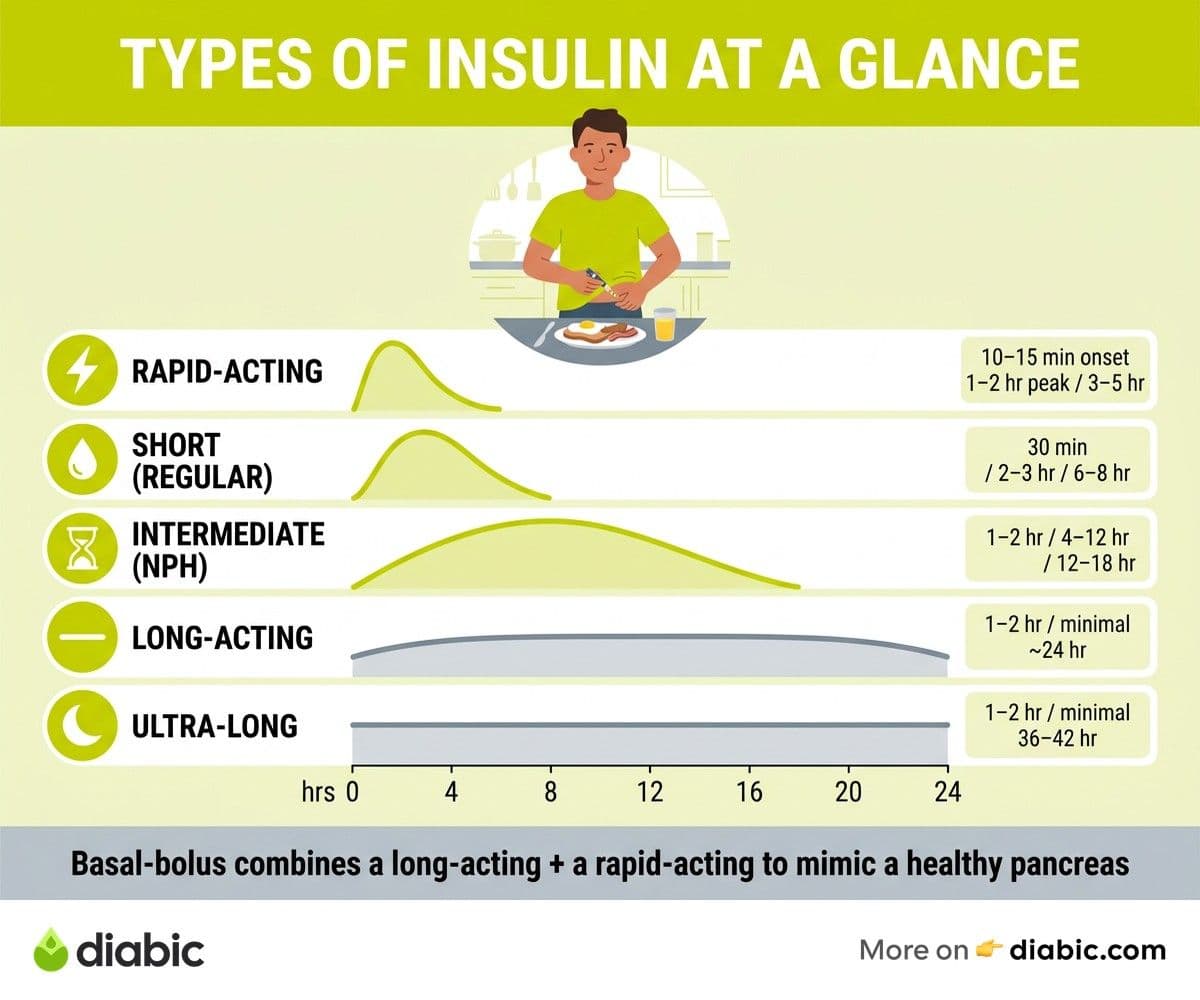
The typical onset is 10 to 15 minutes, with a peak around 1 to 2 hours and a total duration of 3 to 5 hours. Most people inject right before eating, though some providers recommend a few minutes earlier for high-carb meals so the insulin is on board when glucose starts rising. The faster ultra-rapid versions can sometimes be given right after eating, which is helpful for kids or anyone with an unpredictable appetite.
Because rapid-acting insulin works quickly, it is the type used in insulin pumps and the most common choice for correction doses when blood sugar runs high. Timing matters: inject too early and you risk a low before food is absorbed, inject too late and post-meal numbers climb sharply. Your care team will help you find a rhythm that fits your meals.
Short-Acting (Regular) Insulin
Short-acting insulin, also called regular insulin, is the original human insulin. Brands like Humulin R and Novolin R remain widely available and less expensive than analog insulins, which matters for people navigating cost or insurance gaps. Regular insulin has an onset of about 30 minutes, a peak between 2 and 3 hours, and a duration of 6 to 8 hours.
That slower onset means you generally need to inject 30 minutes before eating, which requires more planning than rapid-acting options. If you sit down to dinner and inject at the same time, your insulin may peak well after your food has already raised your blood sugar, leading to spikes followed by lows. Regular insulin is also the formulation used intravenously in hospitals because it can be given as a controlled drip. For day-to-day use it has largely been replaced by rapid-acting analogs, though it remains a reliable, affordable option.
Intermediate-Acting Insulin
NPH insulin, sold as Humulin N or Novolin N, is the main intermediate-acting option. It is regular insulin combined with protamine, which slows absorption and stretches its action. NPH has an onset of 1 to 2 hours, a pronounced peak between 4 and 12 hours, and a duration of 12 to 18 hours.
Because NPH peaks several hours after injection, it can cause hypoglycemia at predictable but inconvenient times, often in the middle of the night when given at dinner. Many people on NPH learn to time a small snack around the peak, or to split doses between morning and evening to smooth coverage. NPH is still used, especially in premixed formulations and in settings where cost is a barrier, and it remains a legitimate tool when used thoughtfully under medical guidance.
Long-Acting and Ultra-Long-Acting Insulin
Long-acting insulins provide the steady background coverage that most modern regimens are built around. Insulin glargine (Lantus, Basaglar, Toujeo), insulin detemir (Levemir), and insulin degludec (Tresiba) all release slowly into the bloodstream over many hours. Onset runs 1 to 2 hours, peaks are minimal or essentially flat, and duration ranges from about 24 hours for Lantus and Levemir to 36 to 42 hours for Toujeo and Tresiba.
The flat profile is the point. Without a sharp peak, these insulins reduce hypoglycemia risk and allow more flexible meal timing, since they are not tied to when you eat. Studies published in Diabetes Care have shown that degludec produces less nocturnal hypoglycemia than older basal options for many people, which is a meaningful improvement for anyone who has woken up shaky at 3 a.m. Most people inject once daily at the same time, though some split the dose. On a basal-bolus regimen, this insulin does the quiet, steady background work while your rapid-acting handles meals.
Premixed Insulin
Premixed insulins combine an intermediate insulin with either a short-acting or rapid-acting insulin in a single pen or vial. Common ratios include 70/30 (70% NPH, 30% regular) and 75/25 versions that pair protaminated analog with rapid-acting lispro or aspart. The appeal is simplicity: two injections a day instead of four or more.
The trade-off is flexibility. Because the ratio is fixed, you cannot adjust the meal-time component independently of the basal, so meal sizes and timing need to stay relatively consistent. Premixed insulin tends to work best for people with steady routines, and it can be a practical choice for older adults or anyone managing dexterity issues. Neither premixed nor separate basal-bolus is universally superior; the right answer depends on your life, not on which insulin is newer.
Comparison Table: All Insulin Types at a Glance
Here is a quick reference you can come back to when you are sorting out what each insulin in your kit actually does. Individual response varies, so your real onset and duration may differ slightly from these averages.
The NIDDK insulin overview is a solid second source if you want to compare these numbers against another reputable reference. Bookmark whichever version sticks in your head.
How Your Doctor Chooses the Right Insulin for You
Your provider weighs several things when picking an insulin regimen: the type of diabetes you have, your daily schedule, your blood sugar patterns, other medications, and practical factors like cost, insurance coverage, and dexterity. Someone with type 1 diabetes almost always needs both basal and bolus insulin, while someone with type 2 might start with a single long-acting injection alongside oral medications. For people not yet on insulin, insulin vs GLP-1 injections is sometimes part of the conversation, and the injectable diabetes medication list gives a fuller picture.
Continuous glucose monitoring has changed how regimens get fine-tuned. With CGM data, your provider can see exactly when your blood sugar drifts up overnight or spikes after lunch and adjust which insulin is doing what. The ADA Standards of Care update their insulin therapy recommendations annually, and CGM-informed adjustments are now central to those guidelines. Expect your regimen to evolve over time as your needs shift.
Frequently Asked Questions
What is the difference between rapid-acting and long-acting insulin?
Rapid-acting insulin starts working within 10 to 15 minutes and is used to manage blood sugar spikes from meals. Long-acting insulin takes 1 to 2 hours to begin working but provides steady coverage for 24 hours or more, handling blood sugar between meals and overnight. Most people with type 1 diabetes use both types together, and many people with type 2 diabetes do as well once oral medications are no longer enough.
How do you know which type of insulin you need?
Your healthcare provider determines which insulin types are right for you based on your type of diabetes, daily blood sugar patterns, lifestyle, and other health factors. The choice often evolves over time as your needs change, so regular follow-up appointments are important. If something is not working, say so. Adjustments are normal, expected, and part of how good care happens.
Can different types of insulin be mixed in the same syringe?
Some can, some cannot. Regular and NPH insulin are commonly mixed in one syringe when prescribed that way. Long-acting analogs like glargine and degludec should never be mixed with other insulins because it changes their absorption profile. Always follow the specific instructions from your provider or pharmacist for your prescribed insulins.
Why does my insulin work differently on different days?
Several factors affect how insulin absorbs and acts: injection site, exercise, illness, stress, hormones, alcohol, and even room temperature. Insulin resistance, the body's reduced sensitivity to insulin, can also fluctuate. If you notice consistent patterns of unexpected highs or lows, share them with your care team.
The bottom line on the types of insulin for diabetes is that each one is a tool with a specific job. Rapid handles meals, long-acting handles the background, and the others fill in around the edges.
Shahriar P. Shuvo is the founder of Diabic. He has lived with diabetes for over 14 years, and built Diabic to deliver the practical, evidence-based self-management tools he wished existed when he was first diagnosed. By trade, Shahriar is a senior design and frontend engineer with 6+ years shipping products at Agora, Timescale (now Tiger Data), and ShareTrip. He writes from the intersection of lived diabetes experience and product craft, focused on what works in daily management rather than what sounds good in a textbook.
Medically reviewed by
Dr. Shanto Arian is an internal medicine physician now specializing in clinical and aesthetic dermatology, with a parallel academic focus on epidemiology and public health. He holds an MBBS, MPH, MSc (UK), MRCP (UK), MRCPI (Ireland), Diploma in Dermatology (UK), and Diploma in Aesthetic Medicine (USA). Dr. Arian trained in internal medicine, including hospital work on hematology cases such as graft-versus-host disease, before moving toward dermatology. Skin is one of the earliest places diabetes shows itself, from acanthosis nigricans and diabetic dermopathy to slow foot wound healing, and that intersection is where his clinical and Diabic-review work meet. On Diabic, Dr. Arian medically reviews content on diabetes diagnosis, complications, dermatologic manifestations, and pharmacotherapy, ensuring every claim aligns with current ADA, NICE, and peer-reviewed literature.
More from Treatment & Medication
View all
Recognizing Diabetic Coma Warning Signs Early
Learn to spot diabetic coma warning signs early. We cover DKA, HHS, and severe hypoglycemia symptoms, plus when to call 911 for immediate help.

Switching to Injectable Diabetes Medication: What to Expect
Switching to injectable diabetes medication can feel daunting. Learn what to expect, how to manage side effects, and why this step is progression, not.

Hyperglycemic Hyperosmolar Syndrome: Warning Signs to Know
Hyperglycemic hyperosmolar syndrome is a serious type 2 diabetes emergency. Learn the warning signs, triggers, and when to call 911 for HHS care.
Clinician-reviewed habits, plain-language guides, and honest answers - the small shifts that make living with diabetes feel lighter, every day.