Injection Site Reactions from Diabetes Medication
Injection site reactions diabetes medication users face are common and manageable. Learn the causes, quick relief tips, and when to call your doctor.

In this article(10)
You finish your shot, glance down, and see an angry red welt staring back at you. Maybe it itches, maybe it stings, maybe it has turned into a small lump that has been there for days. Injection site reactions diabetes medication users experience are frustrating and far more common than most people realize, whether you use insulin, GLP-1 agonists, or any other injectable.
We hear from readers who quietly wonder if something is wrong with them when their skin reacts this way. The honest answer is that mild reactions are part of life with daily injections, and most clear up with a few small adjustments. The trickier question is knowing which reactions need a tweak in technique and which ones deserve a call to your provider.
From my experience: After 14 years of living with type 1 diabetes and giving myself thousands of injections, I have dealt with my share of red dots, surprise bruises, and one stubborn lump on my left thigh that took six months of strict rotation to fade. The reactions are rarely a sign you are doing something wrong, and learning to read what your skin is telling you changes everything.
What Causes Injection Site Reactions on Diabetes Medication
Most reactions come down to a handful of triggers, and once you can name them, you can usually adjust. Your skin contains a dense network of immune cells that scan anything passing through it, including the active drug, preservatives, or stabilizers in your prescription. When those cells flag something as unfamiliar, they release chemicals that cause local redness, warmth, or itching. This is a normal local response, not a sign the medication is failing.
The needle itself plays a role too. Even the thinnest pen needles cause microscopic tissue trauma, which triggers a small healing response that can look like a pink dot or feel tender for a few hours. Some people are sensitive to the alcohol in prep wipes, the adhesive on bandages, or trace components in the formulation, which can produce an itchy hive-like patch around the puncture. If you want a quick refresher on which medications belong to which class, our injectable diabetes medication list breaks down what is in each pen.
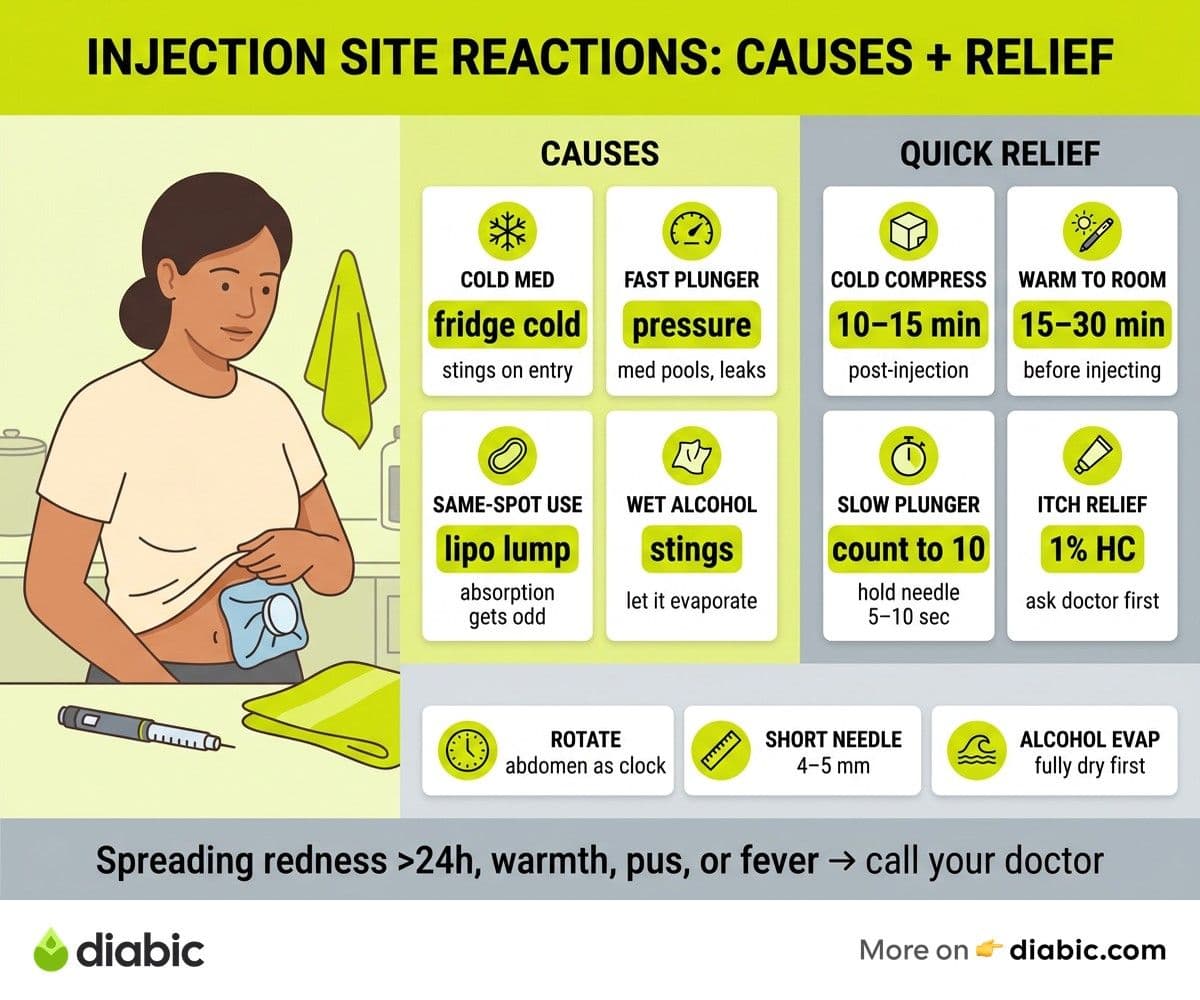
Technique matters more than people expect. Cold medication straight from the fridge stings and is more likely to leave a red mark, because the temperature shocks the surrounding tissue. Pushing the plunger too quickly forces liquid into a small pocket of fat that has not had time to accept it, causing pressure, pain, and sometimes leakage. Some sites are also more reactive than others, with the abdomen generally tolerating injections best and the thighs reacting more visibly in many people.
Common Injection Site Reactions Diabetes Medication Users See
Not all reactions look the same, and naming what you see helps you respond appropriately. The most common reaction is mild redness and swelling, often the size of a dime, that appears within minutes and fades in a few hours. This is your immune system doing its job, and unless it spreads or gets worse, it is not a problem. According to research published in Diabetes Care, studies on injection site complications consistently show that most reactions are short-lived and resolve without intervention.
Itching or hives at the site can suggest sensitivity to a component of the medication or to the alcohol prep. Bruising is another frequent visitor, especially if you accidentally nick a small blood vessel under the skin. Bruises can look alarming but rarely indicate a problem with your dose or absorption, and they fade through the usual color stages over a week or so.
The reaction worth watching most carefully is lipohypertrophy, sometimes called lipodystrophy, a soft lump or thickened patch of fatty tissue that forms when you inject the same spot repeatedly. These lumps feel rubbery under your fingers and may or may not be visible from the outside. Injecting into them feels easier and less painful, so people keep using the same area, which makes the lump grow and absorption become unpredictable. If you take insulin and want a deeper look at how different formulas behave, our piece on types of insulin explained covers how absorption variability shows up in real life.
Pain or burning during the injection is usually about temperature, speed, or needle placement, not the drug itself. Persistent burning that lingers for hours, or a reaction that keeps growing instead of shrinking, is worth flagging to your provider.
Quick Relief Strategies That Actually Help
When a reaction shows up, you usually have a few simple options that take the edge off within minutes. A cold compress, like a clean washcloth wrapped around an ice pack, applied for ten to fifteen minutes after injection can dramatically reduce redness, swelling, and that hot itchy feeling. The cold constricts surface blood vessels and slows the local inflammatory response, which is why it works so reliably.
Letting your medication warm to room temperature for fifteen to thirty minutes before you inject is one of the most useful changes you can make. Research summarized in the Journal of Diabetes Science and Technology has pointed to medication temperature as a major factor in injection comfort. Pull your pen out of the fridge while you make breakfast or brush your teeth, and by the time you are ready, it is at a comfortable temperature.
Slowing down the injection itself helps more than you would think. Counting to ten while you press the plunger, then holding the needle in place for another five to ten seconds before withdrawing, gives the medication time to disperse rather than pooling under pressure. We have heard from countless readers who say this single change cut their post-injection stinging in half.
For mild, localized itching, a thin layer of over-the-counter hydrocortisone one percent cream can calm the skin within a day or two, though we recommend checking with your provider before starting any new topical. Avoid scratching, which can break the skin and invite infection. If you find yourself reaching for relief constantly, that is a signal to talk to your doctor about whether the medication, the needle, or the technique needs adjustment.
How to Prevent Injection Site Reactions on Diabetes Medication
Prevention almost always comes back to two things: rotation and technique. Site rotation means using a different spot every time, mapped systematically rather than randomly. Many people imagine they are rotating when they are actually using a zone the size of a credit card on the same side of the body for weeks. The American Diabetes Association recommends rotating within an area in an organized pattern, then moving to a different area entirely every week or so. Think of your abdomen as a clock face, with the navel at the center and your injection sites moving around the dial.
Correct technique is the second pillar. Pinch up a fold of skin if your provider has recommended it, insert the needle at the angle they showed you, and use the shortest needle length appropriate for your body. Most adults do well with four or five-millimeter pen needles, which deliver medication into fat rather than muscle for the majority of people. The NIDDK and major diabetes organizations recommend these shorter needles because they reduce pain and the risk of injecting into muscle. If you are starting a new injectable, our guide on switching to injectable medication walks through the early adjustments most people make.
Skin prep is a small detail with outsized effects. If you use alcohol wipes, let the alcohol fully evaporate before injecting, because injecting through wet alcohol drags it into the puncture and causes stinging. For most people on a clean home routine, washing with soap and water is enough, and many providers no longer require alcohol prep for routine self-injection at home. A consistent routine at the same general times each day also seems to reduce reactions, perhaps because rushed injections tend to be sloppier ones. If you want a broader look at how injections fit into a lifelong plan, our overview on insulin therapy for type 1 puts the daily details into context.
Keeping a simple log, even a sticky note on your fridge with rotation zones marked off, prevents the unconscious site favoritism that leads to lipohypertrophy over months and years. This single habit cuts down on most of the injection site reactions diabetes medication users see in the long run, and it is one of the most effective routines we recommend to readers using daily injections.
When to Call Your Doctor
Most reactions sort themselves out, but some deserve a phone call or a visit. Talk to your doctor about any reaction that includes increasing redness over twenty-four hours, warmth that radiates outward, pus or weeping fluid, or fever, because these can signal a skin infection that needs treatment. A reaction that spreads well beyond the injection site, especially if it covers a large area or appears in places you did not inject, is also worth flagging promptly.
Severe allergic reactions are rare but real, and they need emergency care, not a wait-and-see approach. Difficulty breathing, swelling of the face, lips, or throat, hives spreading across your body, dizziness, or a sudden drop in blood pressure are signs of anaphylaxis. Call emergency services immediately if any of these appear after an injection. The FDA requires manufacturers to list these warning signs on injectable medications because they demand a fast response.
Lipohypertrophy that is changing how your medication works, leading to unexplained highs or lows even when your dose and food are consistent, is a conversation to have with your provider. They can examine the area, recommend a rotation reset, and sometimes suggest a different needle or technique to help the tissue recover. Persistent reactions that do not improve despite proper technique, fresh sites, and room-temperature medication may point to a sensitivity that could be addressed by switching products. Talk to your doctor about persistent or severe reactions rather than pushing through them, because small changes early prevent bigger problems later.
Frequently Asked Questions
How to reduce injection site pain from diabetes medication?
Letting your medication warm to room temperature before injecting, using a slow and steady technique, rotating sites regularly, and applying a cold compress afterward all help reduce pain. The shortest, thinnest needle appropriate for your body usually makes the biggest difference, since longer needles can reach muscle in leaner people and cause sharper discomfort. If pain persists despite these changes, talk to your healthcare provider about alternative techniques or devices that might suit you better.
When should you worry about an injection site reaction?
Most reactions, including mild redness, swelling, or itching, resolve on their own within a few hours to a couple of days. Contact your healthcare provider if you notice signs of infection like increasing redness, warmth, pus, or fever, or if reactions spread beyond the injection site, cause severe pain, or consistently get worse over time. Seek emergency care for any signs of severe allergic reaction such as difficulty breathing or facial swelling.
Can I keep using a site that has a small lump?
We recommend giving any lump or thickened patch a rest of at least several weeks, and ideally longer, while you rotate to fresh tissue. Continuing to inject into a lump can make it grow and can cause unpredictable absorption, which affects how your medication works. Your provider can examine the area and tell you when it is safe to use again.
Are reactions worse with GLP-1 medications than with insulin?
Reactions vary by person and by formulation rather than strictly by drug class. Some people experience more itching with GLP-1 agonists, while others find insulin pens easier on their skin. The principles of injection site reactions diabetes medication users navigate are the same across both: rotate sites, warm the medication, inject slowly, and watch for changes beyond mild redness.
Shahriar P. Shuvo is the founder of Diabic. He has lived with diabetes for over 14 years, and built Diabic to deliver the practical, evidence-based self-management tools he wished existed when he was first diagnosed. By trade, Shahriar is a senior design and frontend engineer with 6+ years shipping products at Agora, Timescale (now Tiger Data), and ShareTrip. He writes from the intersection of lived diabetes experience and product craft, focused on what works in daily management rather than what sounds good in a textbook.
Medically reviewed by
Dr. Rezwana Parvin Rumpa is an obstetrics and gynaecology specialist with clinical focus on gestational diabetes, PCOS, and fertility. She holds the MRCOG (Final Part) from the Royal College of Obstetricians and Gynaecologists in London, the MRCPI (Final Part) from the Royal College of Physicians of Ireland, and an MBBS from Shaheed Monsur Ali Medical College under Dhaka University. Dr. Rumpa serves as a Senior Medical Officer in the Obs and Gynae department at BRB Hospitals Ltd, where she has spent three years managing prenatal care, emergency obstetric cases, and women's-health surgery. On Diabic, she medically reviews content for women living with diabetes, with particular attention to pregnancy, PCOS, and reproductive-health intersections.
More from Treatment & Medication
View all
Recognizing Diabetic Coma Warning Signs Early
Learn to spot diabetic coma warning signs early. We cover DKA, HHS, and severe hypoglycemia symptoms, plus when to call 911 for immediate help.

Switching to Injectable Diabetes Medication: What to Expect
Switching to injectable diabetes medication can feel daunting. Learn what to expect, how to manage side effects, and why this step is progression, not.

Hyperglycemic Hyperosmolar Syndrome: Warning Signs to Know
Hyperglycemic hyperosmolar syndrome is a serious type 2 diabetes emergency. Learn the warning signs, triggers, and when to call 911 for HHS care.
Clinician-reviewed habits, plain-language guides, and honest answers - the small shifts that make living with diabetes feel lighter, every day.