Does a Continuous Glucose Monitor Hurt? What to Expect
Wondering does continuous glucose monitor hurt? Here is what insertion really feels like, what is under the patch, and how to make wearing one easier.
In this article(10)
Does continuous glucose monitor hurt? It is the first question almost everyone asks before their first sensor, and the honest answer for most people is "barely, and only for a second." That said, the worry is real, and watching a video of a spring-loaded applicator click into your arm before you have used one is genuinely unsettling.
The good news is that the actual sensation is much less dramatic than the hardware looks. Most users compare insertion to a flicked rubber band or a quick pinch, and the wearing experience is mostly a non-event after the first few hours. Below, we walk through what insertion really feels like, what stays under your skin, and the small habits that make wearing a sensor more comfortable.
Does Continuous Glucose Monitor Hurt During Insertion?
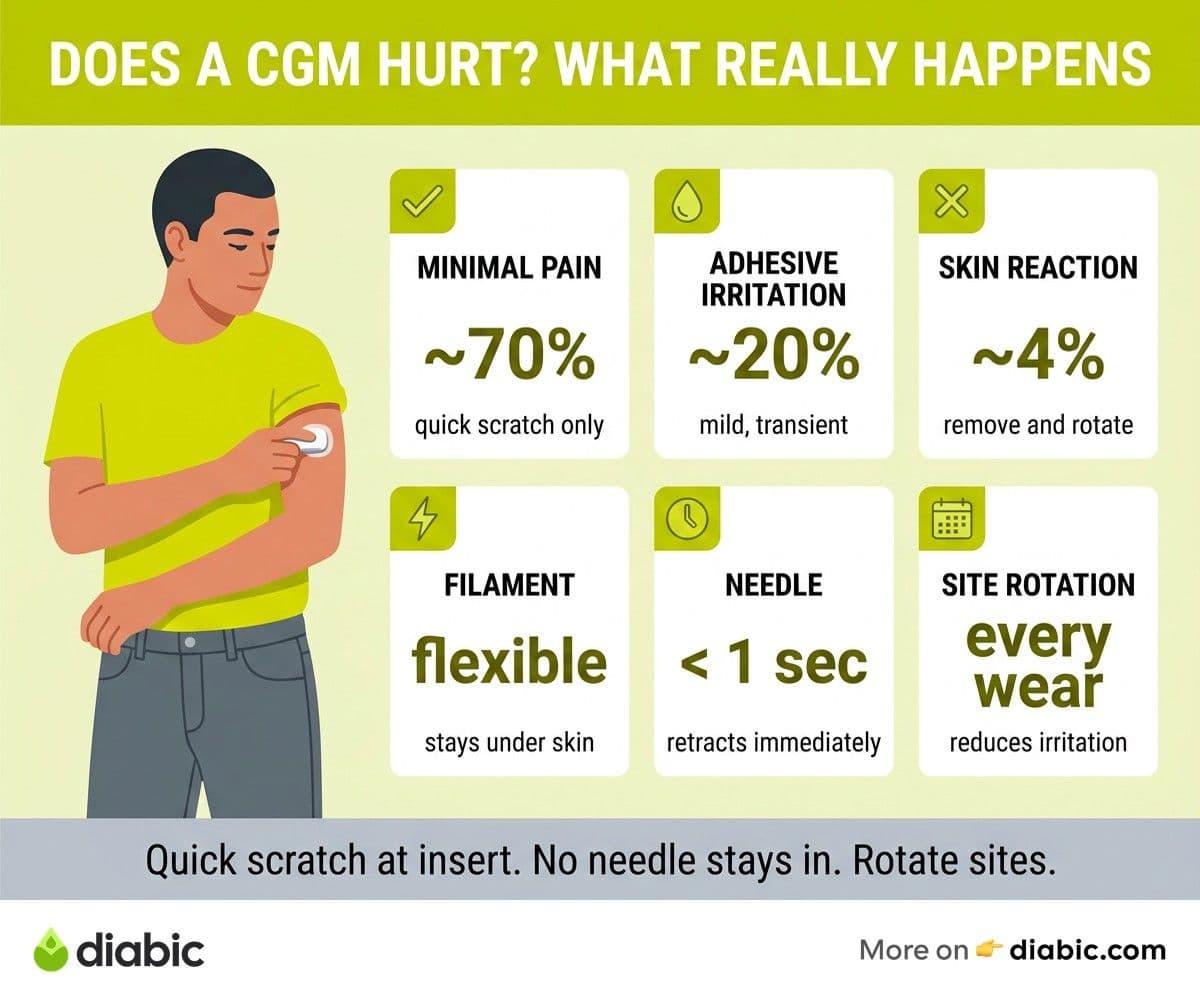
Does continuous glucose monitor hurt at the moment of insertion? In short surveys of new users, roughly 70% report no pain, 20% report a mild pinch, and a smaller share describe a sharper but brief sensation. The first time tends to be the worst because anticipation does most of the work.
Modern CGMs use spring-loaded applicators that fire the introducer needle in under a tenth of a second. The speed is the key to comfort. A slow insertion would hurt; a fast one barely registers. Both Dexcom and Abbott have published application guides showing the design (Dexcom, Abbott).
Needle gauge matters too. Today's CGMs use thin introducer needles in the 23 to 28 gauge range, comparable to a standard blood draw needle but used for a fraction of a second. The flexible filament left behind is much thinner than the introducer, often around 0.4 mm wide. If you want a deeper tour of the technology, our piece on what a CGM is and how it works covers the details.
A few practical points to ease the first insertion:
- Choose a relaxed body position so your shoulder muscle is loose
- Press the applicator firmly to the skin so the sensor sits flush
- Exhale slowly as you press the button to avoid tensing
- Site rotation gets easier with practice, and the third sensor usually feels like nothing
Does a Continuous Glucose Monitor Have a Needle?
This is the question new users ask most often, and the answer is reassuring. Yes, a CGM uses a needle for insertion, but no, the needle does not stay in your skin.
The introducer needle is a hollow guide that places the flexible sensor filament under your skin, then retracts back into the applicator within a fraction of a second. What stays behind is the filament itself, a soft platinum or polymer wire roughly the diameter of a human hair. You cannot feel it once it is in, and most users forget it is there within a few hours. Our deeper guide to using a CGM for hypoglycemia covers what the filament does once it is sitting in your interstitial fluid.
If you peeled back a worn sensor patch (do not do this on a working sensor), you would see a small adhesive pad, the transmitter housing on top, and the thin filament disappearing into your skin. There is no needle visible. The discarded applicator contains the introducer, and most have a built-in safety mechanism so the sharp tip is shielded after firing.
This matters for needle-anxious users. The continuous part of "continuous glucose monitor" does not mean a continuous needle. The needle's job ends within seconds.
Common Comfort Issues While Wearing a CGM
Even when insertion goes well, the wearing period can have small annoyances. None of them are dangerous, but knowing what is normal versus what is not helps you respond appropriately.
Adhesive irritation is the most common complaint. Some users develop a pink ring, mild itch, or occasional bumps under the patch within a few days. For many, it is a reaction to the acrylate adhesive used on most sensor patches, a known side effect NIDDK lists in its CGM overview. Hypoallergenic over-patches and barrier wipes (like Skin Tac wipes) can sit between your skin and the sensor adhesive and meaningfully reduce irritation.
Compression lows are an under-discussed quirk. If you sleep on the sensor or wear a tight strap over it, the pressure can squeeze interstitial fluid out of the sensing area and produce a falsely low reading. The fix is to roll over (or remove the strap), wait two to three minutes, and check again. A fingerstick is your tiebreaker if you feel fine but the alarm keeps firing.
A few other normal-but-annoying issues:
- Edge peeling after day five or six, especially with showers or sweat
- Snagging on doorways, seatbelts, or pet claws (over-patches help)
- Mild itching during wear, often worst on day one and day three
- A faint mark or bruise after sensor removal that fades within a few days
If irritation is severe, painful, or comes with a spreading rash, remove the sensor and talk to your provider before starting another. The American Diabetes Association has guidance on managing skin reactions with diabetes devices (ADA).
Preventing CGM Site Infections and Skin Reactions
A continuous glucose monitor infection is uncommon but possible, and the warning signs are worth knowing. Regular adhesive irritation looks like pink, slightly itchy skin under the patch and resolves within a day or two of removal. An infection looks different: persistent redness that expands beyond the patch, warmth, swelling, fluid or pus, and sometimes a low fever.
The risk of infection is reduced sharply by good site prep. The basic routine takes 60 seconds and pays off across years of wear. Our piece on insulin pump site infections goes deep on the topic, and the same principles apply to CGMs.
A simple insertion routine:
- Wash hands with soap and warm water
- Clean the insertion area with an alcohol swab and let it dry fully
- Apply a barrier wipe if you have sensitive skin or known reactions
- Press the applicator and fire as instructed
- Smooth the adhesive edges down so they sit flush
Site rotation matters too. Wearing every sensor in the same square inch of your upper arm will eventually cause skin breakdown. Move at least an inch between sites and try to give each spot at least three to four weeks of recovery before reusing it.
From my experience: After fourteen years with type 1 and a lot of sensor changes, the single biggest comfort upgrade I made was adding a barrier wipe to the routine. The wipe creates a thin film between adhesive and skin, and my reactions dropped to almost nothing. It adds maybe ten seconds to the process and saves hours of itching later.
Talk to your doctor about removing a sensor early if a site looks infected. Pulling a sensor early is annoying but always the right call when something is off.
Tips to Make Wearing a CGM More Comfortable
A few small habits go a long way. The goal is to make the sensor invisible to your daily life, not to grit your teeth through it.
The most comfortable placement spots vary by person and device, but the FDA-approved sites for most modern CGMs include the back of the upper arm, the abdomen, and the upper buttock. The back of the arm tends to win for stability and comfort because it has fewer bony pressure points and is out of the way during sleep. Some pregnant users move to the upper outer thigh in late trimesters, where appropriate per device labeling.
Adhesive helpers worth trying:
- Skin Tac wipes for users with oily or active skin
- Simpatch or Skin Grip over-patches for adventure sports and hot weather
- Hypoallergenic Tegaderm (cut a hole for the sensor housing) for sensitive skin
- A light bandage on the edge during a heavy workout if peeling has started
For genuinely sensitive users, ice packs applied for two minutes before insertion can numb the skin enough to make the click unnoticeable. A few people use 4% lidocaine cream, but this needs a discussion with your provider, especially if your skin reacts to topicals.
If you ever decide to try an OTC option that does not require a prescription, our Dexcom Stelo review walks through one of the more popular wellness-focused sensors and how its comfort profile compares.
The biggest tip is the simplest: build a routine. Decide on a set day for sensor changes (Sunday morning is popular), pick your two preferred sites, and set a phone reminder. After three or four cycles, the whole process takes about three minutes and stops feeling like an event. Does continuous glucose monitor hurt enough to be a barrier to wearing one? For the vast majority of users, no, and the daily benefits make the brief moment of insertion worth it.
FAQ
Is a continuous glucose monitor painful to wear?
Wearing a CGM is generally not painful after the first few minutes. Some users feel mild itching or pressure under the adhesive, especially on day one or after exercise, but most forget the sensor is there within a day. Persistent pain is not normal and usually means a poor insertion or a developing site reaction, both of which are reasons to remove the sensor.
Does a continuous glucose monitor have a needle in it all the time?
No. The introducer needle retracts within a fraction of a second after firing. What stays under your skin is a flexible filament, often a thin polymer or platinum wire about the width of a hair. You cannot feel the filament once it is in place, and it bends with normal movement.
What should you do if your CGM site gets infected?
Remove the sensor right away and apply gentle pressure with clean gauze if there is any bleeding. Wash the area with soap and water and watch for spreading redness, warmth, swelling, or fluid over the next day. Talk to your healthcare provider promptly if the area worsens, if you develop a fever, or if you have a history of skin infections. Skip your next insertion at the affected site and pick a fresh location once the skin fully heals.
Final answer: does continuous glucose monitor hurt enough to skip wearing one?
For almost everyone, the honest answer is no. Insertion is a brief click, the wearing period is mostly forgettable, and the small annoyances around adhesive or compression are easy to manage with the routines above. Talk to your provider if you have a needle phobia or sensitive skin so you can plan the first insertion with extra support, and give yourself two or three sensor cycles before judging the experience.
Dr. Shanto Arian is an internal medicine physician now specializing in clinical and aesthetic dermatology, with a parallel academic focus on epidemiology and public health. He holds an MBBS, MPH, MSc (UK), MRCP (UK), MRCPI (Ireland), Diploma in Dermatology (UK), and Diploma in Aesthetic Medicine (USA). Dr. Arian trained in internal medicine, including hospital work on hematology cases such as graft-versus-host disease, before moving toward dermatology. Skin is one of the earliest places diabetes shows itself, from acanthosis nigricans and diabetic dermopathy to slow foot wound healing, and that intersection is where his clinical and Diabic-review work meet. On Diabic, Dr. Arian medically reviews content on diabetes diagnosis, complications, dermatologic manifestations, and pharmacotherapy, ensuring every claim aligns with current ADA, NICE, and peer-reviewed literature.
Medically reviewed by
Dr. Rezwana Parvin Rumpa is an obstetrics and gynaecology specialist with clinical focus on gestational diabetes, PCOS, and fertility. She holds the MRCOG (Final Part) from the Royal College of Obstetricians and Gynaecologists in London, the MRCPI (Final Part) from the Royal College of Physicians of Ireland, and an MBBS from Shaheed Monsur Ali Medical College under Dhaka University. Dr. Rumpa serves as a Senior Medical Officer in the Obs and Gynae department at BRB Hospitals Ltd, where she has spent three years managing prenatal care, emergency obstetric cases, and women's-health surgery. On Diabic, she medically reviews content for women living with diabetes, with particular attention to pregnancy, PCOS, and reproductive-health intersections.
More from Devices & Technology
View all
Fasting vs Postprandial Glucose: What's the Difference
Fasting vs postprandial glucose readings tell different stories about your blood sugar. Learn what each number means and how to act on it.

Best Glucometer for Elderly and Low-Vision Users
Best glucometer for elderly and low-vision users: large displays, audio readouts, no-coding strips, and budget picks that make daily testing easier.

Online Diabetes Coaching: How to Choose a Good One
Online diabetes coaching can fill the gaps between doctor visits. Learn what credentials to check, red flags to avoid, and how to pick a quality program.
Clinician-reviewed habits, plain-language guides, and honest answers - the small shifts that make living with diabetes feel lighter, every day.