Affordable Insulin Options: Where to Find Them in 2026
Find affordable insulin options through patient assistance programs, Walmart ReliOn, discount cards, and community clinics. Real pathways to lower costs.

In this article(11)
Finding affordable insulin options can feel like trying to read a map written in another language. One vial of brand-name insulin can cost more than a week of groceries, and the rules change depending on your insurance, your state, and which manufacturer makes the insulin you take. We hear from readers who have skipped doses, watered down doses, or driven hours to a different pharmacy just to afford the medication that keeps them alive.
The good news is that legitimate pathways exist to lower what you pay at the pharmacy counter. Some are well known, some are buried inside manufacturer websites, and some require a phone call to the right office. We will walk through every major option that is currently active for U.S. patients, what each one is good for, and how to start applying today.
From my experience: The first time I priced a vial of Humalog without insurance, around 2018, I left the counter empty handed and called my endo's office from the parking lot. What actually fixed it was a 20-minute call to Lilly Cares the next morning, not anything I found on a price comparison site. The savings were already there; I just had not known the right phone number to ask for.
Why Affordable Insulin Options Are Hard to Find
The U.S. insulin market is shaped by a tangle of pricing layers that most patients never see. A vial leaves the manufacturer at one price, gets marked up by wholesalers, then routed through pharmacy benefit managers who negotiate rebates with insurers. By the time it reaches your pharmacy, the list price and the price you actually pay may differ by hundreds of dollars. This is why two people on the same insulin can pay wildly different amounts, and why pricing advice from a few years ago is often outdated.
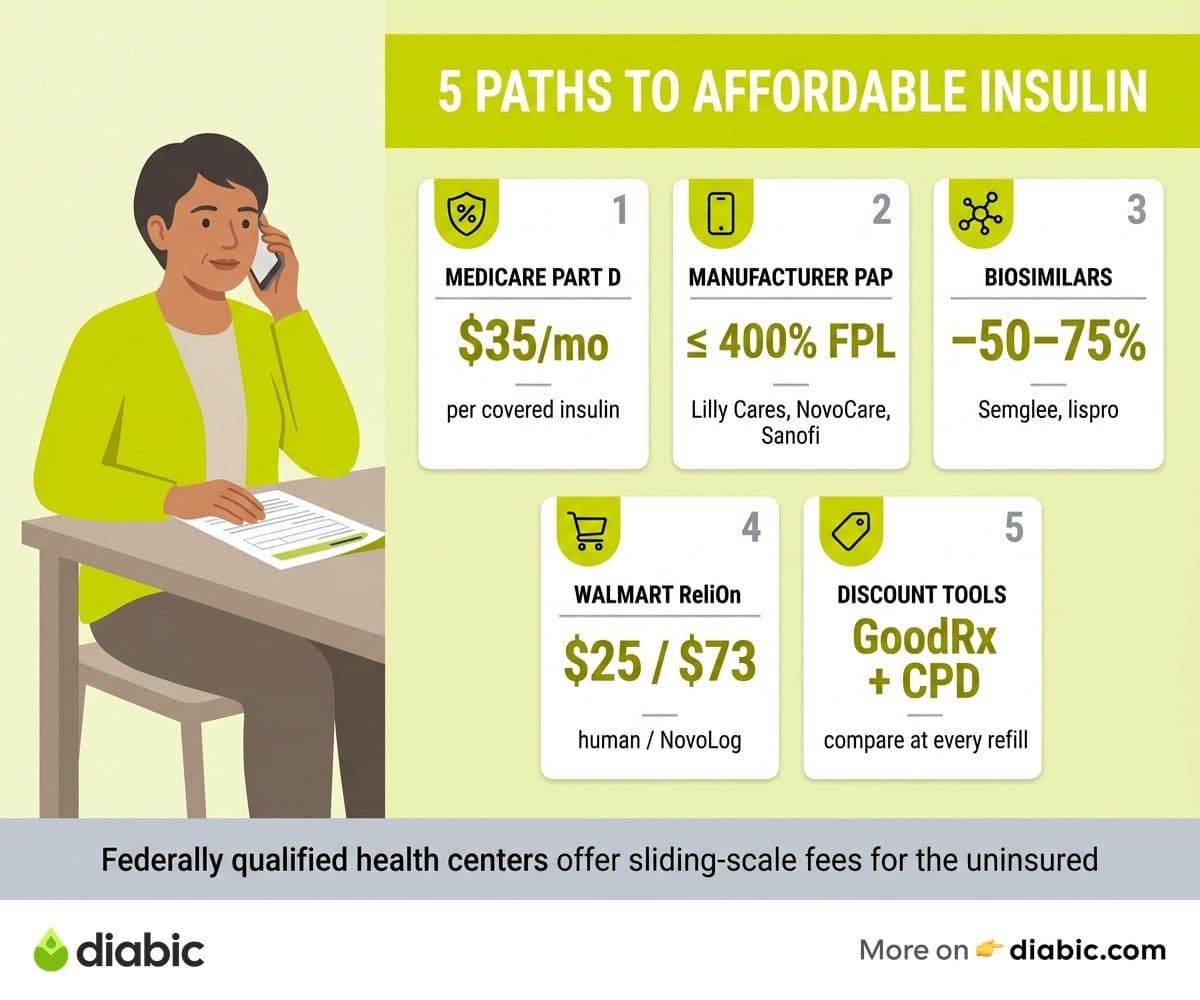
Recent federal policy has changed the picture for some patients. The Inflation Reduction Act capped Medicare Part D insulin copays at $35 per month per covered insulin product, and the three largest manufacturers have voluntarily extended similar caps to many commercially insured and uninsured patients through their own programs. The American Diabetes Association tracks current insulin affordability programs and updates its resource pages as policies shift. We recommend bookmarking that page if you are actively shopping for a lower price.
For those without Medicare or commercial insurance, the patchwork is harder to navigate. Some states have their own insulin affordability laws, while others rely entirely on manufacturer and nonprofit assistance. Knowing which bucket you fall into is the first step, because each pathway has different paperwork, timelines, and eligibility rules.
Generic vs Brand Insulin: Cost Comparison
Biosimilar and unbranded insulins have quietly reshaped what affordable means at the pharmacy counter. A biosimilar is a near-identical version of a brand insulin, manufactured by another company once patent protections lapse, and clinically interchangeable for most patients. Insulin glargine, insulin lispro, and insulin aspart all have authorized generic or biosimilar versions on the U.S. market. These products often cost 50 to 75 percent less than the brand name version, with the same molecule, dose, and delivery devices.
Switching from a brand to a biosimilar is not automatic, and it should always involve your prescriber. Your doctor needs to write a new prescription, and your pharmacist may need to confirm that your insurance covers the alternative. Most patients see no change in blood sugar response, but a small number need a brief adjustment period as they fine tune doses. We have a deeper breakdown in our piece on comparing generic and brand insulin if you want to weigh the tradeoffs in detail.
If you are paying out of pocket, ask your pharmacist to run the price on both the brand and any available biosimilar before you fill. Sometimes a manufacturer coupon makes the brand cheaper, and sometimes the biosimilar wins by a wide margin. A quick price check at refill time is one of the easiest savings habits you can build.
Walmart Insulin and Over-the-Counter Options
Walmart sells its own ReliOn brand of insulin at consistently lower prices than most other retail pharmacies. The lineup includes ReliOn NovoLog (insulin aspart), ReliOn Insulin Lispro, and the older Regular and NPH human insulins that have been available without a prescription in most states for decades. You can see the current lineup on the Walmart ReliOn insulin page, and pricing is published openly, which is unusual in U.S. pharmacy retail.
ReliOn analog insulins (the lispro and aspart versions) work the same way as their brand-name counterparts and require a prescription. The older Regular and NPH human insulins are pharmacologically different. They peak more slowly, last longer, and require more careful meal timing than analog insulins. For some people they work well, especially those who have used them before. For others, particularly those on tight pump or multiple daily injection regimens, switching to human insulin without medical guidance can lead to serious blood sugar swings.
If you are considering Walmart insulin, the guidance we share most often is simple. Talk to your prescriber before you switch, and try not to make the change in an emergency without backup support. Our full breakdown of Walmart insulin options explained covers when ReliOn makes sense, who should think twice, and how to set up your dosing if you do switch.
Patient Assistance Programs for Insulin
Manufacturer patient assistance programs are one of the most underused resources in U.S. diabetes care. All three major insulin manufacturers run programs that provide low cost or free insulin to qualifying patients, and the criteria are more generous than many people assume. The Lilly Insulin Value Program caps monthly out-of-pocket costs for most patients at a low flat rate, with a separate Lilly Cares Foundation program for those who qualify based on income. Novo Nordisk runs NovoCare patient assistance, and Sanofi runs the Sanofi Patient Connection program for Lantus, Toujeo, Apidra, and Admelog.
Eligibility usually depends on income, insurance status, and U.S. residency, but the specifics vary. Lilly Cares, for example, generally serves patients at or below 400 percent of the federal poverty level, which is higher than many people expect. Novo Nordisk has a similar tier for uninsured patients and a separate copay assistance tier for commercially insured patients. Most programs require recent tax documentation, proof of residency, and a prescriber signature on the application.
Approval timelines vary from same-day for digital savings cards to a few weeks for full assistance programs that ship insulin to your home. If you are running low while waiting, ask your prescriber about a 30-day bridge supply, which most clinics can arrange through manufacturer samples. For a deeper walkthrough of how to apply and what to expect, see our guide on patient assistance programs for diabetes medication.
Pharmacy Discount Programs and Coupons
Discount platforms have made it easier to compare insulin prices across pharmacies in the same zip code. GoodRx is the most widely used, and it shows the cash price at major chains alongside any coupon that brings it down further. NeedyMeds runs a similar tool with a focus on chronic disease patients, and many state Medicaid agencies maintain their own discount lookup pages. The catch is that discount card pricing usually does not stack with insurance, so you choose one or the other at the counter.
Mark Cuban Cost Plus Drugs has expanded its insulin offerings since launching, and currently carries select insulin products at transparent, low markup pricing. Availability changes as the company adds new manufacturer partnerships, so we recommend checking their search tool with your specific insulin name before assuming it is or is not available. Mail order pharmacies, especially those connected to your insurance plan, can also lower per-vial costs when you buy 90-day supplies instead of monthly fills.
A few habits make these tools work harder for you. Run a price comparison at every refill, not just when something changes. Ask the pharmacist whether a different vial size or pen pack would lower the per-unit cost, and if your pharmacy quotes a price that feels high, call two or three other locations before filling. The same insulin can vary widely across pharmacies a few miles apart.
Getting Insulin Without Insurance
If you are uninsured and need insulin in the next few days, the fastest path is usually a federally qualified health center. The HRSA Find a Health Center tool maps community clinics that offer sliding-scale fees based on income, and most have on-site pharmacies or partner pharmacies that can fill insulin at reduced cost. Many of these clinics also help patients enroll in manufacturer assistance programs the same day, which can shorten the wait for ongoing supply.
State pharmaceutical assistance programs are the next layer to check. About a dozen states run their own insulin affordability programs that supplement federal options, with rules ranging from emergency 30-day fills to ongoing copay caps. Your state department of health website is usually the easiest place to start, and the JDRF state insulin laws tracker maintains a current map. If you are in a state with strong protections, the savings can be substantial.
Importing insulin from Canada or other countries gets discussed often in patient communities, and the legal picture is complicated. The FDA generally does not permit personal importation of insulin, though it has historically used enforcement discretion for small personal supplies. Risks include cold chain breaks during shipping, counterfeit products from non-pharmacy sellers, and customs seizures. If cost is the driver, we encourage exhausting domestic options first, including the patient assistance programs above, before considering an international route.
Frequently Asked Questions
Where can you find affordable insulin options?
The most reliable U.S. pathways are manufacturer patient assistance programs from Lilly, Novo Nordisk, and Sanofi, Walmart's ReliOn brand insulin, biosimilar versions of common analogs, pharmacy discount platforms like GoodRx, and federally qualified health centers with sliding-scale fees. The right option depends on your insurance status, income level, and which insulin your doctor has prescribed. Starting with a price comparison at your current pharmacy and a quick eligibility check on the manufacturer site usually surfaces the biggest wins fastest.
How can you get cheap insulin without insurance?
Start by calling the manufacturer of your prescribed insulin and asking about their patient assistance program, since uninsured patients often qualify for the most generous tier. While that application is processing, a federally qualified health center can usually arrange a bridge supply at reduced cost. Walmart ReliOn analog insulins offer another lower-cost option with a prescription, and human insulins (Regular and NPH) are available there without a prescription in most states, though they require careful medical supervision before switching.
Does Medicare cap insulin costs?
Yes. As of 2023, Medicare Part D plans cap covered insulin products at $35 per month per insulin, with no deductible. This applies whether you use vials, pens, or pump-compatible insulin, as long as the specific product is on your plan's formulary. If your pharmacy is charging more than $35 for a Medicare-covered insulin, ask them to recheck the claim, because the cap is sometimes missed at the counter.
Are biosimilar insulins as effective as brand name?
For most patients, yes. Biosimilar insulins are required by the FDA to show no clinically meaningful difference from the reference brand product. A small number of patients may need brief dose adjustments after switching, which is why any change should involve your prescriber. When you weigh affordable insulin options, biosimilars often deliver the largest single savings without changing how you dose or feel day to day.
Shahriar P. Shuvo is the founder of Diabic. He has lived with diabetes for over 14 years, and built Diabic to deliver the practical, evidence-based self-management tools he wished existed when he was first diagnosed. By trade, Shahriar is a senior design and frontend engineer with 6+ years shipping products at Agora, Timescale (now Tiger Data), and ShareTrip. He writes from the intersection of lived diabetes experience and product craft, focused on what works in daily management rather than what sounds good in a textbook.
Medically reviewed by
Dr. Shanto Arian is an internal medicine physician now specializing in clinical and aesthetic dermatology, with a parallel academic focus on epidemiology and public health. He holds an MBBS, MPH, MSc (UK), MRCP (UK), MRCPI (Ireland), Diploma in Dermatology (UK), and Diploma in Aesthetic Medicine (USA). Dr. Arian trained in internal medicine, including hospital work on hematology cases such as graft-versus-host disease, before moving toward dermatology. Skin is one of the earliest places diabetes shows itself, from acanthosis nigricans and diabetic dermopathy to slow foot wound healing, and that intersection is where his clinical and Diabic-review work meet. On Diabic, Dr. Arian medically reviews content on diabetes diagnosis, complications, dermatologic manifestations, and pharmacotherapy, ensuring every claim aligns with current ADA, NICE, and peer-reviewed literature.
More from Living with Diabetes
View all
A Gentle Chair Yoga Routine for people with diabetes
A gentle chair yoga for people with diabetes routine with safe poses, modifications for neuropathy, retinopathy, and joint pain, plus tips for older.

Shift Work and Diabetes: Managing Irregular Hours
Shift work and diabetes is a tough combination. Learn how to manage meals, sleep, medication, and blood sugar when your hours rotate or flip overnight.

Dating with Diabetes: When to Tell a New Partner
Dating with diabetes brings unique disclosure questions. Here is when to tell a new partner, what to say, and how to handle the conversation with.
Clinician-reviewed habits, plain-language guides, and honest answers - the small shifts that make living with diabetes feel lighter, every day.