Patient Assistance Programs for Diabetes Medication
Patient assistance programs diabetes patients qualify for can cut prescription costs to little or nothing. Here is how to find and apply for them.

In this article(11)
- What Are Patient Assistance Programs for Diabetes
- Affordable Insulin Through Manufacturer Programs
- The Cost of Diabetes Medication Without Assistance
- Insurance and Assistance Programs Working Together
- How to Apply for Patient Assistance Programs Diabetes Patients Qualify For
- Free Insulin Programs for Uninsured People
If you have ever stared at a pharmacy receipt and felt your stomach drop, you are not alone. Diabetes medication is genuinely expensive in the United States, and the systems built to help people afford it can feel buried under jargon, paperwork, and websites that seem designed to discourage applicants. We want to make this simpler, because patient assistance programs diabetes patients qualify for can mean the difference between filling a prescription and going without.
The frustrating truth is that millions of eligible patients never apply, often because they assume they earn too much, that the process is too complicated, or that the help is reserved for someone in a worse situation than theirs. None of those assumptions are reliably true. In this guide, we will walk through what these programs are, who qualifies, how to apply, and where to turn if you need insulin this week and cannot wait for paperwork to clear.
From my experience: Living with type 1 since my early twenties, I have been between insurance plans more than once, including a stretch around 2017 when I was switching jobs and stared at a Lantus and Humalog refill that would have cost more than my rent. I called the manufacturer's hotline mostly because a friend told me to, expecting to get screened out, and walked away with a savings card the same afternoon. The lesson that stuck with me was how reluctant I had been to ask, and how routine the call turned out to be on the other end of the line.
What Are Patient Assistance Programs for Diabetes
Patient assistance programs, often shortened to PAPs, are structured initiatives that provide free or deeply discounted medications to people who cannot afford them at retail prices. They are run by three different types of organizations, and understanding the differences helps you target the right one for your situation. Pharmaceutical manufacturers run their own programs to provide their branded medications directly. Non-profit foundations like NeedyMeds and the Partnership for Prescription Assistance act as central databases that catalog hundreds of programs in one place. Government programs, including Medicaid and the 340B drug pricing system, work through public funding and federally qualified health centers.
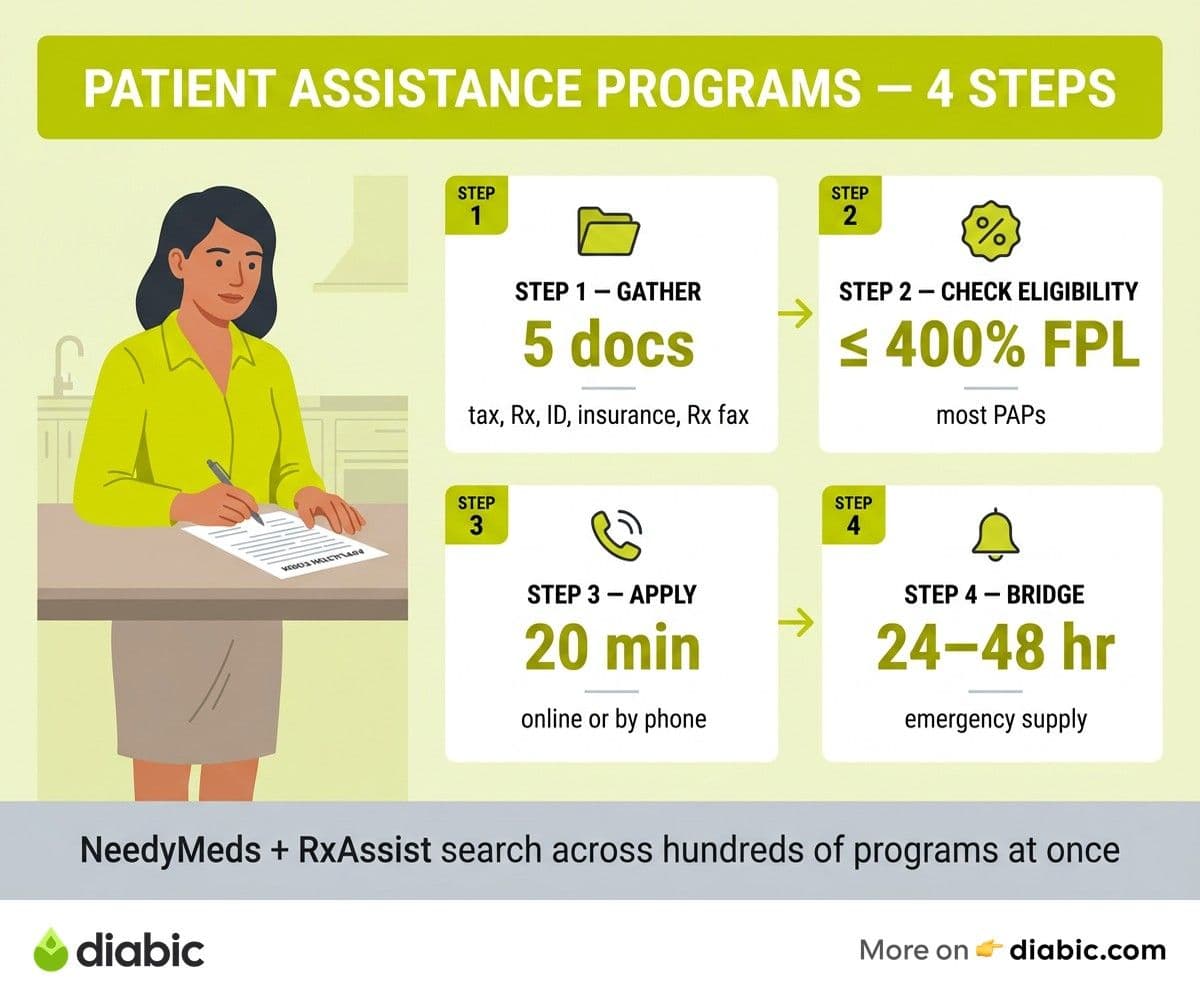
Eligibility is set by each program individually, but most use household income as the primary criterion, often expressed as a percentage of the federal poverty level. Many manufacturer programs accept patients earning up to 400 percent of the federal poverty line, which is well into middle-class territory for a family of four. Insurance status matters too, and some programs are open only to uninsured applicants while others welcome people with private coverage who still face high copays or deductibles.
A few persistent misconceptions keep people from applying who probably should. The first is that the income limits are very low when in reality they are often surprisingly generous. The second is that having insurance disqualifies you, which is rarely true and depends on the specific program. The third is that the process is so complex it cannot be worth the effort, when most applications take less than an hour and renew annually with minimal new paperwork. We have seen people save thousands of dollars a year by spending one afternoon filling out forms.
Affordable Insulin Through Manufacturer Programs
The three companies that produce nearly all insulin sold in the United States each run their own assistance programs, and the savings can be dramatic. If you take insulin and you are paying full retail price, one of these programs almost certainly applies to you. We will walk through each one so you can identify the right starting point.
The Lilly Insulin Value Program caps the monthly cost of Lilly insulins at a low flat fee for many patients regardless of insurance status, and the company also runs a broader patient assistance program for uninsured people meeting income requirements. To apply, you visit the Lilly website, fill out an online form with proof of income, and either receive a savings card or get connected to free medication shipped to your prescriber. Processing for the savings card is typically immediate, while the full assistance program takes longer.
Novo Nordisk operates the Novo Nordisk Patient Assistance Program through NovoCare, which provides free insulin and other Novo medications to qualifying uninsured patients. The eligibility threshold sits at or below 400 percent of the federal poverty level, and applicants must be U.S. citizens or legal residents. Approval lasts twelve months, after which you reapply with updated income documentation. Novo also offers a separate savings card program for insured patients with high copays, capping monthly insulin costs for eligible enrollees.
Sanofi runs Sanofi Patient Connection, which covers insulins like Lantus and Toujeo along with several non-insulin diabetes medications. Sanofi also offers the Insulins Valyou Savings Program, which gives uninsured cash-paying patients a flat monthly rate for up to ten boxes of pens or vials. Both programs require an application, proof of income, and a prescription from your healthcare provider, and the company has dedicated staff to help if you get stuck mid-application.
Across all three manufacturers, the documents you will need are remarkably similar. You will be asked for a recent tax return or pay stubs, a copy of your insurance card if you have one, a valid prescription, and basic identification. Your prescriber's office often has a fax line dedicated to PAP forms, and many practices have a financial counselor or social worker who handles these submissions on your behalf. If your clinic does not advertise this service, ask anyway, because the help often exists quietly.
The Cost of Diabetes Medication Without Assistance
To understand why these programs exist, it helps to look honestly at what diabetes medications cost without help. Insulin alone has been the subject of intense national debate, with list prices for a single vial often falling into the high double or low triple digits, and most people using insulin require multiple vials or pens per month. For a deeper look at how costs add up across the full picture of supplies, visits, and medications, our breakdown of the real cost of managing diabetes gives you the wider view.
When you stack medications, the burden compounds quickly. Someone with type 2 diabetes might take metformin, a GLP-1 receptor agonist, an SGLT2 inhibitor, a statin for cholesterol, and a blood pressure medication, with each prescription carrying its own copay or cash price. Out-of-pocket spending for people with diabetes runs roughly two to three times higher than for people without it, according to the ADA's Economic Costs of Diabetes report and data published in Diabetes Care from the American Diabetes Association. For someone on a fixed income or working a job without strong benefits, the math simply does not work.
The consequence we see most often, and the one that worries us the most, is medication rationing. Surveys have found that roughly one in four people who use insulin has skipped, stretched, or underdosed their medication because of cost. This is medically dangerous and can lead to diabetic ketoacidosis, hospitalization, and death. If you have ever rationed insulin or any other diabetes medication, please know that there are legitimate paths to free or low-cost supply, and you deserve to use them. Reaching out for help is not a failure of self-management. It is self-management.
Insurance and Assistance Programs Working Together
A common assumption is that having insurance disqualifies you from assistance, but the reality is more nuanced. Manufacturer copay cards are specifically designed to layer on top of commercial insurance, reducing what you pay at the pharmacy counter after your plan applies its share. These cards are typically not available to people enrolled in government programs like Medicare or Medicaid, but for anyone with employer-sponsored or marketplace coverage, they can erase a significant portion of the monthly bill.
When insurance covers a medication poorly, full patient assistance programs can sometimes step in to fill the gap. This is most common with newer specialty medications that sit on high formulary tiers with steep coinsurance. If your plan technically covers a drug but charges you hundreds of dollars per fill, you may still qualify for the manufacturer's full PAP based on financial hardship. The application will ask you to document this, often with an explanation of benefits showing what you actually pay.
Medicaid coverage varies by state, but in expansion states it covers most diabetes medications with low or zero copays for enrolled members. Dual-eligible programs, designed for people who qualify for both Medicare and Medicaid, can also significantly reduce out-of-pocket costs. Medicare Part D plans have historically had a coverage gap commonly called the donut hole, and while reforms have improved this, you can still face higher costs at certain points in the year. The Extra Help program through Social Security can lower Part D costs further for people who qualify based on income and assets. For a wider view of what plans cover and where gaps tend to appear, see our guide on insurance coverage for diabetes supplies.
How to Apply for Patient Assistance Programs Diabetes Patients Qualify For
The application process is more straightforward than its reputation suggests, and a little preparation makes it much smoother. Before you start any form, gather your documentation in one place so you are not hunting for paperwork mid-application. Most programs ask for the same core items, so collecting them once lets you apply to multiple programs in a single sitting.
Here is what we recommend pulling together before you sit down to apply. Each item maps directly to a question every program will ask, and having them ready cuts your application time roughly in half.
- Your most recent federal tax return, or recent pay stubs if your income has changed, plus any Social Security or disability statements
- A copy of your prescription bottle labels or a printed list of medications, doses, and prescriber information
- Your insurance card and any explanation of benefits documents showing recent pharmacy charges
- A government-issued photo ID and proof of U.S. residency, such as a utility bill or lease
- The contact information for your prescribing healthcare provider, including their fax number
Most major manufacturers offer online applications, which are faster and provide immediate confirmation. Paper applications still exist for people who prefer them or who do not have reliable internet access, and you can request them by phone. Processing times vary, but expect anywhere from a few days for an instant savings card to four to six weeks for full assistance program approval. While you wait, ask your prescriber's office about samples, which most clinics keep on hand specifically for people in this in-between period.
The single best resource for navigating multiple programs at once is NeedyMeds, a non-profit database that lists thousands of patient assistance programs in one place and lets you search by medication name. RxAssist plays a similar role and is also free to use. Both sites maintain current eligibility criteria and direct application links, which saves you the work of hunting down each manufacturer separately. Once approved, most programs require annual reapplication with updated income documentation, and many will send you reminder notices before your enrollment lapses.
Free Insulin Programs for Uninsured People
If you are completely uninsured, your options are actually broader than you might expect. The major manufacturer programs we already covered all serve uninsured patients as their primary audience, and approval rates are high for people who meet the income threshold. We want to highlight a few additional pathways that exist specifically for the uninsured population, because they are often overlooked.
Federally qualified health centers, sometimes called community health centers, operate on a sliding scale that adjusts your fees based on what you can afford to pay. Many of these centers have on-site pharmacies that participate in the 340B Drug Pricing Program, which lets eligible providers buy outpatient medications at deeply discounted prices and pass those savings on to patients. For someone without insurance, walking into a 340B-eligible community health center can mean paying a small fraction of retail for the same insulin you would buy elsewhere. The Health Resources and Services Administration maintains a search tool to help you find a center near you.
For lower-cost retail alternatives that exist outside of the patient assistance programs diabetes manufacturers run, our pieces on affordable insulin options at the pharmacy counter and the Walmart insulin options worth knowing about cover practical fallback paths. For acute situations, where you need insulin in the next day or two and cannot wait for any application to process, several emergency pathways exist. Lilly, Novo Nordisk, and Sanofi all have emergency or urgent need provisions that can release a short-term supply within twenty-four to forty-eight hours, often through a phone call rather than a full application. Some states have passed emergency insulin access laws that require pharmacies to provide a limited emergency supply with a copay cap. If you are facing a true emergency, calling the manufacturer directly and explaining the situation often produces faster results than any online process.
We also want to acknowledge that asking for help can feel uncomfortable, especially the first time. The systems we are describing were built specifically because diabetes medication has become unaffordable for too many people, and using them is exactly what they exist for. You do not need to be in crisis to qualify, and you do not need to apologize for needing the help.
FAQ
How do you apply for diabetes patient assistance programs?
Visit the manufacturer's website for your specific medication, check the income eligibility requirements, gather proof of income and insurance status, and complete the application online or by mail. Your doctor's office can often help with the process, and many practices have dedicated staff who handle assistance program applications routinely. NeedyMeds and RxAssist are excellent starting points if you want to compare programs across multiple medications in one search.
Are there free insulin programs for uninsured people with diabetes seeking coverage?
Yes. Major insulin manufacturers offer free insulin to qualifying uninsured patients through their patient assistance programs, and Lilly, Novo Nordisk, and Sanofi all have active programs. Community health centers participating in the 340B Drug Pricing Program can also provide insulin at significantly reduced cash prices, often a small fraction of what you would pay at a chain pharmacy. Emergency provisions exist for situations where you cannot wait for a full application to process.
Will I lose patient assistance if I get a job with insurance?
Not necessarily. Many manufacturer programs allow insured patients to continue receiving help through copay assistance cards, even if you no longer qualify for the full free-medication tier. You may need to update your enrollment to reflect your new coverage, and some programs require you to use your insurance first and apply assistance to the remaining cost. It is worth contacting the program directly rather than assuming you have aged out.
How long does it take to get approved for a diabetes assistance program?
Manufacturer copay savings cards often activate immediately or within a day, which can help when you need to fill a prescription this week. Full patient assistance programs that ship free medication typically take two to six weeks to process, depending on the manufacturer and how complete your application is. While you wait, ask your prescriber for samples or inquire about emergency provisions if you are running low.
The path to affordable diabetes medication is rarely a single program. It is usually a combination of manufacturer assistance, smart pharmacy choices, and using community resources like federally qualified health centers when they apply to your situation. If you take only one thing from this guide, let it be that you are likely eligible for more help than you assume, and the time it takes to apply is one of the highest-return uses of an afternoon you will find. Patient assistance programs diabetes patients depend on exist for exactly this reason, and using them is part of taking good care of yourself.
Shahriar P. Shuvo is the founder of Diabic. He has lived with diabetes for over 14 years, and built Diabic to deliver the practical, evidence-based self-management tools he wished existed when he was first diagnosed. By trade, Shahriar is a senior design and frontend engineer with 6+ years shipping products at Agora, Timescale (now Tiger Data), and ShareTrip. He writes from the intersection of lived diabetes experience and product craft, focused on what works in daily management rather than what sounds good in a textbook.
Medically reviewed by
Dr. Shanto Arian is an internal medicine physician now specializing in clinical and aesthetic dermatology, with a parallel academic focus on epidemiology and public health. He holds an MBBS, MPH, MSc (UK), MRCP (UK), MRCPI (Ireland), Diploma in Dermatology (UK), and Diploma in Aesthetic Medicine (USA). Dr. Arian trained in internal medicine, including hospital work on hematology cases such as graft-versus-host disease, before moving toward dermatology. Skin is one of the earliest places diabetes shows itself, from acanthosis nigricans and diabetic dermopathy to slow foot wound healing, and that intersection is where his clinical and Diabic-review work meet. On Diabic, Dr. Arian medically reviews content on diabetes diagnosis, complications, dermatologic manifestations, and pharmacotherapy, ensuring every claim aligns with current ADA, NICE, and peer-reviewed literature.
More from Living with Diabetes
View all
A Gentle Chair Yoga Routine for people with diabetes
A gentle chair yoga for people with diabetes routine with safe poses, modifications for neuropathy, retinopathy, and joint pain, plus tips for older.

Shift Work and Diabetes: Managing Irregular Hours
Shift work and diabetes is a tough combination. Learn how to manage meals, sleep, medication, and blood sugar when your hours rotate or flip overnight.

Dating with Diabetes: When to Tell a New Partner
Dating with diabetes brings unique disclosure questions. Here is when to tell a new partner, what to say, and how to handle the conversation with.
Clinician-reviewed habits, plain-language guides, and honest answers - the small shifts that make living with diabetes feel lighter, every day.