Gestational Diabetes Diet: What to Eat and Avoid
A practical gestational diabetes diet guide with foods to eat, foods to avoid, sample meals, and timing strategies for stable blood sugar in pregnancy.

In this article(11)
A gestational diabetes diet does not mean eating bland, boring food for the rest of your pregnancy. The right pattern of meals can keep your blood sugar steady, fuel your baby's growth, and let you enjoy real food at the same time. The shift is less about what to remove and more about what to combine.
The diagnosis usually comes between 24 and 28 weeks, often as a surprise. The good news is that most women manage gestational diabetes successfully through diet and monitoring alone. Medication or insulin only enters the picture if blood sugar stays above target despite consistent food and activity changes.
Understanding Gestational Diabetes and Nutrition
Gestational diabetes happens when pregnancy hormones make your cells more resistant to insulin, and your pancreas cannot keep up with the extra demand. Blood sugar rises, especially after meals. The condition usually goes away after birth but raises future type 2 risk for both mother and baby.
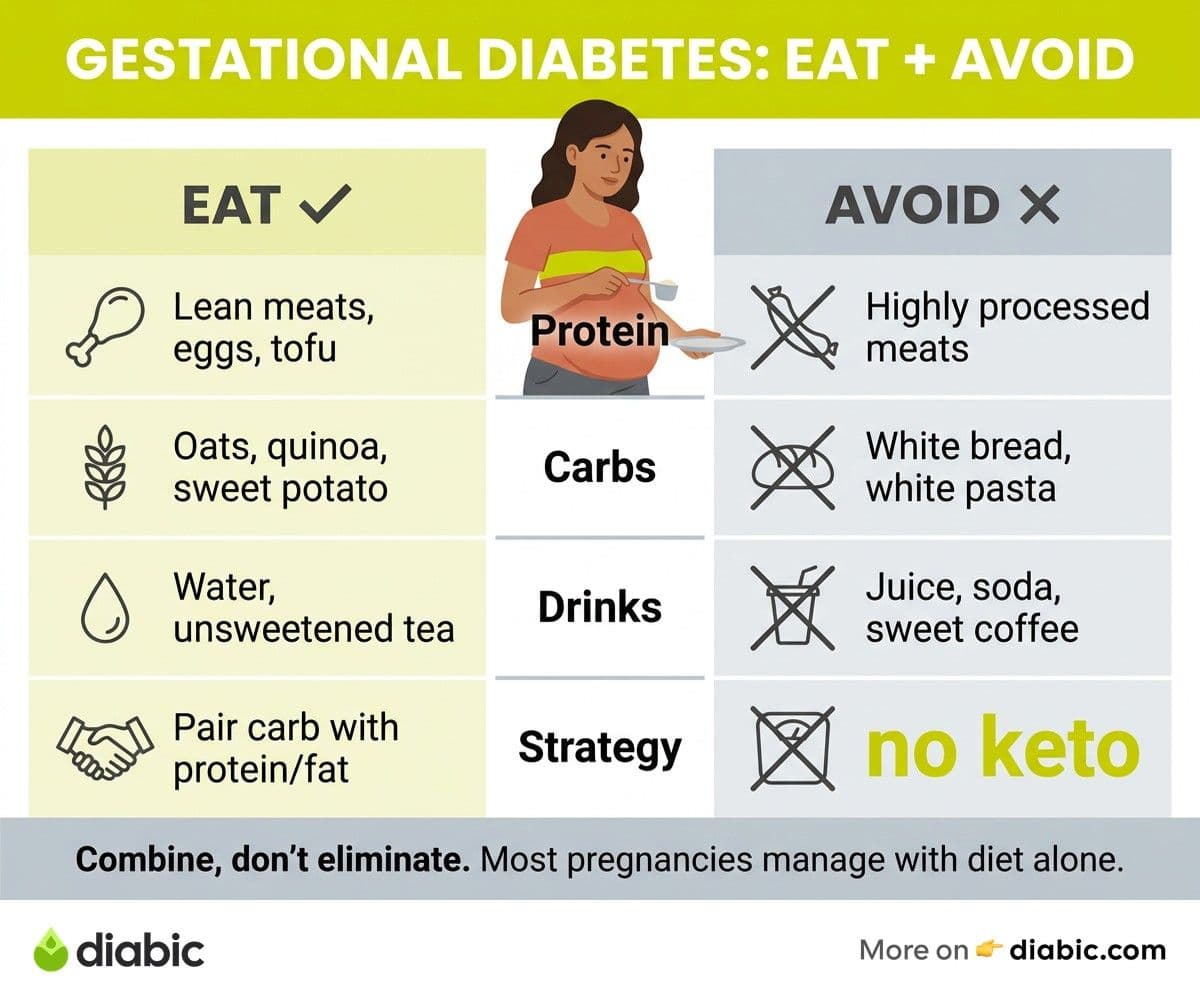
Diet is the first-line treatment. The American Diabetes Association and American College of Obstetricians and Gynecologists both recommend nutrition therapy as the foundation, with medication added only when needed. The goal is steady blood sugar, not extreme restriction. Cutting too many carbs can produce ketones, which is its own problem during pregnancy.
If you are still in the diagnostic stage, our piece on the glucose test during pregnancy walks through what the test involves and what the numbers mean. Many women also wonder whether they missed warning signs; the early gestational diabetes symptoms post explains why most cases are silent.
The pattern most often recommended for gestational diabetes shares a lot with general healthy eating. Vegetables, lean proteins, healthy fats, and a controlled amount of slow-releasing carbs make up the bulk of meals. The differences come in timing, portion size, and the deliberate pairing of carbs with protein and fat.
Foods to Eat for Stable Blood Sugar
Building meals around the right foods makes the rest of gestational diabetes management easier. Here is what works.
Complex carbohydrates in measured portions
- Rolled or steel-cut oats (not instant)
- Quinoa, barley, farro, and bulgur
- Brown rice or wild rice (small portions)
- Sweet potatoes (skin on, baked or roasted)
- Sprouted grain or 100 percent whole-grain bread
- Beans and lentils (protein and fiber together)
Lean proteins
- Chicken and turkey
- Fish and seafood (low-mercury varieties: salmon, sardines, shrimp, cod)
- Eggs (a flexible, complete protein)
- Tofu and tempeh
- Greek yogurt and cottage cheese (also calcium)
- Cheese in modest portions
Healthy fats
- Avocado
- Nuts and seeds (almonds, walnuts, chia, flax, pumpkin seeds)
- Olive oil for cooking and dressings
- Fatty fish (salmon contributes omega-3s for baby's brain)
Non-starchy vegetables (eat freely)
- Leafy greens (spinach, kale, arugula)
- Broccoli, cauliflower, Brussels sprouts
- Bell peppers, zucchini, cucumber, asparagus
- Tomatoes, mushrooms, green beans
Smart snacks
- Cheese with whole-grain crackers
- Apple with almond butter
- Greek yogurt with berries
- Hard-boiled eggs
- Small handful of mixed nuts
For more on the foods that have the smallest blood sugar impact across the day, our list of 8 foods that won't spike blood sugar covers options that pair well with gestational diabetes meal planning.
Foods to Avoid or Limit
The foods that drive most gestational diabetes spikes are predictable. Most are not "bad" foods, just foods that hit blood sugar harder than your pancreas can handle right now.
Sugary drinks (the biggest single culprit)
- Soda, sweet tea, sports drinks
- Fruit juice (even 100 percent juice)
- Sweetened coffee drinks (frappuccinos, lattes with syrup)
- Smoothies made primarily of fruit
Refined carbohydrates
- White bread, white rice, white pasta
- Bagels, muffins, and pastries
- Sugary cereals
- Pretzels, crackers, and chips made from refined flour
Sweets and desserts
- Candy, cookies, cake, ice cream
- Sweetened yogurt with fruit on the bottom
- Granola bars (most are basically candy)
- Honey, agave, and maple syrup in large amounts
Large fruit portions, especially tropical
- Mango, pineapple, watermelon, banana (one small portion is fine, but watch overall amount)
- Dried fruit (concentrated sugar)
- Fruit "leather" or pouches
Fast food and fried foods
- Hidden carbs in breading and sauces
- Trans fats and excessive saturated fats
- Sodium that makes pregnancy swelling worse
You do not have to give these foods up forever. After delivery, when insulin sensitivity returns, most can come back in moderation. During pregnancy, the trade-off is steady glucose for nine months versus complications for both you and baby.
Meal Planning and Timing Strategies
Timing matters as much as food choice. Three small meals plus two to three snacks usually keeps blood sugar steadier than three larger meals. The general framework providers recommend looks like this.
Eat every 2.5 to 3 hours. Long gaps let blood sugar drop, then a hungry, larger next meal spikes it. Steady eating prevents both swings.
Never skip breakfast. Insulin resistance is highest in the morning due to overnight hormone surges. A protein-and-fat-forward breakfast (eggs and avocado, Greek yogurt with nuts) starts the day on solid ground. Avoid juice and sugary cereals here especially.
Pair carbs with protein and fat at every meal. A piece of toast alone spikes blood sugar. The same toast with eggs and avocado does not. Protein and fat slow digestion, which flattens the post-meal curve. Our piece on 7 ways to prevent blood sugar spikes covers more on the science of meal pairing.
Use the plate method. Half your plate non-starchy vegetables, a quarter lean protein, a quarter complex carb. Add a thumb-size of healthy fat. This single rule, applied at most meals, is the easiest way to keep your gestational diabetes diet on track without weighing food.
Cap carbs per meal. Most providers recommend 30 to 45 grams of carbs per meal and 15 to 30 grams per snack, but exact targets are individual. Your dietitian or diabetes educator will help calibrate.
From my experience: After more than a decade with diabetes, the change that helped me most was treating the small evening snack as non-negotiable. A slice of cheese, a few crackers, and a few walnuts before bed kept my morning numbers in range. For gestational diabetes, the same principle applies. Bedtime fasting is when blood sugar can drift the most.
Sample Gestational Diabetes Diet Day
Here is what a steady day might look like. Adjust portions based on your blood sugar readings and your provider's targets. Per the Academy of Nutrition and Dietetics, individualization with a registered dietitian is the gold standard.
Breakfast (around 30g carbs)
- Plain Greek yogurt with a small handful of berries, a tablespoon of chopped walnuts, and a sprinkle of cinnamon
- Or two eggs scrambled with spinach, a slice of sprouted-grain toast with avocado
Mid-morning snack (around 15g carbs)
- Half an apple with one tablespoon of almond butter
- Or a hard-boiled egg with a small handful of grapes
Lunch (around 45g carbs)
- Grilled chicken salad over mixed greens with quinoa, cherry tomatoes, cucumber, feta, and olive oil vinaigrette
- Or a turkey and avocado sandwich on sprouted grain bread with a side salad
Afternoon snack (around 15g carbs)
- One ounce of cheese with five whole-grain crackers
- Or hummus with cucumber and bell pepper slices
Dinner (around 45g carbs)
- Baked salmon, roasted broccoli, and a small baked sweet potato (about half cup)
- Or chicken stir-fry with non-starchy vegetables over half a cup of brown rice
Evening snack (around 15g carbs)
- Half a cup of cottage cheese with a few walnuts
- Or one ounce of cheese with a few rye crackers
This plan totals roughly 165 grams of carbs across the day, which fits most gestational diabetes meal targets. Your provider may suggest more or less based on your weight, activity level, and trimester. Budget-conscious moms can also explore our diabetes on a budget meal planning guide for affordable swaps.
Monitoring Your Response to Food
Blood sugar testing is your feedback loop. Most providers ask for fasting and post-meal readings, often four times a day during pregnancy. The CDC outlines typical blood sugar targets during pregnancy: under 95 mg/dL fasting, under 140 mg/dL one hour after meals, and under 120 mg/dL two hours after meals. Your specific numbers may differ.
Test as your provider directs, usually one or two hours after the start of each meal. Record both the food you ate and the reading. Over a week or two, patterns emerge. You will see which meals consistently stay in range and which ones push you over.
Use the data to adjust. If oatmeal at breakfast spikes you to 160, try eggs and avocado instead. If pasta at dinner pushes you over even with sauce, swap to a smaller portion paired with extra vegetables and protein. Small changes based on your real numbers beat any standard meal plan written without your data.
What works for one person may not work for you. Some women can eat sourdough without issue; others spike on it. Some tolerate small amounts of fruit anytime; others need to keep fruit only with protein. Individualize the approach using your own readings, and bring your log to every prenatal visit.
FAQ
What should I eat with gestational diabetes?
Focus on non-starchy vegetables, lean proteins (chicken, fish, eggs, legumes), healthy fats (avocado, nuts, olive oil), and controlled portions of complex carbs like oats, quinoa, and sweet potato. Pair carbs with protein and fat at every meal to flatten blood sugar response.
What foods should you avoid with gestational diabetes?
Limit sugary drinks (juice, soda, sweetened coffee), refined carbs (white bread, white rice, pastries), candy and desserts, large portions of tropical fruit, and fried/fast foods. These cause the sharpest blood sugar spikes during pregnancy.
How many carbs should I eat per meal with gestational diabetes?
Most providers recommend 30 to 45 grams of carbs per meal and 15 to 30 grams per snack, spread across three meals and two to three snacks per day. Exact targets are individualized; your dietitian will help calibrate based on your weight and blood sugar response.
Can I eat fruit with gestational diabetes?
Yes, in measured portions and paired with protein or fat. Berries, apples, pears, and citrus tend to spike blood sugar less than tropical fruits like mango, pineapple, and banana. Fruit juice should be avoided because it lacks the fiber that slows sugar absorption.
A workable gestational diabetes diet is built around foods you actually enjoy, structured around timing and pairing rather than restriction. The first two weeks are the hardest. After that, the pattern becomes second nature, and the numbers usually follow.
Dr. Rezwana Parvin Rumpa is an obstetrics and gynaecology specialist with clinical focus on gestational diabetes, PCOS, and fertility. She holds the MRCOG (Final Part) from the Royal College of Obstetricians and Gynaecologists in London, the MRCPI (Final Part) from the Royal College of Physicians of Ireland, and an MBBS from Shaheed Monsur Ali Medical College under Dhaka University. Dr. Rumpa serves as a Senior Medical Officer in the Obs and Gynae department at BRB Hospitals Ltd, where she has spent three years managing prenatal care, emergency obstetric cases, and women's-health surgery. On Diabic, she medically reviews content for women living with diabetes, with particular attention to pregnancy, PCOS, and reproductive-health intersections.
Medically reviewed by
Dr. Shanto Arian is an internal medicine physician now specializing in clinical and aesthetic dermatology, with a parallel academic focus on epidemiology and public health. He holds an MBBS, MPH, MSc (UK), MRCP (UK), MRCPI (Ireland), Diploma in Dermatology (UK), and Diploma in Aesthetic Medicine (USA). Dr. Arian trained in internal medicine, including hospital work on hematology cases such as graft-versus-host disease, before moving toward dermatology. Skin is one of the earliest places diabetes shows itself, from acanthosis nigricans and diabetic dermopathy to slow foot wound healing, and that intersection is where his clinical and Diabic-review work meet. On Diabic, Dr. Arian medically reviews content on diabetes diagnosis, complications, dermatologic manifestations, and pharmacotherapy, ensuring every claim aligns with current ADA, NICE, and peer-reviewed literature.
More from Living with Diabetes
View all
A Gentle Chair Yoga Routine for people with diabetes
A gentle chair yoga for people with diabetes routine with safe poses, modifications for neuropathy, retinopathy, and joint pain, plus tips for older.

Shift Work and Diabetes: Managing Irregular Hours
Shift work and diabetes is a tough combination. Learn how to manage meals, sleep, medication, and blood sugar when your hours rotate or flip overnight.

Dating with Diabetes: When to Tell a New Partner
Dating with diabetes brings unique disclosure questions. Here is when to tell a new partner, what to say, and how to handle the conversation with.
Clinician-reviewed habits, plain-language guides, and honest answers - the small shifts that make living with diabetes feel lighter, every day.