Diabetes Supply Savings Tips That Actually Work in Real Life
Practical diabetes supply savings tips for cutting costs on test strips, CGMs, insulin, and pump supplies without compromising your care.

In this article(11)
If you have ever stood at the pharmacy counter trying to decide which supply to skip this month, you already know the math of living with diabetes is brutal. Test strips, CGM sensors, lancets, pen needles, and pump infusion sets add up in ways that catch even careful budgeters off guard. The diabetes supply savings tips floating around the internet often miss the strategies that actually move the needle, which is why we put this together with real-world tactics our community has tested.
We are not going to tell you to clip coupons and call it a day. The tips that work require a little setup, some calls to your insurance company, and occasionally an awkward conversation with your prescriber, but they can save hundreds of dollars a month for people who put them into practice. Most of all, they let you spend your money on the parts of care that genuinely improve your health rather than on the same supplies at marked-up prices.
This guide walks through every category of diabetes supply, where the hidden savings are, and how to combine strategies for the biggest impact. Along the way, we link out to other resources we have built so you can go deeper on whichever pieces matter most to your situation.
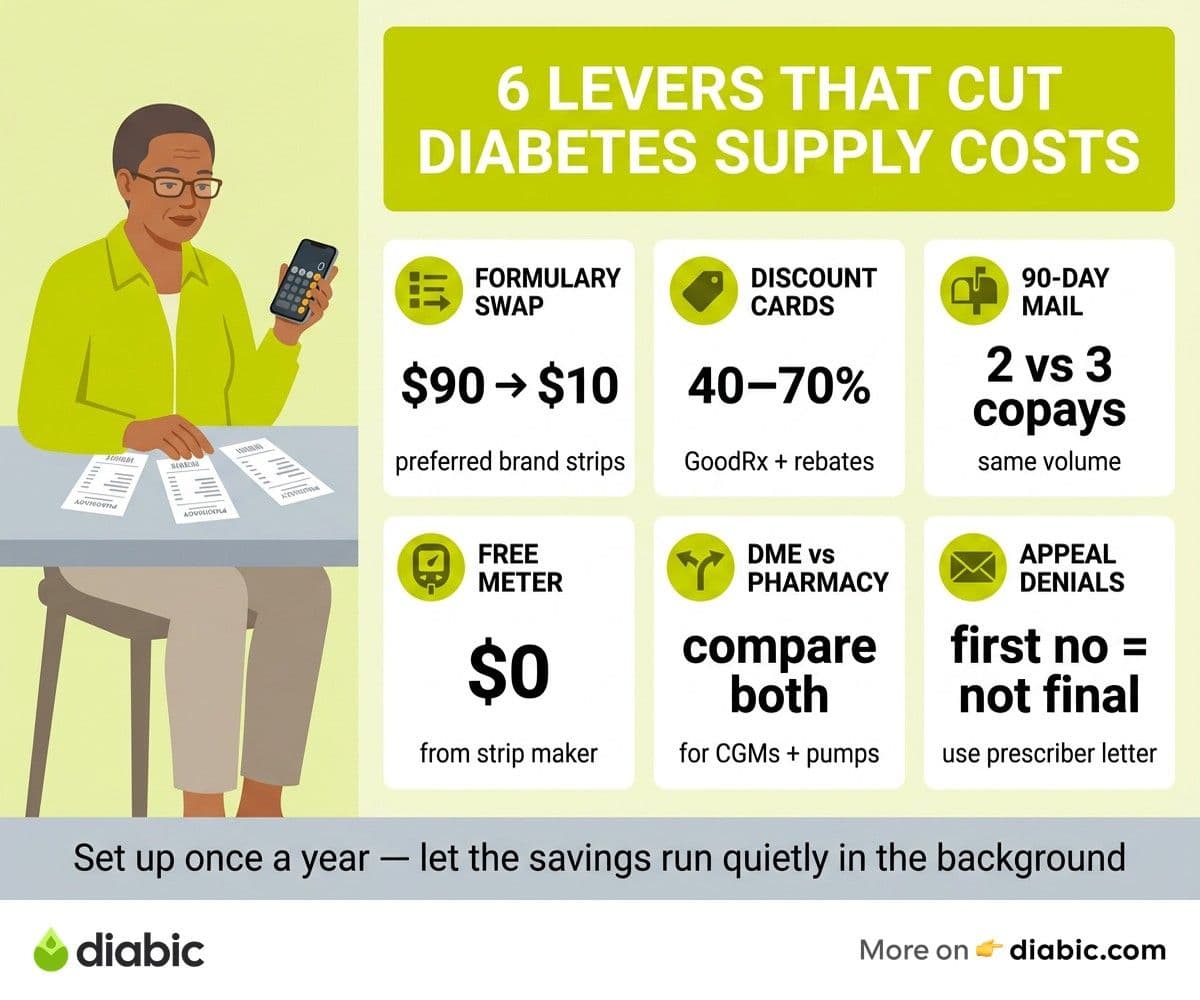
From my experience: Around 2019 I realized I was paying nearly $90 a month for the test strips my old meter took, when the same insurance plan covered a different brand for $10. One five-minute call to my prescriber for a new meter prescription, and the savings showed up the next refill. The fix was almost embarrassingly simple, which is why I never assume the default channel is the cheapest one anymore.
Why Diabetes Supply Savings Tips Matter More Than Ever
Out-of-pocket costs for diabetes supplies have been climbing faster than wages for more than a decade, and the pressure is hitting middle-income households hardest. People with high-deductible health plans are particularly exposed because they pay full price for supplies until they hit their deductible, which can take most of the year. The American Diabetes Association has tracked rising affordability concerns and now treats supply costs as a public health issue, not just a personal finance one.
The hidden costs are what catch most people off guard. The pump that the manufacturer gave you for free comes with a steady stream of infusion sets, reservoirs, and adhesives that cost hundreds of dollars a month. CGM sensors expire on a fixed schedule whether you remember to wear them or not. Test strips run out at the worst possible moment, and the brand your insurance covers may change without warning at the start of a new plan year. We cover the real cost of diabetes management in detail because most people underestimate their true annual spend by thirty percent or more.
Proactive savings strategies beat reactive scrambling because the cheapest supply is the one you bought before you needed it on a discount. Setting up your savings systems once, instead of solving the same problem every month, is the difference between a manageable budget and a stressful one. The NIDDK estimates that people with diabetes spend two to three times more on healthcare than people without it, and supplies are a meaningful slice of that gap.
The True Cost of Diabetes Management
Before you can save money, you need to know where it is going. We recommend pulling three months of pharmacy receipts and durable medical equipment statements and adding up everything you have spent on supplies, not including insulin or oral medications. Most people are surprised by the total, and the surprise is usually motivating rather than depressing.
Test strips are the single biggest ongoing supply expense for many people, especially those testing four or more times a day. Cash prices range from roughly $0.50 to $1.50 per strip depending on the brand and pharmacy, which can mean $60 to $180 a month before any discounts. Generic strips and store brands often work as well as name-brand ones, but they require a meter that accepts them.
CGM sensors run between $250 and $400 per month at retail without insurance, depending on the device. With Medicare or commercial insurance coverage, copays range from zero to around $80 per month for most users, but the supply chain quirks matter. Some pharmacies charge less than durable medical equipment suppliers for the exact same sensor, and switching the channel can cut costs by half.
Insulin pump supplies follow a similar pattern. A month of infusion sets and reservoirs typically runs $200 to $400 at cash prices, with insurance copays varying widely. Patch pumps have their own cost structure where the device and the supply are bundled into a single recurring purchase. Knowing your exact monthly burn rate per category is the foundation everything else builds on.
Insurance Coverage Strategies for Diabetes Supplies
Your insurance plan likely covers more than you think, and it may also be steering you toward more expensive options without your knowledge. Pulling your formulary, the list of preferred medications and supplies your plan covers, is step one. Most insurers post this online, and your member services line can email you a current copy in a few minutes.
The preferred versus non-preferred distinction is where many savings hide. A preferred test strip brand might cost $10 a month while a non-preferred brand costs $80 for the same number of strips, and the only difference is which manufacturer your plan negotiated with. Switching meters to match your formulary requires a new prescription, but most providers will write it without complaint when you explain why. We have a detailed guide to insurance coverage for diabetes supplies explained that walks through this process step by step.
Coverage denials are not always final. If your insurer denies a CGM, pump, or quantity of test strips you genuinely need, you have the right to appeal, and appeals succeed more often than people expect. Your prescriber's office usually has staff who handle these appeals routinely, and the process can take a few weeks but is worth the effort. Medicare publishes its own diabetes supply coverage rules clearly, and Medicare Advantage plans must offer at least the same coverage as traditional Medicare.
In-network durable medical equipment suppliers are often cheaper than retail pharmacies for CGMs and pump supplies, but the reverse is sometimes true. Calling both channels with your insurance information and getting an exact copay quote takes 20 minutes and can save you hundreds per month. Plans renegotiate contracts every year, so the cheapest channel last year may not be the cheapest this year.
Saving on Test Strips and Monitoring Supplies
Test strips are where most readers find their first big win because the market is competitive and the savings strategies are well documented. GoodRx and similar pharmacy discount apps can cut cash prices by 40 to 70 percent at most chain pharmacies, and the discount applies even if you have insurance and your copay is higher than the discount price. Always show the pharmacist both your insurance card and the discount card so they can charge whichever is cheaper.
Switching meter brands is sometimes the right move. If your insurance has a preferred meter that uses cheaper strips, ask your provider to write a prescription for that meter and the matching strips. Most meter manufacturers will mail you a free meter in exchange for buying their strips because the strips are where they make their money. The free meter offer is not a marketing trick, it is the actual business model.
Online retailers like ADW Diabetes, Diabetic Warehouse, and Total Diabetes Supply often beat pharmacy prices on cash purchases of test strips, especially in bulk. Subscription services that ship every 30 or 90 days frequently include an additional discount and remove the worry of running out unexpectedly. Manufacturer loyalty programs from Abbott, Roche, and others sometimes offer free strips or rebates for returning customers, so it is worth registering with whoever makes your meter.
For people without insurance, warehouse club pharmacies at Costco and Sam's Club consistently come in among the cheapest options for both supplies and medications. You do not always need a membership to use the pharmacy, depending on your state's laws, and many readers are surprised by how much they save on their first visit.
Affordable Insulin and Medication Strategies
Insulin is the supply category with the most public attention right now, which means the savings options have multiplied. Pharmacy discount programs work for insulin the same way they do for test strips. Mark Cuban Cost Plus Drugs has added several insulin products at transparent low cash prices, and their model strips out the middleman markups that drive pharmacy costs higher. We cover the full landscape of affordable insulin options in a dedicated guide.
Manufacturer patient assistance programs cap monthly out-of-pocket costs at $35 for many users regardless of insurance status. Lilly, Sanofi, and Novo Nordisk all run these programs, and qualification is broader than most people assume. The application takes 20 minutes and is renewable each year.
Switching from 30-day fills to 90-day fills cuts copays for many plans, and mail-order pharmacies often discount the 90-day price further. Setting up auto-refills with a mail-order program reduces the chance of running out before your next prescription fills, which sounds small but matters when you are juggling supplies for multiple conditions. If you take a brand-name medication that has a generic alternative, asking your provider whether the generic is appropriate for you can cut copays by 80 percent or more.
For Walmart shoppers, the ReliOn line includes both human insulin at roughly $25 per vial and a private-label insulin aspart at around $73 per vial. The human insulins require careful timing and may not suit every regimen, so talk to your doctor before switching. We have a separate guide on Walmart insulin options that covers the trade-offs in detail.
Finding the Cheapest Way to Buy Diabetes Supplies
The cheapest path almost always involves combining strategies rather than picking one. A typical optimization stack looks like insurance for the supplies your plan covers well, manufacturer programs for insulin, GoodRx or Cost Plus Drugs for medications without good coverage, online retailers for cash purchases of test strips and lancets, and warehouse clubs for everything else.
NeedyMeds maintains a database of patient assistance programs, free clinics, and discount cards that is updated frequently. State pharmaceutical assistance programs exist in roughly half the states and can wrap around Medicare or commercial insurance to cover gaps. Federal programs like Medicaid and Extra Help for Medicare beneficiaries provide deeper subsidies for those who qualify.
Community resources matter too. The ADA maintains affordability resources, local chapters often run supply exchange programs, and online communities trade tips on which retailers are running specials. T1 International and similar advocacy groups sometimes connect people in crisis with emergency supplies. Reaching out before you run out is always easier than reaching out after.
For readers in Canada, provincial drug plans cover most diabetes supplies for residents, though coverage levels vary by province. In the UK, the NHS provides supplies on prescription at standard charges or free for those with medical exemptions. The strategies in this guide are most directly applicable to the US system, but the principle of combining channels and asking for what you need transfers everywhere.
Frequently Asked Questions
How can you save money on diabetes test strips?
Compare prices across pharmacies using apps like GoodRx, ask your doctor about switching to a meter that uses cheaper strips covered by your insurance, buy in bulk from online diabetes retailers, register for manufacturer loyalty programs, and check whether your insurance has a preferred brand at a lower copay. Combining two or three of these usually beats the savings from any single tactic.
What is the cheapest way to buy diabetes supplies?
Online retailers and warehouse club pharmacies tend to offer the lowest cash prices on test strips and lancets, while manufacturer assistance programs and Cost Plus Drugs lead on insulin and medications. The cheapest overall path is combining your insurance for items it covers well with discount programs and direct purchases for everything else.
Will using GoodRx or a discount card hurt my insurance?
Discount cards do not affect your insurance and can be used at the same pharmacy on the same day for different medications. The pharmacy charges whichever is cheaper for each prescription. The one nuance is that purchases made with a discount card do not always count toward your insurance deductible, so the math gets more complicated for people close to hitting their out-of-pocket maximum.
Can I appeal an insurance denial for CGMs or other supplies?
Yes, and appeals succeed more often than people expect, especially when your prescriber's office submits documentation explaining medical necessity. Most plans have a multi-step appeal process and you can usually escalate to an independent reviewer if internal appeals fail. The process takes time but is worth the effort for ongoing supplies that affect your daily care.
The most useful frame for these diabetes supply savings tips is to treat them as a setup task once a year, not a monthly hunt. Pull your formulary, line up your preferred pharmacies and online retailers, register for the manufacturer programs that fit your prescriptions, and put renewal dates on your calendar so nothing lapses. From that point on, the diabetes supply savings tips that genuinely work tend to be the boring ones you already have running in the background, and the money you free up can go toward the parts of care that actually move your numbers.
Shahriar P. Shuvo is the founder of Diabic. He has lived with diabetes for over 14 years, and built Diabic to deliver the practical, evidence-based self-management tools he wished existed when he was first diagnosed. By trade, Shahriar is a senior design and frontend engineer with 6+ years shipping products at Agora, Timescale (now Tiger Data), and ShareTrip. He writes from the intersection of lived diabetes experience and product craft, focused on what works in daily management rather than what sounds good in a textbook.
Medically reviewed by
Dr. Rezwana Parvin Rumpa is an obstetrics and gynaecology specialist with clinical focus on gestational diabetes, PCOS, and fertility. She holds the MRCOG (Final Part) from the Royal College of Obstetricians and Gynaecologists in London, the MRCPI (Final Part) from the Royal College of Physicians of Ireland, and an MBBS from Shaheed Monsur Ali Medical College under Dhaka University. Dr. Rumpa serves as a Senior Medical Officer in the Obs and Gynae department at BRB Hospitals Ltd, where she has spent three years managing prenatal care, emergency obstetric cases, and women's-health surgery. On Diabic, she medically reviews content for women living with diabetes, with particular attention to pregnancy, PCOS, and reproductive-health intersections.
More from Living with Diabetes
View all
A Gentle Chair Yoga Routine for people with diabetes
A gentle chair yoga for people with diabetes routine with safe poses, modifications for neuropathy, retinopathy, and joint pain, plus tips for older.

Shift Work and Diabetes: Managing Irregular Hours
Shift work and diabetes is a tough combination. Learn how to manage meals, sleep, medication, and blood sugar when your hours rotate or flip overnight.

Dating with Diabetes: When to Tell a New Partner
Dating with diabetes brings unique disclosure questions. Here is when to tell a new partner, what to say, and how to handle the conversation with.
Clinician-reviewed habits, plain-language guides, and honest answers - the small shifts that make living with diabetes feel lighter, every day.