Whole Grains for Prediabetes: What to Choose
Choosing the right whole grains for prediabetes can steady your blood sugar. Here are the best picks, glycemic comparisons, and meal ideas that work.

In this article(11)
Choosing the right whole grains for prediabetes can make a real difference in how your blood sugar responds to meals. Not all grains behave the same way once they are digested, and a label that reads "made with whole grains" does not always mean what you think it does.
The good news is that the picks that work best are also some of the easiest to find and prepare. This guide walks through which grains deliver the most fiber, which ones spike blood sugar the least, and how to fit them into meals you actually want to eat.
Why Whole Grains for Prediabetes Matter
A whole grain keeps all three parts of the kernel intact: the bran, the germ, and the endosperm. That structure is what gives whole grains their fiber, B vitamins, magnesium, and slow-burning carbohydrates. Refined grains strip away the bran and germ, which is why white bread digests almost as fast as table sugar.
For someone with prediabetes, that difference shows up in the bloodstream. Fiber slows how quickly glucose moves from the gut into the blood, which softens the post-meal spike and reduces the amount of insulin your pancreas has to produce. Over time, that lighter workload helps protect the same cells that prediabetes is already straining.
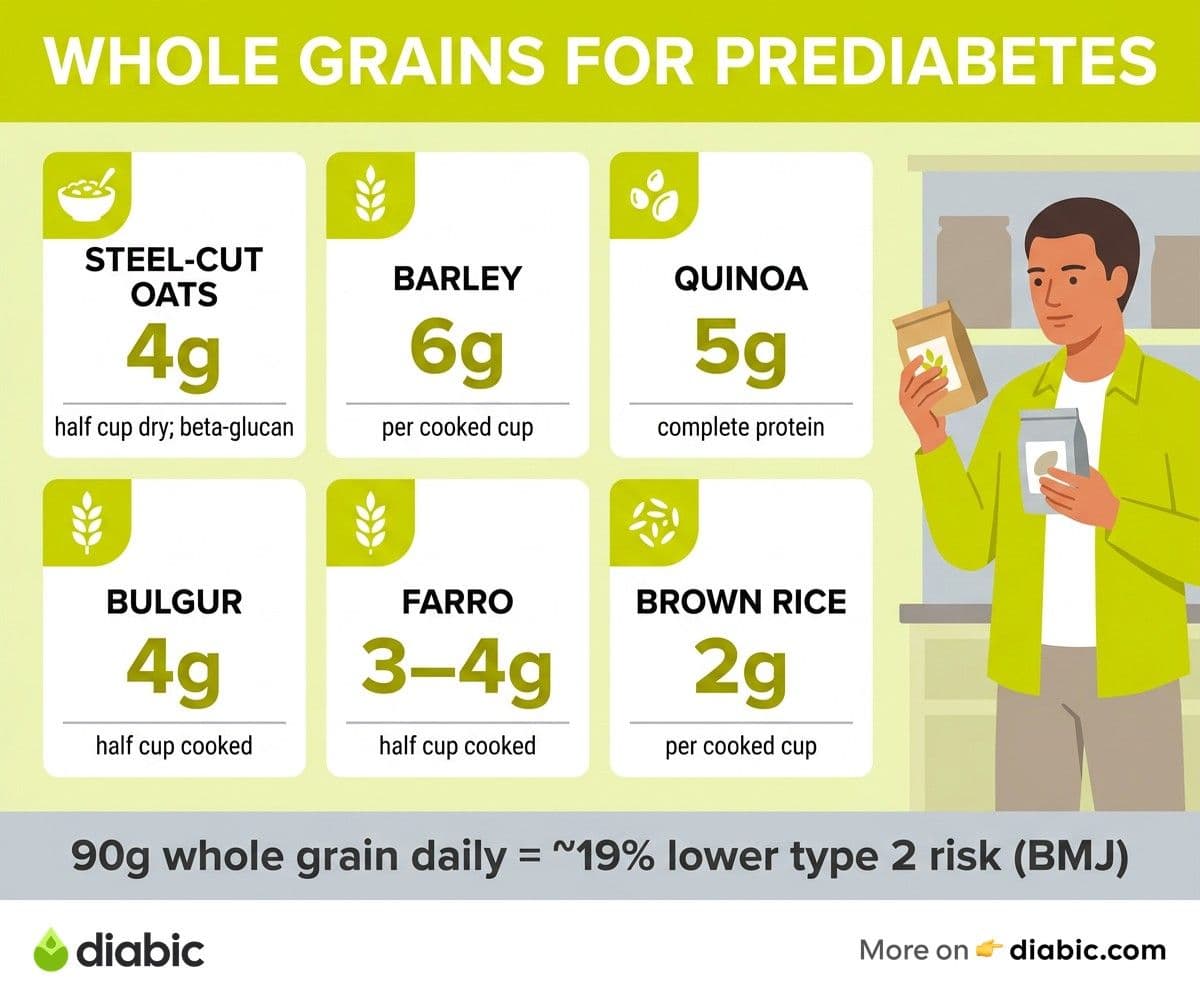
Research on whole grains and diabetes risk is unusually consistent. A BMJ meta-analysis of 14 studies found that each daily 90-gram serving of whole grains, roughly three slices of bread or a generous bowl of oats, was linked to a 19 percent lower risk of developing type 2 diabetes. The effect plateaus around 7 daily servings, but the steepest benefit comes from moving from zero to two.
That does not mean grains have to take over your plate. They sit alongside vegetables, lean protein, and healthy fats as part of a balanced eating pattern. If you are exploring a low carb approach to prediabetes, whole grains can still play a smaller, strategic role rather than being eliminated entirely.
What Whole Grains Are Best for Prediabetes
Some grains pull more weight than others. The best picks for blood sugar tend to share three traits: high fiber, intact or minimally processed kernels, and a lower glycemic index. Here are the ones that show up most often in research and on dietitian recommendations.
Steel-cut and rolled oats are among the most studied. A half-cup of dry steel-cut oats provides about 4 grams of fiber, much of it beta-glucan, a soluble fiber linked to improved insulin sensitivity. Steel-cut oats digest more slowly than rolled, and both digest more slowly than instant.
Quinoa is technically a seed but eats like a grain. It cooks in 15 minutes, delivers about 5 grams of fiber per cooked cup, and brings a complete protein profile that pairs well with vegetables.
Barley, especially hulled or hull-less barley, is one of the highest-fiber grains on the shelf, with around 6 grams per cooked cup. Pearled barley is more processed and lower in fiber but still a reasonable choice. Barley has a notably low glycemic index, which makes it a strong pick for soups, stews, and grain bowls.
Bulgur wheat is parboiled cracked wheat, which cooks in about 10 minutes. It carries about 4 grams of fiber per half-cup cooked and works in tabbouleh, pilafs, and grain salads.
Farro has a chewy texture and a nutty flavor. A cooked half-cup provides 3 to 4 grams of fiber and slightly more protein than brown rice.
Brown rice is the lowest-fiber option on this list at about 2 grams per cooked cup, but it remains a useful staple, especially when paired with beans or vegetables to boost the meal's overall fiber.
The Whole Grains Council keeps a helpful list of grain identifications and nutrition data if you want to compare further. When in doubt, look for the word "whole" first on the ingredient list and aim for at least 3 grams of fiber per serving.
Do Whole Grains Help Lower Blood Sugar
Yes, and the mechanism is worth understanding because it explains why some grains help more than others. The fiber in whole grains, particularly soluble fiber like beta-glucan in oats and barley, forms a gel in the gut that slows glucose absorption. The result is a lower, slower rise in blood sugar after a meal.
This is where the difference between glycemic index and glycemic load matters. Glycemic index ranks how fast a food raises blood sugar relative to pure glucose, but it is measured on a fixed 50-gram carbohydrate portion that does not match how people actually eat. Glycemic load adjusts for typical serving size and is usually a better real-world predictor of post-meal response.
Steel-cut oats, barley, and bulgur all have lower glycemic loads than instant oats, white rice, or processed cereals. Pairing any grain with protein, fat, or non-starchy vegetables further lowers the glycemic load of the meal as a whole.
Studies that tracked A1C levels in people who added more whole grains for prediabetes management have shown small but consistent improvements, typically in the 0.2 to 0.5 percentage point range over several months. That may sound minor, but as NIDDK explains in its prevention guidance, modest changes in eating patterns and weight can substantially shift the trajectory from prediabetes back toward normal glucose levels.
How to Include Whole Grains in Your Prediabetes Diet
The simplest place to start is by swapping. Replace white bread with 100 percent whole wheat or sprouted grain. Trade white rice for brown rice, quinoa, or barley. Switch instant oatmeal packets for plain rolled or steel-cut oats and add your own fruit or cinnamon.
Some practical meal ideas that take little extra effort:
- Breakfast. Steel-cut oats cooked in advance and reheated through the week, topped with berries, walnuts, and a spoon of Greek yogurt. Or whole grain toast with almond butter and sliced apple.
- Lunch. A grain bowl with cooked quinoa or farro, leafy greens, roasted vegetables, chickpeas, and a lemon-tahini dressing.
- Dinner. Barley vegetable soup with a piece of grilled chicken or fish on the side. Or a bulgur tabbouleh next to grilled salmon.
Portion sizes matter too, and the American Diabetes Association suggests treating grains as roughly a quarter of your plate. A cooked cup of brown rice or quinoa is about two servings of carbohydrates by ADA counting. If you tend to fill the plate with grains, scaling back to a half-cup serving and filling the extra space with vegetables usually flattens the post-meal spike.
For a full breakdown of how grains fit alongside other food groups, our guide on what to eat and limit with prediabetes covers the broader pattern.
Whole Grains and a Healthy Diet for Prediabetes
A healthy diet for prediabetes is not built around any single food group, and whole grains work best when they are paired thoughtfully. Combining a whole grain with protein and a healthy fat slows digestion further and keeps you fuller for longer, which makes mid-afternoon snacking less likely.
The Mediterranean and DASH eating patterns both lean heavily on whole grains and consistently show benefit in prediabetes research. They share a few common features: lots of vegetables, beans and legumes, moderate amounts of fish or poultry, olive oil as the main fat, and intact whole grains rather than refined flours.
Neither pattern is rigid. You do not have to eat fish every Tuesday or buy specialty ingredients. The structure simply emphasizes plants, fiber, and minimally processed foods, which describes most successful prediabetes diets in the literature.
Whole grains are one piece of that puzzle, not the whole picture. If your plate already has good vegetables and protein, a sensible serving of whole grain rounds out the meal without overwhelming your blood sugar.
High Fiber Grains vs Other Fiber Sources
Grains are not the only or even the densest source of fiber. A cup of cooked black beans delivers about 15 grams of fiber, more than three cups of cooked brown rice. A medium pear has 6 grams. A cup of raspberries has 8.
That matters because the most resilient prediabetes diets tend to draw fiber from many sources rather than a single category. Legumes, vegetables, fruits, nuts, seeds, and grains all contribute different fibers and nutrients, and variety appears to help the gut microbiome in ways that pure quantity does not.
If you are building meals around a single fiber source, you may hit a daily total but miss the diversity. Mixing grains with beans, vegetables, and fruit through the day usually outperforms doubling up on any one of them.
For a deeper look at fiber sources beyond the grain aisle, our breakdown of high fiber foods for prediabetes lists practical picks across food groups.
From my experience: after 14 years with diabetes, the meal that has stayed in my regular rotation longer than any other is a barley and lentil soup. It is boring on paper, but my blood sugar loves it. The combination of barley's beta-glucan and the lentils' resistant starch produces one of the flattest post-meal curves I see on my monitor, even with a slice of whole grain bread on the side.
FAQ
What whole grains are best for prediabetes?
Steel-cut oats, barley, quinoa, and bulgur are among the strongest choices because of their fiber content and lower glycemic impact. Barley and steel-cut oats are particularly effective at slowing blood sugar spikes thanks to their soluble fiber.
Do whole grains help lower blood sugar?
Yes. The fiber in whole grains, especially soluble fibers like beta-glucan, slows glucose absorption and reduces post-meal spikes. Research has consistently linked higher whole grain intake to a lower risk of developing type 2 diabetes and modest A1C improvements.
How much whole grain should someone with prediabetes eat per day?
Most guidelines suggest aiming for around three servings of whole grains per day, which roughly translates to a slice of whole grain bread, a half-cup of cooked oats, and a half-cup of cooked quinoa or barley. Pacing matters more than precise quantity. Pairing each serving with protein, fat, or vegetables produces the steadiest blood sugar response.
Are whole grains better than going completely grain-free for prediabetes?
For most people, yes. Going completely grain-free can work in some cases, but research suggests that whole grains, when they replace refined grains, are linked to better long-term blood sugar and lower diabetes risk. Talk to your doctor or a dietitian before adopting any restrictive eating pattern.
The grains that help most are usually the ones already on the shelves of an ordinary supermarket. Pick two or three whole grains for prediabetes that you actually enjoy, build a few meals around them, and let the small daily wins do the rest. Talk to your doctor or a registered dietitian about how these picks fit your medications, your lab numbers, and the rest of your eating pattern.
Shahriar P. Shuvo is the founder of Diabic. He has lived with diabetes for over 14 years, and built Diabic to deliver the practical, evidence-based self-management tools he wished existed when he was first diagnosed. By trade, Shahriar is a senior design and frontend engineer with 6+ years shipping products at Agora, Timescale (now Tiger Data), and ShareTrip. He writes from the intersection of lived diabetes experience and product craft, focused on what works in daily management rather than what sounds good in a textbook.
Medically reviewed by
Dr. Shanto Arian is an internal medicine physician now specializing in clinical and aesthetic dermatology, with a parallel academic focus on epidemiology and public health. He holds an MBBS, MPH, MSc (UK), MRCP (UK), MRCPI (Ireland), Diploma in Dermatology (UK), and Diploma in Aesthetic Medicine (USA). Dr. Arian trained in internal medicine, including hospital work on hematology cases such as graft-versus-host disease, before moving toward dermatology. Skin is one of the earliest places diabetes shows itself, from acanthosis nigricans and diabetic dermopathy to slow foot wound healing, and that intersection is where his clinical and Diabic-review work meet. On Diabic, Dr. Arian medically reviews content on diabetes diagnosis, complications, dermatologic manifestations, and pharmacotherapy, ensuring every claim aligns with current ADA, NICE, and peer-reviewed literature.
More from Diabetes Knowledge
View all
6 Safe Dessert for Gestational Diabetes Recipes You Can
Six dessert for gestational diabetes recipes that satisfy your sweet tooth without spiking blood sugar, with carb counts and pairing tips you can use.

8 High Fiber Foods That Help with Prediabetes
Add these 8 high fiber foods for prediabetes to slow glucose absorption, support steady blood sugar, and meet the daily fiber target most people miss.

Mediterranean Diet for Prediabetes: A Practical Guide
The mediterranean diet for prediabetes is one of the best-studied eating patterns for prevention. Here is what to eat, what to avoid, and how to start.
Clinician-reviewed habits, plain-language guides, and honest answers - the small shifts that make living with diabetes feel lighter, every day.