What Your Prediabetes A1C Number Really Means
Your prediabetes A1C number reflects months of blood sugar history. Learn what each range means, what affects it, and how to move it in the right.

In this article(13)
A prediabetes A1C number is more than a single lab value. It reflects your average blood sugar over the past two to three months, which makes it one of the most useful snapshots a doctor can give you. Understanding what your number actually means, and what is influencing it, helps you choose the next step instead of just worrying about it.
The result also lands at a unique point in your health timeline. You have not been diagnosed with diabetes, but your body is signaling that something has shifted. Treating that signal as information rather than a verdict is the most useful frame we can offer.
What Prediabetes A1C Levels Mean
A1C is short for hemoglobin A1C, also called glycated hemoglobin. The test measures the percentage of your hemoglobin (a protein in red blood cells) that has glucose attached to it. Because red blood cells live for about three months, your A1C reflects average blood sugar across that window.
The American Diabetes Association defines three diagnostic ranges:
- Normal: below 5.7%
- Prediabetes: 5.7% to 6.4%
- Diabetes: 6.5% or higher
A1C is preferred over a single fingerstick reading because it averages out daily noise. Stress, a recent meal, illness, and even a poor night of sleep can move your blood sugar up or down at any given moment. A1C smooths over those fluctuations and shows the underlying trend.
That said, A1C is not the only test that matters. Most providers also use a fasting plasma glucose (FPG) or oral glucose tolerance test (OGTT) when interpreting your numbers. These different tests can occasionally disagree, which is part of why your doctor may order more than one. For a fuller picture of how prediabetes is diagnosed across all three tests, our overview of what is diabetes walks through the diagnostic framework in plain language.
If your A1C lands between 5.7% and 6.4%, you are part of a large group: roughly one in three American adults has prediabetes, and most do not know it.
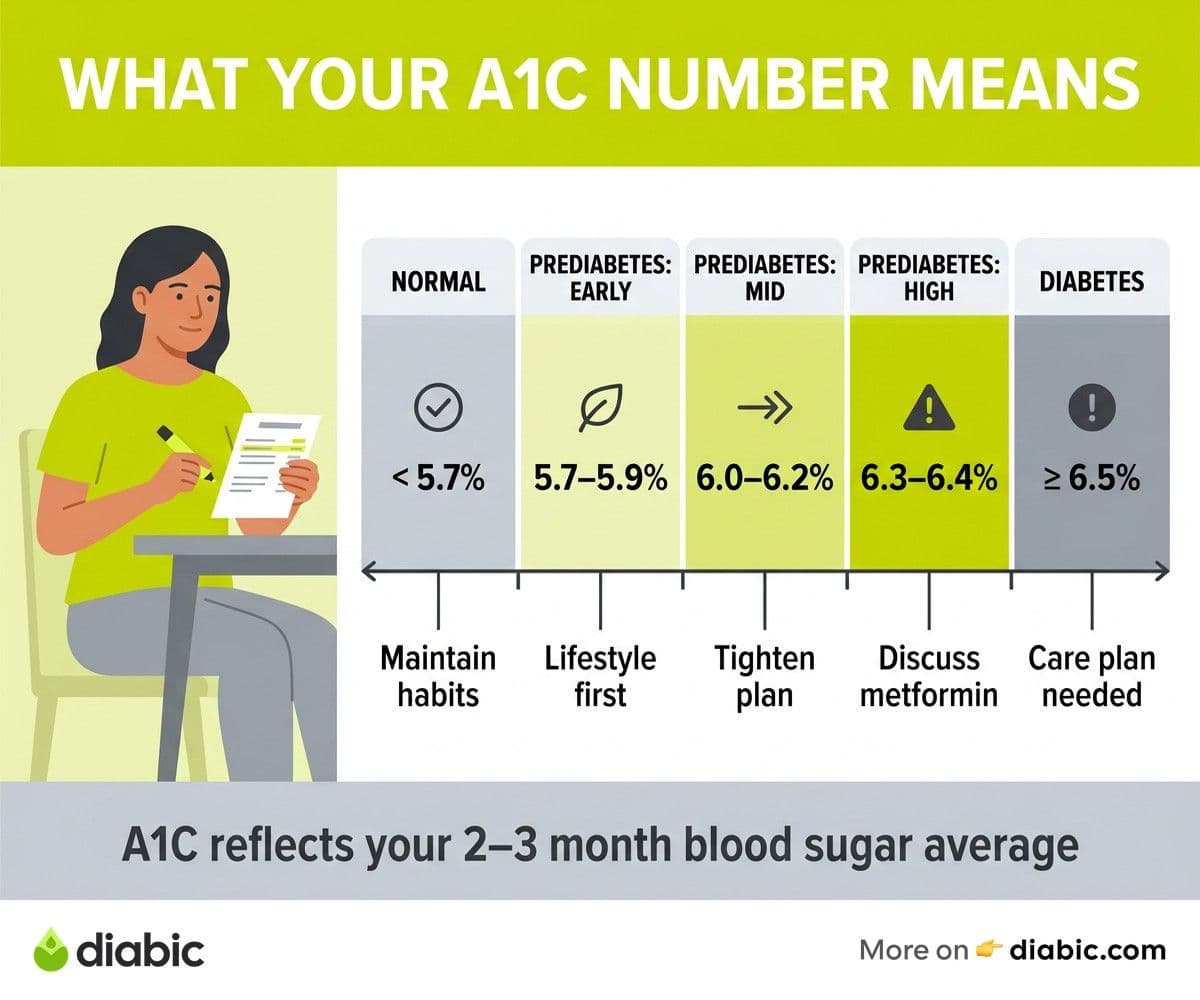
Understanding Your Prediabetes A1C Range
The prediabetes A1C range is not one undifferentiated zone. Where you land within it carries meaningful information about risk and urgency. The CDC and most clinical guidelines treat the band as a continuum, with risk rising the closer you get to the diabetes threshold.
The lower end: 5.7% to 5.9%
This is the early warning stage. Blood sugar is starting to rise above normal, but lifestyle changes alone often bring numbers back into the normal range, especially when caught quickly. Many people at this level feel completely fine and only learn the result through routine bloodwork. Treat it as the most actionable lab finding you have likely ever received.
The mid range: 6.0% to 6.2%
At this point, the metabolic shift is more established. Insulin resistance is doing more work behind the scenes, and the pancreas is compensating by producing more insulin. Without changes, the chance of progressing to type 2 within five years is meaningful. Lifestyle changes still work well, but consistency matters more.
The upper end: 6.3% to 6.4%
You are within reach of the diabetes diagnostic threshold of 6.5%. A small uptick in average glucose, an illness, or a stressful stretch can push the number across. This is the range where many providers begin discussing medication (often metformin) alongside lifestyle changes, particularly for younger adults or people with additional risk factors. We cover this option in our piece on metformin for prediabetes.
Where you land in the range is one input. How fast your number is moving is another. An A1C that climbed from 5.7% to 6.2% in a year tells a different story than one that has held steady at 6.2% for three years. Trends matter as much as single values, which is why our guide on whether your blood sugar is in the prediabetes range pairs naturally with this one.
Factors That Affect Your A1C
A1C is reliable for most people, but it is not perfect. Several conditions can artificially raise or lower the result, and your provider may order additional tests if any apply to you. The NIDDK outlines the main factors.
Anemia and red blood cell turnover. A1C depends on red blood cells living their normal lifespan of about 120 days. Iron-deficiency anemia, vitamin B12 deficiency, hemolytic anemia, recent blood loss, or a recent transfusion can all shift the result, sometimes meaningfully.
Hemoglobin variants. Some people have genetic variants of hemoglobin (such as HbS or HbC, more common in people of African, Mediterranean, or Southeast Asian descent) that interfere with certain A1C tests. Modern lab assays handle most variants correctly, but not all. If your A1C and fingerstick readings disagree, ask whether a hemoglobin variant could be involved.
Kidney disease. Advanced kidney disease, particularly in people on dialysis, can lower A1C below what the actual blood sugar pattern would predict.
Pregnancy. A1C is less reliable in pregnancy because red blood cell turnover speeds up. This is one reason gestational diabetes is diagnosed with a glucose tolerance test rather than A1C.
If any of these apply to you, your doctor may order a fasting plasma glucose, an OGTT, or a fructosamine test (which reflects shorter-term blood sugar averages) to confirm the picture. Asking, "Is there any reason my A1C might not reflect my real blood sugar?" is a perfectly reasonable question at your visit.
How to Lower Your Prediabetes A1C
Most people in the prediabetes range can move their A1C down with consistent lifestyle changes. The Diabetes Prevention Program, a landmark trial funded by the NIH, found that structured lifestyle intervention reduced progression to type 2 diabetes by 58% over three years, more than metformin did in the same study. The path is not exotic, but it asks for steady effort.
Adjust the carbohydrate pattern, not just the amount. Refined carbohydrates and added sugars cause the biggest blood sugar swings. Replacing sweetened beverages, white bread, and sweet baked goods with whole grains, legumes, vegetables, and fruit usually moves A1C noticeably within three to six months. Total carb count matters less than what those carbs are paired with and how processed they are. For practical guidance, our piece on prediabetes treatment options that work covers what the evidence supports.
Build movement into your week. The ADA recommends at least 150 minutes of moderate-intensity activity per week. The blood sugar benefit comes from both the activity itself (muscles use glucose during exercise) and the longer-term improvement in insulin sensitivity. Walking, cycling, swimming, and resistance training all qualify. Splitting it into 30-minute sessions five days a week is a common starting point.
Lose 5 to 7% of body weight if you carry extra weight. The DPP showed that this modest amount of weight loss produced large reductions in diabetes risk. For someone weighing 200 pounds, that is 10 to 14 pounds. Sustainable weight loss often follows from the food and movement changes above rather than a separate plan.
Sleep and stress. Chronic short sleep and unmanaged stress raise cortisol, which raises blood sugar. Seven to nine hours of sleep most nights, and any stress tool you actually use (walking, breath work, time outside, therapy), supports your A1C in ways that show up on the lab report.
Medication when indicated. Metformin is sometimes prescribed for prediabetes, particularly in people under 60, those with a BMI above 35, or women with a history of gestational diabetes. It is not a substitute for lifestyle changes, but it can help when risk is high. The decision belongs in a conversation with your doctor about prediabetes: why catching it now matters for your individual picture.
From my experience: when I work with people who have just learned their A1C is 6.0%, the most common first reaction is to overhaul everything at once. That rarely lasts. The changes that stick tend to start small (a daily walk, swapping one sweetened drink, adding protein to breakfast) and compound. After six months of consistent small habits, A1C typically moves more than after two months of dramatic restriction.
Tracking Your A1C Over Time
A single A1C tells you where you are. A series of A1Cs tells you where you are headed.
For most people in the prediabetes range, the Mayo Clinic and ADA recommend retesting every three to six months until the trend is clear. Once your number is stable in the normal range, annual testing is usually enough. If you start medication or make significant lifestyle changes, an earlier recheck (around three months) gives you a real read on whether the changes are working.
Use the trend, not the single point. An A1C of 6.0% on its own is fine information. Knowing that you were 6.3% three months ago is much better information. Track the values somewhere you will actually look at them, even a note in your phone, so you can compare over time.
Set targets together with your doctor. For some people, the goal is moving back into the normal range (below 5.7%). For others, holding steady or slowing an upward trend is the realistic target. Either way, write the goal down and revisit it at each appointment.
Celebrate movement in the right direction, even small movement. A 0.3% drop in A1C corresponds to about a 9 mg/dL reduction in average blood sugar, and the cardiovascular and microvascular benefits are real. Progress is the metric, not perfection.
FAQ
What A1C level is considered prediabetes?
An A1C between 5.7% and 6.4% is considered prediabetes. Below 5.7% is normal, and 6.5% or higher indicates diabetes. The higher your A1C within the prediabetes range, the greater your risk of progressing to type 2 diabetes within the next several years. Regular testing every three to six months helps you and your doctor track the trend rather than reacting to a single value.
How to lower A1C if you have prediabetes?
Lowering A1C with prediabetes typically involves three changes that work together: reducing refined carbohydrates and added sugars, building up to at least 150 minutes of physical activity per week, and losing 5 to 7% of body weight if you are overweight. These steps reduced diabetes risk by 58% in the Diabetes Prevention Program trial. Your doctor may also recommend metformin if your risk is high, but it works best alongside the lifestyle changes rather than instead of them.
How long does it take to lower A1C?
Because A1C reflects roughly three months of blood sugar, meaningful changes take at least eight to twelve weeks to show up on a lab report. Many people see a 0.3 to 0.7% reduction in three to six months of consistent changes, with larger drops possible at higher starting points.
Is an A1C of 5.7 reversible?
An A1C of 5.7% is at the low end of the prediabetes A1C range and frequently moves back into the normal range with sustained lifestyle changes. Catching your prediabetes A1C this early is one of the strongest positions you can be in.
Dr. Shanto Arian is an internal medicine physician now specializing in clinical and aesthetic dermatology, with a parallel academic focus on epidemiology and public health. He holds an MBBS, MPH, MSc (UK), MRCP (UK), MRCPI (Ireland), Diploma in Dermatology (UK), and Diploma in Aesthetic Medicine (USA). Dr. Arian trained in internal medicine, including hospital work on hematology cases such as graft-versus-host disease, before moving toward dermatology. Skin is one of the earliest places diabetes shows itself, from acanthosis nigricans and diabetic dermopathy to slow foot wound healing, and that intersection is where his clinical and Diabic-review work meet. On Diabic, Dr. Arian medically reviews content on diabetes diagnosis, complications, dermatologic manifestations, and pharmacotherapy, ensuring every claim aligns with current ADA, NICE, and peer-reviewed literature.
Medically reviewed by
Dr. Rezwana Parvin Rumpa is an obstetrics and gynaecology specialist with clinical focus on gestational diabetes, PCOS, and fertility. She holds the MRCOG (Final Part) from the Royal College of Obstetricians and Gynaecologists in London, the MRCPI (Final Part) from the Royal College of Physicians of Ireland, and an MBBS from Shaheed Monsur Ali Medical College under Dhaka University. Dr. Rumpa serves as a Senior Medical Officer in the Obs and Gynae department at BRB Hospitals Ltd, where she has spent three years managing prenatal care, emergency obstetric cases, and women's-health surgery. On Diabic, she medically reviews content for women living with diabetes, with particular attention to pregnancy, PCOS, and reproductive-health intersections.
More from Diabetes Knowledge
View all
6 Safe Dessert for Gestational Diabetes Recipes You Can
Six dessert for gestational diabetes recipes that satisfy your sweet tooth without spiking blood sugar, with carb counts and pairing tips you can use.

8 High Fiber Foods That Help with Prediabetes
Add these 8 high fiber foods for prediabetes to slow glucose absorption, support steady blood sugar, and meet the daily fiber target most people miss.

Mediterranean Diet for Prediabetes: A Practical Guide
The mediterranean diet for prediabetes is one of the best-studied eating patterns for prevention. Here is what to eat, what to avoid, and how to start.
Clinician-reviewed habits, plain-language guides, and honest answers - the small shifts that make living with diabetes feel lighter, every day.