Is Diabetes Genetic? The Truth About Heredity
Is diabetes genetic? Family history matters, but it does not decide your future. Here is how heredity, environment, and lifestyle interact to shape risk.

In this article(12)
When a parent or sibling lives with diabetes, one of the first questions that surfaces is straightforward: is diabetes genetic? The honest answer is that genetics play a real role, but they are only part of the picture. Family history loads the dice, yet it rarely decides the outcome on its own.
Understanding how heredity influences your risk can help you take meaningful steps without living in fear of an inevitable diagnosis. The science here is genuinely encouraging, especially for type 2 diabetes, where lifestyle changes can offset much of the genetic risk people are born with.
This guide walks through what researchers actually know about diabetes genetics, how risk patterns differ between type 1 and type 2, and what you can do if diabetes runs in your family.
Is Diabetes Genetic? What the Science Says
Yes, diabetes is partly genetic, and the picture varies depending on which type you are asking about. Both type 1 and type 2 have a hereditary component, but they involve different genes and different patterns of inheritance. Neither one is caused by a single gene that flips on or off. Instead, dozens of genetic variants each contribute small amounts to overall risk.
For type 2 diabetes, researchers have identified more than 400 genetic regions associated with increased likelihood of developing the condition. Most of these variants are common in the general population and exert small individual effects. They become meaningful when they stack together, especially alongside environmental triggers like weight gain, inactivity, or aging.
For type 1 diabetes, the genetic story centers on the immune system. Variants in the HLA gene complex, which helps the body distinguish self from foreign invaders, account for roughly half of the inherited risk. Other immune-related genes contribute the rest. The American Diabetes Association explains that having these genes does not guarantee diabetes, but it raises the baseline risk substantially.
The classic phrase researchers use is that genetics loads the gun and lifestyle pulls the trigger. That framing is most accurate for type 2 diabetes. For type 1, the trigger is more often a viral infection or another immune event that researchers are still working to fully understand.
Is Diabetes Hereditary from Mother or Father
Both parents can pass along genetic risk, though the patterns differ in interesting ways. For type 2 diabetes, having either parent with the condition roughly doubles your risk. If both parents have type 2, the risk roughly doubles again. The mode of inheritance is mostly symmetric, meaning maternal and paternal contributions are similar in magnitude.
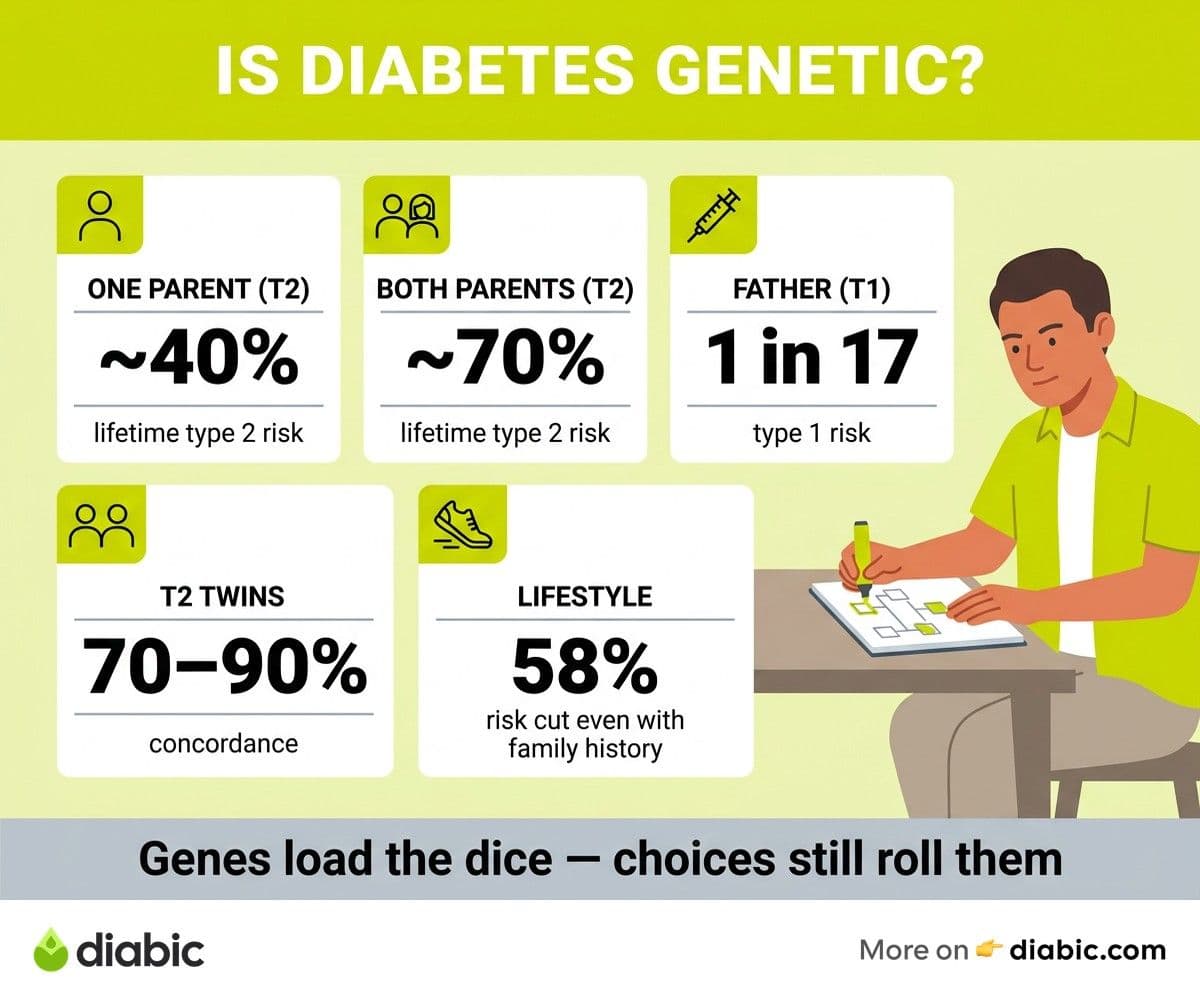
Type 1 diabetes shows a different pattern. According to the NIDDK, if a father has type 1 diabetes, the child's risk is roughly 1 in 17. If the mother has type 1, the risk depends on her age at delivery. For mothers who give birth before age 25, the child's risk is about 1 in 25. For those who give birth after age 25, the risk drops to roughly 1 in 100. Children whose father had early-onset type 1 also tend to have higher risk than children whose mother had it.
These numbers can be unsettling at first glance. It helps to remember that even at the higher end, the absolute risk for any individual child remains relatively low. The vast majority of children of parents with diabetes never develop the condition.
Family history from either side matters when assessing risk, and it is worth sharing with your healthcare provider. Knowing the diabetes status of grandparents, aunts, and uncles helps round out the picture, since type 2 in particular tends to cluster across generations in ways that go beyond direct parent-to-child inheritance. Our guide to type 2 diabetes causes and who is at risk breaks down how to weigh family history alongside other factors.
If My Parent Has Diabetes Will I Get It
This is the question that brings many people to articles like this one, and it deserves a careful answer. Having a parent with diabetes increases your risk, but it does not make diabetes inevitable. Most children of parents with diabetes never develop it.
For type 2 diabetes, the lifetime risk for someone with one affected parent is roughly 40 percent. With two affected parents, the risk climbs to about 70 percent. These numbers come from population studies and reflect what happens on average, not what will happen to any specific person. Lifestyle, weight, age at exposure to risk factors, and even where you live all influence whether genetic predisposition turns into actual disease.
For type 1 diabetes, the risk to a child of an affected parent ranges from about 1 in 100 to 1 in 17, depending on which parent has it and other factors. That is meaningfully higher than the general population risk of about 1 in 300, but it still means most children will not develop type 1.
Identical twin studies offer some of the clearest evidence on the genetics versus environment question. For type 2 diabetes, if one identical twin has the condition, the other twin has roughly a 70 to 90 percent chance of developing it as well. For type 1 diabetes, that concordance rate is closer to 30 to 50 percent. The fact that the twin rate is not 100 percent in either case proves that genes alone do not determine outcomes, even between people who share an identical genome.
Environmental factors matter, and many of them are within your influence. That is the good news hiding inside the genetics conversation.
Type 1 vs Type 2 Diabetes and Their Different Genetic Profiles
Looking at type 1 vs type 2 diabetes through a genetics lens reveals two very different conditions that happen to share a name. Type 1 is primarily an autoimmune disease with a strong immune-system genetic signature. Type 2 is a metabolic condition with a polygenic, lifestyle-sensitive genetic profile.
Type 1 genetic markers cluster heavily in the HLA region of chromosome 6. Specific variants like HLA-DR3 and HLA-DR4 raise risk significantly, while others appear to be protective. Researchers can now estimate type 1 risk in newborns through genetic screening, though this remains primarily a research tool rather than routine practice.
Type 2 genetic risk spreads across hundreds of genes, each contributing modestly. Variants in genes like TCF7L2, KCNJ11, and PPARG influence how beta cells release insulin and how tissues respond to it. These same genes can interact with diet, sleep, and physical activity, which is why lifestyle changes can shift outcomes even for people with high genetic load.
Knowing which type runs in your family matters for understanding your own risk. If a close relative has type 1, your risk for type 1 specifically is higher, but your type 2 risk is unchanged from the general population. If type 2 clusters in your family, the reverse is true. Our guide to the key differences between type 1 and type 2 explains how the two conditions diverge in cause and treatment.
For families where someone has been diagnosed with type 1, our explainer on type 1 diabetes causes and risk factors covers the autoimmune triggers in more depth.
What Is Diabetes and How Genetics Contribute
Stepping back, what is diabetes at its core? It is a condition where the body cannot keep blood glucose in a healthy range. Insulin, a hormone made by the pancreas, normally moves glucose from the bloodstream into cells where it can be used for energy. When insulin is missing or not working effectively, glucose builds up in the blood.
Genetics influence both halves of this system. Some inherited variants affect how well beta cells produce insulin. Others affect how cells respond to insulin once it arrives. A few influence how the body stores and processes carbohydrates and fats. The combination of these effects, plus environment and behavior, shapes whether diabetes develops.
Epigenetics adds another layer. Even when your DNA stays the same, the way genes get expressed can shift in response to diet, stress, sleep, and physical activity. Research published in journals like Diabetes Care shows that epigenetic patterns can change within months of meaningful lifestyle adjustments. Your inherited risk is not a fixed sentence written at birth.
This is one of the more hopeful findings in modern diabetes research. People often arrive at the genetics conversation expecting a deterministic answer, and they leave with something better: a sense that meaningful action can change outcomes.
From my experience: I was diagnosed with type 1 diabetes at twelve, and no one in my immediate family had it. That actually fits the data, since most people with type 1 do not have a close relative with the condition. Over fourteen years of managing it, I have spent time with a lot of families worried about whether their kids will get type 1 too. The honest, comforting truth is that even with a parent who has type 1, the odds are still strongly in the child's favor.
What You Can Do If Diabetes Runs in Your Family
Knowing your family history is the first useful step. Write down which relatives have diabetes, what type they have, and roughly when they were diagnosed. Bring this list to your annual physical. Your provider can use it to recommend appropriate screening, especially if you have multiple first-degree relatives with type 2.
Screening matters more than most people realize. The CDC estimates that millions of Americans have diabetes or prediabetes without knowing it. A simple A1c test at your annual physical can catch things early, when lifestyle changes are most effective. The ADA recommends starting screening at age 35 for most adults, or earlier if you have risk factors.
Lifestyle modifications can shift risk substantially, even with strong family history. The Diabetes Prevention Program, a landmark study funded by the NIH, showed that modest weight loss (5 to 7 percent of body weight) and 150 minutes of weekly physical activity reduced the risk of progressing from prediabetes to type 2 diabetes by 58 percent. That effect holds even for people with a strong genetic load.
Practical steps that may help include:
- Eating mostly whole foods, with attention to fiber, lean protein, and limited refined sugar
- Moving your body in ways you enjoy for at least 30 minutes most days
- Prioritizing sleep, since chronic sleep deprivation worsens insulin resistance
- Managing stress, which affects blood glucose more than many people realize
- Getting screened regularly so any changes are caught early
For type 1 diabetes, prevention strategies are more limited because the autoimmune trigger is not fully understood. However, programs like TrialNet offer free screening for relatives of people with type 1, and early detection allows for newer interventions like teplizumab that can delay onset in high-risk individuals. Talk to your doctor if type 1 runs in your family.
FAQ
Is diabetes hereditary from mother or father?
Both parents can pass along genetic risk. For type 2 diabetes, having either parent with the condition roughly doubles your risk in similar ways. For type 1 diabetes, paternal inheritance carries slightly higher risk than maternal inheritance, especially when the mother gives birth after age 25. Family history from either parent is meaningful and worth discussing with your healthcare provider.
If my parent has diabetes will I get it?
Not necessarily. Having a parent with diabetes increases your risk but does not make it certain. For type 2, the lifetime risk is roughly 40 percent with one affected parent. For type 1, the risk ranges from about 1 in 100 to 1 in 17 depending on which parent has it. Most children of parents with diabetes never develop the condition.
Can I prevent diabetes if it runs in my family?
For type 2 diabetes, yes, often substantially. Modest weight loss, regular physical activity, and a balanced diet can reduce risk by more than half, even for people with strong family history. For type 1, prevention is more limited, but early screening and emerging therapies can change the trajectory for some people at high risk.
Does diabetes skip generations?
Diabetes does not literally skip generations in the genetic sense, but it can appear that way. Genetic risk is inherited from grandparents through parents, even if the parents themselves never develop the condition. Lifestyle and environment can determine whether the inherited risk translates into actual diabetes in any given generation.
Should I get genetic testing for diabetes?
Routine genetic testing for diabetes is not currently recommended for most people, since family history and standard blood tests give doctors the information they need. For type 1 specifically, programs like TrialNet offer screening for first-degree relatives. Talk to your doctor about whether testing makes sense in your situation.
So is diabetes genetic? Yes, partly. But the larger truth is that genes are one input among many, and the choices you make every day still carry real weight. Knowing your family history lets you act earlier, screen smarter, and shape outcomes that even your DNA cannot fully predict.
Shahriar P. Shuvo is the founder of Diabic. He has lived with diabetes for over 14 years, and built Diabic to deliver the practical, evidence-based self-management tools he wished existed when he was first diagnosed. By trade, Shahriar is a senior design and frontend engineer with 6+ years shipping products at Agora, Timescale (now Tiger Data), and ShareTrip. He writes from the intersection of lived diabetes experience and product craft, focused on what works in daily management rather than what sounds good in a textbook.
Medically reviewed by
Dr. Shanto Arian is an internal medicine physician now specializing in clinical and aesthetic dermatology, with a parallel academic focus on epidemiology and public health. He holds an MBBS, MPH, MSc (UK), MRCP (UK), MRCPI (Ireland), Diploma in Dermatology (UK), and Diploma in Aesthetic Medicine (USA). Dr. Arian trained in internal medicine, including hospital work on hematology cases such as graft-versus-host disease, before moving toward dermatology. Skin is one of the earliest places diabetes shows itself, from acanthosis nigricans and diabetic dermopathy to slow foot wound healing, and that intersection is where his clinical and Diabic-review work meet. On Diabic, Dr. Arian medically reviews content on diabetes diagnosis, complications, dermatologic manifestations, and pharmacotherapy, ensuring every claim aligns with current ADA, NICE, and peer-reviewed literature.
More from Diabetes Knowledge
View all
6 Safe Dessert for Gestational Diabetes Recipes You Can
Six dessert for gestational diabetes recipes that satisfy your sweet tooth without spiking blood sugar, with carb counts and pairing tips you can use.

8 High Fiber Foods That Help with Prediabetes
Add these 8 high fiber foods for prediabetes to slow glucose absorption, support steady blood sugar, and meet the daily fiber target most people miss.

Mediterranean Diet for Prediabetes: A Practical Guide
The mediterranean diet for prediabetes is one of the best-studied eating patterns for prevention. Here is what to eat, what to avoid, and how to start.
Clinician-reviewed habits, plain-language guides, and honest answers - the small shifts that make living with diabetes feel lighter, every day.