Type 2 Diabetes Causes and Who Is at Risk
Type 2 diabetes causes go beyond sugar. Learn the real mix of genetics, biology, and lifestyle factors that drive risk, and how to lower yours.

In this article(17)
Understanding the type 2 diabetes causes that actually matter is the first step toward knowing whether you or someone you love is at risk. The answer is not as simple as "too much sugar," and the popular framing leaves a lot of people confused or misinformed. The real story is a combination of genetics, lifestyle, and metabolic factors that interact over years.
This piece walks through what is happening in the body, who carries higher risk and why, and what science says you can actually do about it. We will avoid scare tactics and stick to evidence. The point is not to alarm anyone. The point is to give you a clearer view of how risk works so you can make informed choices and ask better questions at your next checkup.
If you have already been diagnosed, this guide can still help. Knowing the underlying causes makes treatment decisions feel less arbitrary and helps you understand why your provider recommends specific changes.
The Primary Type 2 Diabetes Causes
Type 2 diabetes develops when two things happen: cells stop responding well to insulin, and the pancreas eventually cannot produce enough insulin to compensate. Both pieces are usually in play before any number on a lab report tips into diagnosis territory. The NIDDK overview of type 2 diabetes describes this dual process clearly.
Insulin resistance: when cells stop responding
Insulin's job is to escort glucose from the bloodstream into muscle, fat, and liver cells. Insulin resistance means those cells become less sensitive to insulin's signal, so glucose stays in the blood instead of being put to use. The pancreas tries to push through the resistance by producing more insulin, sometimes far more than normal. For years, this extra effort can keep blood sugar in the normal range while the underlying machinery quietly strains.
Many people are insulin resistant before they ever see an abnormal lab result. Some early signs include skin tags, dark velvety patches on the neck or armpits called acanthosis nigricans, persistent fatigue after meals, and stubborn belly weight that does not respond to ordinary diet shifts. Our piece on insulin resistance symptoms most people overlook covers these signals in more detail.
Beta cell dysfunction: the pancreas slows down
Beta cells in the pancreas produce insulin. After years of working overtime to compensate for insulin resistance, many beta cells stop functioning at full capacity. By the time type 2 diabetes is diagnosed, research suggests roughly 50 percent of beta cell function may already be lost. This is why type 2 tends to require more medication over time, even when lifestyle stays the same.
Beta cell decline is not always linear. Some people stabilize for years on a single oral medication. Others progress faster. Genetics, body composition, sleep, stress, and certain medications all influence the pace.
How the two factors stack up
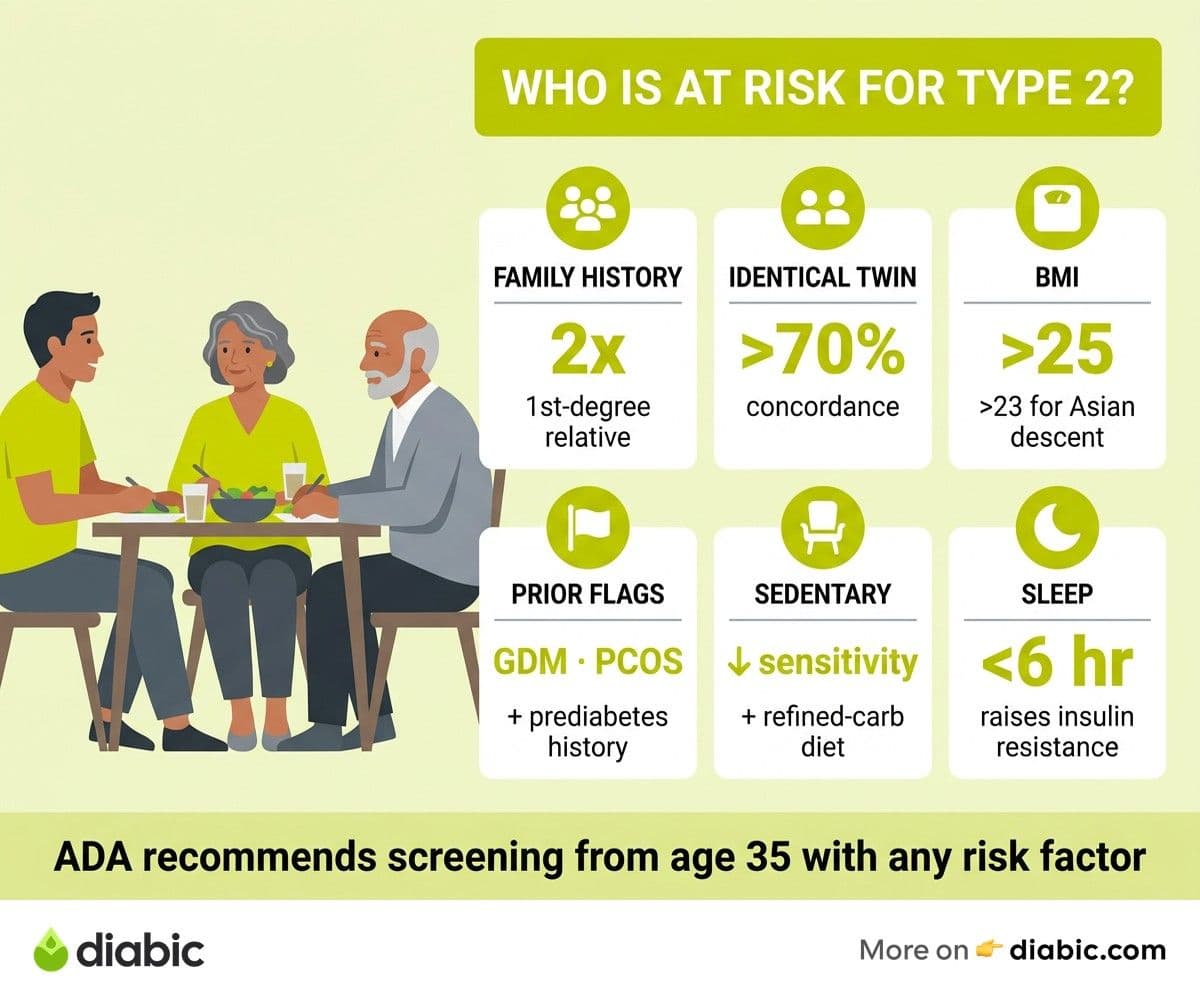
Insulin resistance and beta cell decline reinforce each other. The harder beta cells work, the more they wear out. The more they wear out, the higher blood sugar climbs, which itself further damages beta cells in a phenomenon called glucotoxicity. Catching the problem early gives the remaining beta cells a chance to recover, which is why screening matters even when you feel fine. The American Diabetes Association recommends starting screening at 35 for most adults, earlier with risk factors, and repeating every three years if results are normal.
Genetic and Family Risk Factors
Genetics is one of the strongest predictors of type 2 diabetes risk, and it is the part of the equation most often underestimated. Having a parent or sibling with type 2 roughly doubles your lifetime risk. Having both parents with type 2 raises it further. Identical twins where one has type 2 see concordance rates above 70 percent in some studies, far higher than would be expected from shared lifestyle alone.
Specific genetic variants linked to type 2 affect insulin sensitivity, beta cell function, and fat distribution. The CDC's diabetes risk factor overview lists family history as one of the top non-modifiable risk factors. None of these genes guarantee diabetes. They tilt the odds in ways that environment and lifestyle still influence heavily.
Ethnicity is another genetic and structural factor. Type 2 prevalence is higher in Black, Hispanic, Native American, Pacific Islander, and Asian American populations. Some of this reflects genetic differences in insulin secretion and fat storage, but a meaningful portion also reflects social determinants like access to care, food environments, and historical disinvestment in certain neighborhoods. Acknowledging both layers gives a more honest picture than blaming one or the other.
If you are wondering how strongly heredity drives outcomes in your case, our deep dive on whether diabetes is genetic walks through what the research actually shows and where lifestyle still moves the needle.
Lifestyle and Environmental Causes
Lifestyle factors are real and modifiable, but the conversation often gets oversimplified. Type 2 diabetes is not caused by eating too much sugar in a vacuum. It is caused by a combination of inputs that, over time, push the body's glucose regulation past its limits.
Physical inactivity
Sedentary lifestyles raise type 2 risk substantially. Muscle is the largest sink for blood glucose in the body, and inactive muscle becomes less insulin sensitive within days of disuse. Studies show that even breaking up long sitting periods with two minutes of movement every 30 minutes improves glucose response. The standard 150 minutes per week of moderate activity is a target, but the gap between zero and 30 minutes a week is where the largest risk reduction happens.
Diet patterns
Diets high in refined carbs, added sugars, and ultra-processed foods raise risk through multiple pathways. Sugary drinks are a particularly strong driver because liquid sugar produces faster, sharper glucose spikes than nearly any other food category. Diets low in fiber, vegetables, and whole foods leave fewer nutrients that support insulin sensitivity. The patterns that consistently lower risk in research, including Mediterranean, DASH, and broadly whole-food eating, share more with each other than they differ.
That said, no single food causes type 2 diabetes. Our look at diabetes and obesity myths unpacks some of the popular misconceptions about food and weight that obscure the actual evidence.
Excess weight, especially visceral fat
Body weight is a risk factor, but the location of fat matters more than the total. Visceral fat, the fat around abdominal organs, is metabolically active and contributes directly to insulin resistance through inflammatory signaling. People with the same BMI can have very different risk profiles depending on where they store fat.
Risk rises at a BMI above 25 in most populations and above 23 for people of Asian descent, who tend to develop insulin resistance at lower BMIs. Modest weight loss of 5 to 7 percent of body weight has been shown in major trials to cut diabetes incidence by more than half in high-risk adults. To understand the foundation more broadly, our companion guide What Is Type 2 Diabetes covers how excess weight ties into the underlying disease process.
Sleep, stress, and other modifiable contributors
Chronic poor sleep raises insulin resistance through hormonal changes, including elevated cortisol and disrupted appetite regulation. Less than six hours of sleep a night for an extended stretch is consistently associated with higher diabetes risk. Chronic stress works similarly through cortisol and behavior changes around food and movement.
Other factors include shift work, certain medications such as long-term corticosteroids and some antipsychotics, and exposure to certain environmental pollutants. The Mayo Clinic overview of causes summarizes how these less obvious contributors fit into the picture.
Who Is Most at Risk
Standard risk factors give a useful starting point for assessing personal risk. None are guarantees in either direction. Risk is cumulative, so multiple factors stack.
- Adults over 45, though average age of onset has been dropping for decades and now affects many adults in their 20s and 30s
- BMI above 25, or above 23 for adults of Asian descent
- A first-degree relative (parent or sibling) with type 2 diabetes
- Black, Hispanic, Native American, Pacific Islander, or Asian American background
- A history of gestational diabetes during pregnancy
- Polycystic ovary syndrome, or PCOS
- Prediabetes, defined as an A1C between 5.7 and 6.4 percent or fasting glucose between 100 and 125 mg/dL
- High blood pressure or abnormal cholesterol levels
- Sedentary lifestyle with limited physical activity
- History of cardiovascular disease
If you carry two or more of these factors, it is worth asking your provider about a fasting glucose test and an A1C check, even if you feel fine. Type 2 often develops silently, and screening is the only way to catch it early. From my experience, after 14 years of managing diabetes, almost everyone I know who was diagnosed in their 30s or 40s had multiple risk factors quietly stacking for years before any symptom appeared.
What You Can Do to Reduce Your Risk
The most replicated finding in diabetes prevention research is that lifestyle changes work, often as well as or better than medication, especially in people with prediabetes. The Diabetes Prevention Program, a landmark NIH trial, found that lifestyle changes producing 5 to 7 percent weight loss reduced progression to type 2 by 58 percent in high-risk adults. That is a remarkable effect size for any intervention.
Movement is the highest-uses habit. Aim for 150 minutes per week of moderate activity, plus two sessions of strength work to build the muscle mass that absorbs glucose. Walking after meals is one of the simplest tools available, with research showing 10 to 15 minutes of post-meal walking can lower glucose response substantially.
Dietary shifts that consistently help include reducing sugary drinks, cutting back on ultra-processed foods, increasing fiber from vegetables and whole grains, and adding protein to meals. You do not have to follow a specific named diet. The shared elements of diets that work are more important than the brand name. Modest, sustainable weight loss in the 5 to 10 percent range is a realistic target for many people.
Regular screening is the often-overlooked piece. People with one or more risk factors benefit from earlier and more frequent A1C testing. Knowing your numbers turns abstract worry into a concrete plan, and catching prediabetes opens a window where reversal is most likely. For more on how the condition tends to evolve when it does develop, our breakdown of how type 2 diabetes progresses gives a realistic timeline.
FAQ
What are the main causes of type 2 diabetes?
The main causes of type 2 diabetes are insulin resistance, where cells stop responding properly to insulin, and progressive decline in insulin production by the pancreas. These are influenced by genetics, excess body weight (especially visceral fat), physical inactivity, poor diet, chronic stress, inadequate sleep, and aging. Unlike type 1 diabetes, type 2 is not caused by an autoimmune process.
Who is most at risk for type 2 diabetes?
People with a family history of type 2 diabetes, those who are overweight or obese, adults over 45, individuals with a sedentary lifestyle, and people from Black, Hispanic, Native American, Pacific Islander, and Asian American backgrounds face higher risk. Women with a history of gestational diabetes or PCOS are also at increased risk. Carrying multiple factors raises risk further than any single factor alone.
Can you prevent type 2 diabetes if it runs in your family?
Yes, in many cases. Genetics raises risk but does not guarantee diagnosis. Research from the Diabetes Prevention Program shows that lifestyle changes can cut progression to type 2 by more than half, even in adults with strong family history. Regular movement, modest weight loss, dietary shifts, and good sleep all help, and early screening allows you to act on risk before it becomes diabetes.
Does eating sugar cause type 2 diabetes?
Eating sugar alone does not directly cause type 2 diabetes, but high intake of added sugars and sugary drinks contributes to weight gain, insulin resistance, and overall metabolic strain that raises risk. The bigger picture includes total diet quality, physical activity, body composition, sleep, stress, and genetics. Cutting back on sugary drinks is one of the higher-uses food changes for reducing risk.
The honest summary on type 2 diabetes causes is that no single input creates the condition on its own. Genetics sets the slope, lifestyle nudges the angle, and time decides whether the line crosses into diagnosis territory. Knowing your personal mix of type 2 diabetes causes is the work that lets you act on the levers you can actually move, and it is the work most worth doing before any symptom shows up.
Shahriar P. Shuvo is the founder of Diabic. He has lived with diabetes for over 14 years, and built Diabic to deliver the practical, evidence-based self-management tools he wished existed when he was first diagnosed. By trade, Shahriar is a senior design and frontend engineer with 6+ years shipping products at Agora, Timescale (now Tiger Data), and ShareTrip. He writes from the intersection of lived diabetes experience and product craft, focused on what works in daily management rather than what sounds good in a textbook.
Medically reviewed by
Dr. Shanto Arian is an internal medicine physician now specializing in clinical and aesthetic dermatology, with a parallel academic focus on epidemiology and public health. He holds an MBBS, MPH, MSc (UK), MRCP (UK), MRCPI (Ireland), Diploma in Dermatology (UK), and Diploma in Aesthetic Medicine (USA). Dr. Arian trained in internal medicine, including hospital work on hematology cases such as graft-versus-host disease, before moving toward dermatology. Skin is one of the earliest places diabetes shows itself, from acanthosis nigricans and diabetic dermopathy to slow foot wound healing, and that intersection is where his clinical and Diabic-review work meet. On Diabic, Dr. Arian medically reviews content on diabetes diagnosis, complications, dermatologic manifestations, and pharmacotherapy, ensuring every claim aligns with current ADA, NICE, and peer-reviewed literature.
More from Diabetes Knowledge
View all
6 Safe Dessert for Gestational Diabetes Recipes You Can
Six dessert for gestational diabetes recipes that satisfy your sweet tooth without spiking blood sugar, with carb counts and pairing tips you can use.

8 High Fiber Foods That Help with Prediabetes
Add these 8 high fiber foods for prediabetes to slow glucose absorption, support steady blood sugar, and meet the daily fiber target most people miss.

Mediterranean Diet for Prediabetes: A Practical Guide
The mediterranean diet for prediabetes is one of the best-studied eating patterns for prevention. Here is what to eat, what to avoid, and how to start.
Clinician-reviewed habits, plain-language guides, and honest answers - the small shifts that make living with diabetes feel lighter, every day.