Type 1 Diabetes Causes and Risk Factors
Type 1 diabetes causes are genetic and environmental, not lifestyle-driven. Here is what science knows about who is at risk and what triggers the.

In this article(26)
A type 1 diagnosis often arrives with a single, painful question: why me? Or why my child? Understanding the type 1 diabetes causes that researchers have identified will not undo your diagnosis, but it can lift the weight of self-blame and replace it with something more useful. The science points to a specific combination of genetic susceptibility and environmental triggers, and crucially, none of it is your fault.
This piece walks through the autoimmune mechanism, the genetic risk factors, the environmental influences researchers are still untangling, and the things that absolutely do not cause type 1. We will also touch on the prevention research that is genuinely changing what is possible for at-risk individuals.
Type 1 Diabetes Causes: The Autoimmune Mechanism
At its core, type 1 diabetes is an autoimmune condition. Your immune system, which normally fights infections, mistakenly identifies the insulin-producing beta cells in your pancreas as threats and destroys them. According to the NIDDK's overview of type 1 diabetes, this process is what defines the disease at a biological level and separates it from type 2.
The technical name for the process is autoimmune insulitis. Specialized immune cells (T cells, mostly) infiltrate the islets of Langerhans, the small clusters in the pancreas where beta cells live. Over months to years, beta cells are killed off one at a time. Autoantibodies, which are markers of this attack, often appear in the blood years before any symptoms develop.
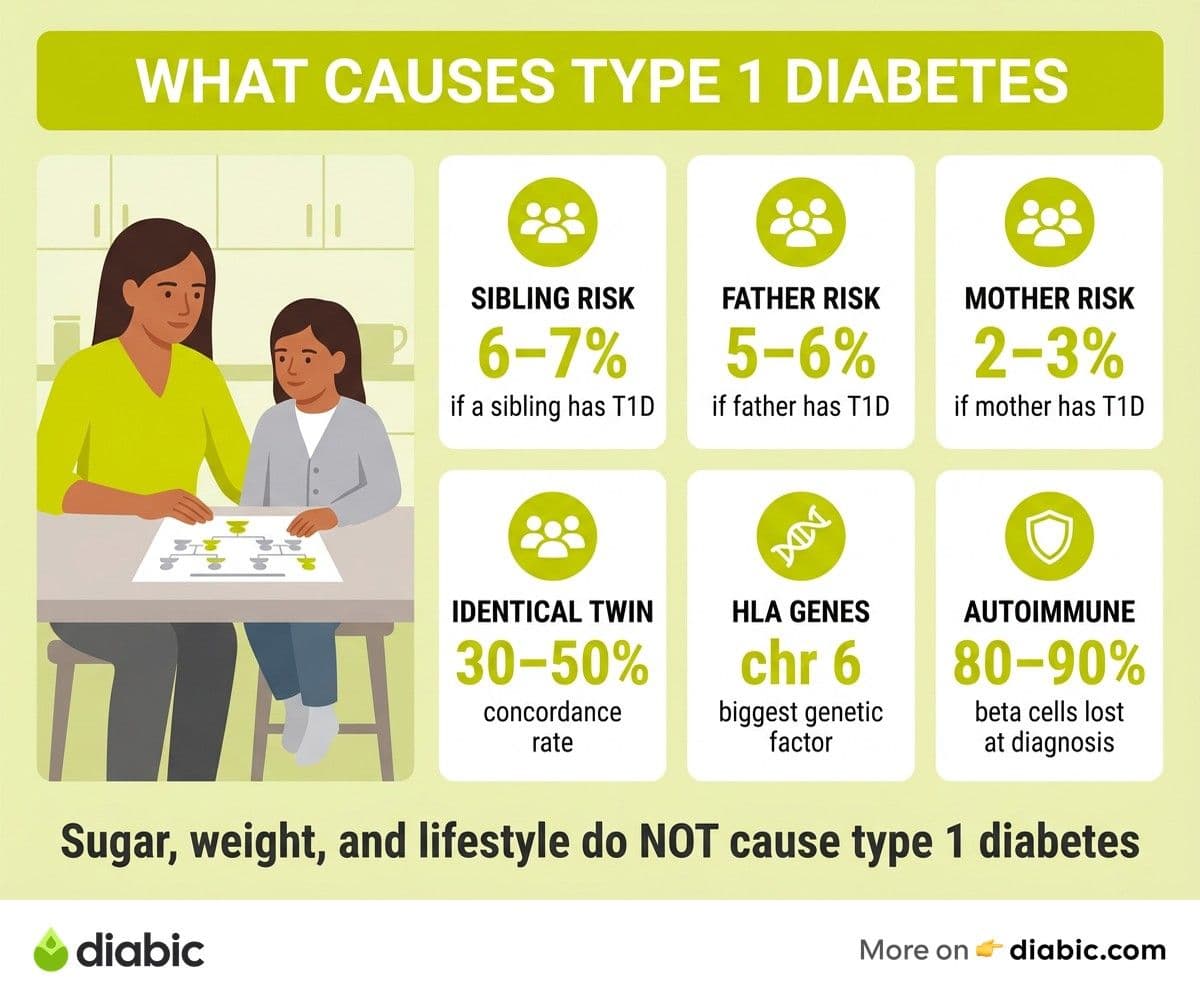
By the time blood sugar climbs high enough to cause classic type 1 diabetes symptoms, roughly 80 to 90 percent of beta cells are typically gone. This explains why your diagnosis can feel like a sudden event even though the underlying process has been quietly unfolding for a long time. By the time the symptoms catch up to the biology, the damage has been accumulating for years.
The pancreas may continue to produce small amounts of insulin for a while after diagnosis, especially during the so-called honeymoon phase. Eventually, however, beta-cell function in classic T1D drops to near zero, and external insulin becomes a permanent requirement. We cover what insulin replacement looks like day to day in our piece on what is type 1 diabetes, a clear explanation.
Genetic Risk Factors for Type 1 Diabetes
Type 1 diabetes has a meaningful genetic component, but it is not inherited the way eye color is. Specific gene variants increase your risk without guaranteeing the disease. Most people who carry the relevant genes never develop T1D, which tells you that genetics load the gun and environment pulls the trigger.
The HLA Gene Complex
The HLA (human leukocyte antigen) complex on chromosome 6 is the single biggest genetic factor in type 1 risk. HLA genes shape how the immune system distinguishes self from non-self. Certain variants, particularly within HLA-DR and HLA-DQ, are strongly associated with T1D risk. Other HLA variants are actually protective.
Outside of HLA, dozens of additional genes contribute smaller amounts of risk. Genome-wide association studies have identified more than 50 such loci, including INS (the insulin gene itself), PTPN22, and CTLA4. None of these are deterministic on their own, but together they shape susceptibility. The American Diabetes Association's overview of type 1 risk factors summarizes the current state of this research.
Family History and Heritability
Having a close relative with type 1 raises your risk:
- General population lifetime risk: about 0.4 percent
- Risk if a sibling has T1D: roughly 6 to 7 percent
- Risk if a mother has T1D: about 2 to 3 percent
- Risk if a father has T1D: about 5 to 6 percent
- Risk for an identical twin of someone with T1D: roughly 30 to 50 percent
The identical-twin number is the most telling data point. If T1D were purely genetic, identical twins would have nearly 100 percent concordance. The fact that it sits closer to 30 to 50 percent means non-genetic factors shape outcomes substantially. We explore the genetic question more broadly in our piece on is diabetes genetic, the truth about heredity.
It is also worth saying that most people with type 1 do not have a close family member with the disease. Roughly 85 to 90 percent of new T1D cases occur in people with no first-degree family history. If you are newly diagnosed, this is sometimes hard to absorb, because the lack of family history can make your diagnosis feel even more random.
Geographic and Ethnic Patterns
Type 1 incidence varies dramatically across the world. Northern European populations, especially in Finland, Sweden, and the British Isles, have the highest rates. Equatorial and Asian populations tend to have lower rates, though the global burden is rising in many regions. Some of this pattern reflects genetic differences across populations, and some likely reflects environmental and lifestyle factors that interact with genetic susceptibility.
In the United States, type 1 has historically been more common in non-Hispanic white populations, but recent data shows rising incidence across multiple groups. The reasons are not fully understood and are an active area of research.
Environmental Triggers That May Play a Role
If genetics set the stage, environment writes the script. Researchers have spent decades trying to identify the specific environmental factors that flip the autoimmune switch in genetically susceptible people. The picture is still incomplete, but several leading candidates have emerged.
Viral Infections
Viral infections are the most consistently studied trigger. Enteroviruses, particularly Coxsackie B, have been associated with the onset of autoimmunity in multiple studies. The proposed mechanism is molecular mimicry: viral proteins resemble proteins on beta cells, and the immune response to the virus crosses over and mistakenly targets beta cells too.
Other viruses studied include rotavirus, mumps, rubella, and cytomegalovirus, with varying degrees of evidence. According to Breakthrough T1D's overview of T1D causes, no single virus has been confirmed as a definitive trigger, but the cumulative evidence suggests that infections during critical windows of immune development can play a role.
Early Childhood Dietary Factors
Several early-life dietary factors have been studied as possible triggers. The introduction of cow's milk before age 4 to 6 months has been associated with higher T1D risk in some studies, though the effect is modest and the evidence is mixed. Vitamin D status in infancy and pregnancy has also drawn attention. None of these factors are proven, and current dietary recommendations for infants are not driven by T1D prevention.
The TEDDY study (The Environmental Determinants of Diabetes in the Young) is a large international cohort that has been tracking children at genetic risk for T1D since 2004. TEDDY data has identified some associations and ruled out others, and it remains one of the most important research efforts in the field.
Geographic and Hygiene Factors
The "hygiene hypothesis" suggests that reduced exposure to common infections in early life may leave the immune system poorly trained, leading to higher rates of autoimmune disease, including T1D. This is one possible explanation for why T1D rates are higher in wealthy, less crowded environments. The hypothesis is not settled, but it is consistent with several patterns researchers have observed.
Vitamin D and sunlight exposure are also studied. Lower latitude regions have more sun, more vitamin D, and lower T1D rates, which has prompted hypotheses about vitamin D's role in immune regulation. Causation has not been proven.
Other Environmental Factors Under Study
Researchers continue to investigate stress, gut microbiome composition, environmental toxins, and other factors. The honest summary is that we know type 1 has environmental triggers, we have several leading candidates, and we do not yet know enough to say with confidence which factors trigger which cases.
What Does Not Cause Type 1 Diabetes
This section matters as much as the previous ones, because the misconceptions about T1D causes still cause real harm. If you have T1D, or you parent a child with T1D, being told you could have prevented it is hurtful and incorrect.
It Is Not Caused by Eating Sugar
One of the most persistent myths is that eating too much sugar causes type 1 diabetes. It does not. Sugar consumption has nothing to do with the autoimmune process that destroys beta cells. People with type 1 develop the disease whether they ate a low-sugar diet, a high-sugar diet, or anything in between.
Type 2 diabetes has metabolic and lifestyle components, which is part of where the confusion comes from. Type 1 does not. The two conditions share a name but have very different underlying causes, and a deeper look at how they differ lives in our type 1 vs. type 2 diabetes key differences breakdown.
It Is Not Caused by Being Overweight
Type 1 develops in people across the full body-weight spectrum. Weight is not a risk factor for type 1 the way it is for type 2. In fact, unexplained weight loss is a classic symptom of type 1, because without insulin your body cannot use glucose effectively and starts breaking down fat and muscle for fuel.
It Is Not Caused by Lifestyle or Personal Choices
Sedentary lifestyle, stress, missed sleep, fast food, lack of exercise, none of these cause type 1. The autoimmune process happens at a level you cannot influence. Children develop T1D. People who eat carefully and exercise daily develop T1D. The disease does not respect your habits.
This distinction matters because diabetes-related stigma is real, and it is heavier when people assume the disease was preventable by personal choice. The Mayo Clinic's overview of type 1 causes and risk factors makes this point clearly.
Why This Distinction Matters
Beyond reducing stigma, getting the cause story right shapes how you and your family process a diagnosis. If you are a parent, you do not need to second-guess what you fed your child or how much sugar was in the house. If you were diagnosed as an adult, you do not need to interrogate what you could have done differently. The energy you might pour into self-blame is much better spent on learning to manage the condition well.
From my experience: I was diagnosed at 17, and one of the hardest parts of the first year was hearing well-meaning people ask if I had been eating too many sweets. After 14 years with T1D, I have heard versions of that question hundreds of times. It still stings a little, but I have come to see it as a moment to teach. The truth is that nobody causes their type 1 diabetes, and saying that out loud, again and again, is part of how the broader public eventually gets it.
Can Type 1 Diabetes Be Prevented?
For most of the history of T1D, the answer to this question was a flat no. That has shifted in the last few years, and while we are not at population-level prevention yet, the science has moved meaningfully.
Screening Programs
Screening for type 1 autoantibodies in at-risk relatives is now widely available through programs like TrialNet (in the United States) and similar efforts internationally. A simple blood test checks for autoantibodies, and a positive result indicates that the autoimmune process has begun, even if blood sugar is still normal. This identifies stage 1 and stage 2 T1D before clinical symptoms appear.
Why screen? Because identifying T1D early reduces the risk of dangerous DKA at diagnosis, prepares families for what is coming, and opens the door to clinical trial participation and prevention therapies.
Teplizumab (Tzield)
In late 2022, the FDA approved teplizumab (brand name Tzield), the first therapy shown to delay the onset of clinical type 1 diabetes. Teplizumab is an immune-modulating monoclonal antibody given as a 14-day intravenous infusion. In the pivotal trial, it delayed clinical T1D onset by an average of about two years in people with stage 2 T1D (multiple autoantibodies plus abnormal glucose tolerance).
Teplizumab does not prevent T1D entirely, but it represents a meaningful shift. T1D is no longer a fully un-modifiable disease. For families with autoantibody-positive children or relatives, it is now reasonable to ask about screening and consider whether teplizumab is appropriate.
Ongoing Research
A growing pipeline of immune-modulating therapies, beta cell replacement strategies, and combination approaches is in clinical trials. None are FDA-approved beyond teplizumab as of this writing, but the trajectory is positive. If you or a family member has been identified as at-risk, talking to a research-active endocrinologist about clinical trials is worth doing. Our follow-up on type 1 diabetes diagnosis tests and next steps walks through the full diagnostic picture.
What Prevention Cannot Do Right Now
It cannot reverse established T1D. It cannot rebuild beta cells that are already gone. And outside of teplizumab in stage 2 disease, it cannot reliably stop progression in people who are already on the autoimmune path. The honest framing is that we are at the beginning of prevention, not the end. That is still a very different place from where we were a decade ago.
FAQ
Is type 1 diabetes hereditary?
Type 1 diabetes has a genetic component, but it is not directly inherited in a simple pattern. Having a parent with type 1 increases a child's risk (roughly 5 to 6 percent if the father has it, 2 to 3 percent if the mother does), but most people who develop type 1 do not have a close family member with the condition. Environmental factors play a meaningful role on top of genetic susceptibility.
What triggers type 1 diabetes?
Researchers believe that type 1 diabetes is triggered when an environmental factor, such as a viral infection, activates the immune system in a person who is genetically predisposed. The immune system then mistakenly begins attacking the insulin-producing beta cells. The exact trigger varies from person to person, and research is ongoing.
Can type 1 diabetes be prevented?
Type 1 diabetes cannot yet be fully prevented, but teplizumab (Tzield) was FDA-approved in 2022 to delay onset by an average of two years in at-risk individuals with stage 2 T1D. Screening programs can identify the autoimmune process before symptoms appear, which opens the door to prevention therapies and reduces the risk of DKA at diagnosis. Research into broader prevention is active.
Does eating sugar cause type 1 diabetes?
No. Eating sugar does not cause type 1 diabetes. Type 1 is an autoimmune condition in which the immune system attacks insulin-producing beta cells, and the autoimmune process is independent of dietary sugar. Type 2 diabetes has metabolic and lifestyle components that can be influenced by diet, but type 1 and type 2 are different conditions with different causes.
Can adults develop type 1 diabetes?
Yes. While type 1 most often appears in childhood, adolescence, or young adulthood, it can develop at any age. Adult-onset type 1 is sometimes confused with type 2 because of the patient's age, and a slower-progressing autoimmune form called LADA (latent autoimmune diabetes in adults) is frequently misdiagnosed as type 2. Autoantibody testing can confirm an autoimmune diagnosis when the picture is unclear.
The short version of the type 1 diabetes causes story is that genes set the stage, environment writes the script, and nobody at the receiving end of the diagnosis caused it. That truth is worth repeating to yourself, to your family, and to whoever asks the wrong question with good intentions. The energy that used to go into self-blame is much better spent on screening at-risk relatives, learning the daily rhythm, and keeping an eye on the prevention research that is finally starting to move.
Shahriar P. Shuvo is the founder of Diabic. He has lived with diabetes for over 14 years, and built Diabic to deliver the practical, evidence-based self-management tools he wished existed when he was first diagnosed. By trade, Shahriar is a senior design and frontend engineer with 6+ years shipping products at Agora, Timescale (now Tiger Data), and ShareTrip. He writes from the intersection of lived diabetes experience and product craft, focused on what works in daily management rather than what sounds good in a textbook.
Medically reviewed by
Dr. Shanto Arian is an internal medicine physician now specializing in clinical and aesthetic dermatology, with a parallel academic focus on epidemiology and public health. He holds an MBBS, MPH, MSc (UK), MRCP (UK), MRCPI (Ireland), Diploma in Dermatology (UK), and Diploma in Aesthetic Medicine (USA). Dr. Arian trained in internal medicine, including hospital work on hematology cases such as graft-versus-host disease, before moving toward dermatology. Skin is one of the earliest places diabetes shows itself, from acanthosis nigricans and diabetic dermopathy to slow foot wound healing, and that intersection is where his clinical and Diabic-review work meet. On Diabic, Dr. Arian medically reviews content on diabetes diagnosis, complications, dermatologic manifestations, and pharmacotherapy, ensuring every claim aligns with current ADA, NICE, and peer-reviewed literature.
More from Diabetes Knowledge
View all
6 Safe Dessert for Gestational Diabetes Recipes You Can
Six dessert for gestational diabetes recipes that satisfy your sweet tooth without spiking blood sugar, with carb counts and pairing tips you can use.

8 High Fiber Foods That Help with Prediabetes
Add these 8 high fiber foods for prediabetes to slow glucose absorption, support steady blood sugar, and meet the daily fiber target most people miss.

Mediterranean Diet for Prediabetes: A Practical Guide
The mediterranean diet for prediabetes is one of the best-studied eating patterns for prevention. Here is what to eat, what to avoid, and how to start.
Clinician-reviewed habits, plain-language guides, and honest answers - the small shifts that make living with diabetes feel lighter, every day.