Metformin for Prediabetes: What to Expect
Considering metformin for prediabetes? Here's how it works, who benefits most, common side effects, and what your first few months on it usually feel like.

In this article(9)
If your doctor has brought up metformin for prediabetes, you probably left the appointment with more questions than answers. Why a medication if you do not technically have diabetes yet. What it actually does in your body. Whether the side effects you have heard about are as bad as they sound. Whether this means you have failed at lifestyle changes.
None of those reactions are unusual, and most of them have reassuring answers. Metformin is one of the most studied medications in modern medicine. It has decades of real-world use, a strong safety record, and clear evidence that it can reduce the chance of prediabetes turning into type 2 diabetes.
This guide walks through what to expect from this medication, from the first dose through the first few months. The goal is to make the decision feel less abstract and more like something you can ask about clearly at your next visit.
How Metformin for Prediabetes Works
Metformin is part of a drug class called biguanides, and it has been used for blood sugar management since the 1950s. Its main job is to lower the amount of glucose your liver releases into your bloodstream, particularly between meals and overnight. It also makes the muscle and fat cells in your body more responsive to your own insulin, which means insulin works more efficiently at every level.
What metformin does not do is push your pancreas to release extra insulin. That distinction matters. Because metformin does not increase insulin production, it does not cause low blood sugar on its own when used alone. People taking it for prediabetes generally do not need to monitor for hypoglycemia the way someone on insulin would.
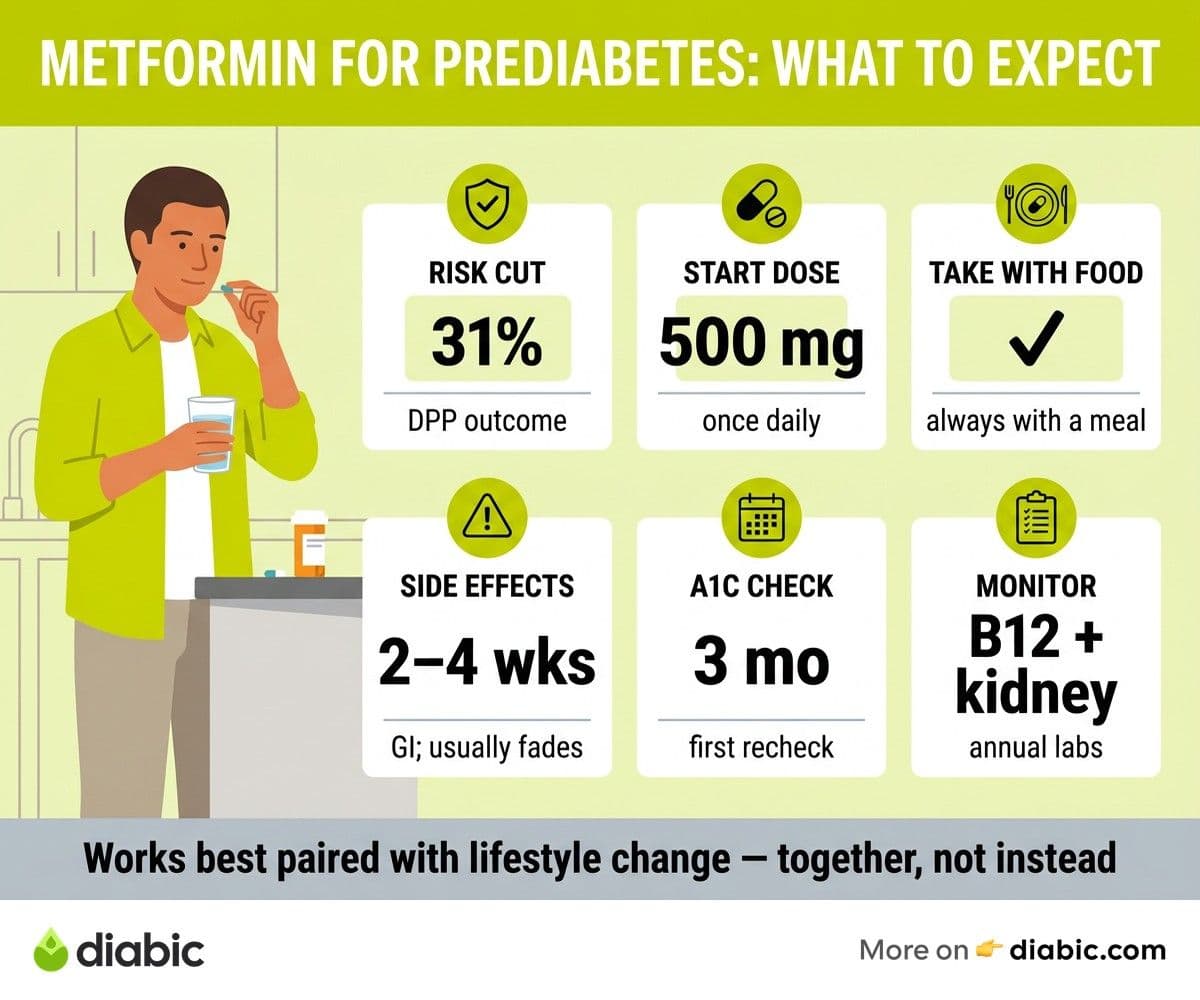
The evidence base for metformin in prediabetes is strong. The Diabetes Prevention Program, the landmark study summarized by the NIDDK, showed that metformin reduced the risk of progressing from prediabetes to type 2 diabetes by 31 percent over three years. Lifestyle changes were even more effective at 58 percent, but metformin held its own as a real and durable intervention, especially in younger adults and people with higher BMI.
Understanding what your numbers mean is part of the picture too. If you have not yet looked at the specifics, our breakdown of what your prediabetes A1C number really means explains where the cutoffs sit and why they matter.
Who Should Consider Metformin for Prediabetes
Not everyone with prediabetes is offered metformin. The medication is approved for type 2 diabetes, and its use for prediabetes is technically off-label, though it is widely supported by guidelines.
The American Diabetes Association recommends considering the medication for prevention in people who are at higher risk of progressing. The criteria they highlight include a BMI of 35 or higher, age under 60, and a history of gestational diabetes. People whose A1C or fasting glucose continues to climb despite serious lifestyle effort also tend to be good candidates.
Some doctors take a more proactive approach and offer metformin earlier than the strict guideline thresholds, particularly when there is a strong family history of type 2 diabetes or other metabolic risk factors. The reasoning is that the medication is inexpensive, well tolerated by most people, and has a long safety record. The trade-off is daily medication and the chance of side effects.
The conversation worth having with your doctor is whether your specific risk profile makes metformin a sensible addition to lifestyle changes, or whether your current numbers and trajectory mean lifestyle alone is reasonable to try first. Our overview of prediabetes treatment options lays out the full menu so you can compare.
What to Expect When Starting Metformin
Most people start metformin at a low dose, often 500 milligrams once a day with a meal. From there, the dose is usually increased slowly over a few weeks toward the target dose, which is commonly 1,000 milligrams twice a day for prediabetes prevention. Slow titration matters because it gives your gut time to adjust.
The most common side effects are gastrointestinal. Nausea, loose stools, stomach cramps, and bloating are typical in the first two to four weeks. The Mayo Clinic lists these clearly in its drug information, and most people find that the symptoms ease significantly as the body adapts. Taking metformin with food, starting low, and increasing the dose gradually all help.
The extended-release formulation, sometimes called metformin ER or XR, tends to cause fewer GI side effects. If standard metformin is rough on your system, asking your doctor about the extended-release version is a reasonable next step. The cost difference is often small.
Blood sugar improvements show up gradually rather than overnight. Fasting glucose may shift within the first few weeks. A1C, because it reflects average blood sugar over roughly three months, takes longer to move. Most doctors will recheck your A1C around the three-month mark to see how the medication and your lifestyle changes are working together.
From my experience: I have lived with diabetes for fourteen years, and I have started metformin twice across that span. Both times, the first ten days were the worst, and both times the symptoms faded faster than I expected. Eating something with the dose, even just a piece of toast, made a noticeable difference. I wish someone had told me earlier that the rocky start was not a sign the medication was wrong for me.
Combining Metformin With Lifestyle Changes
Metformin works, and it works better when paired with the lifestyle changes that target the same underlying issues. Skipping that pairing is one of the most common mistakes people make.
The mechanism is straightforward. Metformin reduces glucose output from the liver and improves insulin sensitivity in your cells. Movement, particularly aerobic activity and resistance training, also improves insulin sensitivity through different pathways. The two effects stack. Diet changes that reduce blood sugar spikes give the medication less work to do at any given moment, which improves overall glucose patterns.
Tracking matters too. A1C every three to six months, fasting glucose checks if your doctor recommends them, and an honest sense of how your daily habits are evolving give you and your care team something to work with. Numbers move, and seeing the movement is motivating.
If reversal is on your mind, you are not alone. Our deep dive into whether prediabetes can be reversed walks through what the evidence shows about returning glucose levels to a normal range, with and without medication. The framing we like most is that you are buying yourself time and capacity, not chasing a single endpoint. The CDC's National Diabetes Prevention Program has structured lifestyle programs that pair well with medication for many people.
For a broader view of why early action matters, prediabetes: why catching it now changes everything covers the long-term picture.
Long-Term Considerations
Metformin is one of the few medications people often stay on for years or decades without major issues, but there are a few things worth knowing for the long run.
Vitamin B12 absorption can decrease over time on metformin. Most doctors check B12 levels at intervals, particularly after several years on the medication. If levels drop, supplementation is straightforward. Symptoms of low B12 can include fatigue, tingling in the hands or feet, and changes in mood, so flagging any of those is worth doing.
Kidney function is monitored periodically because metformin is cleared by the kidneys and its dose may need to be adjusted if kidney function declines. Annual blood work usually covers this, and most adults will not run into limitations. Your doctor will let you know if anything needs to change.
How long you stay on metformin depends on your numbers, your goals, and how your prediabetes responds to the combination of medication and lifestyle. Some people take it for a year or two while they make significant lifestyle shifts and then taper off. Others stay on it long term as one piece of an ongoing prevention strategy. Some eventually progress to type 2 diabetes despite their best efforts, in which case metformin remains a foundation of treatment. Our practical guide to metformin for type 2 diabetes picks up that part of the story.
Discontinuing metformin is a conversation, not a decision to make on your own. Stopping suddenly without a plan can let blood sugar drift back upward, which undoes the progress you made.
FAQ
Does metformin help with prediabetes?
Yes. The Diabetes Prevention Program study showed that metformin reduced the risk of developing type 2 diabetes by 31 percent in people with prediabetes. It works by lowering the amount of glucose the liver produces and improving insulin sensitivity. It is most effective when combined with lifestyle changes, which on their own reduced risk by 58 percent in the same study.
What are the side effects of metformin in prediabetes treatment?
The most common side effects are gastrointestinal: nausea, diarrhea, stomach cramps, and bloating. These usually improve within the first few weeks, especially if you start with a low dose and take the medication with food. The extended-release version tends to cause fewer GI issues. Long-term, your doctor should monitor B12 levels and kidney function.
Can I stop taking metformin once my A1C improves?
Possibly, but it is a decision to make with your doctor rather than on your own. Some people taper off after sustained lifestyle changes bring their numbers into a normal range. Others stay on metformin long term because their risk profile or family history makes prevention an ongoing priority. Stopping abruptly without a plan can allow blood sugar to drift back upward.
Metformin for prediabetes is not a magic fix, and it is not a moral verdict. It is a long-studied tool that, paired with the daily habits that matter most, can shift the odds in your favor. That feels like a reasonable use of something the medical world has been refining for nearly seventy years.
Dr. Shanto Arian is an internal medicine physician now specializing in clinical and aesthetic dermatology, with a parallel academic focus on epidemiology and public health. He holds an MBBS, MPH, MSc (UK), MRCP (UK), MRCPI (Ireland), Diploma in Dermatology (UK), and Diploma in Aesthetic Medicine (USA). Dr. Arian trained in internal medicine, including hospital work on hematology cases such as graft-versus-host disease, before moving toward dermatology. Skin is one of the earliest places diabetes shows itself, from acanthosis nigricans and diabetic dermopathy to slow foot wound healing, and that intersection is where his clinical and Diabic-review work meet. On Diabic, Dr. Arian medically reviews content on diabetes diagnosis, complications, dermatologic manifestations, and pharmacotherapy, ensuring every claim aligns with current ADA, NICE, and peer-reviewed literature.
Medically reviewed by
Dr. Rezwana Parvin Rumpa is an obstetrics and gynaecology specialist with clinical focus on gestational diabetes, PCOS, and fertility. She holds the MRCOG (Final Part) from the Royal College of Obstetricians and Gynaecologists in London, the MRCPI (Final Part) from the Royal College of Physicians of Ireland, and an MBBS from Shaheed Monsur Ali Medical College under Dhaka University. Dr. Rumpa serves as a Senior Medical Officer in the Obs and Gynae department at BRB Hospitals Ltd, where she has spent three years managing prenatal care, emergency obstetric cases, and women's-health surgery. On Diabic, she medically reviews content for women living with diabetes, with particular attention to pregnancy, PCOS, and reproductive-health intersections.
More from Diabetes Knowledge
View all
6 Safe Dessert for Gestational Diabetes Recipes You Can
Six dessert for gestational diabetes recipes that satisfy your sweet tooth without spiking blood sugar, with carb counts and pairing tips you can use.

8 High Fiber Foods That Help with Prediabetes
Add these 8 high fiber foods for prediabetes to slow glucose absorption, support steady blood sugar, and meet the daily fiber target most people miss.

Mediterranean Diet for Prediabetes: A Practical Guide
The mediterranean diet for prediabetes is one of the best-studied eating patterns for prevention. Here is what to eat, what to avoid, and how to start.
Clinician-reviewed habits, plain-language guides, and honest answers - the small shifts that make living with diabetes feel lighter, every day.