Mediterranean Diet for Prediabetes: A Starter Guide
A practical Mediterranean diet for prediabetes guide with research, foods to eat, sample meals, and a gradual three-week starter plan.

In this article(11)
The mediterranean diet for prediabetes is one of the most researched and recommended eating patterns for blood sugar management. It emphasizes whole foods, healthy fats, and balanced meals without rigid restrictions. If you are looking for a sustainable way to eat with prediabetes, this approach is a strong place to start.
What sets it apart from most diets is the lack of strict rules. There are no banned food groups, no mandatory macros, and no calorie counting. The focus is on adding more of the right things rather than cutting out what you love.
What Is the Mediterranean Diet?
The Mediterranean diet is built around the traditional eating patterns of countries like Greece, Italy, Spain, and southern France. Olive oil replaces butter, vegetables fill most of the plate, and fish appears more often than red meat. Whole grains, legumes, nuts, and fruits round out the daily staples.
It is better described as a dietary pattern than a strict plan. There are no portion charts to memorize and no foods that are completely off-limits. The pattern emerged from observational studies in the 1960s, when researchers noticed that people in these regions had lower rates of heart disease and type 2 diabetes than expected.
The American Diabetes Association recognizes the Mediterranean approach as one of the eating patterns supported by strong evidence for diabetes prevention and management. It is recommended alongside other flexible patterns like DASH and plant-based eating, all of which share an emphasis on whole foods and minimal ultra-processing.
The cultural roots matter for one practical reason. Because the pattern grew out of how people actually ate (not how a nutritionist designed it), it tends to be sustainable for the long haul. Meals are social, satisfying, and built around real food.
Does the Mediterranean Diet Help with Prediabetes?
Yes. The mediterranean diet prediabetes connection has held up across decades of research. The landmark PREDIMED trial, published in the New England Journal of Medicine, followed nearly 7,500 adults at high cardiovascular risk over five years. People assigned to a Mediterranean diet supplemented with extra-virgin olive oil or mixed nuts had a 30 percent lower risk of major cardiovascular events compared to those on a low-fat diet.
The same research group later showed a roughly 30 to 50 percent reduction in the development of type 2 diabetes in people following a Mediterranean pattern. That is a meaningful difference for anyone with prediabetes hoping to slow or stop the progression.
Two main mechanisms explain why this works. First, the high fiber content from vegetables, legumes, and whole grains slows glucose absorption after meals. Second, the unsaturated fats from olive oil and nuts improve insulin sensitivity, meaning your cells respond better to the insulin you do produce. Together these effects lead to flatter blood sugar curves and less metabolic stress.
The pattern also reduces inflammation, a key driver of insulin resistance. Polyphenols in olive oil, antioxidants in vegetables, and omega-3s in fish all contribute to a less inflammatory internal environment. People who want to explore other prediabetes treatment options that work often find that combining lifestyle changes like this with medical guidance produces the strongest results.
What to Eat on a Mediterranean Diet for Prediabetes
The prediabetes mediterranean diet looks less like a meal plan and more like a daily rhythm. Here is what to include at each frequency level, drawing on the Oldways Mediterranean Diet Pyramid.
Daily staples
- Vegetables of all kinds, especially leafy greens, tomatoes, peppers, and cucumbers
- Fresh fruit, particularly berries, citrus, apples, and pears
- Whole grains like oats, barley, bulgur, and whole-grain bread
- Olive oil as the main cooking and finishing fat
- Nuts and seeds (a small handful counts)
- Herbs and spices in place of heavy salt or sauces
Weekly staples (2-3 times per week)
- Fish and seafood, especially salmon, sardines, mackerel, and shellfish
- Poultry like chicken or turkey
- Legumes such as lentils, chickpeas, and white beans
- Eggs, plain yogurt, and small amounts of cheese
Occasional items (a few times per month)
- Red meat, ideally lean cuts and modest portions
- Sweets and pastries
- Highly processed foods
A typical day might look like this: a breakfast of Greek yogurt with berries, walnuts, and a drizzle of honey. Lunch is a large salad with mixed greens, chickpeas, cucumber, tomato, feta, and an olive oil vinaigrette, plus a slice of whole grain bread. An afternoon snack of an apple with almond butter holds you over. Dinner is a piece of baked salmon, a side of roasted vegetables, and a half cup of farro.
How the Mediterranean Diet Fits a Prediabetes Diet Plan
A good prediabetes diet centers on slow-releasing carbs, lean proteins, and healthy fats at every meal. Mediterranean eating already does this naturally, which is part of why it translates so well to blood sugar management.
The pattern controls portions without requiring you to count anything. Vegetables and salads fill space on the plate, fiber from legumes and whole grains keeps you full longer, and healthy fats slow digestion. Most people find they eat less without consciously trying. For more on the specifics of food selection, our guide to what to eat and what to limit with prediabetes walks through the choices in more detail.
From my experience: After more than a decade of managing diabetes, the Mediterranean approach is the only eating style I have stuck with for years rather than weeks. It does not feel like a diet. Cooking with olive oil and herbs, eating fish a few times a week, and keeping fruit and nuts on hand became second nature once I stopped trying to do it perfectly.
The framework also adapts well to most grocery options. You do not need imported Italian olive oil or specialty fish to make it work. Frozen vegetables, canned beans, eggs, plain yogurt, and a bottle of decent extra-virgin olive oil cover the basics from any supermarket.
Whole Grains in the Mediterranean Diet
Whole grains are a cornerstone of Mediterranean eating, but the choices reflect what grows in the region rather than what fills American grocery shelves. Barley, bulgur, farro, whole-grain pasta, and stone-ground bread are all common.
Whole grains contribute fiber, B vitamins, and a slower glucose response than refined grains. Replacing white rice with farro, or white pasta with whole-wheat or chickpea pasta, makes a real difference in post-meal blood sugar over time. Even oatmeal in the morning is a Mediterranean-friendly choice.
The simplest swap is moving from refined to whole versions of foods you already eat. White bread becomes whole grain or sourdough. White pasta becomes whole wheat or legume-based. White rice becomes brown rice, farro, or barley. Our deeper guide to whole grains worth choosing for prediabetes compares specific grains by fiber, protein, and glycemic impact.
Getting Started: Practical First Steps
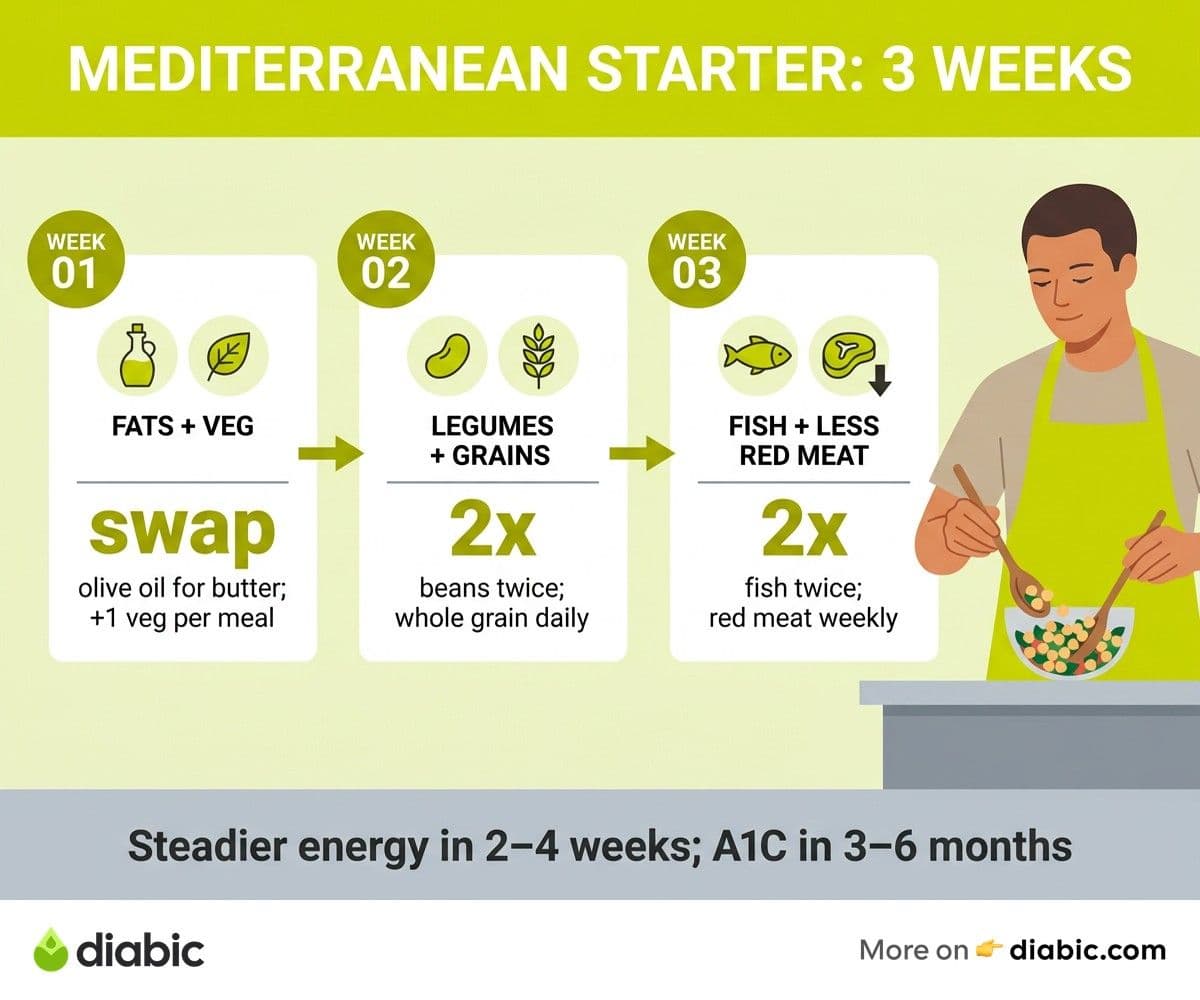
Trying to overhaul your entire diet on a Monday is the fastest way to abandon it by Friday. A gradual transition over three weeks works better and tends to stick.
Week one: change your fats and add more vegetables. Replace butter, vegetable oil, and margarine with extra-virgin olive oil for cooking and salad dressings. Add an extra serving of vegetables to lunch and dinner, even if it is just a side salad or a handful of spinach in your eggs.
Week two: bring in legumes and whole grains. Add beans or lentils to two meals a week (a chickpea salad, a lentil soup, black beans on a grain bowl). Swap one refined grain for a whole one each day, like oats for breakfast or whole-grain bread for a sandwich.
Week three: shift your proteins. Aim for fish twice a week (canned salmon and sardines count and are inexpensive). Reduce red meat to once a week or less, and use chicken, turkey, eggs, or legumes for the rest.
By the end of the third week, the pattern starts to feel automatic. You stop thinking about it as a diet and start thinking of it as how you eat now. This is the gradual shift that beats any overnight overhaul.
FAQ
Does the Mediterranean diet help with prediabetes?
Yes. Multiple large-scale studies, including the PREDIMED trial, show that following a Mediterranean diet reduces the risk of progressing from prediabetes to type 2 diabetes by 30 to 50 percent. It also improves insulin sensitivity, lowers inflammation, and supports healthy weight management.
What to eat on a Mediterranean diet for prediabetes?
Focus on vegetables, fruits, whole grains, legumes, nuts, fish, and olive oil as your primary fat source. Limit red meat, processed foods, and added sugars. Aim for fish two to three times per week and use olive oil as your main cooking fat.
How long does it take to see blood sugar improvements?
Many people notice steadier energy and reduced post-meal spikes within two to four weeks. Measurable improvements in fasting glucose and A1C usually show up over three to six months. The longer you stick with the pattern, the better the metabolic benefits.
Do I have to give up bread and pasta on a Mediterranean diet for prediabetes?
No. Whole grain bread and pasta (or legume-based pasta) are part of the Mediterranean pattern. Portion size matters more than cutting these foods entirely. Pair them with vegetables, protein, and olive oil to slow the blood sugar response.
A mediterranean diet for prediabetes is not a quick fix, but it is one of the most sustainable patterns available. The food is good, the rules are forgiving, and the research backs it up across decades. The first three weeks are the hardest. After that, it usually becomes how you cook.
Shahriar P. Shuvo is the founder of Diabic. He has lived with diabetes for over 14 years, and built Diabic to deliver the practical, evidence-based self-management tools he wished existed when he was first diagnosed. By trade, Shahriar is a senior design and frontend engineer with 6+ years shipping products at Agora, Timescale (now Tiger Data), and ShareTrip. He writes from the intersection of lived diabetes experience and product craft, focused on what works in daily management rather than what sounds good in a textbook.
Medically reviewed by
Dr. Shanto Arian is an internal medicine physician now specializing in clinical and aesthetic dermatology, with a parallel academic focus on epidemiology and public health. He holds an MBBS, MPH, MSc (UK), MRCP (UK), MRCPI (Ireland), Diploma in Dermatology (UK), and Diploma in Aesthetic Medicine (USA). Dr. Arian trained in internal medicine, including hospital work on hematology cases such as graft-versus-host disease, before moving toward dermatology. Skin is one of the earliest places diabetes shows itself, from acanthosis nigricans and diabetic dermopathy to slow foot wound healing, and that intersection is where his clinical and Diabic-review work meet. On Diabic, Dr. Arian medically reviews content on diabetes diagnosis, complications, dermatologic manifestations, and pharmacotherapy, ensuring every claim aligns with current ADA, NICE, and peer-reviewed literature.
More from Diabetes Knowledge
View all
6 Safe Dessert for Gestational Diabetes Recipes You Can
Six dessert for gestational diabetes recipes that satisfy your sweet tooth without spiking blood sugar, with carb counts and pairing tips you can use.

8 High Fiber Foods That Help with Prediabetes
Add these 8 high fiber foods for prediabetes to slow glucose absorption, support steady blood sugar, and meet the daily fiber target most people miss.

Mediterranean Diet for Prediabetes: A Practical Guide
The mediterranean diet for prediabetes is one of the best-studied eating patterns for prevention. Here is what to eat, what to avoid, and how to start.
Clinician-reviewed habits, plain-language guides, and honest answers - the small shifts that make living with diabetes feel lighter, every day.