Preconception Planning for Diabetes: a Practical Checklist
A clear preconception planning diabetes checklist covering A1C targets, folic acid, medication review, and the care team you need before trying to.

In this article(9)
If you are thinking about starting a family, preconception planning diabetes care is one of the most meaningful gifts you can give your future baby and yourself. The first eight weeks of pregnancy shape how a baby's heart, brain, and spine form, and most people do not realize they are pregnant until that critical window is already underway. That is why the work happens before the positive test, not after.
We know this stage can feel heavy. There is excitement, hope, and sometimes a quiet worry that diabetes might make pregnancy harder than it should be. The good news is that with steady preparation, the right team, and a few targeted health goals, your odds of a healthy pregnancy look very similar to anyone else's. This checklist walks through the steps that matter most, in the order most providers recommend tackling them.
Why Preconception Planning Diabetes Care Changes Outcomes
The reason preconception planning diabetes care carries so much weight comes down to timing. Major organs begin forming around week five of pregnancy, often before a missed period registers. Blood sugar levels during those early weeks have a direct relationship with how those organs develop, which is why endocrinologists and OB-GYNs spend so much energy on pre-pregnancy numbers rather than waiting until conception confirms.
Research from the American Diabetes Association shows that an A1C above 7 percent at conception is linked to a meaningfully higher risk of birth defects and miscarriage, while bringing that number closer to 6.5 percent dramatically narrows the gap. The CDC's planning for pregnancy guidance echoes this, noting that women who plan a pregnancy with stable glucose see fewer NICU admissions and fewer complications during delivery.
Beyond blood sugar, several common diabetes medications are not safe during pregnancy and need to be swapped well before conception. Eye and kidney health also tend to shift under the demands of pregnancy hormones, so a baseline assessment helps your care team spot changes early. Putting all of this in place before you try to conceive turns a potentially stressful pregnancy into one that feels structured and supported.
Your Preconception Diabetes Checklist
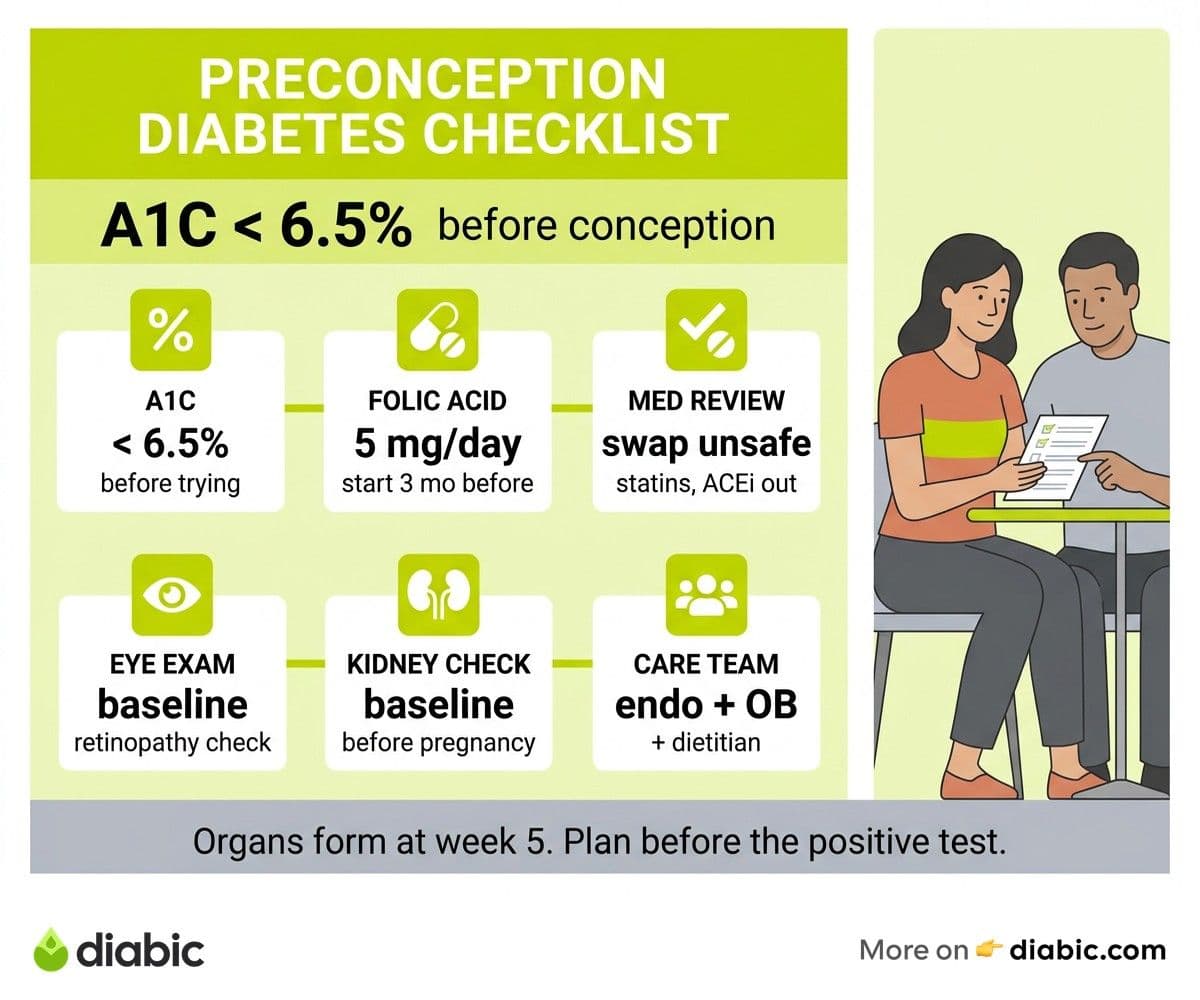
Once you decide you are ready, the following checklist gives you a starting framework to bring to your next appointment. Not every item happens in a single visit, and most people work through these steps over three to six months. Think of it as a preparation runway rather than a sprint.
- Aim for an A1C below 6.5 percent (ideally closer to 6.0) for at least three months before trying. The ACOG preconception counseling guidelines describe this as the single most protective step you can take.
- Start a prenatal vitamin with high-dose folic acid (often 4 to 5 mg daily for people with diabetes, compared with 0.4 to 0.8 mg for the general population). Folic acid lowers the risk of neural tube defects, and the higher dose accounts for the added risk diabetes brings.
- Schedule a full medication review with both your endocrinologist and OB-GYN. ACE inhibitors, ARBs, statins, and certain GLP-1 receptor agonists are typically stopped before conception. Replacements vary, so this conversation cannot wait until the test turns positive.
- Get a comprehensive dilated eye exam. Pregnancy hormones can accelerate diabetic retinopathy, and knowing your starting point lets your ophthalmologist track changes safely. If you are managing pregnancy with type 1 diabetes, this exam often becomes an annual fixture during and after pregnancy.
- Check kidney function through urine microalbumin, serum creatinine, and an estimated GFR. Mild kidney changes do not rule out pregnancy, but your team will want to monitor more closely if any markers are off.
- Confirm thyroid health. Thyroid disorders are more common in people with type 1 diabetes, and untreated thyroid issues complicate fertility and early pregnancy.
Working through this list with a primary clinician reduces the chance that anything important falls through the cracks. Many people find it helpful to keep a single notebook or app where they track which steps are scheduled, completed, and pending. If you also want to think through how lifestyle habits stack up, our guide on how to build a daily diabetes self-care routine covers the everyday foundation that supports preconception goals.
Building Your Pregnancy Care Team
A pregnancy with preexisting diabetes works best when several specialists communicate with each other, not just with you. Building this team before conception means you walk into your first prenatal appointment with everyone already aligned. It also gives you time to find providers you actually like, which matters when you will be seeing them often for the next year.
At the center sits an endocrinologist who has experience with diabetes in pregnancy. Pregnancy changes insulin sensitivity in nonlinear ways, and a clinician who has guided this transition before will adjust faster than one who has not. Alongside the endocrinologist, look for a maternal-fetal medicine specialist, sometimes called a high-risk OB. The March of Dimes preconception health resources explain that MFM involvement does not mean something is wrong with your pregnancy. It simply means more eyes on the details that matter.
A certified diabetes care and education specialist (CDCES) rounds out the team beautifully. Pregnancy carb counting is more granular than non-pregnancy carb counting, and insulin-to-carb ratios shift across trimesters. A registered dietitian who works with people who have pregnancy with type 2 diabetes or type 1 can build meal plans that hit pregnancy nutrition targets without sending blood sugar on a roller coaster. If gestational diabetes runs in your family, a head start on a gestational diabetes friendly eating pattern can also help your team personalize advice later.
Add your primary care doctor, your eye specialist, and a dentist to the contact list as well. Oral health is often overlooked, but gum disease has been associated with preterm birth, and pregnancy hormones can worsen existing dental issues. Having every provider's contact information in one place saves time when questions come up at odd hours.
Fertility, Diabetes, and the Emotional Side of Planning
Talking about fertility and diabetes can feel awkward, but it deserves space. People with well-managed diabetes generally have fertility rates similar to the general population, though irregular cycles, PCOS, and thyroid issues are more common alongside diabetes and can complicate timing. If you have been trying for six months without success (or three months if you are over 35), an early conversation with a reproductive endocrinologist is reasonable.
The emotional side of preconception planning often catches people off guard. There is real grief in the realization that conceiving will require more medical involvement than you might have hoped for, and there is real anxiety in carrying responsibility for two sets of blood sugars. Both feelings are valid. They do not mean you are not ready. They mean you are taking this seriously.
We encourage you to talk openly with your partner about expectations, fears, and the practical changes that may come. Some couples find that one partner takes on more of the meal planning during this stage so the partner with diabetes can focus on glucose data and appointments. Others split tasks differently. There is no single right structure, only the one that fits your relationship.
Connecting with other parents who have walked this path also helps. Online communities, in-person support groups, and patient stories from organizations like Beyond Type 1 can normalize the unfamiliar. Pregnancy with diabetes is more work than pregnancy without it, but it is far from rare, and the people who have done it before are often happy to share what they learned. Hormones can shift mood and energy in ways you may not expect, so reading through hormonal changes from diabetes in men and women gives you a sense of what is biological versus situational.
Putting the Plan Into Motion
Once your appointments are booked and your medications are reviewed, the day-to-day work shifts to consistency. Logging blood sugars, taking your prenatal, sleeping enough, and moving regularly are the small actions that hold the bigger checklist together. None of them require perfection. They require showing up.
Your endocrinologist will likely want to see your numbers more often as you approach the conception window, sometimes monthly. CGM data, if you use one, becomes a useful conversation tool because it shows time in range alongside A1C, and time in range tends to correlate well with pregnancy outcomes. If you are not yet on a CGM and feel like one would help, this is a reasonable thing to bring up.
Give yourself permission to take this in stages. Some people work through the entire checklist in three months, while others spread it across a year. The goal is not speed. The goal is starting pregnancy on solid ground, with a team that knows you, a plan that makes sense, and a body that has been gently prepared for what comes next.
Frequently Asked Questions
How do I prepare for pregnancy with diabetes?
Start at least three to six months before you want to conceive. Bring your A1C as close to 6.5 percent as you safely can, begin a prenatal vitamin with high-dose folic acid, review every medication with your endocrinologist and OB-GYN, and book baseline eye and kidney exams. Build a care team that includes an endocrinologist familiar with pregnancy, a maternal-fetal medicine specialist, and a diabetes educator. Address mental health and partner conversations alongside the medical steps, because emotional readiness matters too.
What is the preconception checklist for women with diabetes?
A common preconception checklist for women with diabetes covers six pillars: glucose targets (A1C below 6.5 percent), high-dose folic acid, a full medication review, a dilated eye exam, kidney function tests, and thyroid screening. From there, build a care team, line up a meal plan that supports pregnancy nutrition, and create space for the emotional work that comes with planning. Each item is meant to be discussed with your provider rather than acted on alone, and your personal checklist may include extras based on your medical history.
How long should I wait between deciding to plan and trying to conceive?
Most diabetes care guidelines suggest at least three months of stable, in-range blood sugar before trying. Some people need longer if medications need to change or A1C is significantly above target. Use the time to build habits you can sustain through pregnancy rather than rushing toward a specific date.
Preconception planning diabetes care is, in the end, just steady preparation done in the right order. Talk to your doctor about which steps to tackle first and which can wait, and let your team help you turn this checklist into a calendar that fits your life.
Dr. Rezwana Parvin Rumpa is an obstetrics and gynaecology specialist with clinical focus on gestational diabetes, PCOS, and fertility. She holds the MRCOG (Final Part) from the Royal College of Obstetricians and Gynaecologists in London, the MRCPI (Final Part) from the Royal College of Physicians of Ireland, and an MBBS from Shaheed Monsur Ali Medical College under Dhaka University. Dr. Rumpa serves as a Senior Medical Officer in the Obs and Gynae department at BRB Hospitals Ltd, where she has spent three years managing prenatal care, emergency obstetric cases, and women's-health surgery. On Diabic, she medically reviews content for women living with diabetes, with particular attention to pregnancy, PCOS, and reproductive-health intersections.
Medically reviewed by
Dr. Shanto Arian is an internal medicine physician now specializing in clinical and aesthetic dermatology, with a parallel academic focus on epidemiology and public health. He holds an MBBS, MPH, MSc (UK), MRCP (UK), MRCPI (Ireland), Diploma in Dermatology (UK), and Diploma in Aesthetic Medicine (USA). Dr. Arian trained in internal medicine, including hospital work on hematology cases such as graft-versus-host disease, before moving toward dermatology. Skin is one of the earliest places diabetes shows itself, from acanthosis nigricans and diabetic dermopathy to slow foot wound healing, and that intersection is where his clinical and Diabic-review work meet. On Diabic, Dr. Arian medically reviews content on diabetes diagnosis, complications, dermatologic manifestations, and pharmacotherapy, ensuring every claim aligns with current ADA, NICE, and peer-reviewed literature.
More from Living with Diabetes
View all
A Gentle Chair Yoga Routine for people with diabetes
A gentle chair yoga for people with diabetes routine with safe poses, modifications for neuropathy, retinopathy, and joint pain, plus tips for older.

Shift Work and Diabetes: Managing Irregular Hours
Shift work and diabetes is a tough combination. Learn how to manage meals, sleep, medication, and blood sugar when your hours rotate or flip overnight.

Dating with Diabetes: When to Tell a New Partner
Dating with diabetes brings unique disclosure questions. Here is when to tell a new partner, what to say, and how to handle the conversation with.
Clinician-reviewed habits, plain-language guides, and honest answers - the small shifts that make living with diabetes feel lighter, every day.