How to Use a Glucagon Emergency Kit: Step by Step
Learn glucagon emergency kit how to use, including injection, nasal Baqsimi, and Gvoke HypoPen steps for severe low blood sugar response.

In this article(11)
Knowing glucagon emergency kit how to use is one of those skills no one wants to need, but every household with a person on insulin should have it ready. When a severe low blood sugar event takes someone past the point of swallowing safely, fast carbs are no longer the answer, and glucagon becomes the bridge that buys time until paramedics arrive. We wrote this guide so that you, your family, and anyone who shares space with you can walk through the exact steps without panic.
Severe hypoglycemia rarely sends a polite warning. One minute your loved one is finishing dinner, the next they are confused, slurring words, or unresponsive. The good news is that modern glucagon products have changed dramatically in the last few years, with nasal sprays and prefilled pens that almost anyone can administer. Pair this read with our hypoglycemia emergency treatment steps so you have the full picture from mild low to severe rescue.
From my experience: I carried the old red Lilly mixing kit for years and only ever practiced with it once, which I now realize was the part I got wrong. When Baqsimi came out around 2019, I switched the household to nasal and walked my partner through the trainer device on a quiet Sunday afternoon. The peace of mind from a five-minute practice run is hard to overstate, and it made the kit feel like a tool instead of a prop in the medicine cabinet.
What Is Glucagon and When Do You Need It
Glucagon is a hormone your pancreas naturally makes alongside insulin, and the two work as opposing signals. While insulin lowers blood sugar by moving glucose into cells, glucagon raises it by telling the liver to release stored glucose into the bloodstream. In an emergency kit, glucagon is the synthetic version of that same signal, ready to be delivered when your body cannot recover on its own.
The line between mild hypoglycemia and a glucagon-level emergency comes down to one question: can the person safely swallow and follow instructions? If they can, fast-acting carbs are the right tool, and the Endocrine Society clinical guidance on hypoglycemia walks through that protocol in detail. If they cannot, because they are unconscious, seizing, combative, or too confused to drink, glucagon becomes the next step. Trying to push juice into someone who cannot swallow can cause aspiration, which is its own emergency.
Every household where someone uses insulin or sulfonylureas should keep at least one current glucagon kit on hand. That includes type 1 diabetes, insulin-treated type 2 diabetes, and anyone whose insulin therapy for type 1 diabetes puts them at meaningful risk of going low. A prescription is required, but most insurance plans cover at least one form of glucagon, and manufacturer savings cards often bring out-of-pocket costs down further.
Types of Glucagon Kits Available Today
The traditional glucagon emergency kit, often the orange or red box from Lilly or the red Novo Nordisk GlucaGen kit, contains a vial of powdered glucagon and a prefilled syringe of sterile diluent. The caregiver mixes the two during the emergency, draws the dose back into the syringe, and injects intramuscularly. These kits work reliably and have been around for decades, but the multi-step preparation can feel daunting under stress.
Nasal glucagon, sold as Baqsimi, changed the playbook in 2019. It is a single-dose nasal spray that does not need to be mixed, inhaled, or even sniffed actively to work. According to FDA prescribing information for Baqsimi, the powder is absorbed through nasal tissue regardless of whether the person is breathing in. That makes it especially friendly for caregivers who are squeamish about needles or unfamiliar with injections.
Gvoke HypoPen and Zegalogue are prefilled auto-injectors that deliver liquid-stable glucagon with a single press, similar in feel to an EpiPen. There is no mixing, no air bubbles to chase, and the device is small enough to slip into a school backpack or a desk drawer. Cost and insurance coverage vary across these three categories, so we recommend asking your pharmacist to run all three and comparing copays before you settle on which form lives in your bag and which lives by the bed.
Step by Step: How to Give a Glucagon Injection
We will start with the traditional kit because it has the most steps. Even if you carry Baqsimi or Gvoke, knowing the older procedure means you can help someone whose only available option is the injection version. The American Diabetes Association guidance on hypoglycemia reinforces these steps and is worth reviewing yearly.
Open the kit and remove the orange or red cap from the vial. Pull the cap off the prefilled syringe and inject all of the diluent liquid into the powder vial. Without removing the syringe, swirl the vial gently until the solution is clear. Draw the entire reconstituted mixture back into the syringe. The standard adult emergency dose is the full syringe, but follow the dose your prescriber set on the label that came with your kit, which may differ for children and smaller bodies.
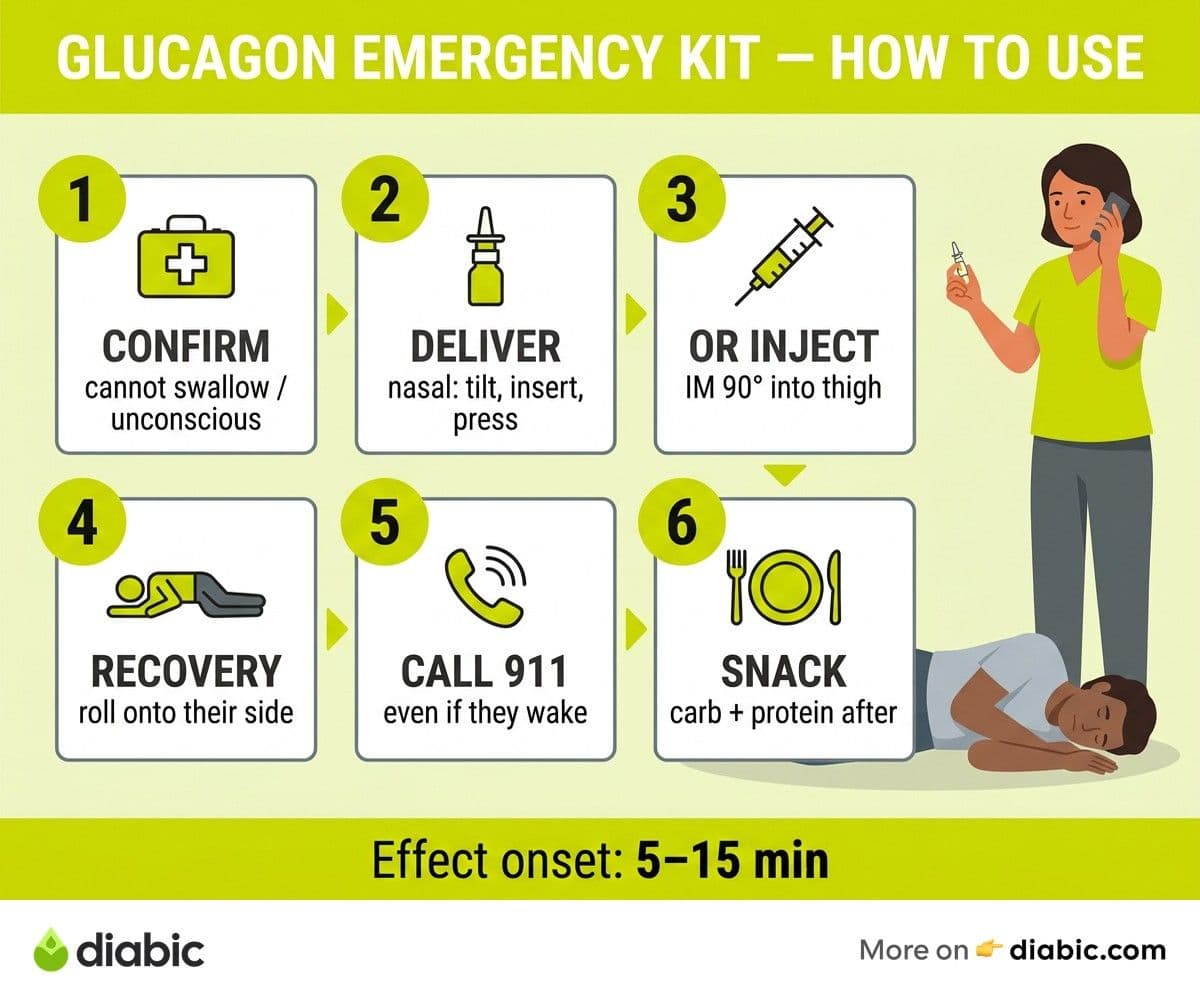
Choose an injection site with muscle underneath: the front of the thigh, the upper outer arm, or the upper outer buttock all work. Insert the needle straight in at a 90 degree angle through clothing if needed, since pulling clothes off wastes precious seconds, and push the plunger down completely. Withdraw the needle and turn the person on their side in the recovery position, because glucagon commonly causes vomiting once they wake. Call 911 right after the injection, even if the person seems to be coming around.
How to Use Nasal Glucagon (Baqsimi)
Baqsimi is intentionally designed to be simple, but practicing once or twice with a trainer device removes the last bit of hesitation. The product comes in a small yellow tube that you twist open to reveal the white nasal applicator. Do not press the plunger before the device is in the nostril, because the dose only fires once.
Tilt the person's head back slightly, insert the tip of the device into one nostril until your fingers touch the outside of the nose, and press the plunger all the way down with your thumb. The dose delivers in less than a second. You do not need the person to inhale, sniff, or even be breathing through their nose for the medication to absorb. Roll them onto their side, call 911, and stay with them.
Caregivers who have never given an injection often find Baqsimi much easier to use under stress. We have heard from parents whose teenagers prefer that grandparents and babysitters carry the nasal version, even though the family also keeps an injection kit at home. The cost is similar to other forms of glucagon, and the device is shelf-stable at room temperature for up to two years.
After Giving Glucagon: What to Do Next
Glucagon usually starts raising blood sugar within 5 to 15 minutes, with full effect within 15 to 20 minutes. While you wait, keep the person on their side, watch their breathing, and do not put anything in their mouth until they are fully alert. Nausea and vomiting are extremely common after glucagon, so the recovery position protects their airway.
Once the person is awake and able to swallow safely, give them a fast-acting carb followed by a longer-lasting snack with protein. Glucagon works by emptying the liver's glucose stores, and those stores need to be refilled before the next meal or insulin dose. Without that follow-up snack, blood sugar can crash again within an hour or two. Keep checking glucose every 15 minutes for the first hour, and read our guide on when to go to the ER for diabetes to know which red flags warrant an evaluation no matter how good they feel.
Always call 911 or your provider's emergency line after giving glucagon, even when the person bounces back and feels fine. Severe hypoglycemia is a sign that something in the management plan needs review, and a clinician should know what happened. If the person does not wake within 15 minutes of the dose, paramedics need to be on the way already, and a second dose may be appropriate based on emergency medical service direction.
Training Family, Friends, and Coworkers
Here is the part people forget: the person with diabetes cannot administer their own glucagon during a severe low. By definition, severe hypoglycemia means they need someone else's help. That makes training the people around you the single most important step in this entire guide.
Sit down with your spouse, parents, adult children, close friends, roommates, and at least one trusted coworker. Walk them through where the kit is stored, what each form looks like, and how to use it. Manufacturers offer free trainer devices that look identical to the real product but contain no medication, and practicing with one removes most of the panic in a real event. We recommend running through the steps once a year, the same way families do fire drills.
For households with kids and teens, age-appropriate training matters. A nine-year-old can absolutely learn to deliver Baqsimi to a parent, and middle schoolers can practice with Gvoke. Pair this section with our diabetes emergency plan checklist so coworkers, school staff, and travel companions all have written instructions to follow when memory fails them. Practice is what turns a chaotic moment into a survivable one.
Glucagon Emergency Kit How to Use, Store, and Replace
Storage rules vary by product. Traditional injection kits and Baqsimi are stable at room temperature between 59 and 86 degrees Fahrenheit, while Gvoke HypoPen has similar guidance, and Xeris Pharmaceuticals' Gvoke usage instructions detail the exact range. Do not store any glucagon product in the refrigerator unless the label says so, and never leave it in a hot car for hours, because heat degrades the medication.
Check expiration dates every time you change the clocks for daylight saving. That rhythm makes it easy to remember twice a year. Replace expired kits promptly, and do not throw the expired ones away immediately. Use them as practice devices once you have your replacement, since handling the real packaging builds muscle memory in a way trainer pens cannot match.
Insurance coverage for glucagon varies, but most plans cover at least one form. If you hit a coverage roadblock, call the manufacturer's patient assistance program directly. Lilly, Eli Lilly's Baqsimi, and Xeris all run savings programs that often bring eligible patients to a low or zero copay. Keep one kit at home, one in your bag or car, and consider a third at work or school depending on your routine.
Frequently Asked Questions
How to give a glucagon injection step by step?
Open the kit, inject the diluent syringe into the powder vial, swirl until clear, and draw the full mixture back into the syringe. Inject the dose at a 90 degree angle into the front of the thigh, upper outer arm, or buttock, even through clothing. Turn the person on their side and call 911 right after the injection.
When should you use a glucagon emergency kit?
Use glucagon when a person with diabetes cannot safely eat or drink fast-acting carbs because they are unconscious, seizing, severely confused, or unable to swallow. If they are awake and can sip juice or chew glucose tablets, treat with carbs first. When in doubt and the person cannot communicate, give glucagon and call 911.
Can you give glucagon to someone who is conscious?
Yes, glucagon is safe to give a conscious person, though it is usually unnecessary if they can swallow fast-acting carbs. Side effects like nausea and vomiting are common, so injecting glucagon when oral treatment would have worked is uncomfortable but not dangerous. If someone is too confused to coordinate eating or drinking, glucagon is appropriate even if their eyes are open.
In any severe low blood sugar event, call 911 or your provider's emergency line. Read the printed instructions that come with your specific glucagon product, and practice with a trainer device when you are not in an emergency. The point of learning glucagon emergency kit how to use steps before a crisis is so the steps are in your hands, not in your head, when you need them. Keep the kit visible at home, train the people who share your day, and refresh the routine each year. That muscle memory is what turns a frightening event into one your household survives without lasting harm.
Dr. Shanto Arian is an internal medicine physician now specializing in clinical and aesthetic dermatology, with a parallel academic focus on epidemiology and public health. He holds an MBBS, MPH, MSc (UK), MRCP (UK), MRCPI (Ireland), Diploma in Dermatology (UK), and Diploma in Aesthetic Medicine (USA). Dr. Arian trained in internal medicine, including hospital work on hematology cases such as graft-versus-host disease, before moving toward dermatology. Skin is one of the earliest places diabetes shows itself, from acanthosis nigricans and diabetic dermopathy to slow foot wound healing, and that intersection is where his clinical and Diabic-review work meet. On Diabic, Dr. Arian medically reviews content on diabetes diagnosis, complications, dermatologic manifestations, and pharmacotherapy, ensuring every claim aligns with current ADA, NICE, and peer-reviewed literature.
Medically reviewed by
Dr. Rezwana Parvin Rumpa is an obstetrics and gynaecology specialist with clinical focus on gestational diabetes, PCOS, and fertility. She holds the MRCOG (Final Part) from the Royal College of Obstetricians and Gynaecologists in London, the MRCPI (Final Part) from the Royal College of Physicians of Ireland, and an MBBS from Shaheed Monsur Ali Medical College under Dhaka University. Dr. Rumpa serves as a Senior Medical Officer in the Obs and Gynae department at BRB Hospitals Ltd, where she has spent three years managing prenatal care, emergency obstetric cases, and women's-health surgery. On Diabic, she medically reviews content for women living with diabetes, with particular attention to pregnancy, PCOS, and reproductive-health intersections.
More from Treatment & Medication
View all
Recognizing Diabetic Coma Warning Signs Early
Learn to spot diabetic coma warning signs early. We cover DKA, HHS, and severe hypoglycemia symptoms, plus when to call 911 for immediate help.

Switching to Injectable Diabetes Medication: What to Expect
Switching to injectable diabetes medication can feel daunting. Learn what to expect, how to manage side effects, and why this step is progression, not.

Hyperglycemic Hyperosmolar Syndrome: Warning Signs to Know
Hyperglycemic hyperosmolar syndrome is a serious type 2 diabetes emergency. Learn the warning signs, triggers, and when to call 911 for HHS care.
Clinician-reviewed habits, plain-language guides, and honest answers - the small shifts that make living with diabetes feel lighter, every day.