Vitamin D Supplements for Diabetes: What the Research Shows
Vitamin D supplements for diabetes: what research shows about insulin sensitivity, dosing, testing, and how to talk to your doctor about supplementation.

In this article(11)
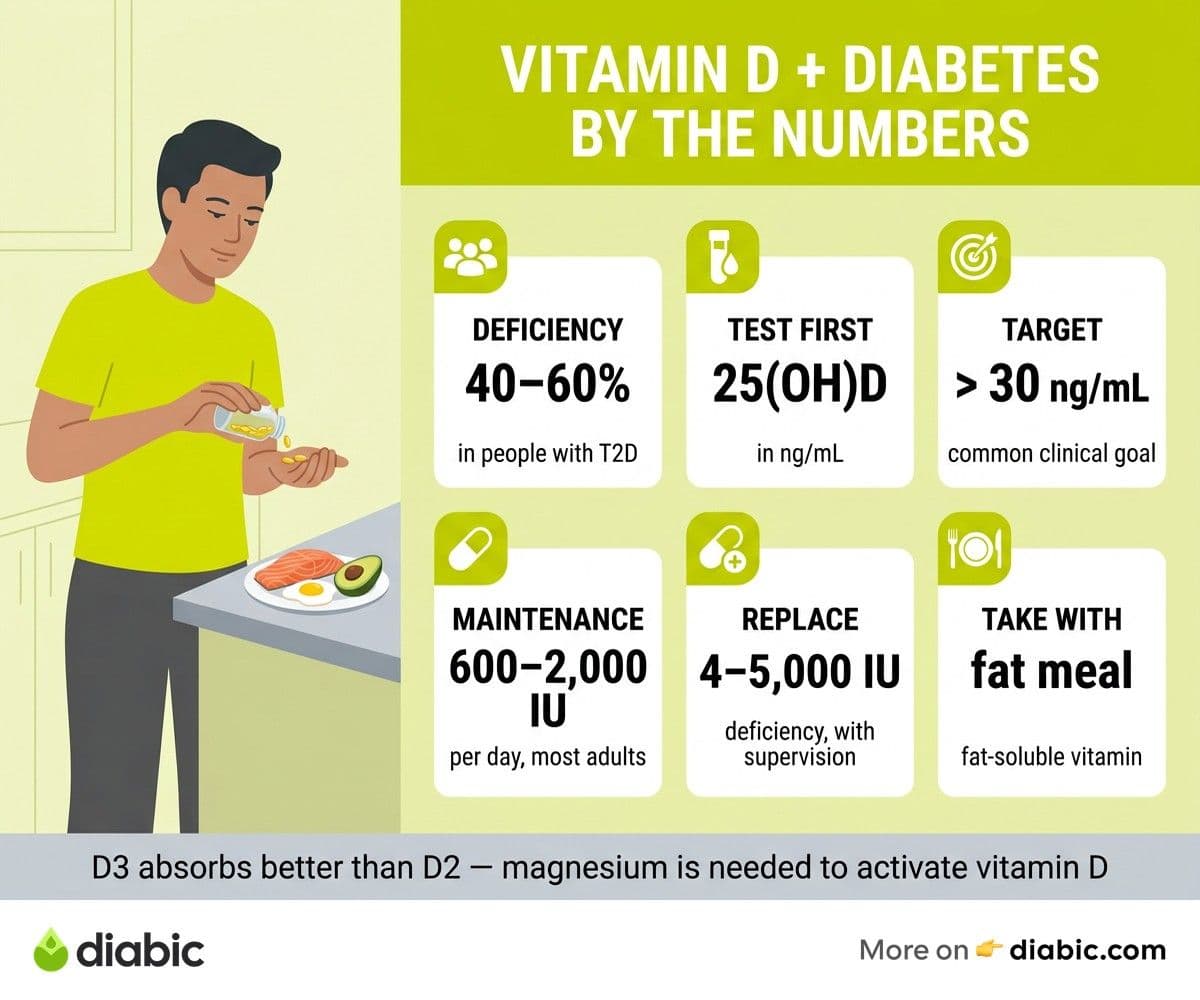
Vitamin D supplements for diabetes have moved from a niche conversation in nutrition circles to a regular topic at endocrinology appointments. Research keeps surfacing connections between low vitamin D levels and impaired insulin function, and an estimated 40 to 60 percent of people with type 2 diabetes test as deficient.
That statistic alone explains the interest. If a common, correctable deficiency is sitting alongside one of the most common chronic conditions in the world, it is reasonable to ask whether fixing the first might help with the second.
This guide walks through what the science actually shows, where the evidence is strong, where it is still mixed, and what to consider if you are thinking about supplementation. It is not a prescription. The right vitamin D plan for you depends on a blood test, your current health, and a conversation with your doctor.
Why Vitamin D Supplements for Diabetes Are Getting Attention
Vitamin D is not really a vitamin in the traditional sense. It behaves more like a hormone, and receptors for it appear in tissues throughout the body, including pancreatic beta cells, the cells responsible for producing insulin. That biological footprint is part of why researchers have been looking closely at vitamin D supplements for diabetes prevention and management.
Several large observational studies have found that people with lower blood levels of vitamin D have a higher risk of developing type 2 diabetes. A study published in Diabetes Care found that participants with the lowest vitamin D levels had measurably greater insulin resistance compared with those whose levels fell in the optimal range. Whether the deficiency contributes to the diabetes or simply travels alongside it is still being worked out.
The mechanisms researchers point to are plausible. Vitamin D appears to influence how beta cells secrete insulin, helps regulate calcium signaling inside those cells, and may modulate inflammation, which is itself a contributor to insulin resistance. None of this means a supplement is a treatment, but it does explain why so many endocrinologists check vitamin D levels at routine visits.
If you are already taking magnesium supplements and diabetes is on your list, vitamin D is often discussed in the same conversation, partly because magnesium is involved in activating vitamin D in the body.
Does Vitamin D Help with Diabetes?
The honest summary is that vitamin D may help if you are deficient, and the benefits beyond correcting deficiency are less clear.
The most cited piece of evidence is the D2d trial, a randomized controlled study published in the New England Journal of Medicine. It enrolled more than 2,400 adults with prediabetes and assigned them either 4,000 IU of vitamin D3 daily or a placebo. Over roughly two and a half years, the supplement group showed a small reduction in the rate of progression to type 2 diabetes, though it did not reach the statistical threshold the researchers set.
A subgroup analysis of D2d, however, suggested that participants who started the trial with lower vitamin D levels saw a more pronounced benefit. This is consistent with the broader pattern in the literature: correcting deficiency tends to help, while pushing already-adequate levels higher tends not to add much.
Smaller clinical trials have shown improvements in insulin sensitivity and beta cell function when deficient participants reach normal vitamin D status. The improvements are typically modest, not transformative, and they do not replace standard diabetes care.
Why do studies disagree? A few reasons. Different trials use different doses, different baseline levels, and different definitions of what counts as deficient. Some study populations were already vitamin D sufficient at the start, which means there was little room to show an effect.
Antioxidant Properties and Diabetes Support
Inflammation and oxidative stress sit at the center of how type 2 diabetes develops and progresses. This is where vitamin D's broader role gets interesting, and why it often shows up in conversations about antioxidant supplements for diabetes.
Vitamin D itself is not a classical antioxidant in the way vitamin C or vitamin E is. What it does seem to do is influence the inflammatory pathways that make insulin resistance worse. Adequate vitamin D appears to help regulate immune signaling, which in turn may reduce some of the chronic low-grade inflammation that often accompanies type 2 diabetes.
Many people pair vitamin D with other nutrients for this reason. Vitamin C, omega-3 fatty acids, and certain plant compounds are all studied for their antioxidant or anti-inflammatory effects. The relationship between vitamin D and vitamin C is particularly interesting because both nutrients appear to support endothelial health, which matters for blood vessel function in people with diabetes. If you are exploring collagen supplements for diabetes for skin and wound healing reasons, vitamin C is often part of that picture too because it is required for collagen synthesis.
Stacking supplements without guidance can create new problems, including drug interactions, kidney strain at high doses, and unnecessary expense. A targeted approach based on blood work tends to be more useful than a maximalist one.
Vitamin C Supplements and Diabetes
Diabetes vitamin C supplements come up often, and for good reasons that touch on both blood sugar and the broader complications associated with diabetes over time.
Some small studies have shown that vitamin C supplementation may modestly reduce post-meal blood sugar rises and lower oxidative stress markers in people with type 2 diabetes. The effects are not dramatic, but they suggest a real, if minor, role.
The more compelling case for vitamin C in diabetes is its role in collagen production and wound healing. People with diabetes often have slower wound healing, and adequate vitamin C supports the structural proteins involved in repairing tissue. People with diabetes also tend to have lower circulating vitamin C levels than people without diabetes, even at the same dietary intake, possibly because higher blood glucose competes with vitamin C for cellular uptake.
Most adults can meet vitamin C needs through food. Bell peppers, citrus fruits, strawberries, broccoli, and tomatoes are among the richer sources. Supplementation makes sense in some cases, but very high doses (above 1,000 mg per day) can interfere with certain blood glucose meters and may not add benefit. A conversation with your provider about your individual situation is the right starting point.
How Much Vitamin D Should You Take?
How much vitamin D should a person with diabetes take? The right answer is the one your doctor gives you after looking at your blood work. The general guidelines below provide context, not personal advice.
The first step is testing. The standard test is called 25-hydroxyvitamin D, often written as 25(OH)D. The NIH Office of Dietary Supplements describes levels above 20 ng/mL as adequate for bone health and most adults, with levels of 30 ng/mL or higher often preferred by clinicians treating other conditions, including diabetes risk. The Endocrine Society has historically used 30 ng/mL as the threshold for sufficiency in patients at risk.
For maintenance, most adults need somewhere between 600 and 2,000 IU daily, depending on age, body weight, sun exposure, and skin tone. Therapeutic doses for correcting deficiency are higher, sometimes 4,000 to 5,000 IU daily, and occasionally weekly bolus dosing under physician supervision. Specific dosing should always come from your provider, not from a guide on the internet.
D2 versus D3 is a small but real consideration. Vitamin D3 (cholecalciferol) is generally better absorbed and raises blood levels more effectively than D2 (ergocalciferol). Most over-the-counter supplements use D3.
A few practical absorption notes. Vitamin D is fat-soluble, so taking it with a meal that contains fat improves absorption. Daily dosing tends to be more effective than weekly mega-dosing for most people. Magnesium status matters because magnesium is involved in converting vitamin D to its active form. If you are already considering zinc supplements for diabetes or other minerals, your provider can help you sequence them sensibly.
Nutrition, Sunlight, and Diabetes
Nutrition and diabetes is rarely about a single nutrient. Vitamin D works alongside the rest of your diet, your sleep, your activity, and your sun exposure, and treating it in isolation tends to disappoint.
Food sources of vitamin D are relatively limited. Fatty fish like salmon, sardines, mackerel, and trout are among the best. Egg yolks contain a small amount. Many countries fortify milk, plant-based milks, certain orange juices, and cereals with vitamin D, which helps for people who consume those products regularly. Mushrooms exposed to ultraviolet light also provide some D2.
Sunlight is the body's natural production source. Ten to thirty minutes of midday sun on the arms, legs, or back, several times a week, can produce meaningful amounts of vitamin D. The practical limitations are real, however. People living above roughly 35 degrees latitude (which includes most of the northern United States, Canada, and the United Kingdom) cannot synthesize vitamin D from winter sunlight at all. People with darker skin tones produce less vitamin D per minute of sun exposure because melanin acts as a natural UV filter. Sunscreen, which is otherwise an excellent idea, also reduces production.
The realistic strategy is layered. Eat vitamin D containing foods regularly. Get reasonable sun exposure when geography and season allow. Test your blood levels, especially if you are at higher risk. Supplement if your provider recommends it.
From my experience: A few years into living with type 2 diabetes, my A1C had crept up despite no obvious changes in my routine. My doctor checked vitamin D, magnesium, and a panel of other basics. My vitamin D was around 18 ng/mL, well below where she wanted it. We corrected it slowly with daily D3 and a brief course of weekly higher dosing under her supervision. It did not transform my diabetes overnight. What it did do was take one nagging variable off the table, and I felt steadier on the days my numbers were steady. After 14 years with diabetes, the boring lesson I keep relearning is that small, measurable corrections often matter more than the dramatic ones.
Frequently Asked Questions
Does vitamin D help with diabetes?
Research shows that correcting vitamin D deficiency may improve insulin sensitivity and beta cell function in people with type 2 diabetes. The evidence is strongest for people who start out deficient. For people who already have adequate vitamin D levels, additional supplementation does not appear to provide meaningful benefit. Vitamin D supplementation is not a substitute for standard diabetes management, including medication, nutrition, and physical activity.
How much vitamin D should a person with diabetes take?
The right dose depends on your current blood level, which is measured with a 25(OH)D test. Most adults need somewhere between 600 and 2,000 IU daily for maintenance, but your doctor may recommend higher therapeutic doses if you are deficient. Specific dosing should come from your healthcare provider after reviewing your labs and overall health, not from a general recommendation.
Should I take vitamin D if I have prediabetes?
The D2d trial suggested a modest benefit for people with prediabetes, particularly those with low baseline vitamin D levels. If you have prediabetes, ask your doctor to check your vitamin D status as part of your care. Decisions about supplementation should be based on your blood work and overall risk picture, not on the diagnosis alone.
Can vitamin D lower blood sugar?
In some people, particularly those who are deficient, correcting vitamin D status appears to improve fasting glucose and HbA1c modestly. The effect is not large, and it is not consistent across all studies. Vitamin D is best thought of as a supportive nutrient, not a glucose-lowering treatment.
Vitamin D supplements for diabetes are not the headline solution some marketing makes them out to be, but they are also not nothing. The most useful framing is simple. Test your level. Correct deficiency if you have one. Pair supplementation with the rest of a thoughtful approach to nutrition and diabetes care. And let your doctor lead the dosing, especially if you take other medications or have kidney concerns.
Shahriar P. Shuvo is the founder of Diabic. He has lived with diabetes for over 14 years, and built Diabic to deliver the practical, evidence-based self-management tools he wished existed when he was first diagnosed. By trade, Shahriar is a senior design and frontend engineer with 6+ years shipping products at Agora, Timescale (now Tiger Data), and ShareTrip. He writes from the intersection of lived diabetes experience and product craft, focused on what works in daily management rather than what sounds good in a textbook.
Medically reviewed by
Dr. Rezwana Parvin Rumpa is an obstetrics and gynaecology specialist with clinical focus on gestational diabetes, PCOS, and fertility. She holds the MRCOG (Final Part) from the Royal College of Obstetricians and Gynaecologists in London, the MRCPI (Final Part) from the Royal College of Physicians of Ireland, and an MBBS from Shaheed Monsur Ali Medical College under Dhaka University. Dr. Rumpa serves as a Senior Medical Officer in the Obs and Gynae department at BRB Hospitals Ltd, where she has spent three years managing prenatal care, emergency obstetric cases, and women's-health surgery. On Diabic, she medically reviews content for women living with diabetes, with particular attention to pregnancy, PCOS, and reproductive-health intersections.
More from Diet & Fitness
View all
Simple Diabetes Exercise Routine for Beginners
A simple diabetes exercise routine for beginners with a 7-day plan, strength basics, and safety tips to help you move more without feeling overwhelmed.

Diabetes Friendly Smoothie Recipes: 5 No-Spike Picks
Five diabetes friendly smoothie recipes that balance protein, fat, and fiber to keep blood sugar steady. Includes a simple framework for building your own.

Can Exercise Prevent Diabetes? Research Says Yes
Can exercise prevent diabetes? Landmark studies show a 58% lower risk with regular activity. Here's how much you need and which workouts help most.
Clinician-reviewed habits, plain-language guides, and honest answers - the small shifts that make living with diabetes feel lighter, every day.