Abbott Simplera Continuous Glucose Monitor Review
An honest look at the Simplera continuous glucose monitor: specs, accuracy, real-world wear, and whether it is worth upgrading from your current sensor.

In this article(9)
The Simplera continuous glucose monitor is Abbott's smaller, simpler successor to the FreeStyle Libre line, and it has been quietly rolling out across the United States, Canada, and parts of Europe since late 2024. If you currently wear a Libre 3 or are considering your first sensor, the obvious question is whether Simplera is meaningfully better or just a polished rebrand.
We spent time looking at the published specs, the FDA clearance documents, and feedback from early users to put together an honest take. The short version: Simplera is the sensor most Libre users have been waiting for, but it is not for everyone. Here is what stands out, where it falls short, and how it compares to the Dexcom G7 and Stelo.
What Is the Simplera Continuous Glucose Monitor?
Simplera is Abbott's next-generation sensor, designed to replace both the FreeStyle Libre 3 (in some markets) and the Libre 3 Plus over time. Abbott received FDA 510(k) clearance for Simplera in 2024 (FDA), and the sensor has since launched in the US, Canada, the UK, Germany, and several other European countries.
The headline change is the all-in-one applicator. Instead of two separate pieces (sensor and applicator) like older Libre models, Simplera ships in a single disposable applicator that you press, click, and toss. The sensor itself is roughly the size of two stacked US pennies, similar in footprint to the Libre 3 Plus but with a redesigned profile.
If you are new to CGMs, our walkthrough of what a CGM is covers the fundamentals before you decide on a specific brand. The Simplera fits the same mold as other modern continuous glucose monitoring system options: a thin filament under the skin, a Bluetooth-connected transmitter, and a smartphone app for data.
Availability is still expanding. As of early 2026, Simplera requires a prescription in most markets and is available through pharmacy benefits in many US insurance plans. Some patients are still being moved from Libre 3 to Simplera through automatic refills, and others have to ask their endocrinologist for a new script.
Simplera Specs and Sensor Technology
On paper, this sensor lines up closely with Abbott's flagship competitors. Here are the specs that matter for daily wear:
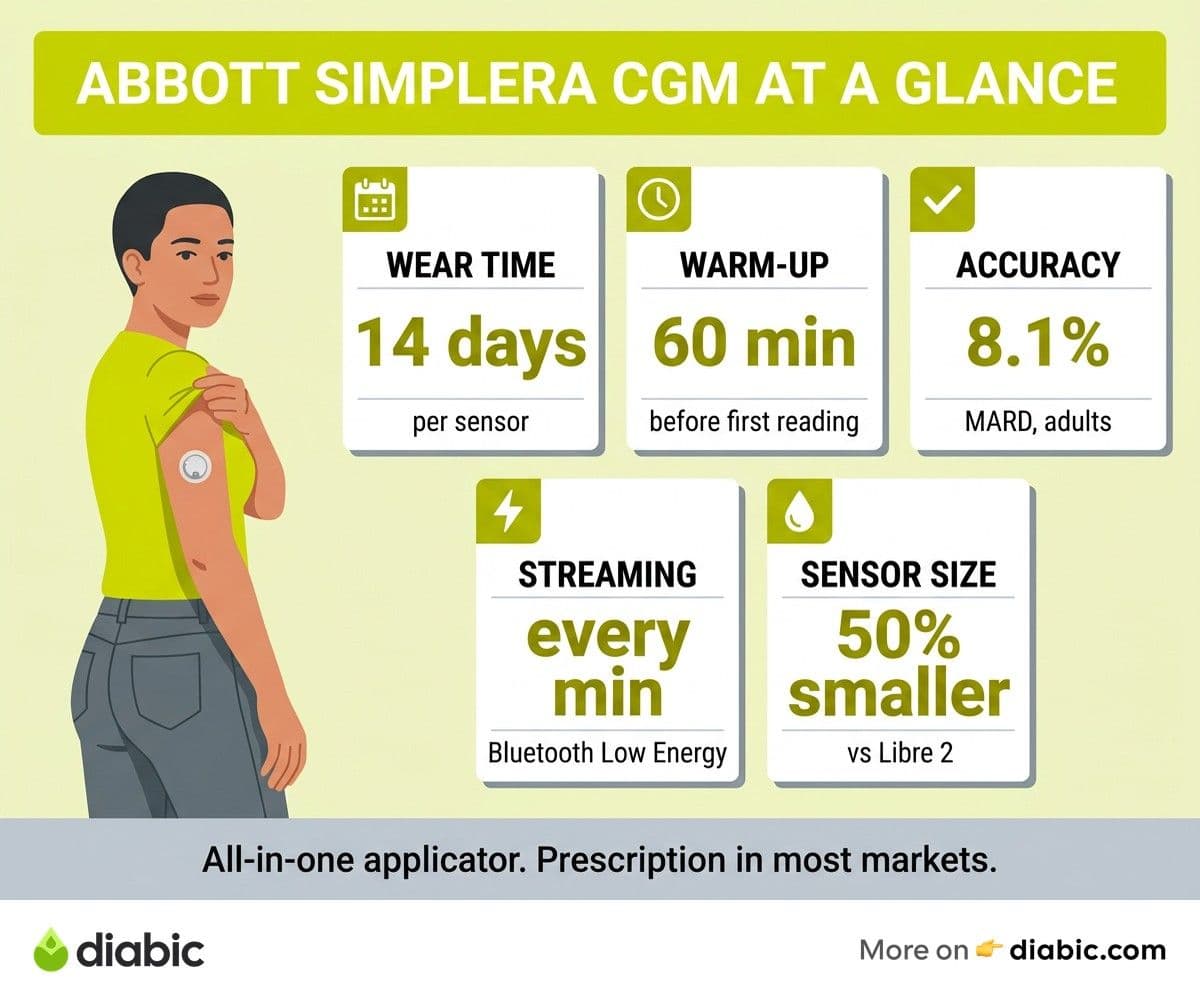
- Wear time: 14 days (15 days in some markets, depending on label)
- Warm-up time: 60 minutes
- Sensor size: about 21 mm in diameter, roughly 50% smaller than the original FreeStyle Libre 2
- Connection: Bluetooth Low Energy, streams readings every minute to your phone
- App support: iOS and Android via the Lingo app for wellness users and the Simplera app for diabetes users
- Calibration: factory calibrated, no fingersticks required for routine use
- Water resistance: rated for showers and swimming up to 3 feet for 30 minutes
The accuracy specs are the most-watched number. Abbott's pivotal trial data put the overall MARD at around 8.1% across adults, which is competitive with the Dexcom G7's 8.2% and a notable step up from the original FreeStyle Libre 2 (about 9.2%). The newer Bluetooth streaming model also means you no longer need to scan the sensor with your phone, which was a frequent friction point with earlier Libre versions.
Where Simplera lags slightly is in the alerts ecosystem. Dexcom G7 still offers more granular alert customization, including a "delay first high alert" setting and tighter integration with Apple Watch as a standalone device. Simplera covers the basics (high, low, urgent low) but does not yet match Dexcom's flexibility.
How Accurate Is the Simplera CGM?
How accurate is a continuous glucose monitor in real-world wear is a fairer question than the lab MARD number, since most of us are not standing still in a clinical study. Early user reports suggest Simplera tracks well in steady-state glucose but, like every CGM, can lag during fast changes (15 to 20 minutes is common across the industry).
Compression lows are still a thing. If you sleep on the sensor, you may see a false low alert that resolves within a minute or two of rolling over. This is a CGM-wide issue, not a Simplera-specific one. The first 24 hours after insertion are also slightly less accurate, which matches what users see on the Libre 3 and the G7.
Hydration matters more than people realize. Going to bed dehydrated or sweating heavily during exercise can both push readings off by 10 to 15 mg/dL temporarily. The fix is the same as with any sensor: a fingerstick when symptoms and the number do not match.
From my experience: I have used Dexcom and FreeStyle sensors over fourteen years with type 1 diabetes, and the move to a smaller, all-in-one sensor genuinely changed what I wear under fitted clothing. That said, I still keep test strips on hand. No CGM removes the value of a fingerstick during fast drops or before driving.
Talk to your doctor about how often to confirm with a fingerstick on Simplera, especially during your first sensor when you are still learning the device's quirks. The FDA labeling for Simplera lists the situations where a confirmatory check is required.
Pros and Cons of the Abbott Simplera
The sensor is a strong upgrade for most Libre users, but it has clear trade-offs worth thinking about before you switch.
Pros
- All-in-one applicator removes the two-step Libre setup, which is genuinely easier with one hand
- Smaller profile reduces the visible bump under shirts and is less likely to snag
- Streaming Bluetooth means no more "scan to read" workflow
- Competitive pricing, often lower out-of-pocket than Dexcom G7 in US pharmacy benefits
- 14 day wear matches the longest in the industry, edging out Dexcom G7's 10 days
Cons
- Alert customization is more limited than Dexcom G7
- No standalone Apple Watch app yet (still requires the phone nearby)
- Smaller user community for troubleshooting compared to Dexcom and the older Libre line
- Pump integration options are still narrower than Dexcom G7 (which works with Tandem t:slim, OmniPod 5, and others)
- Newer adhesive formulation has caused more skin irritation for some early users
Here is a quick side-by-side with the closest alternatives:
For more on the OTC option, see our Dexcom Stelo review.
A few real-world differences are not on any spec sheet. Simplera adhesive runs slightly stickier than the Libre 3, which is good for shower stability and bad if you have sensitive skin. The Bluetooth pairing process is a one-time NFC tap rather than a manual code entry, which makes initial setup easier. The applicator is also lighter in the hand, so users with arthritis or grip strength issues often find it easier to operate alone. None of these are dealbreakers either way, but they show up in daily life within the first week.
Battery and connection reliability matter for any sensor you wear for two weeks straight. Simplera's transmitter is sealed inside the disposable sensor body, so there is no separate battery or transmitter to worry about. The Bluetooth range is rated to 33 feet (10 meters) with line of sight, which holds up well in a typical home but can drop briefly when you walk to another room or put the phone in a tight pocket. Lost-signal events trigger a short data gap that the app fills in once you reconnect.
Data export and sharing are increasingly important for users who want their endocrinologist to see real numbers. The LibreView cloud platform supports Simplera and lets you share reports with a clinic, a family member, or yourself across devices. Glooko and Tidepool integrations are also rolling out, which matters if you are pairing your CGM with a pump that uploads to a different platform. Ask your provider which platform their clinic uses before you set up sharing.
Who Should Consider the Simplera CGM?
Simplera makes the most sense if you fit one of these profiles:
- A current Libre 2 or Libre 3 user who wants the same data with a smaller, easier-to-apply sensor
- A first-time CGM user with type 1 or insulin-using type 2 diabetes who is sensitive about visibility
- Someone whose insurance covers Simplera at a lower cost than Dexcom G7
- A pregnant user whose endocrinologist has recommended Simplera (always confirm pregnancy indication with your provider before starting)
It may not be the right pick if you rely on tight pump integration, if you need an Apple Watch standalone experience, or if you have had skin reactions to Abbott adhesives before. In those cases, the Dexcom G7 or a non-invasive glucose monitor prototype tracker may fit better.
If you have type 2 diabetes and are weighing a few options, our roundup of the best CGMs for type 2 compares pricing, prescription rules, and accuracy.
Cost-wise, Simplera typically lands between $50 and $90 per sensor in the US through commercial insurance, and roughly $75 to $130 cash pay through online pharmacies. Many users see Simplera priced 10 to 20% lower than Dexcom G7 at the pharmacy counter, though insurance benefits vary widely. The ADA has resources on coverage advocacy if your plan denies access (ADA).
Insurance coverage in the US is expanding, but the rollout is uneven. Most major commercial plans cover Simplera under pharmacy benefits (similar to how the Libre 3 was billed), which usually translates to a lower out-of-pocket cost than DME-billed sensors. Medicare Part B covers Simplera for users who meet the standard CGM criteria for type 1 or insulin-requiring type 2 diabetes. Medicaid coverage varies by state, with several states adding Simplera to formularies through 2025 and 2026. Call your plan with the device name and HCPCS code in hand to confirm coverage before your first prescription.
Switching from Libre 2 or Libre 3 to the Simplera continuous glucose monitor is usually a soft transition rather than a hard cutover. Your endocrinologist writes a new prescription, and the next refill ships as Simplera in markets where the rollout has reached your pharmacy. Settings in the app do carry over (high alert, low alert, target range), but you may need to re-pair with your phone the first time. Plan to wear out your remaining Libre sensors before starting the new one so you do not lose readings during the transition.
FAQ
Is the Simplera continuous glucose monitor worth it?
For most Libre users, yes. The smaller sensor, all-in-one applicator, and streaming Bluetooth are real improvements over the Libre 3. If you are already on Dexcom G7 and happy with pump integration and Apple Watch support, Simplera is not a clear upgrade and may even be a step sideways for your specific use case.
How do you put on the Abbott Simplera sensor?
The applicator is a one-piece unit. Clean and dry the back of your upper arm, peel off the protective seal, place the applicator firmly against your skin, and press the button (or push down, depending on the regional version). The sensor inserts in less than a second, and the applicator detaches for disposal. Most users describe the sensation as a brief pinch.
How does the Simplera compare to the Dexcom G7?
The Simplera continuous glucose monitor and Dexcom G7 are close on accuracy (about 8.1% vs 8.2% MARD) and both stream readings via Bluetooth. G7 has a 30-minute warm-up versus Simplera's 60 minutes, wider pump integration, and an Apple Watch standalone app. Simplera offers longer wear (14-15 days vs 10 days) and is often cheaper at the pharmacy. The right choice usually comes down to insurance coverage, your pump (if any), and personal preference on form factor. For most current Libre users weighing an upgrade, the Simplera continuous glucose monitor is a quiet, capable next step rather than a flashy reinvention.
Dr. Shanto Arian is an internal medicine physician now specializing in clinical and aesthetic dermatology, with a parallel academic focus on epidemiology and public health. He holds an MBBS, MPH, MSc (UK), MRCP (UK), MRCPI (Ireland), Diploma in Dermatology (UK), and Diploma in Aesthetic Medicine (USA). Dr. Arian trained in internal medicine, including hospital work on hematology cases such as graft-versus-host disease, before moving toward dermatology. Skin is one of the earliest places diabetes shows itself, from acanthosis nigricans and diabetic dermopathy to slow foot wound healing, and that intersection is where his clinical and Diabic-review work meet. On Diabic, Dr. Arian medically reviews content on diabetes diagnosis, complications, dermatologic manifestations, and pharmacotherapy, ensuring every claim aligns with current ADA, NICE, and peer-reviewed literature.
Medically reviewed by
Dr. Rezwana Parvin Rumpa is an obstetrics and gynaecology specialist with clinical focus on gestational diabetes, PCOS, and fertility. She holds the MRCOG (Final Part) from the Royal College of Obstetricians and Gynaecologists in London, the MRCPI (Final Part) from the Royal College of Physicians of Ireland, and an MBBS from Shaheed Monsur Ali Medical College under Dhaka University. Dr. Rumpa serves as a Senior Medical Officer in the Obs and Gynae department at BRB Hospitals Ltd, where she has spent three years managing prenatal care, emergency obstetric cases, and women's-health surgery. On Diabic, she medically reviews content for women living with diabetes, with particular attention to pregnancy, PCOS, and reproductive-health intersections.
More from Devices & Technology
View all
Fasting vs Postprandial Glucose: What's the Difference
Fasting vs postprandial glucose readings tell different stories about your blood sugar. Learn what each number means and how to act on it.

Best Glucometer for Elderly and Low-Vision Users
Best glucometer for elderly and low-vision users: large displays, audio readouts, no-coding strips, and budget picks that make daily testing easier.

Online Diabetes Coaching: How to Choose a Good One
Online diabetes coaching can fill the gaps between doctor visits. Learn what credentials to check, red flags to avoid, and how to pick a quality program.
Clinician-reviewed habits, plain-language guides, and honest answers - the small shifts that make living with diabetes feel lighter, every day.