Non-Invasive Glucose Monitors: Where the Tech Stands in 2026
A clear-eyed look at the non-invasive glucose monitor landscape in 2026, what is real, what is hype, and what to expect next.

In this article(14)
- What Is a Non-Invasive Glucose Monitor and Why Does It Matter
- Products and Prototypes Closest to Market
- The Accuracy Problem: Why This Is So Hard for Diabetes Wearable Devices
- How Current Continuous Glucose Monitoring System Devices Bridge the Gap
- What to Watch for Before You Buy a Non-Invasive Glucose Device
- Where Non-Invasive Glucose Monitor Technology Goes Next
The promise of a non-invasive glucose monitor, one that checks your blood sugar without needles or sensors under the skin, has been "almost here" for decades. People with diabetes have watched press releases roll in since the 1990s, each one hinting that finger sticks were about to become a relic.
In 2026, several technologies are closer than ever, but separating real progress from marketing hype takes a careful look at the science behind each approach. We pulled together the current state of clinical trials, regulatory pathways, and the products you can actually use today.
If you have seen a flashy ad for a smart ring or wristband that claims to read glucose without a sensor, this guide will help you decide what to trust.
What Is a Non-Invasive Glucose Monitor and Why Does It Matter
A device of this kind estimates blood sugar without breaking the skin. That means no finger pricks, no inserted filaments, and no implanted sensors. The dream is a wristband, ring, or patch that simply reads your glucose through the skin and reports a number to your phone.
People with diabetes want this for obvious reasons. Daily finger sticks add up to thousands of pricks per year, and even modern continuous glucose monitors require a small filament under the skin that needs replacing every 7 to 15 days. The American Diabetes Association still recommends regular monitoring as a core part of diabetes management, so reducing the friction of that task could change daily life for millions.
There is an important distinction worth making before we go further. Truly non-invasive devices do not touch the inside of your body at all. Minimally invasive devices, which include every continuous glucose monitor on the market today, place a tiny sensor just under the skin. Many products marketed as "needle-free" are actually minimally invasive. The difference matters when you read product claims.
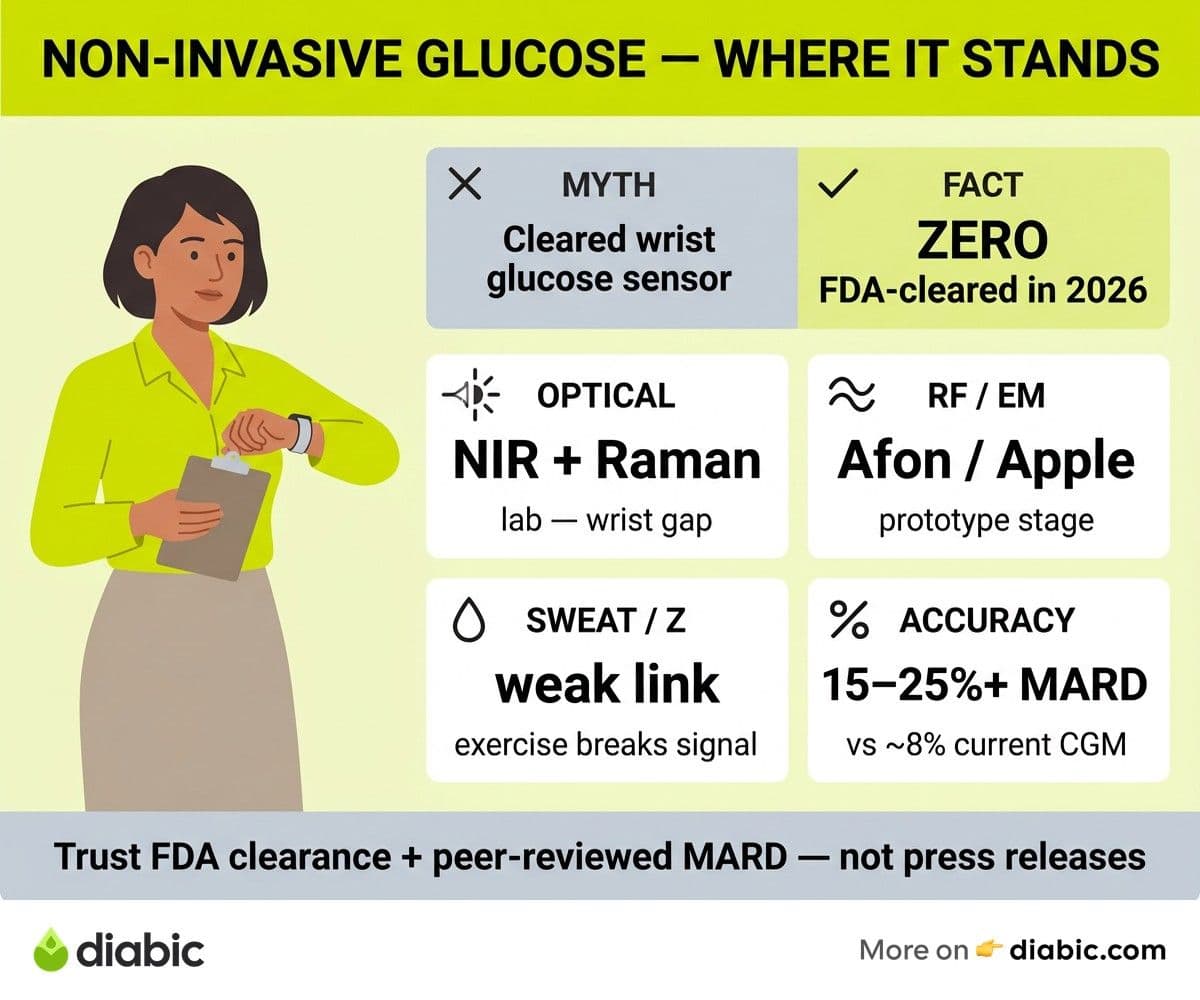
As of April 2026, no FDA-cleared truly non-invasive consumer glucose monitor exists. Any device sold to consumers that claims to measure blood sugar without breaking the skin is either using glucose data from a separate sensor, estimating glucose indirectly from heart rate and other signals, or making claims that have not been validated. We will explain how to spot the difference later in this article.
Technologies Competing to Replace the Finger Prick
Researchers have spent years testing different physical principles to detect glucose through skin. Each approach has shown promise in lab settings, and each has run into the same wall when scaled to real human bodies.
Optical sensing
Near-infrared spectroscopy and Raman spectroscopy shine specific wavelengths of light at the skin and analyze how the light scatters back. Glucose molecules absorb light differently than water, fat, or protein, so in theory you can isolate a glucose signal. In practice, that signal is faint, and tissue, sweat, and skin tone all interfere with the reading.
Research published in Nature Biomedical Engineering has shown progress on signal processing methods, but the gap between lab accuracy and wearable accuracy remains wide. Several startups have built optical prototypes that work on a few subjects in controlled rooms, then struggle when tested across diverse populations.
Electromagnetic and radiofrequency approaches
Some companies are exploring radio waves and millimeter-wave radar to detect glucose-related changes in tissue. The Welsh company Afon Technology is one of the most public examples, with a wrist-worn prototype that uses radio frequency sensing. Apple has reportedly worked on a similar internal project for years.
These methods rely on tiny shifts in how electromagnetic waves pass through your wrist. The challenge is the same as with optical methods. Glucose is one of many substances that affect the signal, and isolating it reliably remains difficult.
Bioelectrical impedance and sweat-based sensors
A few research groups have looked at measuring glucose in sweat or interstitial fluid through the skin's surface using small electrical currents. Sweat glucose correlates loosely with blood glucose but not closely enough for treatment decisions. As IEEE Spectrum has reported in its coverage of biosensor development, the correlation tends to break down during exercise, dehydration, or temperature changes.
Bioelectrical impedance analysis, the technology behind some smart scales, has also been tested for glucose. So far, results suggest it can hint at trends but cannot replace direct measurement.
Products and Prototypes Closest to Market
Several companies have working prototypes or have announced timelines for FDA submission. We covered the current device landscape in detail in our roundup of the best diabetes wearable devices for 2026, but here is where the truly non-invasive contenders stand.
Apple has been rumored to be working on glucose sensing in the Apple Watch since at least 2017, with reports of an internal team using silicon photonics. Bloomberg and other outlets reported in 2024 that the technology was years away from a consumer product. Our breakdown of the Apple Watch diabetes features in 2026 covers what the watch actually does today, which does not include direct glucose measurement.
Afon Technology has tested a wrist-worn radio-frequency device in clinical trials and announced plans for regulatory submission, though commercial availability remains uncertain. Know Labs, based in Seattle, has developed a benchtop prototype using its proprietary radio-frequency sensing platform and has published clinical trial results, but a wearable consumer product is not yet available.
Several smaller players, including DiaMonTech, Hagar, and others, are running pilot studies. None has cleared the FDA pathway for a needle-free consumer device as of this writing.
The FDA regulates glucose monitors as medical devices. A new technology that has never been cleared in this category typically requires a De Novo classification, which is a longer and more rigorous pathway than a 510(k) clearance for a device similar to one already on the market. That regulatory bar is a major reason non-invasive devices have stayed in trials for so long.
The Accuracy Problem: Why This Is So Hard for Diabetes Wearable Devices
Glucose lives in your bloodstream, but most non-invasive sensors try to read it through skin and the fluid between cells. The relationship between blood glucose and the glucose in tissue is real, but it lags behind blood by 5 to 15 minutes and varies between people.
Signal interference makes the problem harder. Hydration, skin temperature, body fat percentage, and skin pigmentation all change how light, radio waves, or electrical signals travel through tissue. A sensor calibrated on one person may give different readings on another.
Studies published in Diabetes Technology and Therapeutics compare new glucose sensors against laboratory reference methods using a metric called Mean Absolute Relative Difference, or MARD. Modern continuous glucose monitors have MARD values around 8 to 10 percent, meaning their readings are typically within 8 to 10 percent of a lab measurement. Most non-invasive prototypes have published MARD values of 15 to 25 percent or higher, which is not yet good enough for insulin dosing decisions.
For perspective, finger-stick meters in home use are typically accurate to within 15 percent of lab values under ideal conditions. A non-invasive device that claims similar accuracy still has to prove it across thousands of users, in real-world settings, with the variability that real life brings.
From my experience: I have lived with type 1 diabetes for 14 years and worn pumps and CGMs for most of that time. Every few years a new headline announces that needle-free glucose monitoring is around the corner. I have learned to read these announcements carefully. The companies making real progress publish peer-reviewed data, run trials with hundreds of subjects, and submit to regulators. The ones making bold claims to consumers without that paper trail almost never deliver a product that works on my wrist.
How Current Continuous Glucose Monitoring System Devices Bridge the Gap
While truly non-invasive monitoring remains in development, the current generation of continuous glucose monitors has become smaller, more comfortable, and more affordable. Understanding what a continuous glucose monitoring system is helps put the non-invasive race in perspective.
Modern CGMs from Dexcom, Abbott, and Medtronic insert a soft filament about the width of a human hair just under the skin. Most users describe the insertion as a brief pinch, and many people forget the sensor is there during normal activities. The Abbott Freestyle Libre 3 and Dexcom G7 are smaller than a quarter and last 14 to 15 days per sensor. The recently approved over-the-counter sensors, including Dexcom Stelo and Abbott Lingo, have expanded access to people without insulin-treated diabetes.
These devices are technically minimally invasive, but the discomfort is low enough that many people no longer rank "needle-free" as their top wish. Battery life, accuracy, and integration with phones and pumps tend to matter more day to day. Our roundup of the best diabetes wearable devices in 2026 covers the current options in detail.
The point is not that non-invasive technology is unnecessary. It is that the experience of CGM use has improved enough that the bar a non-invasive device must clear has risen. A truly non-invasive monitor that is less accurate or less reliable than a current CGM is not going to win over experienced users.
What to Watch for Before You Buy a Non-Invasive Glucose Device
A growing number of products on Amazon, social media, and direct-to-consumer websites claim to measure blood sugar without a sensor. Some are scams, some are based on indirect estimates that have no clinical validation, and a few are real prototypes still in development. Here is how to tell the difference.
Look for FDA clearance or approval. Any legitimate glucose monitoring device sold in the United States must be cleared by the FDA for that purpose. A wellness wearable may track heart rate, steps, and sleep, but it cannot legally make medical claims about blood sugar without clearance. The same caution applies to products marketed for children, where families understandably want gentler options. Our guide to diabetes wearable devices for children walks through what is actually available and what to skip.
Look for peer-reviewed clinical trial data. A real glucose sensor will have published MARD values, sample sizes, and comparison against laboratory references. A product page that says "clinically tested" without linking to a study is not enough. Also check whether the company has actually submitted to a regulator, not just announced plans.
Be skeptical of any consumer device that claims to read blood sugar from a smartwatch or smart ring with no separate sensor. As of April 2026, no such product is FDA cleared. Some smartwatch apps display CGM data from a separate sensor, which is a different thing. If a marketing page is vague about how the measurement actually works, that is a red flag.
Realistic expectations matter. The next 2 to 3 years are likely to bring incremental improvements rather than a single breakthrough. Smaller and longer-wearing CGM sensors are the most likely near-term advance. A truly non-invasive device cleared for diabetes treatment decisions remains uncertain, and any timeline you see is a guess.
Where Non-Invasive Glucose Monitor Technology Goes Next
The science behind non-invasive glucose sensing is genuinely advancing, and the long arc of research suggests a viable consumer device will eventually exist. The honest answer in 2026 is that it is not here yet, and the products that claim otherwise have not earned the trust of regulators or clinicians.
For now, the best path for someone managing diabetes is to use a current CGM if you qualify, talk to your doctor about coverage and which sensor fits your routine, and treat any non-invasive marketing claim with healthy skepticism until clinical data and FDA clearance back it up. Following the published research and the regulatory filings, rather than press releases, will keep you grounded as the technology evolves.
If you want to keep learning, the related Diabic guides linked above cover wearables, CGM basics, and current Apple Watch features in more depth.
Frequently Asked Questions
Are non-invasive glucose monitors accurate?
As of 2026, no FDA-cleared truly needle-free device is available for consumer purchase. Prototypes in clinical trials have shown MARD values that are higher, meaning less accurate, than current CGMs. Research suggests the technology is improving, but no device has yet matched the accuracy required for treatment decisions.
When will non-invasive glucose monitors be available?
There is no confirmed launch date. Several companies have announced timelines, but FDA clearance for a new sensing technology typically takes years of trials. Most analysts expect the first cleared needle-free consumer device to arrive sometime in the late 2020s, though this is not guaranteed.
Can the Apple Watch measure blood sugar without a sensor?
No. As of April 2026, the Apple Watch cannot measure blood glucose directly. It can display data from a connected CGM through compatible apps. Apple has reportedly worked on internal glucose sensing research for years, but no consumer feature has been announced or cleared by the FDA. Talk to your doctor about whether a current sensor is right for you.
If you take one thing from this guide, make it this: the non-invasive glucose monitor space is moving forward, but the proof still lives in peer-reviewed studies and FDA filings, not press releases. Until a device clears that bar, current CGMs and finger sticks remain the tools that earn trust from clinicians and from your own day-to-day decisions.
Shahriar P. Shuvo is the founder of Diabic. He has lived with diabetes for over 14 years, and built Diabic to deliver the practical, evidence-based self-management tools he wished existed when he was first diagnosed. By trade, Shahriar is a senior design and frontend engineer with 6+ years shipping products at Agora, Timescale (now Tiger Data), and ShareTrip. He writes from the intersection of lived diabetes experience and product craft, focused on what works in daily management rather than what sounds good in a textbook.
Medically reviewed by
Dr. Shanto Arian is an internal medicine physician now specializing in clinical and aesthetic dermatology, with a parallel academic focus on epidemiology and public health. He holds an MBBS, MPH, MSc (UK), MRCP (UK), MRCPI (Ireland), Diploma in Dermatology (UK), and Diploma in Aesthetic Medicine (USA). Dr. Arian trained in internal medicine, including hospital work on hematology cases such as graft-versus-host disease, before moving toward dermatology. Skin is one of the earliest places diabetes shows itself, from acanthosis nigricans and diabetic dermopathy to slow foot wound healing, and that intersection is where his clinical and Diabic-review work meet. On Diabic, Dr. Arian medically reviews content on diabetes diagnosis, complications, dermatologic manifestations, and pharmacotherapy, ensuring every claim aligns with current ADA, NICE, and peer-reviewed literature.
More from Devices & Technology
View all
Fasting vs Postprandial Glucose: What's the Difference
Fasting vs postprandial glucose readings tell different stories about your blood sugar. Learn what each number means and how to act on it.

Best Glucometer for Elderly and Low-Vision Users
Best glucometer for elderly and low-vision users: large displays, audio readouts, no-coding strips, and budget picks that make daily testing easier.

Online Diabetes Coaching: How to Choose a Good One
Online diabetes coaching can fill the gaps between doctor visits. Learn what credentials to check, red flags to avoid, and how to pick a quality program.
Clinician-reviewed habits, plain-language guides, and honest answers - the small shifts that make living with diabetes feel lighter, every day.