Time in Range for Diabetes: Why It Matters
Time in range diabetes targets, what 70% TIR really means, and why this metric often tells you more about your blood sugar than A1C alone.

In this article(14)
Time in range diabetes data is quickly becoming as important as A1C for measuring how well your blood sugar is managed. While A1C gives you an average, time in range tells you how many hours per day your glucose actually stays in a healthy zone, and that distinction matters for how you feel and your long-term health.
For decades, the conversation at endocrinology appointments started and ended with A1C. That single lab number summarized three months of glucose into one tidy percentage. The trouble is that two people with identical A1Cs can have completely different days, with one person riding a smooth line and the other ping-ponging between highs and lows. Time in range diabetes data captures that difference.
This post covers what TIR is, why the international consensus settled on the targets it did, how the targets shift across populations, and what you can do to nudge your number upward without burning out.
What Is Time in Range
Time in range, or TIR, is the percentage of time your glucose stays between 70 and 180 mg/dL. It is calculated from CGM readings, which sample glucose roughly every five minutes, giving you somewhere around 288 data points per day. Add up the readings that landed inside the target band, divide by the total, and that is your TIR.
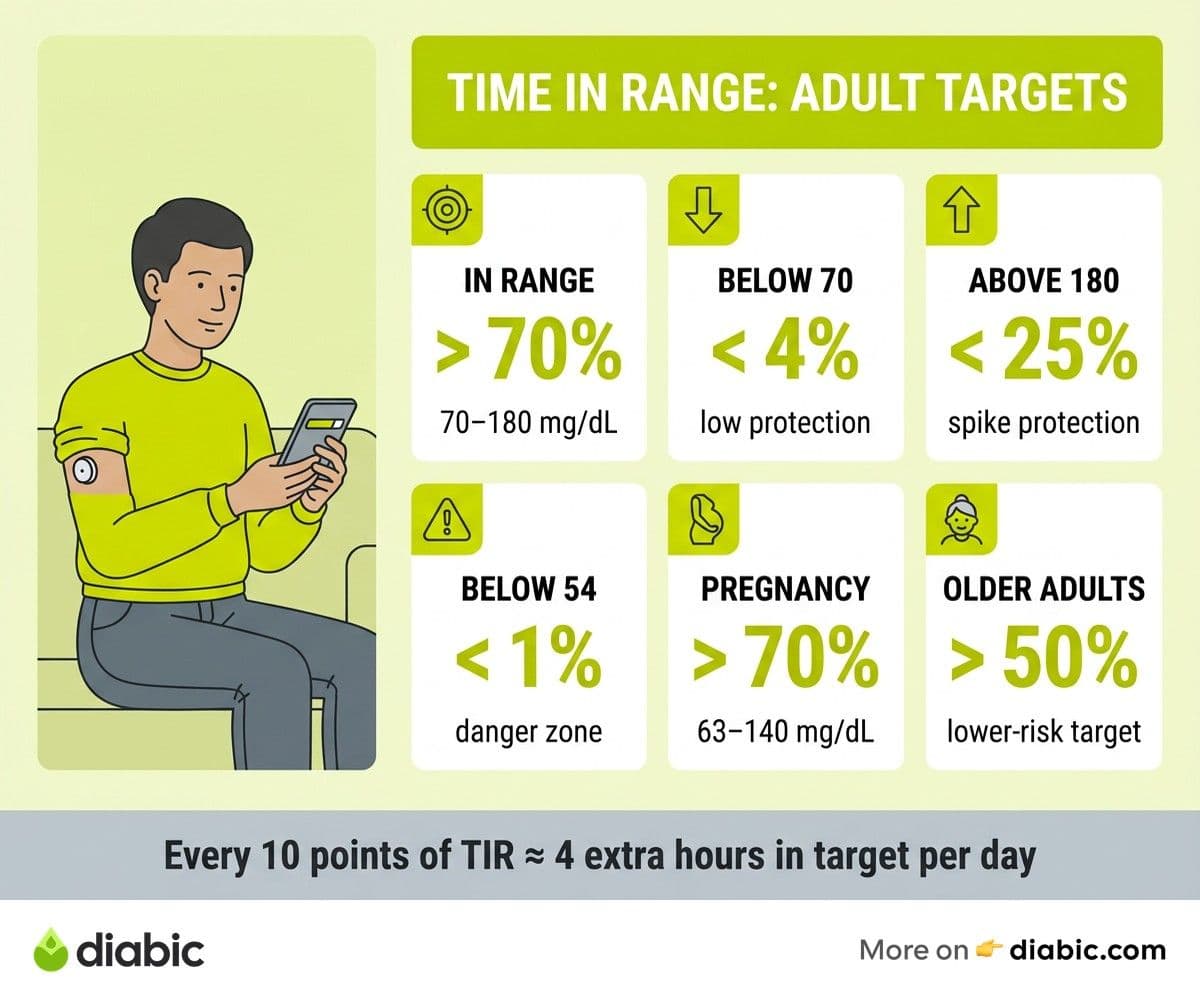
The international consensus targets, published in Battelino et al., Diabetes Care 2019, set a clear bar for most adults with diabetes. Spend more than 70% of the day in 70 to 180 mg/dL. Spend less than 4% of the day below 70 mg/dL. Spend less than 1% of the day below 54 mg/dL, the level where hypoglycemia becomes dangerous. Spend less than 25% of the day above 180 mg/dL, with less than 5% above 250 mg/dL.
Those targets are also reflected in the ADA Standards of Care 2026 and the ATTD consensus on TIR, and they form the basis of nearly every CGM report you will see today.
How TIR Differs From A1C
A1C reflects how much sugar is stuck to your red blood cells over the past two to three months. It is an average, and like any average, it hides the spread. A 7.0% A1C might come from steady glucose around 154 mg/dL most of the time, or from glucose that bounces between 50 and 280 mg/dL and happens to average out to 154. Both can produce the same A1C while feeling very different to live with.
TIR closes that gap. By measuring how many minutes per day your glucose actually sits in target, it tells you something A1C cannot. The two metrics are complementary, and the most useful conversations with your care team often draw on both at once. The post on A1C normal range walks through what your lab number means and how to interpret it alongside CGM data.
Why Time in Range Matters More Than You Think
The case for paying attention to TIR is not just about precision. It is about what time in range actually predicts for your health and how you feel.
Two people with the same A1C can have very different daily experiences. One spends most of the day between 90 and 160 mg/dL with the occasional gentle excursion. The other rides a roller coaster, bottoming out at 55 in the afternoon and climbing past 280 after dinner. Both lab reports might show 7.2%, but the second person feels worse, runs higher complication risk in some research, and has a much less stable life.
Higher TIR is associated with reduced risk of long-term complications. The Beck et al. JAMA 2019 analysis found that each 10 percentage point improvement in TIR was linked to a meaningful reduction in retinopathy progression. Other research has connected TIR to kidney and cardiovascular outcomes, though the strongest evidence so far is for eyes and nerves.
How TIR Affects Daily Quality of Life
Beyond complication risk, TIR maps closely to how you feel during the day. Highs above 250 mg/dL often bring fatigue, thirst, blurry vision, and brain fog. Lows below 70 mg/dL bring shakiness, anxiety, hunger, and the recovery hangover that follows. Both pull energy out of your day in ways that A1C cannot capture.
When TIR climbs from, say, 55% to 70%, that is not just a statistical improvement. That is roughly four extra hours per day spent in a comfortable glucose zone. People often report feeling better, sleeping better, and finding decision-making easier well before any A1C change shows up. That is the practical case for tracking TIR alongside, not instead of, your lab work.
Time in Range Diabetes Targets by Population
The 70% target applies to most adults with type 1 or type 2 diabetes, but the consensus also defines specific targets for different groups. One target does not fit every situation, and your provider should tailor the goal to your circumstances.
For pregnancy with type 1 diabetes, the targets tighten significantly. The recommended range is 63 to 140 mg/dL, with a TIR goal of greater than 70% inside that narrower window. The reasoning is that fetal development is sensitive to maternal glucose, and the literature supports tighter targets during pregnancy.
Older adults or those at high risk of hypoglycemia get relaxed targets. For someone with frailty, hypoglycemia unawareness, or significant comorbidities, the consensus suggests greater than 50% TIR with less than 1% time below 70 mg/dL. The reduction in low-glucose risk takes priority over hitting a tighter average.
Type 1 Versus Type 2
The targets themselves are the same for adults with type 1 and type 2 diabetes, but the path to them looks different. Type 1 diabetes, where the body produces little or no insulin, often involves more dramatic excursions and requires careful insulin timing to lift TIR. Type 2 diabetes brings a different mix of challenges, often involving meal patterns, medications that work over hours rather than minutes, and lifestyle adjustments.
Whatever your type, the AGP report walkthrough shows how TIR fits into the bigger picture of your CGM data and how to spot the time-of-day patterns that drag the number down.
How to Improve Your Time in Range
Improving TIR is rarely about a single dramatic change. It is usually about small, repeatable adjustments stacked over weeks. Here are the levers most people find useful.
Post-meal spikes are often the largest contributor to time above range. Pre-bolusing insulin 10 to 20 minutes before eating, when appropriate for your routine, lets the insulin start working closer to when carbs hit your bloodstream. Carb awareness, simple portion adjustments, and pairing carbs with protein or fat can flatten spikes meaningfully. None of this requires perfection, only consistency.
Overnight management is the second big lever. If your CGM shows a steady climb from 3 a.m. onward, dawn phenomenon may be at play, and a basal insulin or medication adjustment with your provider may help. If your line drifts low in the early morning, the conversation may shift to reducing overnight basal or adjusting bedtime snacks.
Exercise, Alerts, and Variability
Exercise affects TIR in ways that depend on the type, timing, and intensity of activity. Steady aerobic work often lowers glucose during and after, while high-intensity efforts can briefly raise it. Tracking how your body responds, then planning timing or fueling around those patterns, often improves TIR within a few weeks.
Tuning your CGM alerts so they catch excursions earlier can also raise TIR. An alert at 160 mg/dL trending upward gives you time to act. An alert at 200 mg/dL means you are already correcting after the fact. The goal is not constant beeping, but useful nudges at the moments where action matters.
Reducing glucose variability often raises TIR as a side effect. When your glucose moves in smaller, more predictable arcs, more of those arcs land inside the target zone. A coefficient of variation under 36% and a TIR above 70% tend to travel together.
From my experience: I have lived with type 1 diabetes for 14 years and have worn CGMs for most of the last decade. The biggest TIR jump I ever made came not from a new pump or a different insulin, but from learning to pre-bolus by 15 minutes for breakfast. My morning spike shrank, my overall TIR climbed by about eight points over two months, and I felt the difference. It was not flashy. It was just one boring habit that compounded.
Tracking Time in Range With Your CGM
Every modern CGM platform exposes TIR somewhere in its app or web portal. Knowing where to look saves time and keeps you from feeling lost in menus.
In Dexcom Clarity, TIR appears on the overview dashboard and on the AGP report. In LibreView, it is on the snapshot summary and the daily reports. Medtronic Guardian Connect surfaces TIR through CareLink. If you use a CGM app on your phone, TIR is usually one or two taps from the home screen, sometimes labeled "Time in Target" instead of "Time in Range."
If you are new to your device, the post on what a CGM is covers the basics of how readings get from your sensor to your screen. That foundation makes the TIR view much easier to read.
Setting and Tracking Goals
Setting TIR goals with your diabetes team turns the number into something actionable. A common framework is to pick a single, realistic target for the next three months. If you are at 55% TIR today, aiming for 65% is more useful than aiming for 80%. Smaller, achievable goals build the momentum that bigger goals never quite manage.
Watching trends over weeks and months is more useful than scrutinizing a single day. A bad day rarely tells you much. A pattern of bad afternoons across two weeks tells you exactly where to focus. The TIR view in your CGM app exists to surface that kind of pattern, not to grade you on each individual hour.
FAQ
What is a good time in range for diabetes?
For most adults with type 1 or type 2 diabetes, the international consensus target is greater than 70% time in range, defined as glucose between 70 and 180 mg/dL. Targets shift to greater than 70% in 63 to 140 mg/dL during pregnancy, and to greater than 50% for older adults at higher risk of hypoglycemia. Talk to your doctor about which target makes sense for your situation.
What percentage time in range is the target?
The standard adult target is 70% or more time in range, with less than 4% of the day below 70 mg/dL, less than 1% below 54 mg/dL, and less than 25% above 180 mg/dL. These targets come from the international TIR consensus published in Diabetes Care in 2019 and are echoed in current ADA Standards of Care.
Can you improve time in range without medication changes?
Often yes, especially through consistent meal timing, carb awareness, post-meal walks, sleep, stress management, and tuning CGM alerts. Many people see meaningful TIR improvements through behavior changes alone, though some situations call for medication or insulin adjustments. Research suggests that combining lifestyle changes with provider-guided medication tuning produces the largest, most durable TIR gains, so it is worth keeping the conversation with your care team open as you experiment.
Time in range diabetes data is one of the most actionable numbers in modern diabetes care. It tells you what your glucose is actually doing across the day, gives you a target backed by international consensus, and points you toward the small habits that compound into meaningful change. If you have CGM data, this week is a good time to open the app, find your TIR, and bring the number to your next appointment.
Shahriar P. Shuvo is the founder of Diabic. He has lived with diabetes for over 14 years, and built Diabic to deliver the practical, evidence-based self-management tools he wished existed when he was first diagnosed. By trade, Shahriar is a senior design and frontend engineer with 6+ years shipping products at Agora, Timescale (now Tiger Data), and ShareTrip. He writes from the intersection of lived diabetes experience and product craft, focused on what works in daily management rather than what sounds good in a textbook.
Medically reviewed by
Dr. Shanto Arian is an internal medicine physician now specializing in clinical and aesthetic dermatology, with a parallel academic focus on epidemiology and public health. He holds an MBBS, MPH, MSc (UK), MRCP (UK), MRCPI (Ireland), Diploma in Dermatology (UK), and Diploma in Aesthetic Medicine (USA). Dr. Arian trained in internal medicine, including hospital work on hematology cases such as graft-versus-host disease, before moving toward dermatology. Skin is one of the earliest places diabetes shows itself, from acanthosis nigricans and diabetic dermopathy to slow foot wound healing, and that intersection is where his clinical and Diabic-review work meet. On Diabic, Dr. Arian medically reviews content on diabetes diagnosis, complications, dermatologic manifestations, and pharmacotherapy, ensuring every claim aligns with current ADA, NICE, and peer-reviewed literature.
More from Devices & Technology
View all
Fasting vs Postprandial Glucose: What's the Difference
Fasting vs postprandial glucose readings tell different stories about your blood sugar. Learn what each number means and how to act on it.

Best Glucometer for Elderly and Low-Vision Users
Best glucometer for elderly and low-vision users: large displays, audio readouts, no-coding strips, and budget picks that make daily testing easier.

Online Diabetes Coaching: How to Choose a Good One
Online diabetes coaching can fill the gaps between doctor visits. Learn what credentials to check, red flags to avoid, and how to pick a quality program.
Clinician-reviewed habits, plain-language guides, and honest answers - the small shifts that make living with diabetes feel lighter, every day.