Insulin Pump for Type 1 Diabetes: A Practical Guide
A practical guide to using an insulin pump for type 1 diabetes, covering how pumps work, daily routines, tubing, swimming, and choosing the right brand.

In this article(12)
The first time you see an insulin pump, it looks smaller than you expect. Then someone mentions infusion sets, basal rates, and bolus calculations, and the device suddenly feels intimidating. Most guides skip the messy middle, the part where you actually live with one.
An insulin pump for type 1 diabetes replaces multiple daily injections with a small device that delivers insulin continuously through a thin cannula under your skin. If you are weighing whether to switch from injections, just got prescribed pump therapy, or are helping a family member adjust, this guide walks through how pumps work, what daily life looks like, and how to choose the brand that fits your routine.
How an Insulin Pump Works for Type 1 Diabetes
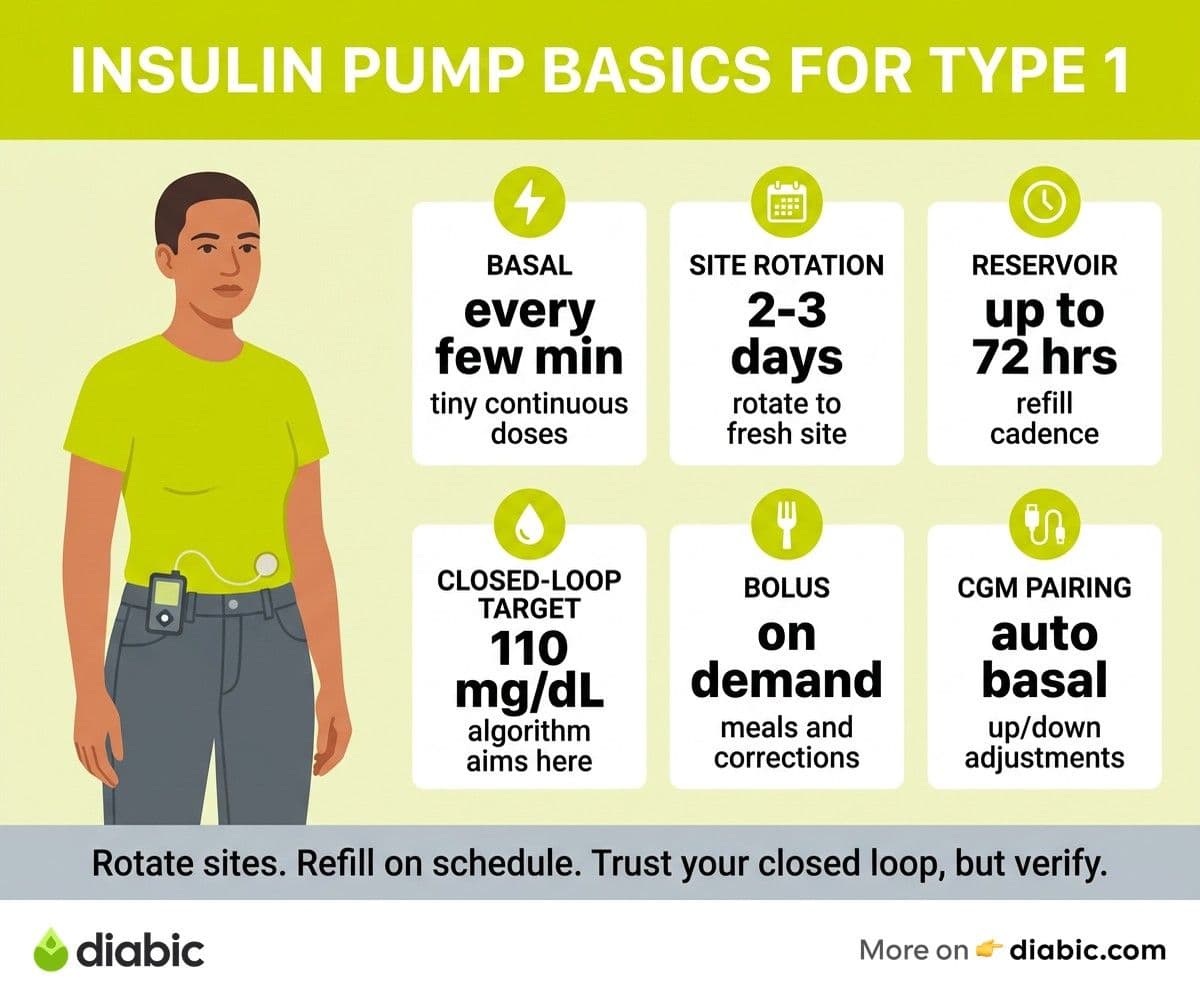
An insulin pump for type 1 diabetes mimics what a healthy pancreas does, in slow motion and with your help. It delivers a small steady drip of rapid-acting insulin throughout the day, called the basal rate, and larger on-demand doses at meals or to correct a high reading, called boluses. The result is a more flexible, more precise version of the basal-bolus regimen used with multiple daily injections.
The basal rate replaces the long-acting insulin you would otherwise inject once or twice daily. Pumps let you program different basal rates for different times of day, which matters if you run high in the early morning or need less insulin overnight. The American Diabetes Association's Standards of Care lists pump therapy as a recommended option for adults and children with type 1 diabetes who can manage the technical demands.
Boluses cover the carbohydrates you eat and bring down high readings. You enter the carb count and current glucose, and the pump's built-in calculator suggests a dose based on your insulin-to-carb ratio, correction factor, and active insulin still on board from earlier doses. This math used to happen in your head before every meal. With a pump, the device handles it.
A pump does not contain long-acting insulin. If your pump fails or your infusion set kinks, your basal coverage stops within a few hours and ketones can rise. This is why every pump user keeps a backup pen of long-acting insulin and rapid-acting pens for emergencies.
Pumps work best when paired with a continuous glucose monitor. Closed-loop systems use CGM readings to automatically adjust basal delivery and deliver micro-corrections, which is a major leap beyond traditional pump therapy. If you want a primer before reading further, our explainer on what a CGM is and how it works covers the basics.
Pump Components
Every tubed pump has four main parts. The pump itself is the controller, about the size of a small pager, that holds the battery, screen, and motor. Inside is a reservoir or cartridge that holds two to three days of rapid-acting insulin.
A flexible tube connects the reservoir to an infusion set, which is the cannula that sits under your skin. Tubeless pumps like the OmniPod skip the tubing entirely by housing the reservoir, motor, and cannula inside a single pod stuck directly to the body, with a separate handheld controller. The trade-offs between these two designs influence almost every other choice you make.
Pumps approved for use in the United States appear in the FDA Premarket Approval database, which lists every cleared model and any safety updates. Checking your model's entry once a year is a reasonable habit, especially if you start to notice unusual behavior.
How to Use an Insulin Pump Day to Day
Learning how to use an insulin pump takes about two weeks of awkwardness followed by months of refinement. Most clinics walk you through the basics over a one-day training, then schedule follow-ups every few weeks to fine-tune your settings.
You start by filling the reservoir with rapid-acting insulin from a vial. Most users replace the reservoir every two to three days, which usually coincides with changing the infusion set. Filling involves drawing insulin into the reservoir slowly to avoid air bubbles, then priming the tubing so insulin reaches the cannula tip before insertion.
Programming begins with basal rates. Your endocrinologist will set initial rates based on your total daily insulin dose from injections, often starting at 50% of that total spread across 24 hours. Rates are adjusted weekly based on overnight and between-meal glucose patterns. Most pumps allow at least 24 different rates per day, which is overkill for most people but useful for shift workers or athletes.
Bolus dosing happens at every meal and snack with carbs. You enter the grams of carbohydrate and your current glucose, and the pump suggests a dose. Your carb ratio (units per gram of carb) and correction factor (how much one unit drops glucose) are programmed during setup and refined over time.
A typical day with a pump looks something like this. Morning: check CGM, deliver breakfast bolus, eat. Mid-morning: maybe a small correction. Lunch and dinner: same routine. Bedtime: confirm basal program, set a temporary lower basal if you exercised hard. Every 48 to 72 hours, change the infusion set and refill the reservoir. The mental load is lower than injections, but the tactile load (changing sets, troubleshooting alarms) is higher.
Exercise is where pumps shine. You can suspend basal during a run, set a temporary 50% basal for two hours after a workout to prevent the post-exercise low, or extend a bolus over hours for a meal high in fat and protein. None of this is possible with injections.
Benefits of an Insulin Pump for Type 1 Diabetes
The benefits of insulin pump therapy show up in three places: glucose stability, lifestyle flexibility, and the body itself. Each one matters, though the order changes from person to person.
Pumps tend to deliver lower A1C with less hypoglycemia compared to multiple daily injections, especially when paired with a CGM. A landmark meta-analysis published in the BMJ by Pickup and Sutton showed pump users averaged 0.5 to 1.0 percentage point lower A1C with significant reductions in severe hypoglycemia. More recent closed-loop trials show even larger time-in-range gains.
Basal precision is the underrated benefit. Long-acting insulin gives you one curve over 24 hours. A pump lets you raise your basal at 3 a.m. to handle the dawn phenomenon, then drop it again at 7 a.m. so breakfast does not push you into hypoglycemia. People who run high in the early morning often see the biggest improvement here.
Mealtime flexibility is the lifestyle benefit you notice immediately. You can split a bolus over a long brunch, suspend insulin during a hike, or correct a 280 mg/dL reading without pulling out a pen. Travel across time zones becomes a clock adjustment instead of a math problem.
Fewer injections means less skin scarring and lipohypertrophy, the lumpy buildup that develops after years of injecting the same sites. One infusion set every three days replaces four to six injections per day, which adds up to roughly 1,500 fewer needle pokes per year.
The trade-offs are real. Pumps cost more, demand more attention, and tether you to a device 24 hours a day. Many people thrive on them. Some people prefer pens. Both are valid.
From my experience: I switched from pens to a pump around year four of living with type 1, and the change I felt most was in the early hours. My fasting numbers had been climbing for years no matter what dose of long-acting I tried, and within two weeks of pump therapy with a higher 4 a.m. basal rate, my morning glucose finally settled. Fourteen years in, I still notice that overnight precision is the single biggest reason I stay on the pump.
Understanding Insulin Pump Tubing and Infusion Sets
Insulin pump tubing is the part of the system most people obsess over before starting and rarely think about after. It connects the pump to the cannula sitting under your skin, and modern tubing is thin, flexible, and far less obtrusive than the medical tubing of 15 years ago.
Tubed pumps like the Tandem t:slim X2 and Medtronic MiniMed 780G use clear plastic tubing in lengths from 23 to 43 inches. Shorter tubing is easier to manage under fitted clothes. Longer tubing gives you more freedom when you set the pump down on a nightstand or counter.
Tubeless pumps like the Insulet OmniPod 5 eliminate tubing entirely. The pod sticks to your skin and contains everything needed for delivery, while a separate controller (or your phone in some markets) handles dosing decisions. There is a real freedom to wearing nothing on your waistband. The trade-off is that pods are larger than infusion sets and replaced every three days as a unit.
Infusion sets come in a few flavors. Angled (or "off-set") sets insert at a 30 to 45 degree angle and use a soft Teflon cannula, which sits more comfortably for many people. Straight sets insert at 90 degrees, also with a soft cannula. Steel-needle sets are still used by a smaller group, especially people who experience absorption issues with Teflon.
Set the schedule and stick to it. Most clinicians recommend changing infusion sets every 48 to 72 hours, which prevents irritation, scarring, and absorption problems at the site. Rotating sites (abdomen, upper buttocks, thighs, back of upper arm) keeps tissue healthy over decades. We dig deeper into pod-specific routines in our OmniPod insulin pump review.
Living With a Pump: Swimming, Sports, and Sleep
Can you swim with insulin pump therapy? It depends on your model. The OmniPod 5 is rated waterproof and can be worn in pools, oceans, and showers. Most tubed pumps, including the Tandem t:slim X2 and Medtronic 780G, are water-resistant rather than waterproof, meaning they tolerate splashes but should be disconnected for swimming and prolonged showers.
Disconnecting is straightforward. Tubed pumps clip off at the infusion set with a quick release, leaving the cannula in place under a small adhesive disc. You can stay disconnected for up to about an hour without any noticeable rise in glucose, since basal insulin from the previous hour is still active in your tissue. Longer than that, plan to bolus for missed basal or reconnect briefly.
Sports add their own wrinkle. Contact sports often require disconnecting and protecting the infusion site with extra adhesive or athletic tape. Endurance activities benefit from setting a temporary basal rate of 30 to 70% an hour before the workout. Strength training can spike glucose afterward, sometimes requiring a small correction.
Sleeping with a pump takes a few nights to figure out. Most people clip the pump to pajama pants, tuck it inside a small pocket, or use a sleep band designed for pump users. Tubing wants to follow gravity, which means you will feel a tug if you roll over the wrong way for the first week or two. After that, you stop noticing it.
Travel and airport security are easier than the internet sometimes suggests. The TSA explicitly permits insulin pumps and CGMs through security, and most pump manufacturers provide a wallet card for international travel. Pumps and pods cannot go through full-body scanners (the X-ray scanners are fine, but the millimeter-wave body scanners can affect electronics), so request a pat-down. Bring backup pens and extra supplies in your carry-on, never checked baggage.
Can People With Type 2 Diabetes Use an Insulin Pump
Pump therapy was designed for type 1, but a growing number of people with insulin-requiring type 2 diabetes use pumps successfully. The decision is usually driven by glucose variability that injections cannot smooth out, severe insulin resistance requiring complex dosing, or quality-of-life factors like work schedules.
Insurance coverage for pumps in type 2 is the bigger barrier. Medicare typically requires documented C-peptide testing showing low or absent insulin production, which is a high bar for most people with type 2. Private insurance varies widely, with some carriers covering pumps for type 2 on intensive insulin therapy and others denying outright.
The pump settings differ from type 1 in subtle but important ways. Carb ratios for type 2 are often more aggressive (smaller numbers, more insulin per gram) due to insulin resistance, and basal rates are typically higher overall. Dosing may also include U-200 or U-500 insulin in select pumps designed for high total daily doses.
Talk to your endocrinologist about whether pump therapy makes sense for you and what your insurance is likely to approve. The conversation is worth having even if the answer is "not yet."
Choosing the Right Insulin Pump
Choosing a pump is part technology, part lifestyle. Four major systems dominate the U.S. market in 2026, each with strengths that fit different people.
The Tandem t:slim X2 with Control-IQ technology is the slimmest tubed pump on the market and integrates with Dexcom G6 and G7 sensors for closed-loop dosing. Its touchscreen interface feels familiar to smartphone users, and the company pushes free firmware updates that have added new features without requiring a hardware swap.
The Medtronic MiniMed 780G uses Medtronic's Guardian sensor for closed-loop control with auto-corrections every five minutes. It is the only system with built-in meal detection, which delivers a small bolus when post-meal glucose starts to rise. Coverage is strong with most insurance plans. We compare versions in our Medtronic MiniMed insulin pump review covering the 670G vs 780G.
The Insulet OmniPod 5 is the only tubeless option with closed-loop functionality, working with Dexcom G6 and G7 sensors. The lack of tubing is a major lifestyle advantage, especially for kids, athletes, and anyone who finds wearable electronics on a clip annoying.
The Beta Bionics iLet bionic pancreas takes a different approach. You enter only your weight at startup, with no basal rates, carb ratios, or correction factors to program. The algorithm learns and dosing happens automatically. It is the simplest pump to start with, though it offers less manual control for users who want it. Our iLet insulin pump review covers the experience in depth.
Cost varies widely depending on insurance. A pump itself runs $4,000 to $8,000 retail, with monthly supplies adding $200 to $500. Most insured users pay a copay or deductible plus a smaller monthly supply cost. Our breakdown of insulin pump cost and insurance coverage details what to expect.
Questions worth bringing to your endocrinologist include how each pump pairs with the CGM you already use, what loaner programs exist, what the supply waste looks like in real-world use, and how the warranty handles failures.
FAQ
How do you insert an insulin pump infusion set?
You insert most infusion sets with a spring-loaded inserter that fires the cannula at a controlled angle. Clean the site with alcohol, let it dry, place the inserter, and press the button. Inserters take less than a second and most users describe minimal discomfort. Pod insertion is similar but happens automatically once you press start on the controller.
Can type 2 diabetes use an insulin pump?
People with type 2 diabetes can use insulin pumps when their care team supports it and insurance covers it. Pumps make the most sense for type 2 patients on intensive insulin therapy who struggle with glucose variability or hypoglycemia. Coverage is harder to obtain than for type 1 and may require documentation of C-peptide levels and prior injection failures.
How often do you change an insulin pump site?
Most clinicians recommend changing your infusion set every 48 to 72 hours and your reservoir every two to three days. Sticking to this schedule prevents site irritation, scarring, and absorption problems that develop when sets stay in too long. OmniPod pods are designed to be replaced every three days as a unit.
If you are weighing whether an insulin pump for type 1 diabetes fits your life, the best next step is a conversation with your endocrinologist about which models you can trial, what your insurance will cover, and what your daily routine actually demands. Pump therapy is not for everyone, but for people who fit it well, the precision and flexibility are difficult to match with any other form of insulin delivery.
Dr. Shanto Arian is an internal medicine physician now specializing in clinical and aesthetic dermatology, with a parallel academic focus on epidemiology and public health. He holds an MBBS, MPH, MSc (UK), MRCP (UK), MRCPI (Ireland), Diploma in Dermatology (UK), and Diploma in Aesthetic Medicine (USA). Dr. Arian trained in internal medicine, including hospital work on hematology cases such as graft-versus-host disease, before moving toward dermatology. Skin is one of the earliest places diabetes shows itself, from acanthosis nigricans and diabetic dermopathy to slow foot wound healing, and that intersection is where his clinical and Diabic-review work meet. On Diabic, Dr. Arian medically reviews content on diabetes diagnosis, complications, dermatologic manifestations, and pharmacotherapy, ensuring every claim aligns with current ADA, NICE, and peer-reviewed literature.
Medically reviewed by
Dr. Rezwana Parvin Rumpa is an obstetrics and gynaecology specialist with clinical focus on gestational diabetes, PCOS, and fertility. She holds the MRCOG (Final Part) from the Royal College of Obstetricians and Gynaecologists in London, the MRCPI (Final Part) from the Royal College of Physicians of Ireland, and an MBBS from Shaheed Monsur Ali Medical College under Dhaka University. Dr. Rumpa serves as a Senior Medical Officer in the Obs and Gynae department at BRB Hospitals Ltd, where she has spent three years managing prenatal care, emergency obstetric cases, and women's-health surgery. On Diabic, she medically reviews content for women living with diabetes, with particular attention to pregnancy, PCOS, and reproductive-health intersections.
More from Devices & Technology
View all
Fasting vs Postprandial Glucose: What's the Difference
Fasting vs postprandial glucose readings tell different stories about your blood sugar. Learn what each number means and how to act on it.

Best Glucometer for Elderly and Low-Vision Users
Best glucometer for elderly and low-vision users: large displays, audio readouts, no-coding strips, and budget picks that make daily testing easier.

Online Diabetes Coaching: How to Choose a Good One
Online diabetes coaching can fill the gaps between doctor visits. Learn what credentials to check, red flags to avoid, and how to pick a quality program.
Clinician-reviewed habits, plain-language guides, and honest answers - the small shifts that make living with diabetes feel lighter, every day.