Insulin Pump Site Infections: Signs and Prevention
Learn the early signs of insulin pump site infections, plus a prevention routine and treatment steps that may help keep your skin healthy.

In this article(16)
A pink ring around your infusion set. A tender spot that feels warmer than the skin around it. Blood sugars that drift up and refuse to come down even after a correction bolus. These are the early hints of insulin pump site infections, and most of us learn to spot them only after dealing with one the hard way.
The good news is that site infections are not common. Published research puts the rate at somewhere between 0.06 and 0.4 episodes per pump-year of use, depending on the population studied. The better news is that almost all infections are preventable with a small set of habits that take seconds at every site change.
This guide walks through what causes infusion set infections, the signs to watch for, a prevention routine that actually works, and what to do when something is brewing under the adhesive. If you are still deciding whether pump therapy fits your life, our insulin pump guide covers that decision separately.
What Causes Insulin Pump Site Infections
An insulin pump site infection happens when bacteria, usually Staphylococcus aureus from your own skin, gets past the cannula entry point and starts multiplying in the soft tissue underneath. The cannula creates a tiny channel into the body that stays open for days, which is why hygiene at insertion matters so much.
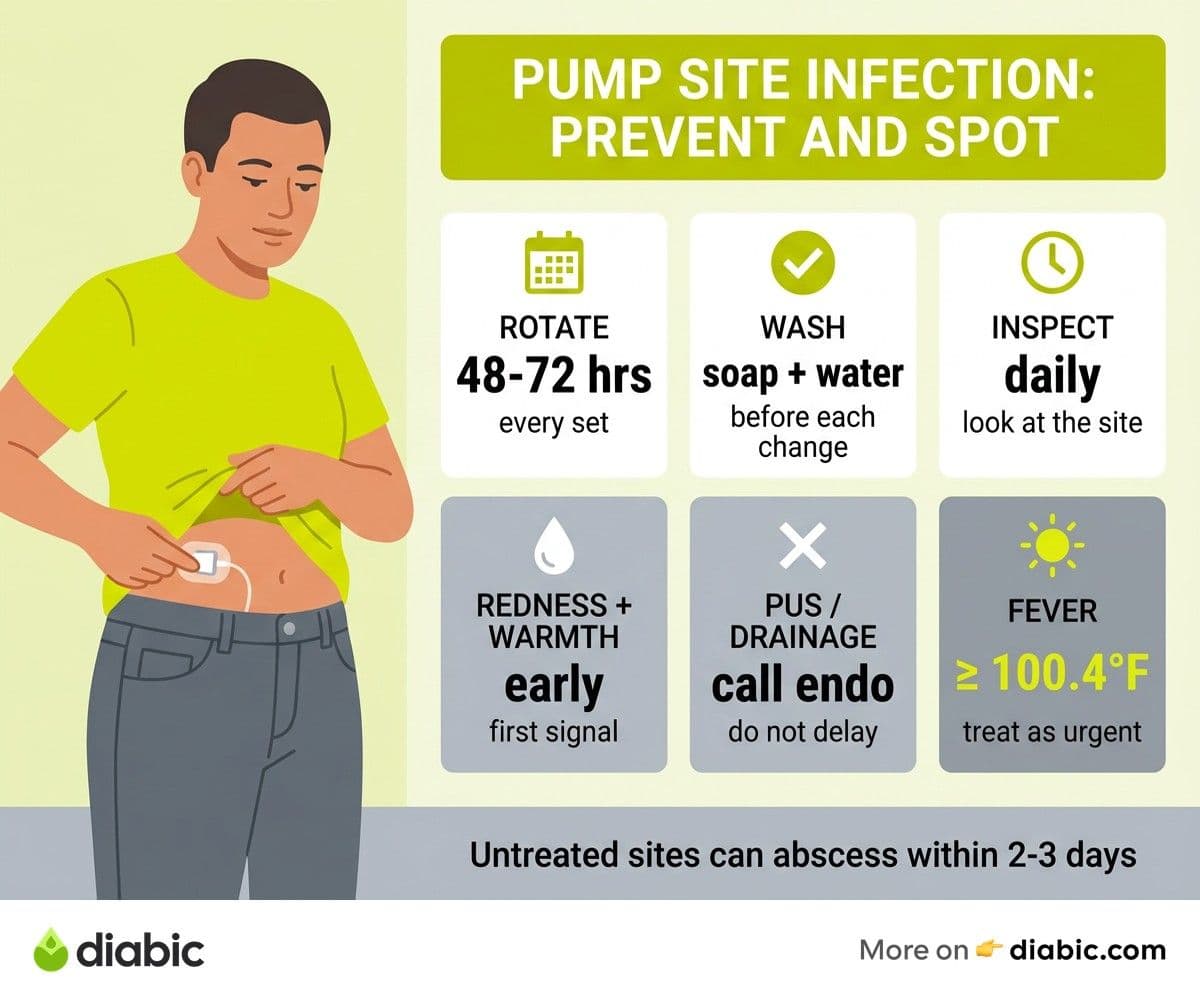
Three things drive most insulin pump for type 1 diabetes infusion site infections. The first is wearing a set longer than the manufacturer recommends. Tandem, Medtronic, and Insulet all set a 2 to 3 day limit for a reason: the cannula starts to irritate tissue and break down adhesive after that point, creating an entry path for bacteria.
The second is poor skin prep before insertion. Skipping the alcohol wipe, inserting before the alcohol fully dries, or using lotion or oil on the area earlier in the day can all leave bacteria sitting at the insertion site when the cannula goes in.
The third is the local environment. Warm, humid skin under an occlusive adhesive is a near-perfect bacterial culture dish. Heavy sweat, a hot summer, or a workout that soaks the dressing without a change can shift the risk substantially. Research published in Diabetes Technology and Therapeutics (Schmid et al.) found infusion site complication rates climb when set wear extends past 72 hours, especially in adolescents and active adults.
Why Some Sites Get Infected More Than Others
Body location matters. Areas with more friction (waistband, bra line) or more sweat (armpit-adjacent abdomen, lower back near a chair) tend to fail faster than the upper outer thigh or the back of the upper arm. People who do not rotate sites also see local skin breakdown over time, and broken skin is easier for bacteria to colonize.
Lipohypertrophy, the lumpy fatty tissue that builds up at heavily reused sites, also raises infection risk. Insulin absorption from those areas is unpredictable, and the tissue itself heals more slowly when irritated.
Signs of an Infected Insulin Pump Site
Most infections announce themselves clearly if you know what to look for. The classic signs are redness, warmth, swelling, and tenderness at the insertion site, often with a small amount of pus or cloudy drainage when the set is removed.
Redness alone does not mean infection. A small pink ring can be a normal adhesive reaction or mild irritation from the cannula. The line we draw is whether the redness is spreading outward over hours, whether the area is warm to the touch compared to surrounding skin, and whether it hurts to press on.
Unexplained high blood sugars that resist correction boluses are an early functional sign. When the tissue around a cannula is inflamed or infected, insulin absorption drops, and you may need 2 to 3 times your usual correction dose to bring numbers down. If a correction bolus does not lower glucose within 90 minutes, the site is the first place to suspect.
When to Worry About a Systemic Infection
A localized infection is uncomfortable but rarely dangerous. A systemic infection, where bacteria spread beyond the local site into the bloodstream, is a different situation and needs urgent care.
Watch for fever above 100.4 degrees Fahrenheit, chills, nausea, a red streak spreading away from the site, or general feelings of being unwell. Any of these signs warrant a same-day call to your healthcare provider or a visit to urgent care, especially in someone with diabetes whose immune response can be slower than average.
How to Prevent Skin Reactions and Infections at the Site
A reliable prevention routine costs about 60 seconds at every set change and dramatically reduces infection risk. Here is the one we use and recommend.
Start by washing your hands thoroughly with soap and water for at least 20 seconds. The CDC hand hygiene guidance applies to medical device insertion just as it does to clinical procedures. Hand sanitizer is acceptable in a pinch but plain soap and water is better.
Pick a site that has had at least 7 to 10 days of rest since the last cannula was there, and that is at least an inch away from your previous site. Clean the area with an alcohol prep pad, working in a circle from the center outward to push bacteria away from the insertion point. Let the alcohol fully dry, which usually takes 30 to 60 seconds. Inserting through wet alcohol can drive bacteria into the tissue.
Apply a fresh infusion set per manufacturer instructions. Tandem, Insulet, and Medtronic all publish detailed insertion guides on their websites, and the technique varies slightly by set type. Visit Tandem Diabetes Care or the Omnipod review for set-specific guidance.
The Non-Negotiable Habits
A short list of habits that make the biggest difference:
- Change infusion sets every 2 to 3 days without exception. Pushing to day 4 or 5 is the single biggest risk factor we see.
- Rotate sites in a planned pattern (clockwise around the abdomen, alternating thighs, alternating upper arms) so no single area sees back-to-back use.
- Replace the set immediately if you see blood at the cannula tip after insertion, since blood in the tubing is a sign the cannula nicked a small vessel and the site is at higher risk.
- Replace the set if the adhesive lifts more than 25 percent or the dressing gets wet enough to compromise the seal.
- Watch for early redness or itching and trust your instincts: if a site feels off, change it.
The American Diabetes Association includes infusion set rotation and timely replacement in its Standards of Care recommendations for pump users. These are not just manufacturer suggestions; they are evidence-based clinical guidelines.
Skin Prep Products Worth Knowing
Some people benefit from a barrier wipe (Skin-Tac, Skin Prep) applied after the alcohol dries and before the set goes on. These products improve adhesive bonding and create a thin protective layer that may reduce skin irritation. They are not antiseptics, so they do not replace the alcohol step.
For people with persistent skin reactions, a hydrocolloid dressing cut to fit around the cannula can reduce contact between adhesive and irritated skin. Talk to your diabetes educator about specific options, since the right product depends on your skin chemistry and the set type you use.
How to Treat an Infected Insulin Pump Site
If you suspect an infection, the first move is always the same: remove the infusion set immediately and start a fresh set in a clean area on the opposite side of the body. Continuing to dose insulin through an infected site does not work well and keeps the bacteria fed.
Clean the affected area with mild soap and water, pat dry, and apply a small amount of over-the-counter triple antibiotic ointment (like Neosporin or a generic equivalent). Cover with a clean adhesive bandage if the site is in a friction area, or leave it open to air if it is not.
Watch the site over the next 24 to 48 hours. Mild redness and tenderness should improve, not worsen. Take a photo when you first notice the issue so you have a baseline to compare against the next day.
When to Call Your Doctor
Call your healthcare provider if any of the following happens:
- Redness, swelling, or pain expands beyond the original area after 24 hours of antibiotic ointment.
- Pus continues to drain or worsen.
- You develop a fever, chills, or feel systemically unwell.
- A red streak appears extending away from the site (a sign of cellulitis spreading through lymph channels).
- Blood sugars stay elevated despite multiple corrections from a fresh site.
Your provider may prescribe an oral antibiotic, often a first-generation cephalosporin or a similar agent that targets common skin bacteria. Most clinicians ask you to finish the full course even if the site looks better after a few days, since stopping early can raise the risk of recurrence and resistance, but follow the specific instructions your prescriber gives you.
Documenting Infections to Spot Patterns
After every site infection, jot down a short note: where the site was, how long the set had been in, what you were doing the day before (heavy exercise, swimming, hot weather), and how the infection presented. After two or three episodes, patterns often jump out.
We have seen people figure out that they always get infections on their right thigh in the summer, or that one specific brand of infusion set triggers reactions for them, or that they were stretching wear time on travel days. Without the log, those patterns hide in the noise.
Special Considerations for Active Lifestyles
If you exercise heavily, swim regularly, or work outdoors in heat, your infection prevention plan needs a few extra steps. Sweat under adhesive is the biggest variable, and managing it well is mostly about pre-empting set failure rather than reacting to it.
For swimmers, a waterproof film dressing (Tegaderm, IV3000) over the infusion set extends adhesive life and keeps water from creeping under the edges. Apply the film before swimming and replace it if the edges lift. Saltwater and chlorine both break down standard adhesives faster than fresh water.
For heavy exercisers, plan set changes for after a workout rather than before, and consider scheduling a fresh site on a rest day so the new cannula has 12 to 24 hours of low-stress wear before you sweat through it. Adhesive barriers (Skin-Tac, Mastisol) help bond hold during high-sweat sessions.
Travel and Hot Weather
Travel scrambles routines, and that is when most people stretch their set wear. Pack 50 percent more infusion sets and reservoirs than you think you will need, and bring alcohol prep pads and hand sanitizer in your day bag so you are never without them. Our traveling with diabetes devices post covers the full packing list.
Hot weather is its own category. The combination of sweat, sunscreen residue, and pool exposure stacks risk factors for infusion site failure. In summer, we recommend tightening the change interval to every 2 days even if the manufacturer allows 3, and keeping a closer eye on the site through the day.
For CGM users, the same hygiene rules apply at sensor insertion sites, though the infection risk is lower because CGM filaments are smaller and shorter than pump cannulas. Our does a CGM hurt post walks through CGM insertion comfort and skin care in more depth.
From my experience: I have had two infusion site infections in 14 years on pumps, and both happened the same way: I pushed a set to day 4 because I was busy and skipped the change. Both times I noticed redness expanding by hour 36 of the new symptom and started antibiotic ointment within an hour of pulling the set. Neither needed oral antibiotics, but both were uncomfortable for several days. The lesson I took away was that the 2 to 3 day rule is not a suggestion. It is the cost of doing business with a pump.
FAQ
How do you prevent infusion set infections?
Prevent these infections by washing your hands before every set change, cleaning the insertion area with alcohol and letting it dry fully, changing infusion sets every 2 to 3 days, rotating sites with at least an inch of space from the last one, and replacing sets immediately if you see blood, irritation, or adhesive failure. Most infections come from extended wear time and skipped skin prep.
How do you treat an infected insulin pump site?
Treat an infected insulin pump site by removing the set immediately, starting a fresh set in a clean area on the opposite side of the body, washing the affected skin with mild soap and water, and applying over-the-counter triple antibiotic ointment. Watch the area for 24 to 48 hours, and call your doctor if redness expands, pus worsens, you develop a fever, or you see a red streak spreading away from the site. Your provider may prescribe oral antibiotics for a moderate or worsening infection.
How often should you change your infusion set?
Change your infusion set every 2 to 3 days as recommended by your pump manufacturer. Steel cannulas are typically rated for 2 days, and Teflon cannulas for 3 days. Pushing wear time beyond that interval is the most common driver of site infections, lipohypertrophy, and unexplained high blood sugars. Talk to your doctor if you find yourself stretching set life because of cost or supply issues.
Insulin pump site infections are an uncommon but real risk of pump therapy, and they are largely preventable with consistent habits. A clean insertion routine, a 2 to 3 day change cadence, and an early-warning eye for redness and unexplained highs will keep most people infection-free for years at a time.
Dr. Shanto Arian is an internal medicine physician now specializing in clinical and aesthetic dermatology, with a parallel academic focus on epidemiology and public health. He holds an MBBS, MPH, MSc (UK), MRCP (UK), MRCPI (Ireland), Diploma in Dermatology (UK), and Diploma in Aesthetic Medicine (USA). Dr. Arian trained in internal medicine, including hospital work on hematology cases such as graft-versus-host disease, before moving toward dermatology. Skin is one of the earliest places diabetes shows itself, from acanthosis nigricans and diabetic dermopathy to slow foot wound healing, and that intersection is where his clinical and Diabic-review work meet. On Diabic, Dr. Arian medically reviews content on diabetes diagnosis, complications, dermatologic manifestations, and pharmacotherapy, ensuring every claim aligns with current ADA, NICE, and peer-reviewed literature.
Medically reviewed by
Dr. Rezwana Parvin Rumpa is an obstetrics and gynaecology specialist with clinical focus on gestational diabetes, PCOS, and fertility. She holds the MRCOG (Final Part) from the Royal College of Obstetricians and Gynaecologists in London, the MRCPI (Final Part) from the Royal College of Physicians of Ireland, and an MBBS from Shaheed Monsur Ali Medical College under Dhaka University. Dr. Rumpa serves as a Senior Medical Officer in the Obs and Gynae department at BRB Hospitals Ltd, where she has spent three years managing prenatal care, emergency obstetric cases, and women's-health surgery. On Diabic, she medically reviews content for women living with diabetes, with particular attention to pregnancy, PCOS, and reproductive-health intersections.
More from Devices & Technology
View all
Fasting vs Postprandial Glucose: What's the Difference
Fasting vs postprandial glucose readings tell different stories about your blood sugar. Learn what each number means and how to act on it.

Best Glucometer for Elderly and Low-Vision Users
Best glucometer for elderly and low-vision users: large displays, audio readouts, no-coding strips, and budget picks that make daily testing easier.

Online Diabetes Coaching: How to Choose a Good One
Online diabetes coaching can fill the gaps between doctor visits. Learn what credentials to check, red flags to avoid, and how to pick a quality program.
Clinician-reviewed habits, plain-language guides, and honest answers - the small shifts that make living with diabetes feel lighter, every day.