Medtronic MiniMed Insulin Pump: 670G vs 780G Review
An honest comparison of the insulin pump Medtronic MiniMed 670G and 780G: features, costs, alarms, and which one fits your day-to-day diabetes routine.

In this article(10)
The insulin pump Medtronic MiniMed line has been part of the diabetes hardware story for over two decades, and the 670G and 780G represent two distinct chapters of that story. The 670G was the first hybrid closed-loop system to land in many countries; the 780G is the upgraded successor with a smarter algorithm and a better sensor pairing.
If you are choosing between staying on the 670G or moving to the 780G, the differences matter more than the marketing copy suggests. We walk through what each pump actually does, where each one falls short, and which scenarios genuinely call for an upgrade.
Insulin Pump Medtronic MiniMed Lineup: 670G vs 780G at a Glance
Both models share a similar industrial design: a small box you wear in a pocket or clipped to clothing, attached to an infusion set with a thin tube. Inside the hardware, though, the algorithms and sensor pairings tell two different stories.
The 780G is the system Medtronic now actively markets in the US, Canada, the UK, and Europe. The 670G is being phased out, and many users are getting upgrade offers as their warranty period closes. Medtronic publishes the latest specs and user materials on their Medtronic Diabetes site.
The reason for the upgrade is not branding. It is performance. The 780G's pivotal trial data showed time in range improvements of roughly 12 to 15 percentage points over open-loop pump therapy, with similar gains over the 670G in real-world use (FDA approval letter, 2023). For a deeper background on the technology category, see artificial pancreas systems.
Medtronic MiniMed 670G: What You Get
The insulin pump MiniMed 670G launched commercially in 2017 and was the first FDA-approved hybrid closed-loop pump. The headline feature was Auto Mode, which adjusts basal insulin every five minutes based on Guardian Sensor 3 readings.
Auto Mode worked, but the experience had real friction:
- Frequent Auto Mode exits, often after sensor calibration drift or temporary high readings
- Guardian Sensor 3 required two fingerstick calibrations every 12 hours
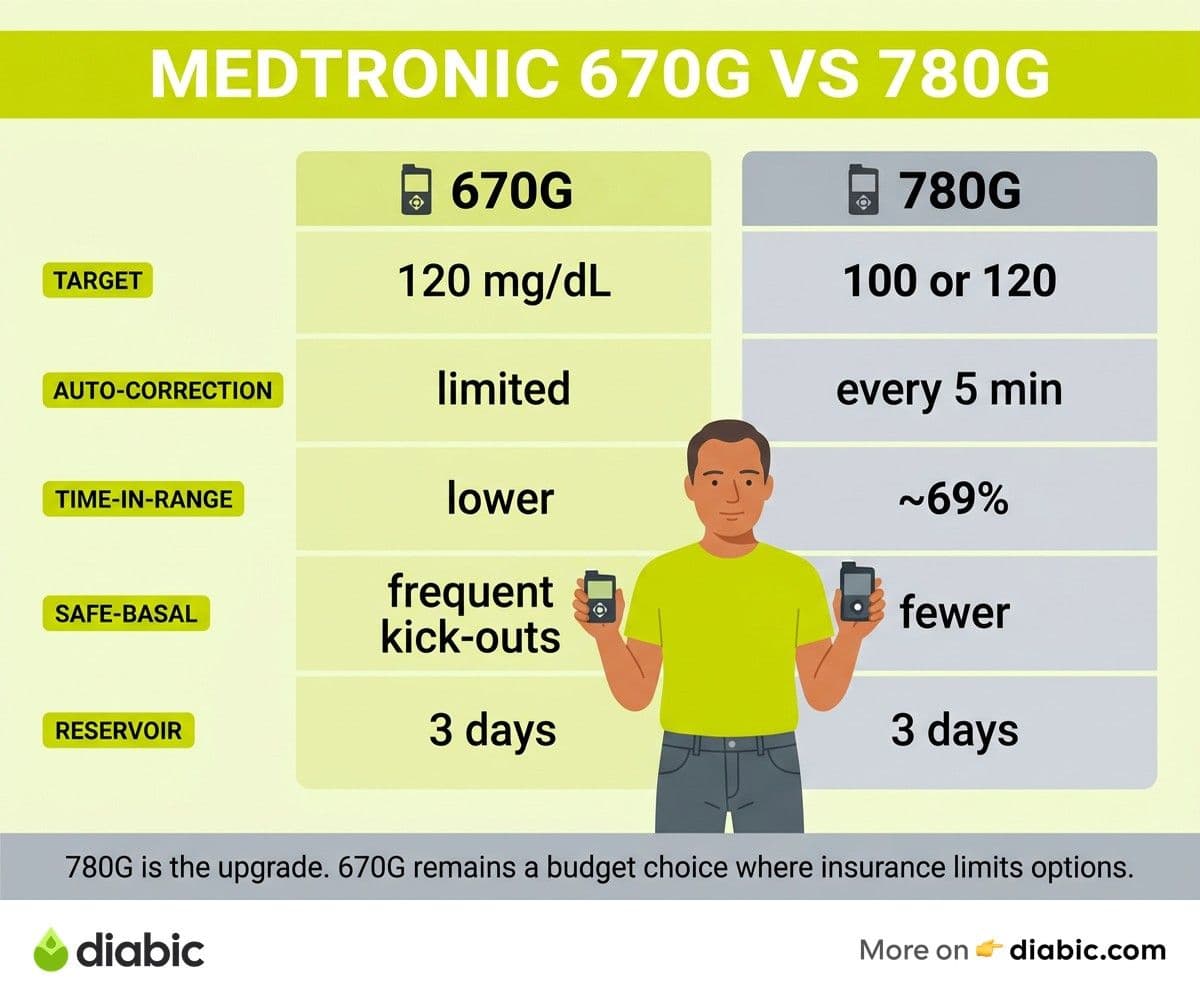
- The fixed target of 120 mg/dL was higher than many endocrinologists wanted for tight management
- The alarm density became fatigue-inducing for some users, especially overnight
For new pumpers in 2026, the 670G is rarely the first choice. It still works for users who are happy with their current setup and not eligible for an upgrade, but Medtronic stopped accepting new sales of the 670G in many regions during 2023 and 2024.
If you have a 670G, the practical question is whether to ride it out to warranty's end or push for an upgrade now. Most US users with private insurance qualify for a 780G upgrade once their 670G is out of warranty (typically four years), and many manufacturers run upgrade discount programs.
Medtronic MiniMed 780G: What Changed
The MiniMed 780G insulin pump system addressed the 670G's biggest pain points, and most users who upgrade describe the experience as significantly less stressful.
The first big change is auto-corrections. The 780G's algorithm not only adjusts basal rates every five minutes; it also delivers automatic correction boluses up to every five minutes when glucose rises above target. Users still bolus for meals, but post-meal spikes get the algorithm's help.
The second big change is Guardian 4 sensor. The Guardian 4 is factory calibrated, meaning no fingerstick calibrations are required for routine use (though confirmatory checks are still recommended in specific situations). Wear time is up to seven days. Accuracy is improved versus Guardian Sensor 3, with a published MARD around 10.6% in adults.
The third improvement is the adjustable target. The 780G lets you (and your provider) choose between 100, 110, and 120 mg/dL as the algorithm's target. For users who have been frustrated with the 670G's higher fixed target, this change alone can move time in range by several points.
A few practical 780G features worth noting:
- Bluetooth smartphone connectivity via the MiniMed Mobile app on iOS and Android
- CareLink Connect for remote data sharing with caregivers
- Simplified menu navigation and a brighter color screen
- Same basic infusion set compatibility as the 670G (Mio, Quick-set, and others)
For a comparison with the iLet bionic pancreas, our iLet bionic pancreas review covers a different approach to closed-loop control. For OmniPod fans, our OmniPod insulin pump review breaks down the tubeless alternative.
Side-by-Side Performance Comparison
Algorithm improvements only matter if they translate to better days. The 780G pivotal trial enrolled 157 adults and adolescents with type 1 diabetes and reported a mean time in range (70 to 180 mg/dL) of 74.5%, up from a baseline of about 69%. Mean A1C dropped from 7.5% to 7.0%. Those are clinically meaningful changes.
User experience differences show up in alarm volume. The 780G has fewer "lost signal" alerts thanks to the Guardian 4's improved Bluetooth, and Auto Mode (now called SmartGuard on the 780G) stays engaged more reliably. Many former 670G users describe the upgrade as "finally being able to sleep through the night."
From my experience: I have lived with type 1 diabetes for fourteen years and tried different pump systems over that time. The single biggest factor in pump satisfaction is not the spec sheet. It is alarm fatigue. A pump that wakes you up six times a night is exhausting, no matter how good the algorithm is. The 780G's reduced alarm density is a real, daily quality-of-life upgrade for users coming from the 670G.
A few practical notes on supplies and battery:
- Reservoir size: 300 units, same as the 670G
- Battery: AA alkaline, replaced as needed (no charging required)
- Infusion set change: every 2 to 3 days, similar to the 670G
- CGM sensor change: every 7 days for Guardian 4
For new pumpers, our insulin pump guide walks through what infusion set rotation and reservoir filling actually look like in daily life.
How Much Does the Medtronic MiniMed Cost?
The insulin pump Medtronic cost varies widely by country and insurance. In the US, the cash list price for a MiniMed 780G system is roughly $7,000 to $8,000 for the pump itself, with ongoing supply costs for sensors, infusion sets, and reservoirs.
Most US users with private insurance pay between $0 and $2,500 out of pocket after deductible and coinsurance, often spread across the warranty period. Medicare covers the 780G for type 1 diabetes and for type 2 diabetes that meets specific C-peptide and insulin therapy criteria, classified under durable medical equipment (Medicare.gov).
Ongoing supply costs (US, with insurance):
- Infusion sets: $40 to $90 per box of 10 (one box typically lasts a month)
- Reservoirs: $20 to $50 per box of 10
- Guardian 4 sensors: about $50 to $120 per sensor with insurance, $300+ cash
If you are upgrading from a 670G in warranty, Medtronic often offers reduced upgrade pricing or trade-in programs. Out of warranty, the upgrade often goes through your insurance just like a fresh device. If cost is the central question, our deeper guide on insulin pump cost breaks down the brand-by-brand picture and assistance programs.
The ADA has up-to-date guidance on AID system access and coverage advocacy if your insurance denies the upgrade (ADA Standards of Care 2026).
Which Medtronic Pump Should You Choose?
If you are starting fresh on a Medtronic pump, the 780G is the obvious choice. It is the model Medtronic actively supports with software updates, trains educators on, and stocks supplies for. The 670G is in wind-down mode in most markets.
If you are currently on a 670G and out of warranty, the 780G upgrade is worth pursuing for three reasons: better time in range, fewer alarms, and no calibration fingersticks. Users who were frustrated by 670G Auto Mode exits often describe the 780G experience as a different pump entirely.
If you are currently on a 670G inside warranty and reasonably happy, there is no urgent need to upgrade. Your endocrinologist can tell you whether your specific data (A1C, time in range, hypoglycemia events) suggests a switch would help.
If you are weighing Medtronic against other AID systems, the main alternatives are the OmniPod 5 (tubeless, integrates with Dexcom G6/G7), the Tandem t:slim X2 with Control-IQ (touchscreen, Dexcom G6/G7 integration), and the iLet bionic pancreas (no carb counting). Each has trade-offs around tubing, CGM choice, algorithm style, and supply logistics. None is universally "best," and the right pick depends on your sensor preference, lifestyle, and insurance coverage.
A few practical questions can sharpen the decision. Do you want a tubed pump with a larger reservoir or a tubeless patch that you replace every three days? Do you already wear (and like) a specific CGM that locks you into one or two pump options? Does your insurance cover one brand at 100% and another at 70%? Will you be comfortable changing infusion sets, or would a tubeless pod be easier? Working through these with your diabetes educator usually narrows the field to one or two clear contenders.
Training and support matter more than most people realize before they start a pump. Medtronic provides a dedicated trainer (often a CDE or RN) for the first 90 days, plus ongoing phone support during business hours. Sensor training is separate from pump training, and most users do them in two appointments two to four weeks apart. Plan to be fully on the system within six to eight weeks of your first delivery box arriving, not on day one.
For users moving from multiple daily injections to a pump for the first time, the 780G's automation can feel both empowering and disorienting. The first month often brings more highs than expected as the algorithm learns your patterns. By month three, most users see meaningful time-in-range gains, and by month six the pump usually feels like an unobtrusive part of daily life rather than a constant reminder of diabetes. Patience during onboarding pays off in long-term satisfaction.
FAQ
What insulin pump works with FreeStyle Libre 3?
As of early 2026, no major closed-loop insulin pump in the US has full integration with the FreeStyle Libre 3 or the newer Abbott Simplera. The Medtronic 780G uses Guardian 4. The Tandem t:slim X2 uses Dexcom G6 or G7. The OmniPod 5 also uses Dexcom G6 or G7 (and is being expanded to other sensors). Abbott has announced upcoming integrations with several pumps, but real-world availability has been limited so far. Talk to your endocrinologist about which sensor and pump combination fits your specific needs.
Does the Medtronic 780G work with the Dexcom G7?
Not in the US as of this writing. The 780G uses Medtronic's own Guardian 4 sensor for closed-loop function. Medtronic and Abbott have been working on cross-compatibility, and some early integration trials are underway, but the 780G does not currently use a Dexcom CGM. If Dexcom integration is essential, the OmniPod 5 or the Tandem t:slim X2 are your closest options.
How often do you change the MiniMed infusion set?
Medtronic recommends changing your insulin pump Medtronic MiniMed infusion set every 2 to 3 days (every 48 to 72 hours), depending on the specific set type and your skin's tolerance. Some sets, like the Mio Advance, are approved for up to 3 days, while extended-wear sets are emerging on the market. Changing more often than this is fine if you have skin irritation; less often increases risk of site failure and erratic absorption.
Dr. Shanto Arian is an internal medicine physician now specializing in clinical and aesthetic dermatology, with a parallel academic focus on epidemiology and public health. He holds an MBBS, MPH, MSc (UK), MRCP (UK), MRCPI (Ireland), Diploma in Dermatology (UK), and Diploma in Aesthetic Medicine (USA). Dr. Arian trained in internal medicine, including hospital work on hematology cases such as graft-versus-host disease, before moving toward dermatology. Skin is one of the earliest places diabetes shows itself, from acanthosis nigricans and diabetic dermopathy to slow foot wound healing, and that intersection is where his clinical and Diabic-review work meet. On Diabic, Dr. Arian medically reviews content on diabetes diagnosis, complications, dermatologic manifestations, and pharmacotherapy, ensuring every claim aligns with current ADA, NICE, and peer-reviewed literature.
Medically reviewed by
Dr. Rezwana Parvin Rumpa is an obstetrics and gynaecology specialist with clinical focus on gestational diabetes, PCOS, and fertility. She holds the MRCOG (Final Part) from the Royal College of Obstetricians and Gynaecologists in London, the MRCPI (Final Part) from the Royal College of Physicians of Ireland, and an MBBS from Shaheed Monsur Ali Medical College under Dhaka University. Dr. Rumpa serves as a Senior Medical Officer in the Obs and Gynae department at BRB Hospitals Ltd, where she has spent three years managing prenatal care, emergency obstetric cases, and women's-health surgery. On Diabic, she medically reviews content for women living with diabetes, with particular attention to pregnancy, PCOS, and reproductive-health intersections.
More from Devices & Technology
View all
Fasting vs Postprandial Glucose: What's the Difference
Fasting vs postprandial glucose readings tell different stories about your blood sugar. Learn what each number means and how to act on it.

Best Glucometer for Elderly and Low-Vision Users
Best glucometer for elderly and low-vision users: large displays, audio readouts, no-coding strips, and budget picks that make daily testing easier.

Online Diabetes Coaching: How to Choose a Good One
Online diabetes coaching can fill the gaps between doctor visits. Learn what credentials to check, red flags to avoid, and how to pick a quality program.
Clinician-reviewed habits, plain-language guides, and honest answers - the small shifts that make living with diabetes feel lighter, every day.