Diabetes Summer Camp: What Parents Need to Know
Diabetes summer camp builds confidence, peer connection, and self-management skills. A parent guide to what to expect, how to choose, and how to prepare.

In this article(9)
Sending your child to a diabetes summer camp might be the best thing you do for their confidence and independence. For the first time, they are surrounded by kids who get it, who check blood sugar at the same time, and who do not stare when they pull out an insulin pen. The week often does more for self-management than a year of clinic visits.
Camp also gives parents a real break, sometimes the first one since diagnosis. The medical team is on site around the clock. The activities are real summer camp activities. The diabetes piece runs in the background, normalized by the fact that everyone has it.
What Happens at a Diabetes Summer Camp?
A good program looks like a regular sleepaway camp on the surface. Swimming, hiking, archery, arts and crafts, campfires, talent shows, friendships forged in two weeks. The medical infrastructure is built underneath.
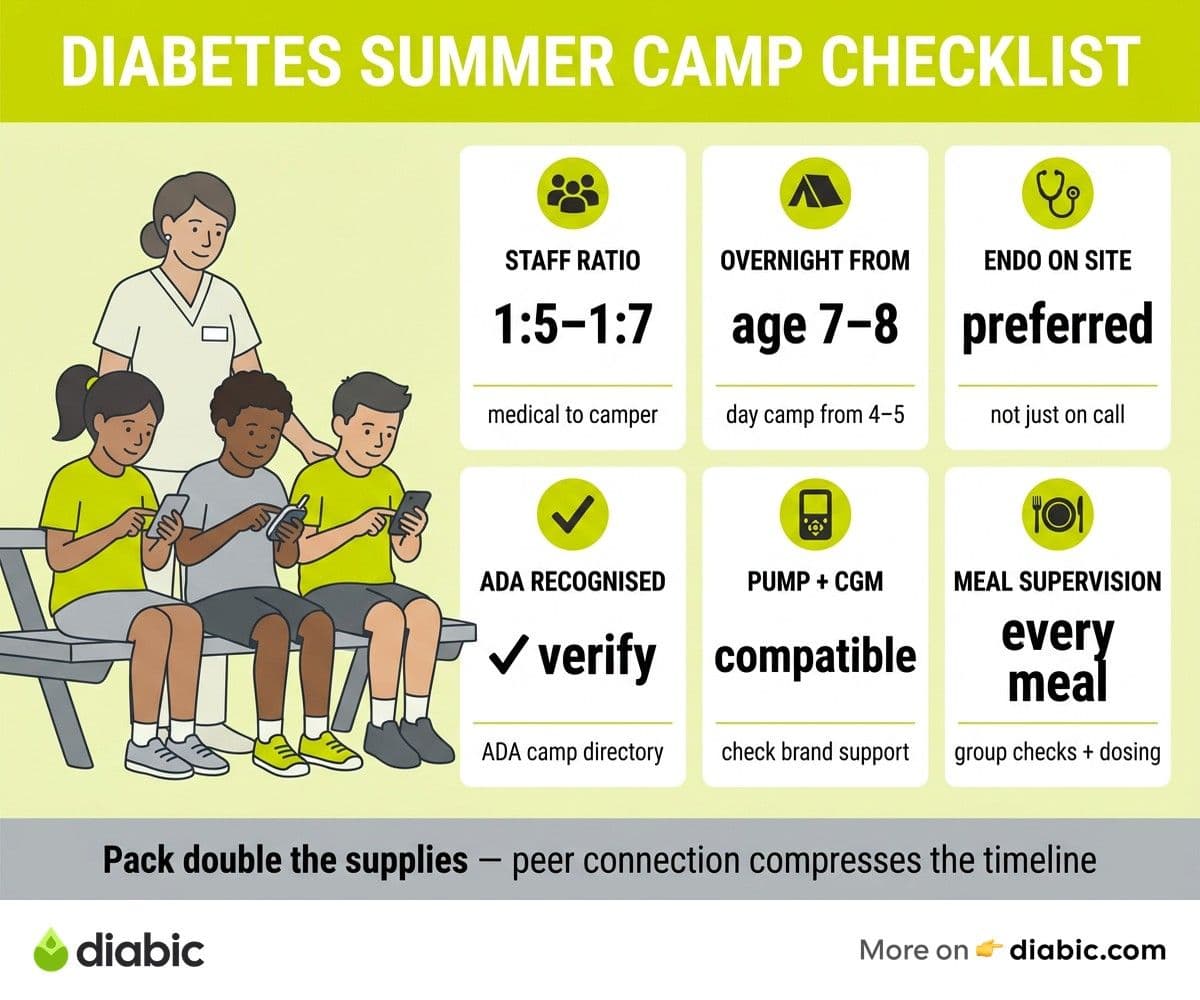
Medical staff on site 24/7. Most camps run with a team that includes pediatric endocrinologists, registered nurses, certified diabetes care and education specialists (CDCES), and trained counselors. Staff-to-camper medical ratios are usually much tighter than typical camps, often 1 medical staff for every 5-7 campers with diabetes.
Supervised diabetes care at every meal. Pre-meal blood sugar checks, carb counting reviews, insulin dosing decisions, and post-meal monitoring all happen as a group activity. Kids learn by doing alongside others doing the same thing. Cabin counselors typically have basic diabetes training and a CDCES nurse on call.
Education woven into activities. Most camps avoid lecture-style sessions in favor of teaching during real moments. A pre-swim glucose check becomes a lesson on exercise and insulin. Carb counting at lunch becomes a friendly game. The learning sticks because it happens in context.
Real summer camp experiences. This part matters. The point of camp is not 24/7 medical training. It is normal childhood activities with the diabetes burden distributed across a community that shares it. Kids paddle canoes, play capture the flag, sleep in cabins, and miss home. The diabetes is part of the day, not the center of it.
Research published in Diabetes Care and other journals shows measurable improvements in diabetes knowledge, self-management confidence, and A1C among campers, especially those attending multiple summers in a row.
Benefits for Kids and Teens
The benefits go beyond diabetes skills. The peer piece is what most families remember years later.
Peer connection. For many kids with type 1, camp is the first time they meet another kid with diabetes. The isolation that builds during the school year, the only kid checking blood sugar at lunch, the only one with a CGM on their arm, dissolves. Friendships from camp often last decades.
Confidence boost. Managing diabetes in a new environment, away from parents, with peer support, builds a kind of confidence that is hard to manufacture at home. Kids come back believing they can handle more than they thought.
Reduced isolation. Hearing other kids talk about pump sites, low alarms, or the awkwardness of explaining diabetes to a friend at school normalizes experiences that often feel uniquely lonely.
Skills that transfer home. Many parents report that their child returns from camp with new self-management skills (better carb estimation, more independent dosing, smoother low-treatment routines) that took months of clinic visits to teach. The peer learning environment compresses the timeline.
Mental health support. Camp counselors and staff often catch early signs of burnout that parents miss. Our piece on teen diabetes mental health covers what to watch for, and camp is one of the most effective interventions for adolescent diabetes distress. The Children with Diabetes (CWD) Friends for Life conference is another high-impact community option.
For parents new to all of this, our cornerstone parent's guide to type 1 covers the broader framework camp fits into.
How to Choose the Right Camp
Not all camps are equal. Three considerations help narrow the choice.
ADA recognition vs independent. The American Diabetes Association maintains a list of recognized diabetes camps that meet specific medical and safety standards. Camps on the ADA list have showed adequate medical staffing, emergency protocols, and counselor training. Independent camps may be excellent too but require more diligence on your part to verify.
Day camp vs overnight. Day camps are a good first step for younger children (ages 6-9) or kids who have never been away from home. Overnight camps offer the deeper independence and peer-bonding experience but require both child and parent readiness. Many families do day camp first and graduate to overnight in a later summer.
Geographic and program options. The JDRF camp resources and the ADA directory together cover most US options. Notable programs include Camp Sweeney (Texas), Camp Nejeda (New Jersey), Camp Carolina Trails (North Carolina), Camp Conrad-Chinnock (California), and dozens of regional programs. Family camps that include parents and siblings are also available for younger or more anxious campers.
Questions to ask before signing up:
- What is the staff-to-camper ratio, both medical and counselor?
- Is there an endocrinologist on site or only on call?
- How are CGMs and pumps supported? Is there technology compatibility (Dexcom Follow, t:slim X2 wireless updates, etc.)?
- What is the emergency protocol for severe hypoglycemia, DKA, or pump failure?
- What if my child uses Omnipod or Loop or another less common system?
- How are food options handled? Are carb counts provided?
- What is the cancellation and tuition assistance policy?
For active kids, our sports and diabetes for kids post pairs well, the activity-related blood sugar adjustments camps make are similar to the ones used at home for sports.
Preparing Your Child for Camp
A few weeks of preparation makes a real difference in how camp goes.
Practice independence skills before camp. If your child does not yet do their own blood sugar checks, start. If you still calculate their boluses, walk through the math together so they can do it themselves. The first time should not be at camp.
Pack with a clear checklist. Include twice the supplies you think they need: extra insulin, extra pump infusion sets, extra CGM sensors, extra pen needles, extra glucose tabs, extra batteries, extra everything. Label all medical supplies with your child's name. Bring backup supplies in two separate bags in case one is lost.
Talk through social scenarios. How will they introduce themselves and their diabetes to a new cabinmate? What if a counselor asks them to pause an activity for a CGM alarm? Walk through the scripts. Our explaining diabetes to kids post has frameworks by age.
Manage your own anxiety. This is the hardest part for many parents. Camp staff has trained for years to handle exactly the situations you fear. Your child will probably manage fine, sometimes better than at home. Most camps allow brief check-in calls or letters during the session. Trust the team. Your child's confidence will grow if you let it.
From my experience: After more than a decade with diabetes, the camp summers in my early teens were the most formative weeks of my diabetes life. Meeting other kids who lived the same routine erased a kind of loneliness I had not even named. The skills I picked up in two weeks at camp would have taken six months to learn at home. If your child is hesitant, ask the camp director about a half-week starter session or family camp option to bridge the transition.
FAQ
What happens at a diabetes summer camp?
A diabetes summer camp combines normal camp activities (swimming, hiking, crafts, campfires) with built-in diabetes care. Medical staff supervise blood sugar checks, insulin dosing, and meal carb counting. Education is woven into activities so kids learn by doing alongside other kids who share the condition.
Are these camps safe for kids?
Yes. ADA-recognized diabetes camps are staffed with pediatric endocrinologists, nurses, and CDCES specialists, often at much tighter ratios than typical camps. Emergency protocols for severe hypoglycemia, DKA, and pump issues are well-established. Research consistently shows safety records and improved outcomes among campers.
How much does a session typically cost?
Costs vary widely, from free (subsidized programs through diabetes organizations and donations) to several thousand dollars for premium overnight camps. Many camps offer scholarships and tuition assistance. The ADA, JDRF, and Children with Diabetes can connect families with funding resources.
What age can my child start attending camp?
Day camps often accept children as young as 4-5. Overnight camps typically start at age 7 or 8. Family camps are available for younger children or for the first overnight experience. Pace the decision to your child's readiness, not strictly to age.
When you send your child to a diabetes summer camp, you are giving them more than two weeks of activities. You are giving them a community of peers who get it, a confidence boost in their own self-management, and skills that follow them home. The week is often a turning point.
Shahriar P. Shuvo is the founder of Diabic. He has lived with diabetes for over 14 years, and built Diabic to deliver the practical, evidence-based self-management tools he wished existed when he was first diagnosed. By trade, Shahriar is a senior design and frontend engineer with 6+ years shipping products at Agora, Timescale (now Tiger Data), and ShareTrip. He writes from the intersection of lived diabetes experience and product craft, focused on what works in daily management rather than what sounds good in a textbook.
Medically reviewed by
Dr. Shanto Arian is an internal medicine physician now specializing in clinical and aesthetic dermatology, with a parallel academic focus on epidemiology and public health. He holds an MBBS, MPH, MSc (UK), MRCP (UK), MRCPI (Ireland), Diploma in Dermatology (UK), and Diploma in Aesthetic Medicine (USA). Dr. Arian trained in internal medicine, including hospital work on hematology cases such as graft-versus-host disease, before moving toward dermatology. Skin is one of the earliest places diabetes shows itself, from acanthosis nigricans and diabetic dermopathy to slow foot wound healing, and that intersection is where his clinical and Diabic-review work meet. On Diabic, Dr. Arian medically reviews content on diabetes diagnosis, complications, dermatologic manifestations, and pharmacotherapy, ensuring every claim aligns with current ADA, NICE, and peer-reviewed literature.
More from Living with Diabetes
View all
A Gentle Chair Yoga Routine for people with diabetes
A gentle chair yoga for people with diabetes routine with safe poses, modifications for neuropathy, retinopathy, and joint pain, plus tips for older.

Shift Work and Diabetes: Managing Irregular Hours
Shift work and diabetes is a tough combination. Learn how to manage meals, sleep, medication, and blood sugar when your hours rotate or flip overnight.

Dating with Diabetes: When to Tell a New Partner
Dating with diabetes brings unique disclosure questions. Here is when to tell a new partner, what to say, and how to handle the conversation with.
Clinician-reviewed habits, plain-language guides, and honest answers - the small shifts that make living with diabetes feel lighter, every day.