Children with Type 1 Diabetes: A Parent's Guide
Children with type 1 diabetes need a steady team and steady routines. A parent's guide to daily care, school, independence, and emotional support.

In this article(10)
A type 1 diabetes diagnosis in your child changes everything overnight, from how you pack school lunches to how you sleep at night. This guide walks you through what to expect, what to do, and how to build confidence as you learn to manage your child's diabetes alongside them.
The first weeks are the hardest. Numbers feel like a foreign language, dosing math feels like high-stakes algebra, and every meal turns into an event. The learning curve is steep but it does flatten. Children with type 1 diabetes can grow up healthy, active, and independent. The path there is built one steady week at a time.
Understanding Children with Type 1 Diabetes
Type 1 diabetes is an autoimmune condition in which the immune system destroys the insulin-producing beta cells of the pancreas. Without insulin, the body cannot move glucose from the bloodstream into cells for energy. Blood sugar climbs, and the child needs insulin therapy from outside the body for life.
This is fundamentally different from type 2 diabetes, which is driven mostly by insulin resistance and is more common in adults. Children can develop either type, but type 1 is far more common in pediatric patients. The CDC tracks roughly 200,000 American children and teens currently living with diabetes, the majority with type 1. The cause is not lifestyle, sugar intake, or anything a parent did or did not do. It is autoimmune, and current research has not pinpointed a preventable trigger.
Onset is most common between ages 4 and 14, though it can happen at any age (including infancy). Early signs that often get missed: increased thirst, frequent urination (sometimes bedwetting in a previously dry child), unexplained weight loss, fatigue, and a fruity smell on the breath. By the time many children are diagnosed, they are already in or near diabetic ketoacidosis (DKA). The JDRF resources for newly diagnosed families walk through what the early days look like in the hospital and at home.
The emotional impact lands hard. Most parents describe the diagnosis as a kind of grief. There is mourning for the carefree childhood you imagined. There is fear about lows, highs, and long-term complications. There is exhaustion. All of these are normal reactions to a major life shift. They do not mean you cannot handle this. They mean you are human.
Daily Management Essentials
Day-to-day care boils down to three pillars: monitoring blood sugar, delivering insulin, and matching food to dosing. The American Diabetes Association publishes Standards of Care for pediatric diabetes that providers use to set targets.
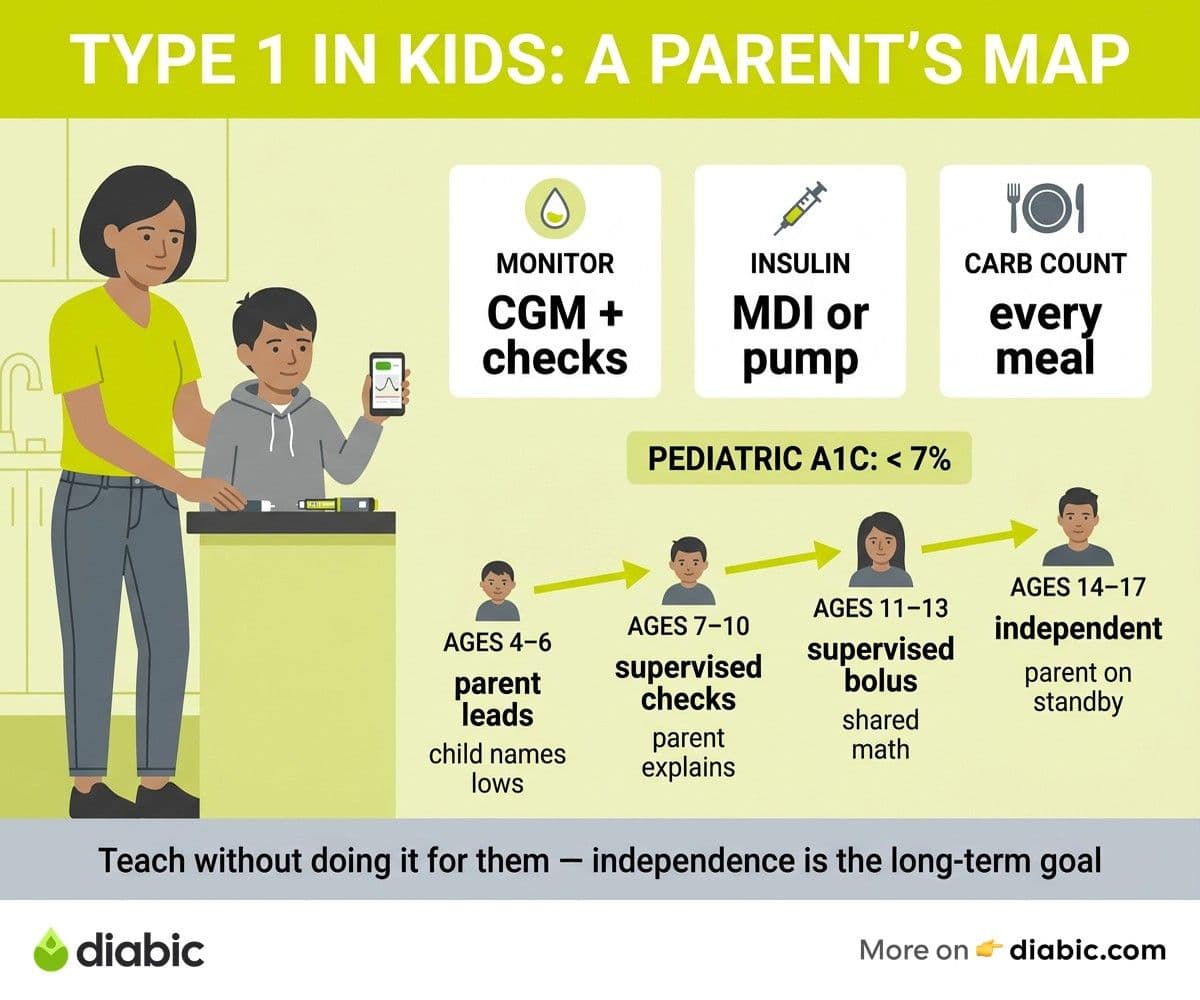
Blood sugar monitoring. Most children check or wear a CGM (continuous glucose monitor) at least four times a day. Pediatric A1C targets are individualized but generally aim for under 7 percent. CGMs like Dexcom G7 (FDA-cleared for ages 2 and up) and Freestyle Libre 3 (ages 4 and up) have transformed pediatric care by giving real-time readings and alerts that can be shared with parents' phones, even when the child is at school or at a friend's house.
Insulin delivery. Two main options:
- Multiple daily injections (MDI): long-acting insulin once or twice daily plus rapid-acting insulin at meals and corrections
- Insulin pumps: continuous subcutaneous infusion that delivers basal insulin around the clock plus mealtime boluses
Pumps integrated with CGMs (called automated insulin delivery or AID systems) can adjust insulin automatically based on real-time glucose. The Omnipod 5, Tandem t:slim X2 with Control-IQ, and Medtronic 780G are FDA-cleared for pediatric use and significantly reduce the burden on both child and parent.
Carb counting. Most meal-time insulin doses come from a carb ratio: one unit of insulin per X grams of carbohydrate, plus a correction factor for high blood sugar. Reading nutrition labels and weighing portions becomes second nature within a few months. Apps like Carb Manager and Calorie King make it faster.
Real life: school lunches, parties, sleepovers. This is where parents lose sleep. The general approach is to pre-bolus 10 to 15 minutes before meals (a strategy your provider may recommend), pre-plan for high-carb birthday cake, and brief sleepover hosts on emergency hypo treatment. Most children can resume close-to-normal childhood activities, including sports, our sports for kids with diabetes post covers the specific blood sugar adjustments around exercise.
Building Your Child's Care Team
You are not doing this alone. A solid pediatric diabetes team includes:
Pediatric endocrinologist. Quarterly visits to review A1C, time in range, dosing, and growth. Tweaks to insulin regimen happen here. Find one who specializes in pediatric type 1 if possible (different from adult endocrinology).
Certified Diabetes Care and Education Specialist (CDCES). Often a registered nurse or RD with diabetes credentials. They translate the medical plan into daily practice, especially in the first months.
Registered dietitian. Helps with carb counting, meal timing, and sport-day adjustments. Many endo offices have an RD on staff.
Mental health support. A therapist familiar with chronic illness can help your child (and you) process the diagnosis and the ongoing burden. Bring this in early, not as a last resort. Burnout in children with type 1 is real, and our teen diabetes and mental health guide covers what to watch for as kids age.
School team. A nurse (full-time or part-time), the classroom teacher, and any coaches need to be in the loop. A school diabetes management plan lays out the medical, food, and emergency protocols. Federal law (Section 504, IDEA, ADA) protects your child's right to manage diabetes safely at school.
Peer community. Connecting with other families is one of the highest-uses things you can do. The Children with Diabetes (CWD) organization hosts conferences and online communities where families share what works. Local JDRF chapters host walks and family events. Online groups (Facebook, Reddit) are active and supportive. Our diabetes summer camps post covers another high-impact community option.
From my experience: After more than a decade managing my own diabetes, the single piece of advice I give newly diagnosed families is to find one other family with a child the same age and type 1. The medical team is essential, but the family that knows what it feels like to send a child to a sleepover with a CGM can shorten your learning curve by months.
Helping Your Child Build Independence
Independence is the long-term goal, not the starting point. The pace varies by child and personality, but a general developmental framework helps.
Ages 4-6: Recognize symptoms of low blood sugar. Help with finger pricks. Learn the names of insulin and glucose tabs. Identify "carb foods." Parents do most of the dosing math and decisions.
Ages 7-10: Begin checking blood sugar with supervision. Know how to call for help. Learn to count carbs in familiar foods. Start using a CGM independently. Parents still drive insulin dosing decisions but explain the reasoning.
Ages 11-13: Inject or bolus from pump with supervision. Estimate carbs in meals. Manage low blood sugar independently. Learn the math behind dose calculations. Parents shift toward coaching rather than directing.
Ages 14-17: Independent management at school and during activities. Schedule own appointments (with parent backup). Recognize signs of burnout. Parents step back but stay available, especially around exam stress, sports, and social pressures. Our explaining diabetes to kids at every age guide breaks down how to talk through the condition at each developmental stage.
Technology helps. CGM data sharing to parent phones lets you back up your child without hovering. Some families set agreed-on rules: parents check the app once before bed, child gets full autonomy during school hours, alerts only get a text or call if a low or high is sustained.
The principle is to teach without doing it for them. Every dose your child calculates (with backup) is one they will know how to do on their own at college or at work. Every bolus you give without explaining is one they may not understand later.
Emotional Support for Parents and Siblings
The emotional weight on the family deserves more attention than it usually gets in medical visits.
Parents. Caregiver burnout is documented and real. Sleep disruption from overnight CGM alarms, the constant calculation of carbs and insulin, and the worry about lows when your child is out of sight all add up. Signs to watch in yourself: persistent exhaustion, irritability, loss of interest in things you used to enjoy, withdrawal from friends, or feeling like the only person in the world handling this. None of these mean you are failing. They mean you need support, too.
What helps:
- Trade overnight monitoring with a partner if possible
- Use CGM share thoughtfully (alerts can be set higher/lower for sleep)
- Schedule short breaks for yourself even if they feel impossible
- Talk to a therapist familiar with chronic illness caregiving
- Connect with other parents who get it
Siblings. Brothers and sisters of a child with diabetes often feel overlooked, anxious, or jealous of the attention. Some react by becoming overly responsible; others by acting out. Both are normal.
What helps:
- One-on-one time with each child, even brief
- Honest, age-appropriate conversations about diabetes
- Including siblings in care (not as helpers, but as informed family members who know what to do in an emergency)
- Watching for signs of anxiety or sadness, and bringing in support if needed
It does get easier. The first six months feel impossible. By year two, the pattern becomes a daily rhythm rather than a daily crisis. By year five, most families say it just becomes part of life. Children grow into adults who manage their type 1 successfully and live full lives. Your job in these early years is to lay the groundwork.
FAQ
How do I help a child with type 1 diabetes?
Start with the basics: monitor blood sugar regularly, deliver insulin as prescribed, count carbs at meals, and treat lows promptly. Build a strong care team (pediatric endocrinologist, CDCES, school nurse, mental health support). Lean on community: connect with other families managing childhood type 1. Help your child build age-appropriate independence over time. And take care of your own emotional health alongside theirs.
What do parents need to know about type 1 diabetes in kids?
Type 1 is an autoimmune condition, not caused by anything in your child's diet or behavior. Insulin therapy is required for life and cannot be replaced by oral medications or lifestyle alone. Daily life involves blood sugar monitoring, insulin delivery, and carb counting. Schools must accommodate diabetes management under federal law. Kids with type 1 can do everything other kids do, sports, sleepovers, summer camp, school trips, with planning. The first months are the hardest; the learning curve does flatten.
When should children with type 1 diabetes start managing their own care?
There is no single age. Children typically take on more independence between ages 7 and 14, with full self-management by late adolescence. Pace it to your child's interest, maturity, and capability. Use technology (CGM sharing) to back up independence without hovering.
What's the best insulin delivery method for kids?
It depends on the child, family, and resources. Multiple daily injections work well for many families and are usually cheaper. Insulin pumps (especially automated insulin delivery systems like Omnipod 5, t:slim X2 with Control-IQ, or Medtronic 780G) reduce the daily burden and can improve time in range. Talk to your pediatric endocrinologist about which fits your child's lifestyle, age, and your family's preferences.
Children with type 1 diabetes need steady support and steady routines, not perfection. The medical team handles the clinical details. The family handles the love, the patience, and the daily rhythm that makes diabetes one part of a kid's life rather than the whole of it.
Shahriar P. Shuvo is the founder of Diabic. He has lived with diabetes for over 14 years, and built Diabic to deliver the practical, evidence-based self-management tools he wished existed when he was first diagnosed. By trade, Shahriar is a senior design and frontend engineer with 6+ years shipping products at Agora, Timescale (now Tiger Data), and ShareTrip. He writes from the intersection of lived diabetes experience and product craft, focused on what works in daily management rather than what sounds good in a textbook.
Medically reviewed by
Dr. Shanto Arian is an internal medicine physician now specializing in clinical and aesthetic dermatology, with a parallel academic focus on epidemiology and public health. He holds an MBBS, MPH, MSc (UK), MRCP (UK), MRCPI (Ireland), Diploma in Dermatology (UK), and Diploma in Aesthetic Medicine (USA). Dr. Arian trained in internal medicine, including hospital work on hematology cases such as graft-versus-host disease, before moving toward dermatology. Skin is one of the earliest places diabetes shows itself, from acanthosis nigricans and diabetic dermopathy to slow foot wound healing, and that intersection is where his clinical and Diabic-review work meet. On Diabic, Dr. Arian medically reviews content on diabetes diagnosis, complications, dermatologic manifestations, and pharmacotherapy, ensuring every claim aligns with current ADA, NICE, and peer-reviewed literature.
More from Living with Diabetes
View all
A Gentle Chair Yoga Routine for people with diabetes
A gentle chair yoga for people with diabetes routine with safe poses, modifications for neuropathy, retinopathy, and joint pain, plus tips for older.

Shift Work and Diabetes: Managing Irregular Hours
Shift work and diabetes is a tough combination. Learn how to manage meals, sleep, medication, and blood sugar when your hours rotate or flip overnight.

Dating with Diabetes: When to Tell a New Partner
Dating with diabetes brings unique disclosure questions. Here is when to tell a new partner, what to say, and how to handle the conversation with.
Clinician-reviewed habits, plain-language guides, and honest answers - the small shifts that make living with diabetes feel lighter, every day.