Explaining Diabetes to Kids at Every Age
Explaining diabetes to kids requires the right words for the right age. Here is what to say to toddlers, elementary kids, tweens, teens, and siblings.

In this article(14)
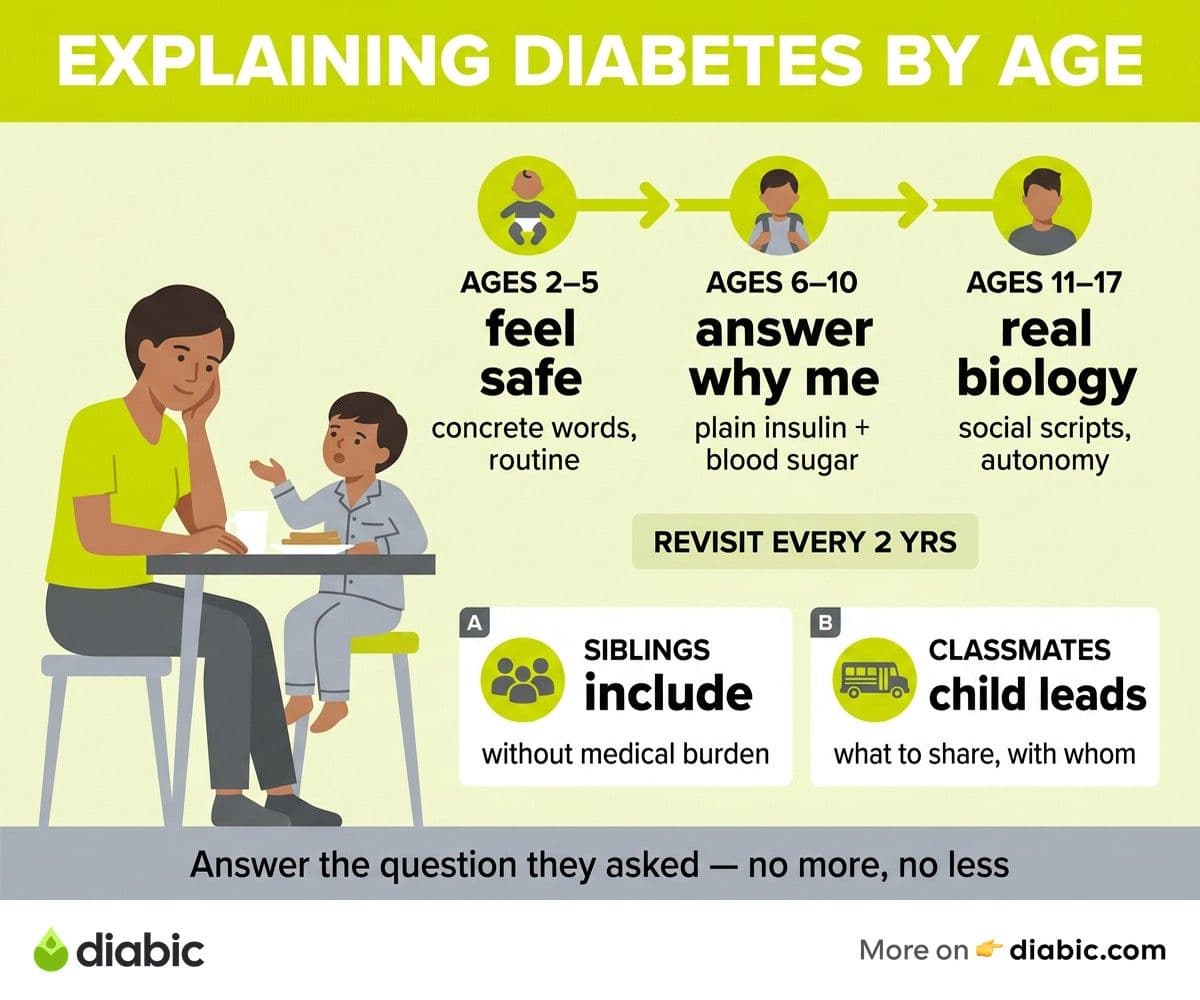
Explaining diabetes to kids takes different words at different ages. A curious five-year-old needs a story about helpers in their body. A worried ten-year-old needs honest answers to "why me." A fifteen-year-old needs you to step back and let them lead the conversation, even when it scares you. Getting the language right helps children feel informed, included, and less afraid of something they see and feel every day.
The conversation is not a single talk. It happens in small moments at the breakfast table, in the car after a doctor's appointment, and in the quiet minutes before bed when a child suddenly asks something you did not see coming. You do not need a script to get this right. You need a sense of what each age can hold, and the willingness to keep coming back to the topic as your child grows. We will walk you through each stage, plus how to handle siblings and classmates who have their own questions.
Talking to Toddlers and Preschoolers (Ages 2-5)
The youngest kids do not need biology. They need safety, predictability, and language they can repeat. At this age, your child is mostly noticing what their body feels like and what the people around them do about it. Your job is to make finger pricks and insulin feel as routine as brushing teeth.
Use concrete language tied to what they can see. "Your body needs a little help turning food into energy. The pen gives the help" is enough. Avoid saying things like "you are sick" because preschoolers tend to think sickness comes and goes. Diabetes is not a flu. Frame it as how their body works, not as something wrong with them.
Make the tools friendly. Some families name the meter and the pump like they would a pet. Others read books written for very young children, which helps normalize what is happening. The American Diabetes Association keeps resources for talking to children about diabetes that include book recommendations. Children with Diabetes (CWD) also runs the Friends for Life conference where families connect and share materials.
Make Routines Predictable
At this age, the more predictable the routine, the calmer your child. Check at the same times. Sit in the same spot. Use the same words. "Quick poke, then a sticker" works. If your child resists a check, slow down and try again in five minutes rather than forcing it. Resistance at three becomes refusal at thirteen if you do not handle it gently now.
Our parent's guide to type 1 goes deeper into the daily routines that help young children adjust. The big picture for this age is simple: your child does not yet need to understand diabetes. They need to feel that you do, and that they are safe.
Explaining Diabetes to Elementary-Age Kids (Ages 6-10)
Around six or seven, kids start asking real questions. Why did this happen. Why do I have to eat differently. Why do my friends not have to do this. The honest, age-appropriate answers you give now shape how your child feels about diabetes for years.
Introduce insulin and blood sugar in plain words. "Your pancreas is the part of your body that usually makes a helper called insulin. Yours stopped making enough, so we add it back with the pen." That is it. You do not need to explain the immune system or beta cells. If your child asks more, follow their lead, but stop when their face says they have what they need.
Answer "why me" honestly. This is a question every kid with diabetes asks, often more than once. The truthful answer is that no one knows exactly why some people get type 1, but it is not because of anything they ate, did, or thought. The American Academy of Pediatrics' guidance on chronic illness communication emphasizes that children need clear, blame-free explanations they can repeat to themselves later.
JDRF (now Breakthrough T1D) has age-appropriate family resources including videos and workbooks for elementary kids. These are useful when a child wants to dig into the science but you are not sure how to pitch it. Pair the materials with your own conversations rather than handing them off solo.
Teach Body Awareness
Help your child name what highs and lows feel like. "Shaky and a little scared" might mean low. "Tired and thirsty" might mean high. The earlier they connect symptoms to numbers, the safer they will be the day they realize something is off without you in the room.
Empower them with small management tasks. Choosing which finger to prick, reading the number on the meter, picking which juice box for a low. These tiny acts of agency build confidence and reduce the sense that diabetes is happening to them rather than something they are part of. If you are still navigating the early months after diagnosis, our piece on coping with a diabetes diagnosis walks through the emotional side for the whole family.
Having the Conversation with Tweens and Teens (Ages 11-17)
By the time your child is eleven or twelve, they can hold real biology. They can also hold real feelings about it, and those feelings often surface as eye-rolls, withdrawal, or bursts of frustration. The conversations at this age are less about explaining diabetes and more about negotiating who is in charge of it.
Be detailed about the science when they ask. Type 1 is autoimmune, meaning the immune system mistakenly attacked the cells that make insulin. Type 2 is more about insulin resistance and is influenced by genetics and lifestyle. Treat your tween or teen like a competent person, not a child you are protecting from information. They will hear the harder facts at school anyway, and you want them to hear it from you first.
Address the social piece directly. Teens worry about how to handle questions from friends, what to say at sleepovers, whether to tell a date. The American Psychological Association on adolescent chronic illness notes that peer acceptance is a huge driver of mental health for teens with chronic conditions. Practice scripts together for awkward moments. "I have type 1 diabetes, my body does not make insulin, I take it every day, and I am totally fine" covers most situations.
Hand Over the Reins, Slowly
At this age, your job shifts from running their diabetes to coaching them on running it themselves. That includes encouraging them to take the lead in conversations with their endo. Stay in the room if they want, but let them describe their numbers, ask their questions, and make their requests. Watch for diabetes in teenagers burnout signs as you transition responsibility, because handing it all over too fast is its own kind of pressure.
Talk about the future without catastrophizing. Teens hear plenty of "you'll damage your kidneys" warnings from worried adults. They need fewer threats and more partnership. Frame management as something that gives them options, not as the price they pay to avoid disasters. We have a separate piece on diabetes summer camp that many teens find life-changing once they meet other kids who get it.
From My Experience
From my experience: I was diagnosed as a child and went through every age this article describes. The single biggest thing my parents got right was answering my questions at the level I asked them, no more and no less. When I asked at six why my pancreas broke, they said, "Sometimes bodies just do this, and it is not your fault." When I asked at fourteen whether I would die young, they said, "We don't know everything, but with good care most people with type 1 live long lives, and I am here for whatever the future looks like." Honest, calm, short. That is the move at every age.
Explaining a Sibling's or Classmate's Diabetes
Other kids in your child's life need their own version of the conversation. Siblings often feel a quiet jealousy because the child with diabetes gets so much attention, snacks at odd hours, and extra time with parents. Naming this out loud helps. "I know it can feel like Sam gets more of our time. That is because his body needs help right now. Your needs matter too."
Give siblings small, age-appropriate roles if they want them. Helping pick out juice boxes, fetching the meter, knowing the signs of a low. Avoid making the sibling the medical backup; that is too much pressure. The goal is inclusion, not responsibility transfer.
For classmates, work with the school and your child to decide what gets shared. Some kids want a teacher to explain it once at the start of the year, others want a specific friend to know but not the whole class, others want everyone to know everything. Honor your child's preference. The school management plan you set up should include language about how and when classroom education happens. If a classmate asks a question your child is not ready to answer, having a one-line script ready helps. "It's a thing my body does, I take a shot, I'm fine, want to play?" closes most loops.
Keeping the Conversation Going When Explaining Diabetes to Kids
The talk you have at five is not the talk you have at fifteen. Plan to revisit the explanation every couple of years, especially after milestones like starting a pump, switching to a CGM, or transitioning to high school. Each new tool and each new chapter of life invites new questions.
Your child will also pick up information from the internet, friends, and well-meaning relatives. Some of it will be wrong, scary, or outdated. Stay the trusted source. Make it easy for them to come to you with what they hear. "I read that diabetes makes you go blind" is a sentence you want to receive calmly, not be surprised by.
The goal of explaining diabetes to kids at every age is not to make diabetes go away from the conversation. It is to make the conversation itself feel safe enough that diabetes never becomes the secret they hide from you. Whatever stage you are in, explaining diabetes to kids is a habit, not a one-time event, and the rhythm you build now will carry your family for years.
Frequently Asked Questions
How do I explain diabetes to a 5-year-old?
Use simple, concrete words tied to what they can see and feel. Say something like, "Your body needs a little help turning food into energy. The pen gives the helper." Avoid medical jargon and avoid framing diabetes as a sickness that comes and goes. Make the routine predictable, name the tools in friendly ways, and read children's books about diabetes together.
What are age-appropriate ways to talk about diabetes with kids?
For toddlers, use concrete language and predictable routines. For elementary-age kids, introduce insulin and blood sugar in plain words and answer "why me" honestly without blame. For tweens and teens, share the real science, address social concerns, and gradually hand over self-management. Match the depth of explanation to the question your child is actually asking.
How do I help siblings understand a brother or sister's diabetes?
Acknowledge that siblings may feel jealous of the extra attention, name those feelings without judgment, and give them small, optional roles like helping pick supplies. Reassure them their needs matter too. Avoid placing medical responsibility on a sibling, and answer their questions at their developmental level, not the level of the child with diabetes.
Should I tell my child's classmates about their diabetes?
Let your child lead. Some prefer a brief teacher-led explanation at the start of the year, others want only one or two close friends to know. Build the preference into the school's accommodations plan, and prepare a short, low-stakes script your child can use if classmates ask questions in the moment. The same principle that guides explaining diabetes to kids at home applies here: meet them where they are, answer the question asked, and keep the door open for the next one.
Shahriar P. Shuvo is the founder of Diabic. He has lived with diabetes for over 14 years, and built Diabic to deliver the practical, evidence-based self-management tools he wished existed when he was first diagnosed. By trade, Shahriar is a senior design and frontend engineer with 6+ years shipping products at Agora, Timescale (now Tiger Data), and ShareTrip. He writes from the intersection of lived diabetes experience and product craft, focused on what works in daily management rather than what sounds good in a textbook.
Medically reviewed by
Dr. Rezwana Parvin Rumpa is an obstetrics and gynaecology specialist with clinical focus on gestational diabetes, PCOS, and fertility. She holds the MRCOG (Final Part) from the Royal College of Obstetricians and Gynaecologists in London, the MRCPI (Final Part) from the Royal College of Physicians of Ireland, and an MBBS from Shaheed Monsur Ali Medical College under Dhaka University. Dr. Rumpa serves as a Senior Medical Officer in the Obs and Gynae department at BRB Hospitals Ltd, where she has spent three years managing prenatal care, emergency obstetric cases, and women's-health surgery. On Diabic, she medically reviews content for women living with diabetes, with particular attention to pregnancy, PCOS, and reproductive-health intersections.
More from Living with Diabetes
View all
A Gentle Chair Yoga Routine for people with diabetes
A gentle chair yoga for people with diabetes routine with safe poses, modifications for neuropathy, retinopathy, and joint pain, plus tips for older.

Shift Work and Diabetes: Managing Irregular Hours
Shift work and diabetes is a tough combination. Learn how to manage meals, sleep, medication, and blood sugar when your hours rotate or flip overnight.

Dating with Diabetes: When to Tell a New Partner
Dating with diabetes brings unique disclosure questions. Here is when to tell a new partner, what to say, and how to handle the conversation with.
Clinician-reviewed habits, plain-language guides, and honest answers - the small shifts that make living with diabetes feel lighter, every day.