Insulin vs GLP-1 Injections: Differences Explained
Insulin vs GLP-1 injections explained: how each medication works, when doctors prescribe them, and why combining both may help with type 2 diabetes.

In this article(11)
If your provider has mentioned starting an injectable medication, you may be weighing the difference between insulin vs GLP-1 injections and wondering what each one actually does inside your body. Both involve a needle, both lower blood sugar, and both are commonly prescribed for diabetes. The similarities largely end there. Understanding how these two classes of medication work, what they were designed to do, and when each makes sense can help you walk into your next appointment with sharper questions and a clearer sense of your options.
We hear from readers who feel intimidated by the idea of injections, especially when the conversation shifts away from pills. That hesitation usually comes from a lack of plain-language information about what these medications are really doing. The goal here is to clear up the differences so you can have a more productive conversation with your care team.
From my experience: Living with type 1 for 14 years, I have spent that whole stretch on insulin, first MDI with Lantus and Humalog, then a pump with rapid analog only. A friend with type 2 started Ozempic around 2022 and described feeling full off half a sandwich, which is a sensation I will never get from my long-acting basal. The two medications share a needle and a goal, but they live in very different parts of the day, and that contrast is what finally made the distinction click for me.
What Insulin Injections Do
Insulin is a hormone your pancreas naturally produces to help glucose move from your bloodstream into your cells, where it can be used for energy. When you have type 1 diabetes, your pancreas no longer makes insulin, so injecting it is the only way to keep blood sugar in a livable range. In type 2 diabetes, your body still produces insulin, but it may not make enough or may not respond to it properly, which is what providers often call insulin resistance. Injected insulin replaces or supplements what your body cannot supply on its own.
There are several formulations, and the right mix depends on how your body responds throughout the day. Basal insulin works in the background to keep your blood sugar steady between meals and overnight, while bolus or mealtime insulin handles the sharper rise after eating. Some people use multiple daily injections, and some use an insulin pump that delivers small amounts continuously. Our guide on the different types of insulin used in diabetes care walks through each one.
Because insulin directly lowers blood sugar regardless of what your body is doing in the moment, it carries a real risk of hypoglycemia, which is when blood sugar drops too low. People on insulin learn to count carbohydrates, monitor their blood sugar regularly, and recognize early warning signs of a low. According to the American Diabetes Association Standards of Care, insulin remains essential for all people with type 1 diabetes and for many with advanced type 2 diabetes.
What GLP-1 Injections Do
GLP-1 receptor agonists work very differently from insulin. They mimic a natural gut hormone called glucagon-like peptide-1, which your intestines release after you eat. This hormone signals your pancreas to release insulin only when your blood sugar is elevated, slows down how quickly food leaves your stomach, and tells your brain that you are full. The result is a medication that lowers blood sugar, reduces appetite, and often leads to meaningful weight loss in people with type 2 diabetes.
Unlike insulin, GLP-1 medications do not replace a hormone your body has stopped making. They enhance the system that is already there, which is why they are most effective in people who still have functioning pancreatic cells, and why they are typically prescribed for type 2 diabetes rather than type 1. Common GLP-1 medications include semaglutide (Ozempic, Wegovy), dulaglutide (Trulicity), liraglutide (Victoza), and tirzepatide (Mounjaro), which is technically a dual GIP/GLP-1 agonist. For a closer look at the science, see our explainer on why GLP-1 receptor agonists changed diabetes care.
The hypoglycemia risk with GLP-1 medications alone is low because they only stimulate insulin release when blood sugar is already high. They have also been shown to offer cardiovascular and kidney benefits in many people with type 2 diabetes, which is part of why they have moved earlier in treatment guidelines. Side effects are real, and most people experience some nausea, fullness, or digestive changes when starting or increasing the dose, which usually fade over a few weeks.
Insulin vs GLP-1 Injections: Key Differences at a Glance
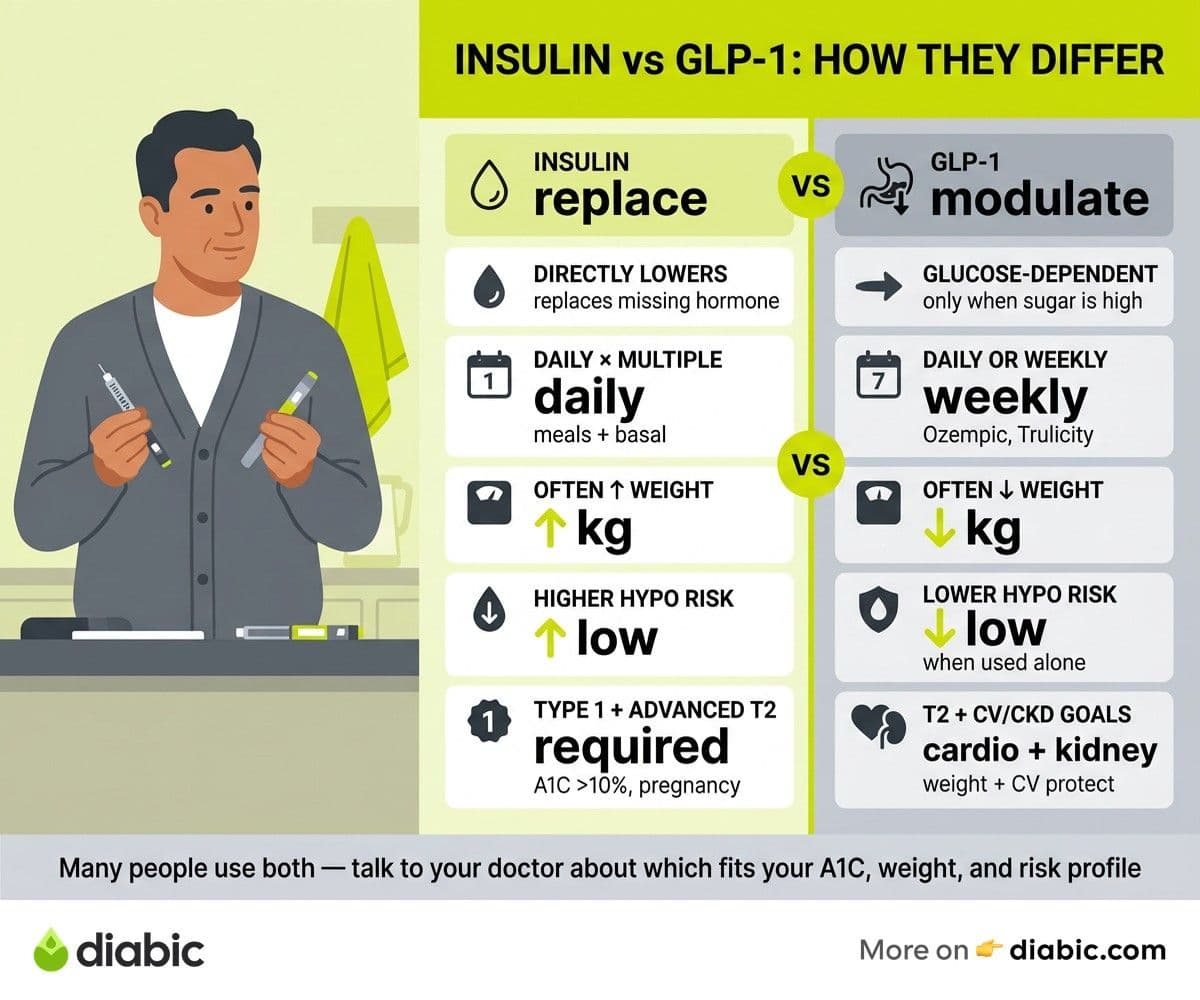
When you put insulin and GLP-1 medications side by side, the contrast in how they behave becomes much clearer. Insulin is a direct replacement therapy that adds glucose-lowering power to whatever your body is doing, while GLP-1 medications are modulators that work with your existing biology. Neither is universally better. Each was designed for a different problem, and each has tradeoffs around weight, hypoglycemia risk, dosing frequency, and cost. The table below summarizes the main differences for type 2 diabetes injection medication decisions.
For a fuller breakdown that includes brand names, dosing intervals, and delivery methods, our injectable diabetes medication list is a useful next step. Research published in Diabetes Care consistently shows the right choice depends on individual factors like A1C, weight, kidney function, cardiovascular history, and how long someone has lived with diabetes. The decision is about which medication fits the person sitting in the exam room.
When Doctors Choose Insulin Over GLP-1
There are situations where insulin is clearly the right call, and a GLP-1 medication simply will not do the job. The clearest example is type 1 diabetes, where the pancreas has stopped producing insulin entirely. No GLP-1 medication can replace what is missing, so people with type 1 diabetes always need insulin. Our guide on insulin therapy for people with type 1 diabetes goes deeper into how this looks in daily life.
Insulin is also the preferred starting point when blood sugar is dangerously high at diagnosis. If your A1C is above 10 percent, or if you are showing symptoms like unexplained weight loss or extreme thirst, your provider will likely want to bring your numbers down quickly. Insulin works fast, while GLP-1 medications take weeks to titrate up. The ADA and EASD consensus report treats this scenario as a clear indication for insulin, at least initially.
Other situations that often call for insulin include long-standing type 2 diabetes where the pancreas no longer produces enough insulin to respond to GLP-1 stimulation, pregnancy (since most GLP-1 medications are not approved during pregnancy), and acute illness or hospitalization. Talk to your doctor about whether insulin is the right starting point if any of these apply to you.
When Doctors Choose GLP-1 Over Insulin
GLP-1 medications have become a first-line injectable for many people with type 2 diabetes, especially earlier in the disease. If your pancreas still makes a reasonable amount of insulin and the bigger problem is insulin resistance treatment, a GLP-1 medication can address multiple issues at once. It lowers blood sugar, supports weight loss, and may protect your heart and kidneys. For someone who has been managing type 2 diabetes with oral medications and needs more help, this is often the preferred next step.
Weight is a major factor in this decision. Insulin tends to cause weight gain, which can worsen insulin resistance and create a difficult cycle. GLP-1 medications usually do the opposite, which is why providers reach for them when weight management is part of the goal. Research suggests that for many people with type 2 diabetes and obesity, starting with a GLP-1 produces better long-term outcomes than starting with insulin.
GLP-1 medications also make sense when hypoglycemia is a real concern. Older adults, people who live alone, those with irregular eating schedules, and anyone with a history of severe lows often benefit from a medication that does not push blood sugar down on its own. Once-weekly options like semaglutide or dulaglutide tend to fit better into busy lives than daily insulin injections, which can improve adherence over time.
Can You Use Both Together
Insulin and GLP-1 medications are not mutually exclusive, and combining them is one of the most effective strategies in modern type 2 diabetes care. A common approach is pairing a long-acting basal insulin with a weekly GLP-1 medication. The basal insulin handles overnight and between-meal blood sugar, while the GLP-1 reduces post-meal spikes, blunts appetite, and counteracts the weight gain that insulin alone often causes. The result is often better A1C, less weight gain, and lower total insulin doses than insulin therapy alone.
There are also fixed-ratio combination products that bundle both medications into a single daily injection. Soliqua combines insulin glargine with lixisenatide, and Xultophy combines insulin degludec with liraglutide. These products are detailed in FDA prescribing information and can simplify life for people who would otherwise need two separate injections. The DUAL trial program, published in part in the New England Journal of Medicine and other journals, helped establish the evidence base for these combinations.
Whether dual therapy is right for you depends on your A1C, current medications, weight, and tolerance for side effects. Talk to your doctor about whether adding a GLP-1 to your insulin regimen, or vice versa, could improve your outcomes. The goal is the lowest effective dose of each medication that gets you to your targets safely.
Frequently Asked Questions
Can you take insulin and GLP-1 at the same time?
Yes, and this combination is well established in type 2 diabetes care. Pairing basal insulin with a GLP-1 receptor agonist can produce better blood sugar outcomes with less weight gain and lower hypoglycemia risk than increasing insulin alone. Fixed-ratio products like Soliqua and Xultophy bundle both into a single daily injection, which simplifies the routine. Talk to your healthcare provider about whether combination therapy fits your situation.
Is GLP-1 better than insulin for type 2 diabetes?
Neither is universally better. GLP-1 medications are often preferred earlier in type 2 diabetes because they support weight loss, carry low hypoglycemia risk, and offer cardiovascular protection. Insulin becomes necessary when blood sugar is very high, when the pancreas no longer produces enough insulin, or when GLP-1 alone cannot reach blood sugar targets. Many people benefit from both. Your provider can guide the decision based on your A1C, weight, kidney function, and overall health history.
Do GLP-1 medications work for type 1 diabetes?
GLP-1 medications are not approved as a replacement for insulin in type 1 diabetes, since people with type 1 do not produce enough insulin for the GLP-1 mechanism to work on. Some research has explored using GLP-1 medications alongside insulin in type 1 diabetes for weight management and reduced insulin needs, but this is considered off-label. Talk to your endocrinologist if you have type 1 diabetes and are curious about whether a GLP-1 might play a role in your care.
What are the most common side effects of switching between insulin and GLP-1?
When starting insulin, the main concerns are low blood sugar and possible weight gain, both of which improve with dose adjustment and meal planning. When starting a GLP-1, most people experience nausea or mild stomach upset for the first few weeks, which typically fades. Always report persistent or severe symptoms to your healthcare provider.
The choice between insulin vs GLP-1 injections is not about picking a winner, it is about finding the right tool for what your body needs at this point in your diabetes management. Both have changed how people live with diabetes, and the best treatment plans often draw on both. Bring your A1C history and your priorities to your next appointment, and work through the options together.
Dr. Shanto Arian is an internal medicine physician now specializing in clinical and aesthetic dermatology, with a parallel academic focus on epidemiology and public health. He holds an MBBS, MPH, MSc (UK), MRCP (UK), MRCPI (Ireland), Diploma in Dermatology (UK), and Diploma in Aesthetic Medicine (USA). Dr. Arian trained in internal medicine, including hospital work on hematology cases such as graft-versus-host disease, before moving toward dermatology. Skin is one of the earliest places diabetes shows itself, from acanthosis nigricans and diabetic dermopathy to slow foot wound healing, and that intersection is where his clinical and Diabic-review work meet. On Diabic, Dr. Arian medically reviews content on diabetes diagnosis, complications, dermatologic manifestations, and pharmacotherapy, ensuring every claim aligns with current ADA, NICE, and peer-reviewed literature.
Medically reviewed by
Dr. Rezwana Parvin Rumpa is an obstetrics and gynaecology specialist with clinical focus on gestational diabetes, PCOS, and fertility. She holds the MRCOG (Final Part) from the Royal College of Obstetricians and Gynaecologists in London, the MRCPI (Final Part) from the Royal College of Physicians of Ireland, and an MBBS from Shaheed Monsur Ali Medical College under Dhaka University. Dr. Rumpa serves as a Senior Medical Officer in the Obs and Gynae department at BRB Hospitals Ltd, where she has spent three years managing prenatal care, emergency obstetric cases, and women's-health surgery. On Diabic, she medically reviews content for women living with diabetes, with particular attention to pregnancy, PCOS, and reproductive-health intersections.
More from Treatment & Medication
View all
Recognizing Diabetic Coma Warning Signs Early
Learn to spot diabetic coma warning signs early. We cover DKA, HHS, and severe hypoglycemia symptoms, plus when to call 911 for immediate help.

Switching to Injectable Diabetes Medication: What to Expect
Switching to injectable diabetes medication can feel daunting. Learn what to expect, how to manage side effects, and why this step is progression, not.

Hyperglycemic Hyperosmolar Syndrome: Warning Signs to Know
Hyperglycemic hyperosmolar syndrome is a serious type 2 diabetes emergency. Learn the warning signs, triggers, and when to call 911 for HHS care.
Clinician-reviewed habits, plain-language guides, and honest answers - the small shifts that make living with diabetes feel lighter, every day.