Injectable Diabetes Medication List and Comparison
A complete injectable diabetes medication list with side-by-side comparison of GLP-1s, insulins, tirzepatide, and amylin analogs to help you and your.

In this article(12)
The injectable diabetes medication list has expanded so much in the past decade that even seasoned clinicians sometimes pause to remember which drug belongs to which class. If your provider has mentioned starting an injection, or you are weighing whether to switch from one brand to another, the sheer number of options can feel paralyzing. We put this guide together to give you a clear, side-by-side view of every major injectable used in type 1 and type 2 diabetes today.
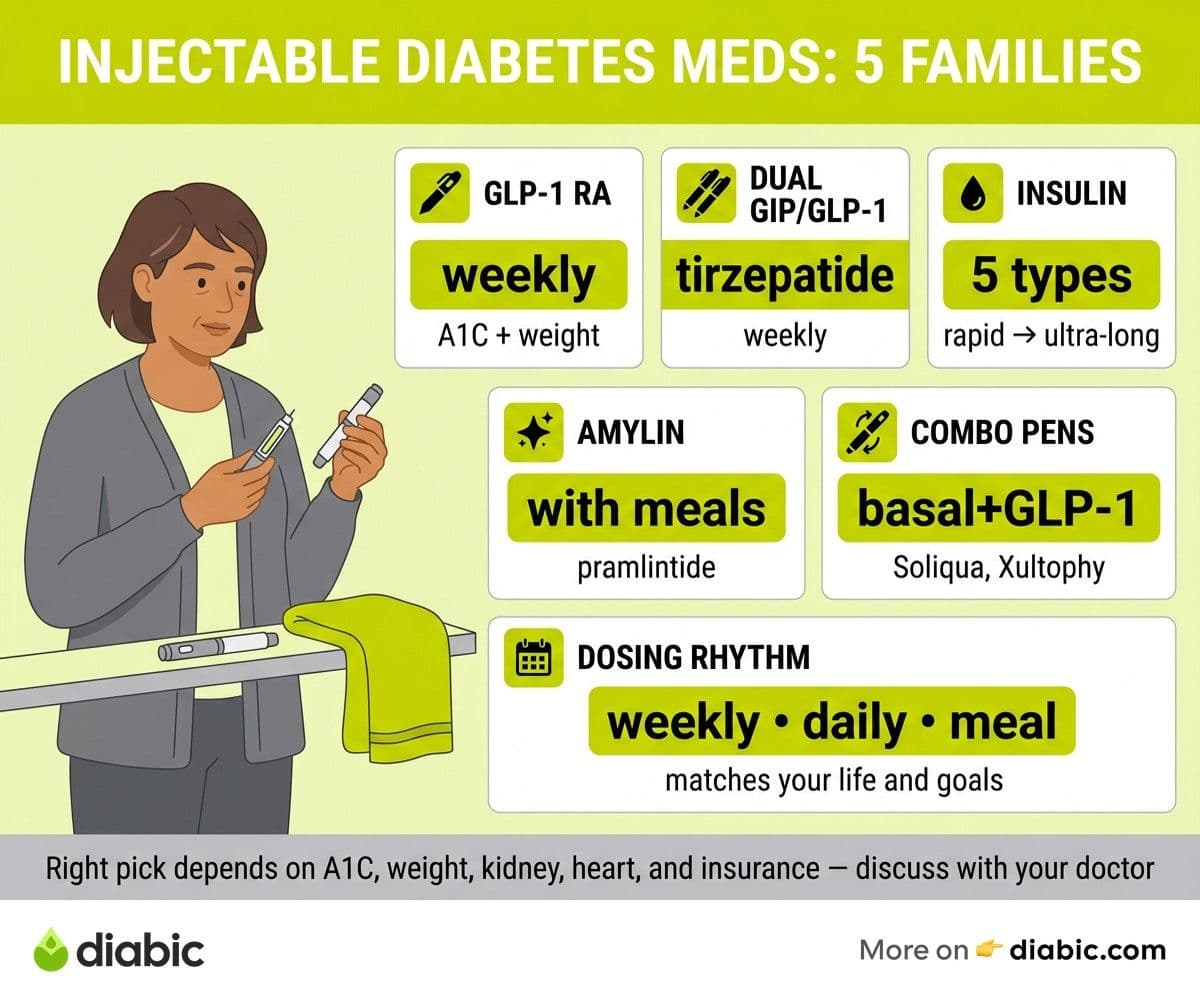
Our goal is not to tell you which medication is best, because that answer depends on your A1C, weight, kidney function, insurance, and personal preferences. Instead, we want you to walk into your next appointment knowing the categories, the brand names, the dosing rhythms, and the questions worth asking. Think of this as a reference you can bookmark and return to whenever a new option enters the conversation.
From my experience: When my endocrinologist switched me from Lantus to Tresiba a few years ago, I expected the routine to feel identical. It did not. The flexibility on dose timing, especially on weekends when I sleep in, quietly changed how I structured my mornings. Different injectables really do live differently in your day, and that part is hard to predict from a comparison chart alone.
Why Injectable Diabetes Medications Are Prescribed
Oral medications like metformin remain the first stop for most people with type 2 diabetes, but they have limits. When A1C stays above target despite two or three pills, when weight loss becomes a priority, or when complications like kidney disease or heart disease enter the picture, injectable therapy often becomes the next logical step. According to the American Diabetes Association Standards of Care, modern guidelines now favor adding a GLP-1 receptor agonist or dual agonist before insulin in many type 2 cases, especially when weight management or cardiovascular protection is a goal.
For people with type 1 diabetes, injections are not optional. The pancreas no longer produces insulin, so external insulin is required for survival. That said, type 1 patients sometimes add a second injectable like pramlintide alongside insulin to smooth out post-meal spikes. The decision tree looks different for each type, and your endocrinologist will weigh dozens of factors before recommending a specific drug.
It also helps to understand the difference between insulin and non-insulin injectables. Insulin directly replaces the hormone your body cannot make enough of. Non-insulin injectables, like GLP-1 receptor agonists, work upstream by mimicking gut hormones that prompt your own pancreas to release insulin when needed. If you are weighing this decision, our guide to switching to injectable diabetes medication walks through what the first few weeks typically look like.
GLP-1 Receptor Agonists
Glucagon-like peptide-1 receptor agonists, usually shortened to GLP-1 RAs, mimic a natural gut hormone released after meals. They prompt the pancreas to release insulin when blood sugar rises, suppress glucagon (the hormone that raises blood sugar), and slow how quickly food leaves the stomach. The combined effect is lower post-meal glucose, reduced appetite, and gradual weight loss in many users. We have a deeper look at how GLP-1 receptor agonists changed diabetes if you want the full backstory.
Semaglutide is the most widely recognized name in this class right now. Sold as Ozempic for type 2 diabetes and Wegovy for chronic weight management, semaglutide is given as a once-weekly injection under the skin of the abdomen, thigh, or upper arm. The SUSTAIN clinical trial program published in NEJM showed strong A1C reduction and meaningful weight loss compared to placebo and other comparators. An oral version, Rybelsus, is also available, though most prescriptions in the injectable category remain weekly shots.
Dulaglutide, marketed as Trulicity by Eli Lilly, is another once-weekly option with a long safety record and a single-use auto-injector that many people find easier than drawing up a dose. Liraglutide (Victoza for diabetes, Saxenda for weight) requires a daily injection but has decades of data behind it, including the LEADER trial showing cardiovascular benefit in people with type 2 diabetes and established heart disease. Exenatide rounds out the older GLP-1 lineup, available as twice-daily Byetta or weekly Bydureon, though newer agents have largely replaced it in everyday practice.
Common side effects across all GLP-1 RAs include nausea, especially in the first few weeks, along with occasional vomiting, diarrhea, or constipation. These usually fade as your body adjusts. Your provider will start you at a low dose and titrate up gradually, and the FDA prescribing information for each brand details the full safety profile worth reviewing before you begin.
Dual GIP/GLP-1 Agonists
Tirzepatide, sold as Mounjaro for type 2 diabetes and Zepbound for chronic weight management, was the first medication in a brand new class when the FDA approved it in May 2022. Instead of activating only the GLP-1 receptor, tirzepatide also activates the GIP (glucose-dependent insulinotropic polypeptide) receptor, another gut hormone involved in insulin release and energy balance. This dual mechanism appears to produce stronger results than single GLP-1 activation alone.
The SURPASS clinical trial program published in NEJM compared tirzepatide head-to-head against semaglutide and showed greater A1C reduction and greater weight loss across multiple trial arms. For some participants, A1C dropped into the non-diabetes range and weight loss exceeded 20 percent of body weight. These are average results, of course, and individual response varies widely based on starting weight, diet, activity, and dose tolerance.
Tirzepatide is given as a once-weekly subcutaneous injection using a single-dose pen. Side effects mirror those of GLP-1 RAs (nausea, mild GI upset, occasional injection site reactions) and generally improve with time. Because it is still a relatively new drug, supply has been tight in some markets and insurance coverage varies more than for older agents. Talk to your doctor about whether tirzepatide fits your treatment goals and what your out-of-pocket cost would be.
Insulin Injectables
Insulin remains the cornerstone of type 1 diabetes care and an essential tool when type 2 progresses to the point that oral and non-insulin injectable therapy can no longer keep blood sugar in range. There are five main categories of insulin grouped by how quickly they start working and how long their effect lasts. Each plays a different role in a daily regimen, and most people on insulin use a combination of two types: one for meals and one for background coverage. We cover this in detail in our breakdown of types of insulin explained.
Rapid-acting insulins like insulin lispro (Humalog), insulin aspart (Novolog), and insulin glulisine (Apidra) start working within 15 minutes and are taken right before meals to cover the glucose rise from food. Short-acting regular insulin (Humulin R, Novolin R) acts a bit slower and is less commonly used now outside hospital settings. Intermediate-acting NPH insulin (Humulin N, Novolin N) provides several hours of coverage and is sometimes used in twice-daily regimens. Long-acting basal insulins like glargine (Lantus, Basaglar) and detemir (Levemir) provide steady background coverage for roughly 24 hours, while ultra-long-acting degludec (Tresiba) lasts even longer and offers more flexible timing.
Pre-mixed insulins combine a rapid or short-acting insulin with an intermediate-acting one in a single pen, which can simplify the routine for people who struggle with multiple daily injections. The trade-off is less flexibility around meal timing and dose adjustment. Whether insulin is the right next step versus a non-insulin injectable depends on factors like A1C trajectory, beta-cell function, and personal preference. Our piece on insulin vs GLP-1 injections compares the two paths in more detail.
Other Injectable Options
Pramlintide, sold under the brand Symlin, is an amylin analog used alongside mealtime insulin in people with type 1 or insulin-treated type 2 diabetes. Amylin is a hormone normally released with insulin from the pancreas, and it helps slow stomach emptying and suppress glucagon after meals. Adding pramlintide can smooth out post-meal spikes that mealtime insulin alone struggles to handle. According to the NIDDK overview of insulin and other injectable medications, pramlintide is given as a separate injection at meals, never mixed in the same syringe as insulin.
Combination insulin and GLP-1 products offer another path for people whose blood sugar is not controlled by basal insulin alone. Soliqua combines insulin glargine with lixisenatide (a GLP-1 RA) in a single daily pen, while Xultophy combines insulin degludec with liraglutide. These fixed-ratio combinations reduce the number of injections per day and have shown strong A1C reductions in clinical trials. They are not a fit for everyone, but they can be useful for someone already on basal insulin who needs additional mealtime coverage without adding rapid-acting insulin.
The injectable diabetes medication pipeline continues to grow. Oral semaglutide tablets, weekly insulins like icodec, and next-generation triple agonists targeting GLP-1, GIP, and glucagon receptors are all in late-stage development or recently approved in some markets. Talk to your doctor about whether any newer therapies might be appropriate for your situation.
Injectable Diabetes Medication List Comparison Table
The table below summarizes the major injectable options at a glance. A1C reduction figures are averages from clinical trials and should be treated as ballparks, not promises. Weight effects depend heavily on dose, diet, and activity level. Always review the full FDA prescribing information and discuss specifics with your healthcare team before starting or switching any medication.
Comparative data above is drawn from peer-reviewed sources including Diabetes Care and The Lancet Diabetes & Endocrinology, and your individual results may differ.
How to Choose the Right Injectable with Your Doctor
There is no single best injectable for type 2 diabetes, and any clinician who tells you otherwise is oversimplifying. The right choice depends on your starting A1C, your weight goals, your kidney and heart health, your insurance formulary, and how a daily versus weekly schedule fits your life. Some people prioritize the strongest A1C reduction and lean toward tirzepatide, while others value the longer safety record of dulaglutide or liraglutide.
Insurance coverage often becomes the deciding factor in practice. Newer GLP-1 RAs and tirzepatide can carry a list price well over a thousand dollars per month without coverage, and even with insurance, prior authorization requirements vary by plan. Patient assistance programs from manufacturers like Eli Lilly and Novo Nordisk can reduce costs significantly for those who qualify, and your pharmacist or diabetes educator can often help with the paperwork. Our overview of type 2 diabetes treatment options explained goes deeper into how cost, coverage, and clinical evidence intersect.
Talk to your doctor about which injectable aligns with your specific health profile rather than chasing the option you saw in a commercial. Bring a written list of your priorities (weight, cost, dosing schedule, side effect tolerance) and ask how each candidate medication scores against them. The conversation works best when you treat your provider as a collaborator and come prepared with questions about both benefits and trade-offs.
Frequently Asked Questions
What injectable diabetes medications are available?
Current injectable diabetes medications include GLP-1 receptor agonists (semaglutide, dulaglutide, liraglutide, exenatide), the dual GIP/GLP-1 agonist tirzepatide, various insulin formulations spanning rapid-acting through ultra-long-acting, the amylin analog pramlintide, and combination insulin plus GLP-1 products like Soliqua and Xultophy. The injectable diabetes medication list continues to grow as new agents move through clinical trials and reach the market. Your healthcare provider can help determine which options are appropriate for your specific situation.
How do injectable diabetes medications differ from oral ones?
Injectable diabetes medications often produce greater A1C reductions than oral medications, and many offer additional benefits like weight loss, kidney protection, or cardiovascular risk reduction. They work through different mechanisms, with some mimicking gut hormones and others directly replacing insulin, and they bypass the digestive system entirely. Oral medications remain first-line for most people with type 2 diabetes, but injectables are typically added when pills alone do not reach blood sugar targets or when other health goals make them a better fit.
Are injectable diabetes medications safe long-term?
The major injectable classes have been studied for years and decades in some cases, with insulin in clinical use for over a century and the older GLP-1 RAs for more than 15 years. Common side effects like injection site reactions and mild GI upset usually resolve, though rare serious risks exist for each drug and warrant discussion with your provider. Newer agents like tirzepatide have shorter real-world track records, so ongoing post-marketing surveillance continues to refine our understanding of long-term safety.
Can I switch between injectable medications?
Yes, switching between injectables is common and often planned when one option causes intolerable side effects, fails to reach A1C targets, or becomes unaffordable. Your provider will guide the transition, including any washout period, starting dose adjustments, and monitoring plan. Never stop or switch any injectable on your own without medical guidance, since abrupt changes can cause dangerous swings in blood sugar.
Use this injectable diabetes medication list as a starting point for the conversation with your endocrinologist or primary care provider. Bring your goals, your insurance details, and your questions, and let the right pick come from a shared decision rather than a hurried one.
Shahriar P. Shuvo is the founder of Diabic. He has lived with diabetes for over 14 years, and built Diabic to deliver the practical, evidence-based self-management tools he wished existed when he was first diagnosed. By trade, Shahriar is a senior design and frontend engineer with 6+ years shipping products at Agora, Timescale (now Tiger Data), and ShareTrip. He writes from the intersection of lived diabetes experience and product craft, focused on what works in daily management rather than what sounds good in a textbook.
Medically reviewed by
Dr. Shanto Arian is an internal medicine physician now specializing in clinical and aesthetic dermatology, with a parallel academic focus on epidemiology and public health. He holds an MBBS, MPH, MSc (UK), MRCP (UK), MRCPI (Ireland), Diploma in Dermatology (UK), and Diploma in Aesthetic Medicine (USA). Dr. Arian trained in internal medicine, including hospital work on hematology cases such as graft-versus-host disease, before moving toward dermatology. Skin is one of the earliest places diabetes shows itself, from acanthosis nigricans and diabetic dermopathy to slow foot wound healing, and that intersection is where his clinical and Diabic-review work meet. On Diabic, Dr. Arian medically reviews content on diabetes diagnosis, complications, dermatologic manifestations, and pharmacotherapy, ensuring every claim aligns with current ADA, NICE, and peer-reviewed literature.
More from Treatment & Medication
View all
Recognizing Diabetic Coma Warning Signs Early
Learn to spot diabetic coma warning signs early. We cover DKA, HHS, and severe hypoglycemia symptoms, plus when to call 911 for immediate help.

Switching to Injectable Diabetes Medication: What to Expect
Switching to injectable diabetes medication can feel daunting. Learn what to expect, how to manage side effects, and why this step is progression, not.

Hyperglycemic Hyperosmolar Syndrome: Warning Signs to Know
Hyperglycemic hyperosmolar syndrome is a serious type 2 diabetes emergency. Learn the warning signs, triggers, and when to call 911 for HHS care.
Clinician-reviewed habits, plain-language guides, and honest answers - the small shifts that make living with diabetes feel lighter, every day.