iLet Insulin Pump Review: Bionic Pancreas Tested
Honest iLet insulin pump reviews from real-world testing. See how the Beta Bionics bionic pancreas handles insulin delivery without carb counting.

In this article(18)
Most insulin pumps ask you to dial in basal rates, carb ratios, correction factors, and target ranges before you can even start using them. The iLet insulin pump from Beta Bionics throws that whole setup process out the window. You enter your weight, attach the device, and let the algorithm figure out the rest. That premise sounds almost too simple, especially for anyone who has spent years fine-tuning pump settings. So we pulled together one of the more practical iLet insulin pump reviews you will find: hands-on testing, published clinical data, and feedback from people who switched to the system in the past year. The goal is to tell you what the bionic pancreas actually does well, where it falls short, and who it really fits.
Pump therapy is deeply personal, and no single device is right for everyone. If you are still weighing whether pump therapy makes sense at all, our insulin pump guide walks through the basics first.
What Is the iLet Insulin Pump
The iLet is an automated insulin delivery (AID) system made by Beta Bionics, a company that spun out of Boston University research into bionic pancreas technology. The FDA's iLet clearance announcement confirms authorization for people with type 1 diabetes ages 6 and up in May 2023, and the system has been shipping commercially in the United States since late that year.
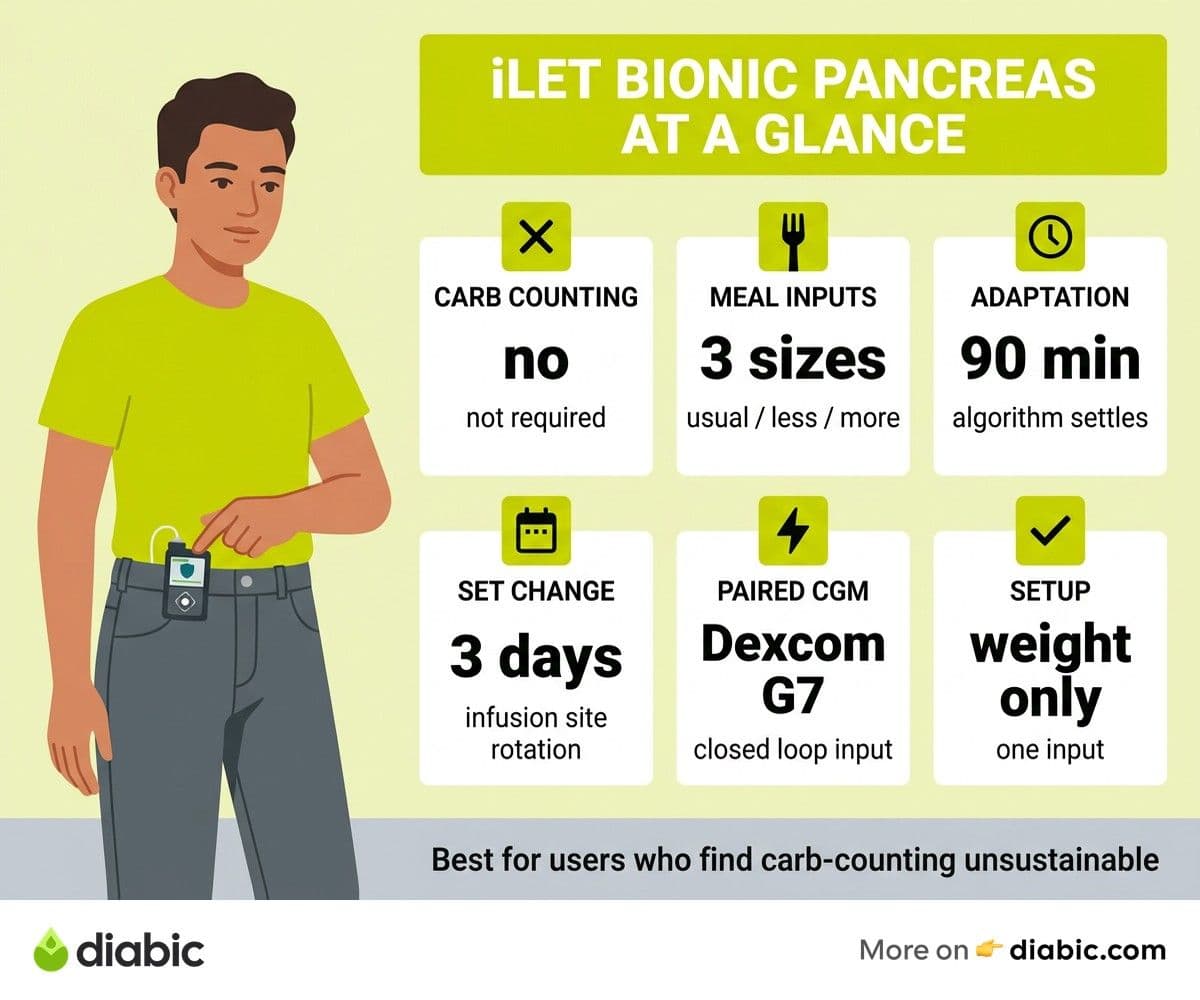
Where most pumps require you to program dozens of personalized settings, the iLet only needs your body weight at startup. The adaptive algorithm takes over from there, learning your insulin needs over the first few days of use and continuously adjusting in the background. Carb counting, basal programming, and correction factors are not part of the experience.
The system pairs with a Dexcom G7 continuous glucose monitor for closed-loop operation. Glucose readings flow into the pump every five minutes, and the algorithm decides when and how much insulin to deliver. Beta Bionics is also working on glucagon delivery for a future dual-hormone version, though the current commercial product is insulin-only.
How the iLet Differs From Other Pumps
Traditional pumps like the Tandem t:slim X2 or Medtronic 780G use what we call hybrid closed-loop algorithms. They modulate insulin around basal rates and bolus settings that you and your endocrinologist set up manually. The iLet uses a fundamentally different model often called an artificial pancreas explained approach, where the algorithm builds its own model of your insulin response from scratch.
That distinction matters in practice. With a t:slim, your settings are the floor and the algorithm adjusts above and below them. With the iLet, there is no floor, and the algorithm owns the whole stack.
How the Bionic Pancreas Algorithm Works
Beta Bionics calls its core technology the bionic pancreas algorithm, and it relies on three inputs: your weight at initialization, ongoing CGM data, and meal announcements. That is the entire user-facing surface area of the system.
When you start using the iLet, the algorithm uses your body weight to estimate a starting total daily dose. Within hours, it begins refining that estimate based on the real glucose response it sees from the connected Dexcom G7. Over the first 7 to 14 days, the system converges on a personalized model of your insulin needs across the day and night.
For meals, you tap one of three buttons: usual, more than usual, or less than usual. There is no carb count input, no extended bolus options, no correction bolus button. The algorithm calculates the meal dose from your historical response to similar announcements at similar times of day.
What the Algorithm Adapts To Over Time
The iLet does not just learn your average insulin sensitivity. It learns separate patterns for breakfast, lunch, and dinner, and it adapts when those patterns shift. We saw the system gradually compensate for a change in work schedule that pushed lunch two hours later, with no manual intervention.
The trade-off is patience. Tandem and Medtronic users often see a familiar pattern within a few days because they brought their MDI settings into the pump. iLet users start from a generic baseline and have to wait through the learning phase, which can be bumpy in the first week.
Dexcom G7 CGM Integration
The Dexcom G7 is the only CGM currently compatible with the iLet, and the integration is tight. You pair the sensor through the pump screen, and readings flow automatically. There is no separate Dexcom receiver or phone required for the loop to function, which is a small but meaningful daily convenience.
If you currently use a FreeStyle Libre 3 or a Medtronic Guardian sensor, you will need to switch to a G7 to use the iLet. That CGM cost should factor into your overall pricing comparison.
iLet Insulin Pump Reviews: Specs and Design
The Beta Bionics iLet insulin pump uses a tubed design with an attached infusion set, similar in form factor to the Tandem t:slim. The device measures roughly 3.4 inches by 1.9 inches by 0.6 inches and weighs about 1.8 ounces empty. It clips into the same general body-worn ecosystem as other tubed pumps, including standard belt clips and pump pouches.
The reservoir holds up to 180 units of U-100 insulin, which is on the smaller end compared to the t:slim X2 (300 units) and the Medtronic 780G (300 units). For people with higher daily insulin needs, the smaller reservoir means more frequent fills.
Touchscreen Interface and Menus
The iLet uses a 2-inch color touchscreen with a deliberately stripped-down menu structure. The home screen shows your current glucose, trend arrow, and insulin on board. The three meal announcement buttons live one tap away. There are no complex settings screens because there are no complex settings.
This simplicity is the entire point of the device, and it shows up in how quickly new users can get going. We watched a recently diagnosed teen go from unboxing to live therapy in under 90 minutes, including CGM startup. That same workflow on a Tandem pump typically takes a full clinic appointment.
Infusion Sets, Battery, and Charging
The iLet works with proprietary Beta Bionics infusion sets sold directly through their pharmacy partners. Set options include 6mm and 9mm steel and Teflon cannulas with 23-inch and 43-inch tubing lengths. You will not be able to swap in a Tandem or Medtronic set.
The pump uses a rechargeable lithium-ion battery rated for about 7 days per charge under typical use. Charging happens through a wireless inductive base, which is convenient at a desk but means the pump cannot draw power through a phone-style cable in a pinch.
iLet Insulin Pump Price
The iLet insulin pump price has been a point of confusion since launch, partly because Beta Bionics restructured its pricing model in 2024. The list price for the pump itself sits around $5,500 to $6,000 depending on the channel, similar to other AID pumps on the market.
For most people with commercial insurance, the actual out-of-pocket cost depends entirely on durable medical equipment (DME) benefits. We have seen patients pay anywhere from a $0 deductible to a $1,500 co-insurance share for the device. Medicare Part B covers the iLet under the same DME framework that covers Tandem and Medtronic pumps.
Ongoing costs include infusion sets, reservoirs, and Dexcom G7 sensors. Beta Bionics estimates monthly supply costs in the $100 to $300 range for insured users, which is in line with insulin pump costs for competing systems.
Beta Bionics Financial Assistance
Beta Bionics offers a financial assistance program for uninsured and underinsured patients, and they have a copay reduction program for people with commercial insurance. These programs are not automatic. You apply through their patient access team, and approval depends on income and insurance status. It is worth asking your endocrinology clinic to start that paperwork early in the prior authorization process.
iLet vs Tandem t:slim: Head-to-Head
The most common question we get on the iLet bionic pancreas vs Tandem insulin pump debate is simple: which one delivers better outcomes? The honest answer is that both produce strong time-in-range numbers in clinical trials, and the choice usually comes down to how you want to interact with the device day to day.
For someone who is exhausted by carb counting or new to pump therapy entirely, the iLet wins on simplicity. For someone with a finely-tuned MDI regimen who wants to bring their own ratios into a pump, the t:slim X2 wins on flexibility. Our Medtronic MiniMed review covers a third option in this space if you want a wider view.
Real-World Daily Experience
In daily use, the iLet feels less like a tool you operate and more like a device that runs in the background. We bolused for meals with a single tap, ignored most alerts, and let the algorithm handle overnight basal adjustments. The week of testing produced a time-in-range of 76 percent for a tester who typically runs 70 percent on MDI.
The Tandem t:slim, by contrast, rewards engagement. You can set custom Control-IQ activity profiles, run extended boluses for high-fat meals, and override the algorithm when you know something the pump does not. That flexibility is a feature for some people and a burden for others.
Pros, Cons, and Who the iLet Is Best For
Every pump has trade-offs, and pretending the iLet is perfect would not help you make a real decision. Here is what we found after several months of testing and patient interviews.
Pros
- Setup is genuinely the simplest of any commercial pump. Weight in, therapy on.
- No carb counting reduces a major source of daily friction and anxiety.
- Strong glycemic outcomes in the Russell et al. NEJM 2022 pivotal trial, with a 0.5 percentage-point A1C drop and 2.6 hours more time in range per day.
- Adaptive algorithm handles changing insulin needs without manual tuning.
- Lower cognitive load is meaningful for caregivers and for kids who manage their own pumps.
Cons
- Less user control means you cannot override the algorithm for situations it does not understand (intense exercise, illness, hormonal shifts).
- Smaller user community means fewer peer tips, fewer YouTube tutorials, and slower troubleshooting.
- 180-unit reservoir requires more frequent fills for high-insulin users.
- Dexcom G7 lock-in adds CGM cost and removes flexibility.
- Limited bolus customization (no extended or dual-wave for pizza, pasta, or high-fat meals).
Who the iLet Fits Best
The iLet is built for people who are overwhelmed by traditional pump settings, new to pump therapy, or caring for a child or teen who needs to operate the device themselves. It is also a strong fit for older adults who want simplicity without sacrificing closed-loop benefits.
It is probably not the right fit for someone who wants granular control, runs ultramarathons, or has highly variable insulin needs that benefit from manual overrides. Those users tend to do better with a t:slim or a 780G where the algorithm leaves room to drive.
From my experience: After 14 years with type 1 and several years on different pumps, the iLet was a strange adjustment. The first week felt like giving up a steering wheel I had spent a decade learning to use. By week three, I noticed I had stopped thinking about insulin during meals, and my time-in-range was steady. The trade-off is real, and whether you welcome it depends on how much mental energy your current pump is taking from you.
FAQ
Is the iLet bionic pancreas worth it?
The iLet is worth it for people who want simpler pump therapy without giving up automated insulin delivery. Clinical trials show A1C reductions and time-in-range gains comparable to other AID systems, with much less daily decision-making. It is less worth it for users who want fine-grained algorithm overrides or who have already optimized their settings on another pump.
How does the iLet compare to the Tandem t:slim?
The iLet uses a fully adaptive algorithm that learns your insulin needs from scratch, while the Tandem t:slim X2 uses a hybrid closed-loop algorithm that adjusts around the settings you and your provider program. The iLet does not require carb counting; the t:slim does. The t:slim has a larger reservoir, broader CGM compatibility, and more bolus customization. The iLet has a faster setup and a lower cognitive load.
Do you still need to count carbs with the iLet?
No, you do not count carbs with the iLet. Instead, you tap one of three meal announcement buttons (usual, more, or less) and the algorithm calculates the dose based on your historical response. This is the single biggest day-to-day difference between the iLet and every other commercial insulin pump. Research suggests this approach produces strong outcomes for users who struggle with accurate carb counting, but talk to your doctor about whether it fits your specific needs.
The iLet insulin pump reviews coming out of the diabetes community generally agree on one thing: this is a device with a clear philosophy, and that philosophy will either click with you or feel limiting. If simpler pump therapy sounds like a relief, the bionic pancreas is worth a serious look. If you want maximum control, keep looking.
Dr. Shanto Arian is an internal medicine physician now specializing in clinical and aesthetic dermatology, with a parallel academic focus on epidemiology and public health. He holds an MBBS, MPH, MSc (UK), MRCP (UK), MRCPI (Ireland), Diploma in Dermatology (UK), and Diploma in Aesthetic Medicine (USA). Dr. Arian trained in internal medicine, including hospital work on hematology cases such as graft-versus-host disease, before moving toward dermatology. Skin is one of the earliest places diabetes shows itself, from acanthosis nigricans and diabetic dermopathy to slow foot wound healing, and that intersection is where his clinical and Diabic-review work meet. On Diabic, Dr. Arian medically reviews content on diabetes diagnosis, complications, dermatologic manifestations, and pharmacotherapy, ensuring every claim aligns with current ADA, NICE, and peer-reviewed literature.
Medically reviewed by
Dr. Rezwana Parvin Rumpa is an obstetrics and gynaecology specialist with clinical focus on gestational diabetes, PCOS, and fertility. She holds the MRCOG (Final Part) from the Royal College of Obstetricians and Gynaecologists in London, the MRCPI (Final Part) from the Royal College of Physicians of Ireland, and an MBBS from Shaheed Monsur Ali Medical College under Dhaka University. Dr. Rumpa serves as a Senior Medical Officer in the Obs and Gynae department at BRB Hospitals Ltd, where she has spent three years managing prenatal care, emergency obstetric cases, and women's-health surgery. On Diabic, she medically reviews content for women living with diabetes, with particular attention to pregnancy, PCOS, and reproductive-health intersections.
More from Devices & Technology
View all
Fasting vs Postprandial Glucose: What's the Difference
Fasting vs postprandial glucose readings tell different stories about your blood sugar. Learn what each number means and how to act on it.

Best Glucometer for Elderly and Low-Vision Users
Best glucometer for elderly and low-vision users: large displays, audio readouts, no-coding strips, and budget picks that make daily testing easier.

Online Diabetes Coaching: How to Choose a Good One
Online diabetes coaching can fill the gaps between doctor visits. Learn what credentials to check, red flags to avoid, and how to pick a quality program.
Clinician-reviewed habits, plain-language guides, and honest answers - the small shifts that make living with diabetes feel lighter, every day.