How Much Does an Insulin Pump Cost With Insurance?
How much does an insulin pump cost? A clear breakdown of brand pricing, insurance coverage, Medicare rules, and ways to lower out-of-pocket spending.

In this article(9)
How much does an insulin pump cost depends on three things: the brand you pick, the insurance plan covering it, and the supplies you will buy every month for the next four years. With strong insurance, your out-of-pocket can land near zero. Without coverage, the same pump can run over $6,000 up front, plus $250 to $400 a month for sensors, infusion sets, and reservoirs.
The good news is that several manufacturer programs, nonprofit grants, and Medicare pathways exist to bring costs down. Below, we break down the real numbers in 2026 by brand, walk through what insurance typically covers, and lay out the assistance options worth knowing about before you sign anything.
How Much Does an Insulin Pump Cost in 2026?
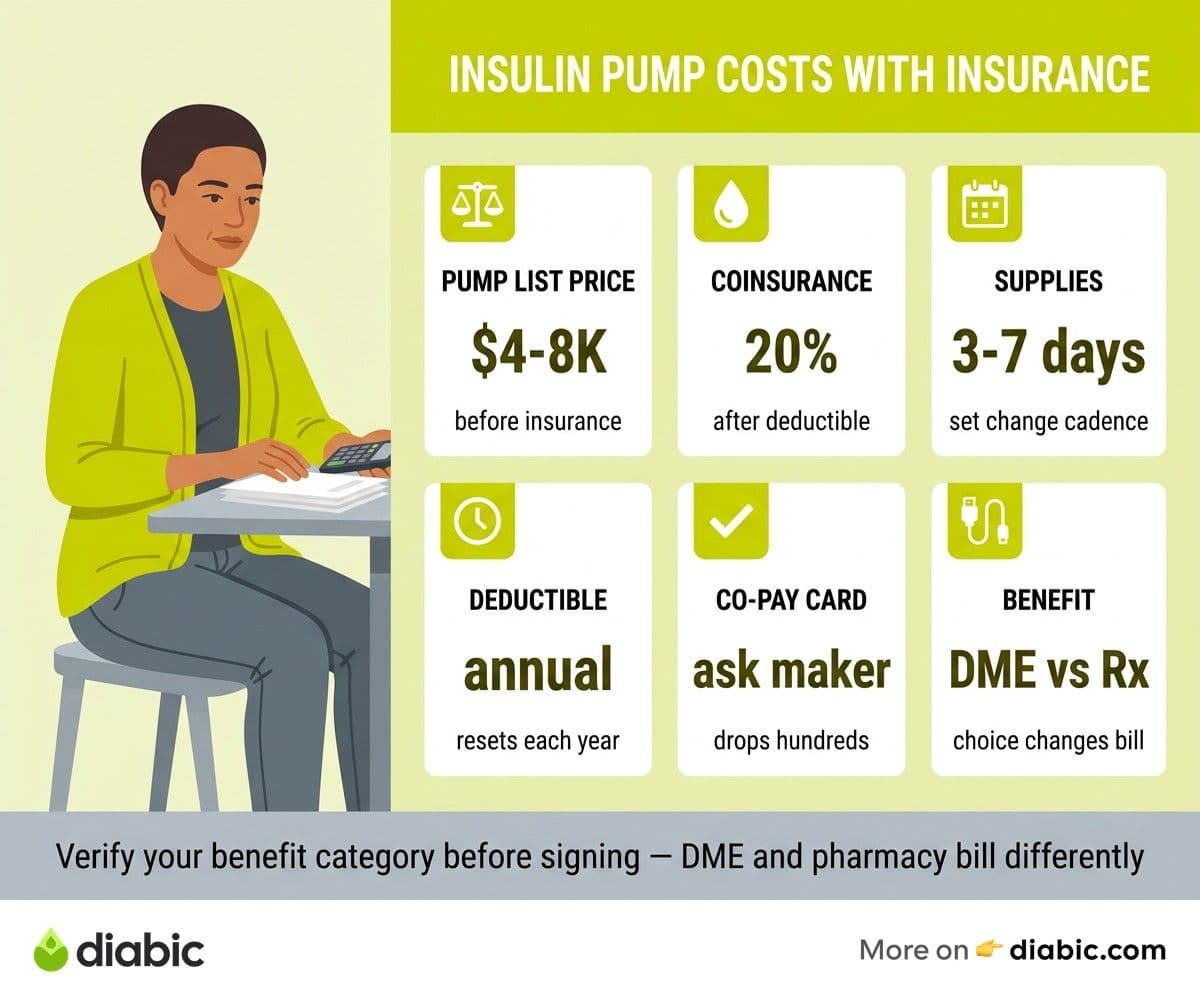
How much does an insulin pump cost at list price (cash, no insurance) varies by brand, but most major systems land in a similar window:
- OmniPod 5: about $800 for the starter kit, then $300 to $400 per month for pods (no large upfront pump cost since the device is disposable)
- Tandem t:slim X2: roughly $4,000 to $4,500 for the pump alone
- Medtronic MiniMed 780G: roughly $7,000 to $8,000 for the pump system
- iLet bionic pancreas: roughly $4,000 to $5,000 for the pump
These are list prices, not what most US users actually pay. Insurance contracts, manufacturer rebates, and durable medical equipment supplier markups all change the real number.
Monthly supply costs (cash, before insurance):
- Infusion sets and reservoirs: $200 to $300 (Medtronic, Tandem, iLet)
- OmniPod pods (which include the pump and infusion set in one): $300 to $400
- CGM sensors (when integrated): $150 to $400 depending on the sensor
Total first-year cash cost for a tubed pump with a CGM can run $9,000 to $14,000 without insurance. With strong commercial insurance, the same setup often costs between $0 and $3,500 across the year, depending on your plan's deductible and coinsurance.
If you are also weighing CGMs as part of the package, our CGM vs glucometer comparison helps you think through whether to bundle a CGM with your pump.
Does Insurance Cover Insulin Pumps?
Most US private insurance plans cover insulin pumps for type 1 diabetes and for insulin-using type 2 diabetes that meets specific medical criteria. NIDDK's overview of insulin and other diabetes treatments explains how pumps fit alongside multiple daily injections in standard treatment plans, which is the framework most insurers use when reviewing prior authorizations. Insulin pumps are classified as durable medical equipment (DME), which means they are covered under your DME benefit rather than your prescription benefit. Your DME deductible and coinsurance may differ from your pharmacy or major medical numbers.
The typical private insurance flow looks like this:
- Your endocrinologist documents medical necessity (often including A1C, hypoglycemia history, or insulin requirements)
- The pump manufacturer or DME supplier submits a prior authorization request
- Insurance approves or denies based on plan rules
- If approved, you pay the deductible and any coinsurance (often 10% to 20%)
Prior authorization can take two to six weeks and sometimes requires multiple submissions. Denials are common on first attempts and often successful on appeal, especially when an endocrinologist writes a letter of medical necessity. The ADA has resources on coverage advocacy if your plan pushes back (ADA).
A few practical tips:
- Ask your insurance whether the pump goes through DME or pharmacy (OmniPod is often pharmacy)
- Confirm whether your CGM is bundled or billed separately
- Get the prior authorization in writing so you know exactly what is covered
- If denied, ask for the specific reason and appeal with additional documentation
For users considering the move from injections, our injections vs pump comparison walks through the medical and lifestyle factors that often weigh into insurance approval.
Does Medicare Cover an Insulin Pump for Type 2 Diabetes?
Does Medicare cover insulin pump for type 2 diabetes? Yes, in many cases, but the criteria are stricter than for type 1.
Medicare Part B covers insulin pumps as durable medical equipment when specific criteria are met (Medicare.gov). For type 1 diabetes, the path is relatively straightforward: documented insulin therapy, multiple daily injections, and your endocrinologist's recommendation. For type 2 diabetes, Medicare requires:
- A documented C-peptide level at or below 110% of the lower limit of the normal range (or specific values when fasting glucose is 225 mg/dL or lower)
- Multiple daily insulin injections (typically three or more)
- Self-monitoring of blood glucose at least four times per day
- Completion of a comprehensive diabetes education program
- A trial of multiple daily injections that has not adequately managed glucose
Once approved, Medicare Part B covers 80% of the approved amount for the pump and most supplies. Medigap or Medicare Advantage plans often pick up the remaining 20%. Your Medicare-enrolled DME supplier handles the billing, not the manufacturer directly.
Medicaid coverage varies state by state. Some states (California, New York, Washington) have relatively broad coverage for insulin pumps. Others limit coverage to specific brands or impose stricter prior authorization. Call your state Medicaid office or your DME supplier for current rules.
Medtronic Insulin Pump Cost Breakdown
The insulin pump Medtronic cost picture is worth a closer look because the MiniMed 780G is the only system on this list that includes its own integrated CGM (the Guardian 4) by default.
For a US user with commercial insurance and the MiniMed 780G:
- Pump (with insurance): typically $0 to $2,500 out of pocket after deductible
- Guardian 4 sensors: about $50 to $120 per sensor with insurance ($300+ cash); one sensor lasts 7 days
- Infusion sets: $40 to $90 per box of 10 with insurance (one box ≈ one month)
- Reservoirs: $20 to $50 per box of 10 with insurance
Without insurance, the MiniMed 780G system runs roughly $7,000 to $8,000 for the pump and $400 to $700 per month for ongoing supplies (sensors, infusion sets, reservoirs).
Medtronic offers a few financial pathways worth asking about:
- A Pump Choice program that includes upgrade options for current Medtronic users
- Charitable assistance through Medtronic Foundation programs for income-qualifying users
- Payment plans for cash-pay users, often through their internal financing partners
Our deeper Medtronic MiniMed review covers the 670G to 780G upgrade path and what to expect when moving between models.
Ways to Reduce Your Insulin Pump Costs
A pump is a four-year decision, so even a small monthly cost difference compounds. Here are the routes that typically save the most money in 2026.
Manufacturer assistance programs are the most direct path. Each of the major manufacturers runs a patient assistance or financial hardship program:
- Insulet (OmniPod): patient assistance for income-qualifying users
- Tandem Diabetes Care: financial assistance and payment plans
- Medtronic: charitable foundation grants and payment options
- Beta Bionics (iLet): financial assistance through internal program
Visit each manufacturer's site directly. Insulet publishes details on the OmniPod site, Tandem on Tandem Diabetes Care, and Medtronic on Medtronic Diabetes.
Nonprofit and foundation grants exist beyond the manufacturers. Programs like JDRF One Walk-affiliated funds, the Diabetes Scholars Foundation, and local diabetes nonprofits sometimes cover devices or supplies for users without insurance. The ADA's advocacy resources list active programs by state.
A few other tactics worth knowing:
- Ask whether OmniPod or other systems are billed pharmacy versus DME on your plan; the pharmacy route is often cheaper
- Check if your employer's HRA or HSA covers DME copays
- Look into used or refurbished pump programs (some pumps come with reduced warranty but can cut upfront cost by 50% or more)
- For test strips and meters between pump moments, our roundup of affordable test strips covers low-cost options
From my experience: I have lived with type 1 diabetes for fourteen years and used different pumps over that time. The smartest financial move I made was reading my actual insurance benefits document carefully (not the summary) before picking a pump. The plan I assumed covered Medtronic 80/20 actually had OmniPod at 100% under pharmacy benefits, which saved me roughly $1,800 a year. Spending two hours on the phone with insurance pays off.
Talk to your doctor and a diabetes educator before committing to a pump. The cheapest pump on paper is not always the right pick if it does not fit your daily routine, your CGM, or your insulin needs. Our insulin pump guide walks through the trade-offs that matter beyond price.
How much does insulin pump cost in your specific case? The answer comes from a phone call to your insurer with the brand, model, and HCPCS code in hand, plus a follow-up to your endocrinologist's office for prior authorization details. That hour of work usually changes the number more than any other research you could do.
FAQ
Does Medicare cover an insulin pump for type 2 diabetes?
Yes, Medicare Part B covers insulin pumps for type 2 diabetes when specific criteria are met, including documented C-peptide levels, multiple daily insulin injections, and completion of a diabetes education program. Once approved, Medicare covers 80% of the approved amount, with Medigap or Medicare Advantage often covering the rest. Talk to your endocrinologist about whether your records support a coverage request.
How much does an insulin pump cost without insurance?
Cash list prices in 2026 range from about $4,000 (Tandem t:slim X2, iLet) to $7,000 to $8,000 (Medtronic MiniMed 780G) for the pump itself. The OmniPod 5 has a lower upfront cost (about $800 for the starter kit) but charges $300 to $400 per month for pods. Add $200 to $700 a month for ongoing supplies depending on the system and whether a CGM is bundled.
Can you get an insulin pump for free?
In some cases, yes. Manufacturer charitable programs, nonprofit grants, and certain Medicaid plans cover the full cost of a pump for income-qualifying users. Some clinical trials provide pumps and supplies at no cost during the study period. Refurbished pump donation programs run by diabetes nonprofits also occasionally make pumps available. None of these are guaranteed, but they are worth applying for if cost is the main barrier between you and pump therapy.
Dr. Shanto Arian is an internal medicine physician now specializing in clinical and aesthetic dermatology, with a parallel academic focus on epidemiology and public health. He holds an MBBS, MPH, MSc (UK), MRCP (UK), MRCPI (Ireland), Diploma in Dermatology (UK), and Diploma in Aesthetic Medicine (USA). Dr. Arian trained in internal medicine, including hospital work on hematology cases such as graft-versus-host disease, before moving toward dermatology. Skin is one of the earliest places diabetes shows itself, from acanthosis nigricans and diabetic dermopathy to slow foot wound healing, and that intersection is where his clinical and Diabic-review work meet. On Diabic, Dr. Arian medically reviews content on diabetes diagnosis, complications, dermatologic manifestations, and pharmacotherapy, ensuring every claim aligns with current ADA, NICE, and peer-reviewed literature.
Medically reviewed by
Dr. Rezwana Parvin Rumpa is an obstetrics and gynaecology specialist with clinical focus on gestational diabetes, PCOS, and fertility. She holds the MRCOG (Final Part) from the Royal College of Obstetricians and Gynaecologists in London, the MRCPI (Final Part) from the Royal College of Physicians of Ireland, and an MBBS from Shaheed Monsur Ali Medical College under Dhaka University. Dr. Rumpa serves as a Senior Medical Officer in the Obs and Gynae department at BRB Hospitals Ltd, where she has spent three years managing prenatal care, emergency obstetric cases, and women's-health surgery. On Diabic, she medically reviews content for women living with diabetes, with particular attention to pregnancy, PCOS, and reproductive-health intersections.
More from Devices & Technology
View all
Fasting vs Postprandial Glucose: What's the Difference
Fasting vs postprandial glucose readings tell different stories about your blood sugar. Learn what each number means and how to act on it.

Best Glucometer for Elderly and Low-Vision Users
Best glucometer for elderly and low-vision users: large displays, audio readouts, no-coding strips, and budget picks that make daily testing easier.

Online Diabetes Coaching: How to Choose a Good One
Online diabetes coaching can fill the gaps between doctor visits. Learn what credentials to check, red flags to avoid, and how to pick a quality program.
Clinician-reviewed habits, plain-language guides, and honest answers - the small shifts that make living with diabetes feel lighter, every day.